
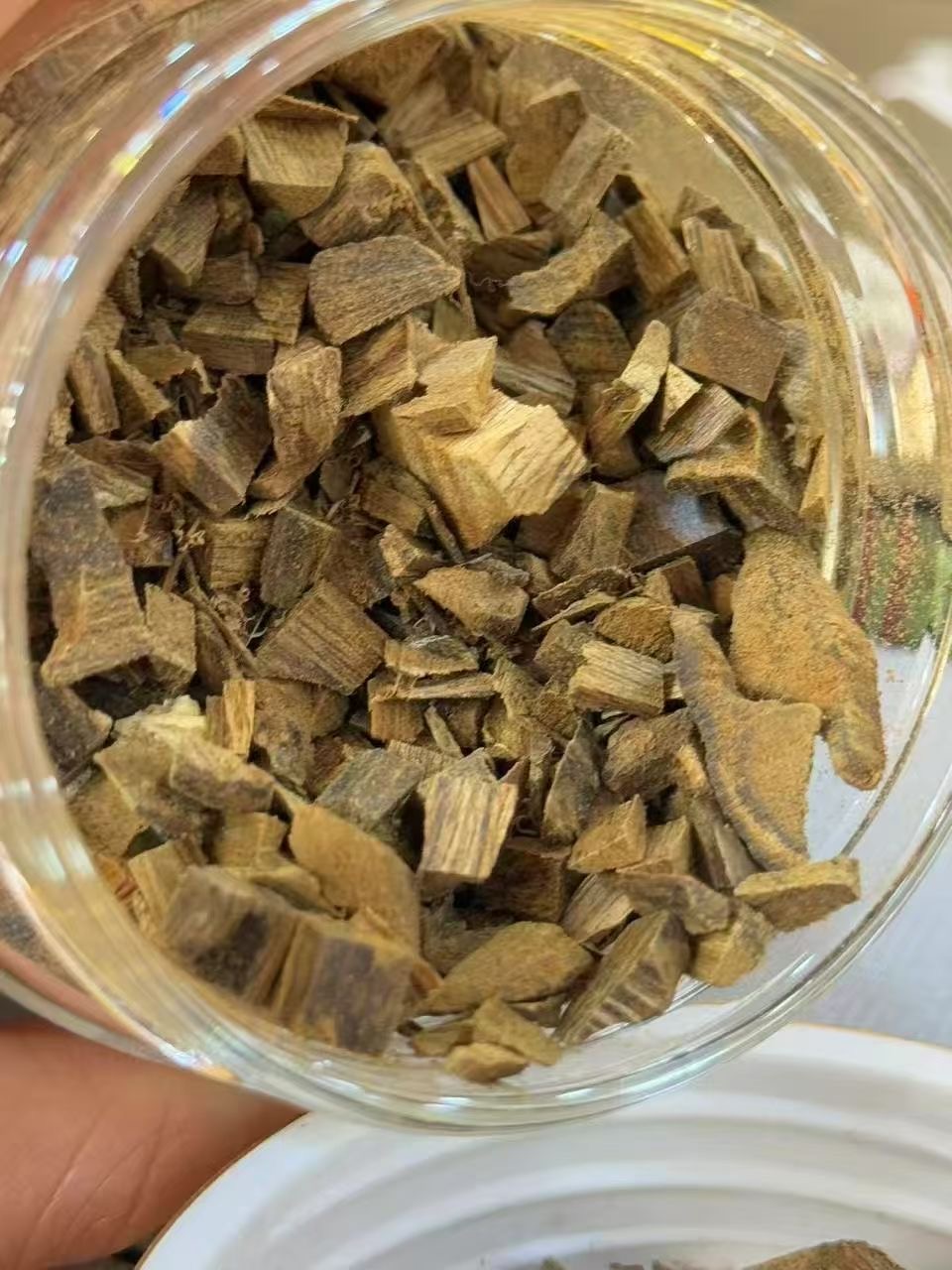
Agarwood shavings supplier evaluation starts with one uncomfortable fact: "shavings" is a form description, not a grade, and no international standard fixes what the word contains. Two suppliers can both quote agarwood shavings and ship material that differs in piece size, fines share, moisture and usable yield — so wholesale buyers who compare on the name rather than on measured specifications end up paying for weight they cannot process. This guide gives importers, incense manufacturers, bakhoor producers and material distributors a scored method for evaluating a shavings supplier before the first container, built on form definitions, written tolerances, lot evidence and a cost per usable kilogram.
Why "Shavings" Cannot Be Your Specification
Agarwood is traded in several physical forms, and the vocabulary is not standardised between countries, factories or sales channels. A supplier may use "shavings" for thin planing waste, for small cut chips, or for the fine fraction left after screening. Another may call the same material "small chips" or "fragments". Because the word carries no measurement, a purchase order that says only "agarwood shavings" gives the supplier nothing to fail and the buyer nothing to claim against.
The practical consequence is that form names must be converted into a definition the supplier can produce and the buyer can test. That definition usually covers piece geometry, a screen opening or size band, the share of material passing below the smallest screen, visible foreign matter, moisture basis, and how the lot is packed. Without those clauses, a quotation is a price for a word.
What the four form names usually describe
In commercial practice, the four forms buyers encounter most often behave differently in processing, even when they come from the same raw material:
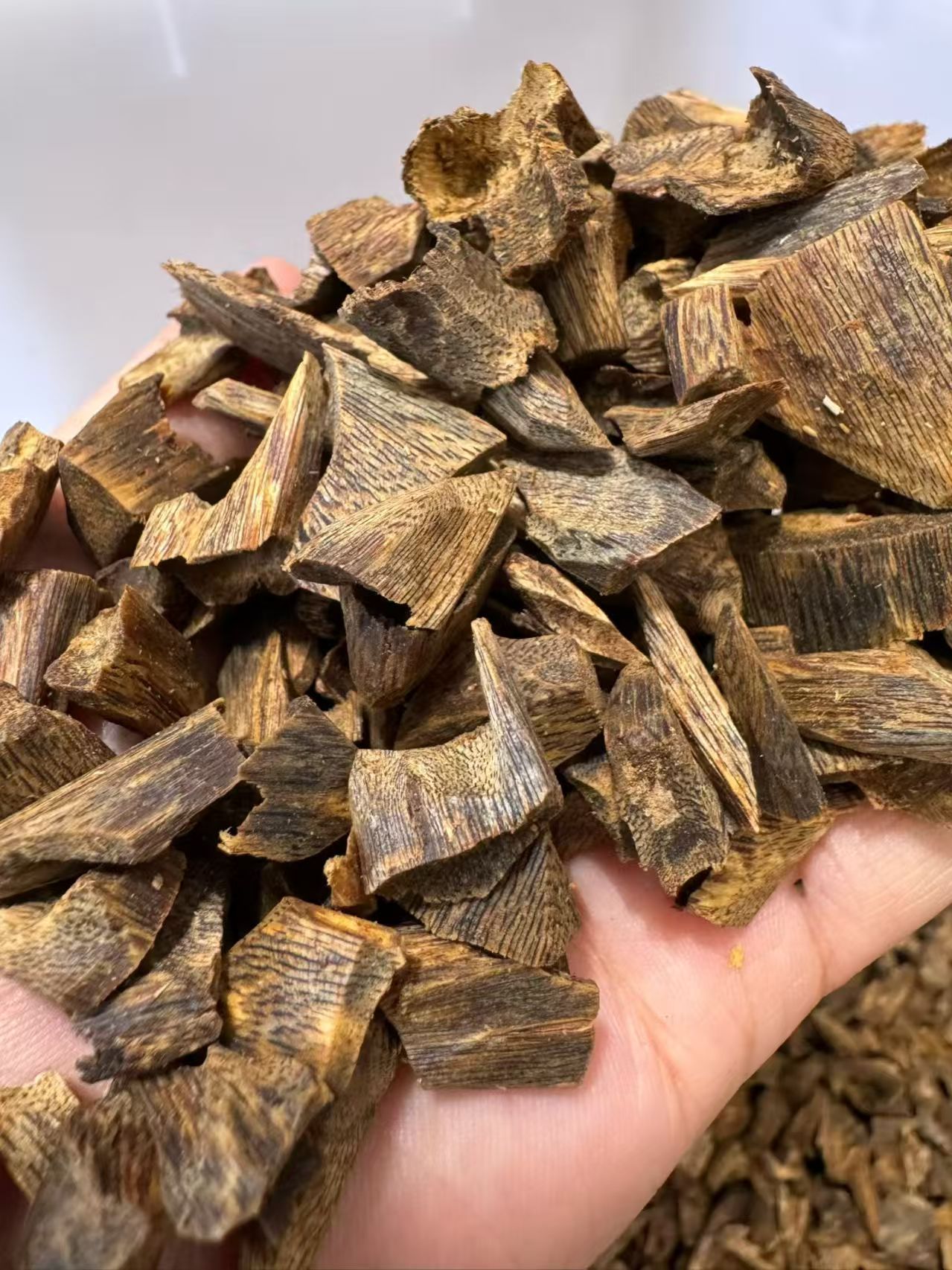
- Chips and fragments are pieces with visible wood structure, cut or broken to a rough size. They are the form most often used for burning, bakhoor blending, display and further size reduction.
- Shavings are thin, elongated pieces produced by planing, slicing or a light cutting pass. Their high surface-to-weight ratio makes them dusty and bulky, and their bulk density is usually lower than chips of the same species.
- Granules are material reduced and screened into a defined size band, typically more uniform than shavings and easier to meter into a blend.
- Powder is milled material specified by the share passing a stated mesh or screen, used where the material must disperse into a formulation.
None of these names implies a resin level, a grade letter or an aroma outcome. A supplier's own grade scale — often letters such as A, B or C — is a commercial sorting convention, not a published standard, and it is not comparable between companies unless both parties agree what each letter measures. Buyers who need the underlying distinction between cut forms should read the comparison of agarwood chips, granules and powder before drafting an RFQ.
How form changes the process, not the price alone
Form affects feeding, dust, blending and losses. Shavings and light fragments tend to bridge in hoppers and generate more airborne dust when handled; granules meter more evenly into a mixer; powder disperses but can segregate in a bag and cling to surfaces. A form that suits one operation can be a defect in another, which is why the buyer should describe the downstream step — burning, milling, blending, extrusion, repacking — and let the supplier propose the form that fits it. Where size is the disputed variable, the method for writing particle size specifications for chips and granules applies directly to shavings.
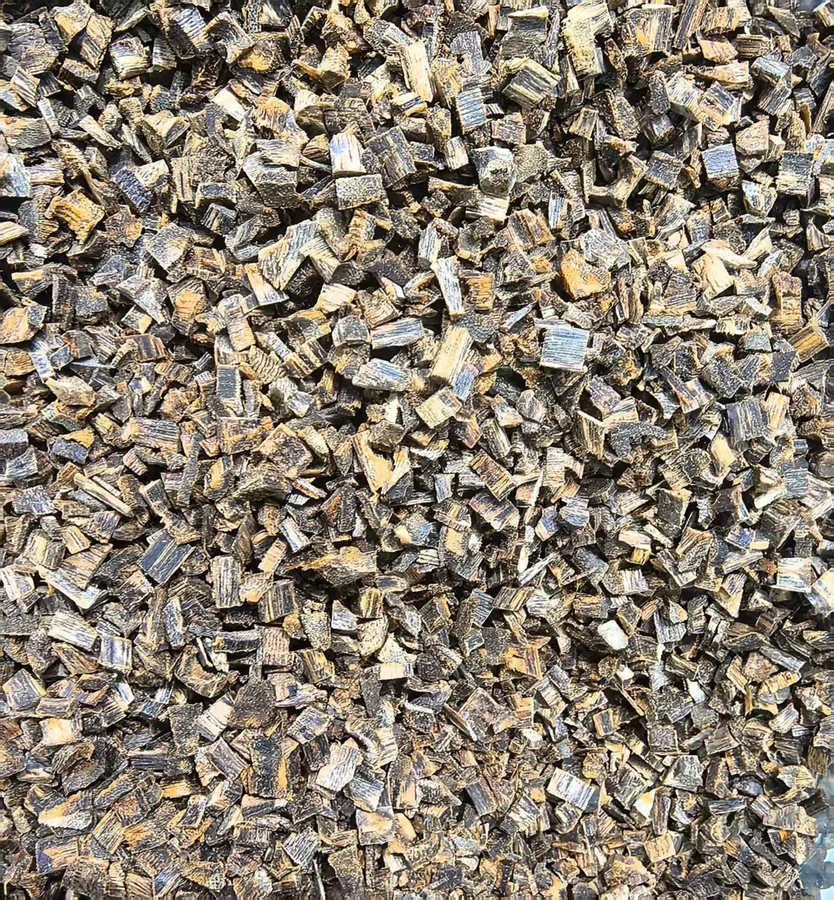
Agarwood Raw Material Specification Comparison Table
The table below is a buying framework, not a product catalogue. Each row lists what the form name usually means, what must be confirmed in writing, where the form commonly fits, and the risk that most often turns into a claim.
| Form (as suppliers label it) | Physical character | What to confirm in writing | Likely process fit | Common purchasing risk |
|---|---|---|---|---|
| Chips / fragments | Irregular pieces with visible grain and resinous colour; size varies by lot | Size band and screen openings, oversize and undersize limits, foreign matter limit, moisture basis, pack weight | Burning, bakhoor blending, display, further cutting or grinding | Size drift between lots; visible pieces used to justify a price that the screened yield does not support |
| Shavings | Thin, elongated pieces from planing or slicing; low bulk density, dusty | Thickness and length range, fines share, dust content, moisture basis, compression and pack format | Loose incense blends, burning, milling feedstock, repacking | Quoted by weight but shipped by volume; fines and dust paid for at material price |
| Granules | Reduced and screened material in a defined band; more uniform than shavings | Nominal band, share above and below the band, fines limit, moisture, uniformity across the lot | Metered blending, incense formulation, sachets, automated filling | Band stated as a name without screen sizes; segregation in transit changing the arrival profile |
| Powder | Milled material specified by the share passing a stated screen | Mesh or screen size, passing percentage, moisture, agglomeration, packing and liner | Incense stick and cone formulations, aromatic blends, extraction feedstock | Fineness claimed without a test method; caking or moisture pickup in an unsuitable pack |
The Clauses That Decide Whether a Lot Is Usable
Particle size and screen fractions
Size should be written as a test, not an adjective. A workable clause names the sieve or screen series, the nominal band, the maximum share allowed above the top screen, and the maximum share allowed below the bottom screen. It should also say how the test is run: sample mass, whether the material is dried first, how long the stack is shaken, and whether the result is reported on a wet or dry basis. Two labs testing the same lot with different procedures will produce different numbers, so the procedure belongs in the specification.
Fines, foreign matter and moisture
Fines are the fraction that falls below the smallest useful screen. They are not automatically a defect — some processes use them — but they must be priced and counted rather than discovered on arrival. Foreign matter needs a defined limit and a defined inspection method: visual sorting of a stated sample mass, with a list of what counts (bark, sand, fibre, packaging debris). Moisture needs a basis and a method, because a wet-basis figure and an oven-dry figure describe different things, and resin-rich agarwood behaves awkwardly in a standard oven test. The point of writing these clauses is not to demand laboratory precision from a supplier; it is to make the measurement method, the sample and the permitted deviation agreed before the price is fixed. Buyers handling moisture disputes will find the underlying logic in this guide to oud chips moisture content.
Uniformity, packing state and batch difference
Uniformity is a separate clause from size. A lot can sit inside its size band on average and still be visibly mixed, with dense dark pieces in one part of the bag and pale material in another. Ask how the lot is blended before packing, whether it is packed from a single screening run, and what the supplier considers an acceptable variation between bags in the same shipment. Packing state belongs in the same clause: unit weight, liner, seal, carton or bag grade, and whether the material is compressed. Loose shavings settle in transit, so the arrival profile is not the packing profile unless the pack is specified.
Sampling and Incoming Inspection: What to Record
Representative samples and retained samples
A sample is only evidence if it is traceable. Ask for the sample to be drawn from the lot that will actually ship, labelled with lot or batch reference, date and the specification version it was drawn against, and sealed. Keep a retained sample from the arrival and store it under the same conditions as the approved sample, so a later dispute can be settled by comparison rather than memory. Where a supplier cannot link a sample to a lot, treat the sample as a marketing document. The approval mechanics are set out in this protocol for oud chip sample approval.
Same-condition comparison and a small processing trial
Comparing samples from different suppliers is only meaningful when they are tested the same way: same sample mass, same screens, same drying condition, same observation sheet. Record the fines share, the visible foreign matter, the moisture result and the usable share in your own process, then run a small trial — a burn, a mill pass, a blend, an extrusion — and record what happened to dust, bridging, breakage and finished appearance. A photograph and a form name cannot show you how a lot feeds a machine. A trial lot can. Where repeat shipments are the real risk, the measurement routine in this audit of repeatability across shavings shipments is the right template.
Quotation and the Cost That Never Appears on the Price List
A price per kilogram is the beginning of a cost model, not the end. Shavings and light fragments are bulky, so freight is charged on volume while material is sold on weight; the same container carries less usable material than a denser form. Add screening or re-screening if the arrival profile does not match, the loss from material that falls outside your process, packing and palletisation, inland handling, duty and import charges, and the working capital tied up in a lot that is slower to consume than expected. The effect of density on landed cost is worked through in this guide to shavings density, packing and freight cost.
Convert every bid to cost per usable kilogram
The comparison that matters is landed cost divided by the kilograms you can actually use, calculated on the same moisture basis and the same screen definition for every bid. That single conversion exposes offers that look competitive per kilogram and are expensive per usable kilogram, and it gives you a defensible number when a supplier asks why another bid won. There is no universal loss rate to apply: the usable share depends on your screens, your process and the lot, which is why it must be measured on your own trial rather than assumed from a market average.
Documents, terms and currency
Fix the delivery term, the currency, the payment structure and the inspection point before comparing prices, and state which documents travel with the shipment. For agarwood, permit and phytosanitary paperwork is part of the commercial offer, not an afterthought: most Aquilaria species and other agarwood-producing genera are listed in the CITES appendices, so international movement requires the corresponding permits, and the permit description must match the material actually shipped. The CITES Secretariat maintains the Checklist of CITES Species that buyers and their brokers use to confirm listing status. A quotation that excludes documentation is not comparable with one that includes it.
Supplier Screening and International Sourcing
Identity, capacity and quotation-to-form match
Confirm who is actually shipping: the legal entity on the invoice, the bank account, the permit holder and the production site should be consistent, and a trading company should be able to name the factory behind it. Then test whether the quoted form is a form the supplier can repeat. A supplier who sells mostly chips may quote shavings from a single screening run and be unable to reproduce the profile on the second order. Ask what the standard output of their line is, and how much deviation they will accept in writing.
Inspection, claims and the document set
Agree the inspection method, the claim window and the evidence you will both accept before the order is placed. A claim clause that requires a laboratory report the buyer cannot obtain is not a remedy. Practical terms name the sample mass for inspection, the photographs and records required, the period after arrival in which a claim can be raised, and the remedy ladder — replacement, credit, price adjustment — in the order you would accept them. The evidence pack that actually gets answered is described in this guide to oud chips claims and arrival inspection.
MOQ, lead time and custom screening
Minimum order quantity in this category is usually set by lot allocation and screening batch rather than by sales policy, so it moves with the form and the grade. Ask what the minimum is for the exact profile you specified, not for the catalogue item, and ask what changes if you accept a wider band. Lead time should be broken into material allocation, screening, drying, permits and freight, because a single quoted number hides which of those is the constraint. Custom screening is only real if the supplier can show the screens and the retained sample. The commercial mechanics are covered in this guide to oud chips manufacturer MOQ, and the quotation-normalisation method in comparing bulk agarwood shavings suppliers and the shavings specification RFQ shows how to put the clauses into a document two suppliers can quote against.
Agarwood Shavings Supplier Evaluation Checklist
Score each supplier out of the weights shown. A supplier that cannot produce evidence for a line scores zero on that line, however persuasive the conversation. Adjust the weights to your own risk profile, then keep the completed sheet as the record of why an order was placed.
| Area | Evidence to request | Pass condition | Weight |
|---|---|---|---|
| Sample | Lot-linked, sealed sample with batch reference, date and specification version | Sample traceable to the shipping lot; retained sample agreed | 15 |
| Specification | Written form definition: size band, screen series, oversize and fines limits, moisture basis and test method | Every claim measurable by a named method; deviations stated numerically | 20 |
| Batch consistency | Records from two or more previous lots; blending and screening practice | Arrival profile repeatable within the agreed band | 15 |
| Packaging | Unit weight, liner, seal, carton or bag grade, compression, labelling | Pack protects the specified moisture and profile through freight | 10 |
| Logistics | Packed bulk density, container loading plan, port of loading, freight basis | Landed cost calculated per usable kilogram, not per kilogram | 10 |
| Documents and compliance | Legal entity, permit holder, CITES and phytosanitary documents matching the shipped form | Documents consistent with invoice, bank account and material description | 15 |
| After-sales terms | Inspection method, claim window, remedy ladder, response route | Claim procedure enforceable without a laboratory the buyer cannot access | 15 |
What NanjaOud Supplies
NanjaOud supplies agarwood raw materials from its own cultivation and processing base in Jiangmen, Guangdong, and it is worth being precise about the forms on the current range, because "shavings" is not a product name used on this site. The raw material range is listed under agarwood raw materials and chips, which includes natural large agarwood chips and natural small agarwood chips described as irregular pieces retaining visible wood grain and resinous colour, and agarwood wood fragments described as irregular fragments suitable for sorting, blending, further grinding and incense-related processing. Milled material is offered separately as incense-grade agarwood powder for stick, coil and cone formulations.
If your process needs a defined shavings profile, the honest starting point is a conversation about which of those existing forms is closest to your requirement and what screening or processing would be needed to reach it — not an assumption that a shavings SKU exists. Buyers who want to review the supply and control approach first can read the quality and supply pages, and a written enquiry can set out the target form, sample requirement, specification, expected volume and destination market through the contact page.
Frequently Asked Questions
Are agarwood shavings the same as agarwood chips?
No. Chips are pieces with visible wood structure cut or broken to a rough size; shavings are thin, elongated pieces produced by planing or slicing, with a higher surface-to-weight ratio and lower bulk density. Suppliers use the terms inconsistently, so the only reliable comparison is a written size band, screen series and fines limit.
What particle size should I specify for shavings?
Specify a screen series and a nominal band rather than a word. State the maximum share above the top screen, the maximum share below the bottom screen, the sample mass, the drying condition and the shaking time. Without those, two labs will report different results on the same lot.
How much sample is enough to evaluate a lot?
Enough to run the screen test, the moisture test, a visual foreign-matter check and a small processing trial, plus a retained portion stored under the same conditions as the approved sample. The exact mass depends on your test methods; what matters is that the sample is drawn from the shipping lot and labelled with its batch reference.
What minimum order quantity should I expect?
MOQ in agarwood raw material is usually driven by lot allocation and screening batch size rather than by a standard policy, so it changes with the form, the grade and the width of the size band you accept. Ask for the minimum on your exact profile, and ask what a wider band would do to it.
How do I verify moisture and fines on arrival?
Use the method written into the specification, on a stated sample mass, and record the result against the approved sample. Fines are measured as the share passing the smallest useful screen; moisture is reported on the basis named in the contract. Record both on every arrival so the trend, not just the single result, is visible.
Do I need CITES documents for agarwood shavings?
Most Aquilaria species and other agarwood-producing genera are listed in the CITES appendices, so international shipments normally require the corresponding permits, and the permit description must match the material shipped. Confirm the listing status for the species and form with your broker and the importing authority before the order is fixed.
Can I compare a shavings quotation with a granule quotation?
Only after both are converted to landed cost per usable kilogram on the same moisture basis and the same screen definition. A granule quote and a shavings quote describe different physical profiles, so the per-kilogram price alone says nothing about which is cheaper for your process.
What should I do if the arrival does not match the approved sample?
Follow the inspection and claim clause agreed before the order: document the sample mass, the screen result, the moisture and photographs, notify within the claim window, and invoke the remedy ladder in order. A claim is far stronger when the approved sample was lot-linked and retained.
Conclusion
Choosing an agarwood shavings supplier is a specification exercise before it is a price negotiation. Define the form as a measurable profile, sample the shipping lot, test every bid on the same method, convert the result to cost per usable kilogram, and score the supplier on the evidence they can actually produce. Buyers who do that stop arguing about a word and start comparing material.
Start with the end use: state the process, the target form, the sample you need, the specification you will test against, the volume you expect and the market you ship to. NanjaOud can then confirm which of its current agarwood raw material forms fits, and what would be required to reach your profile — you can send those details through the contact page.


