
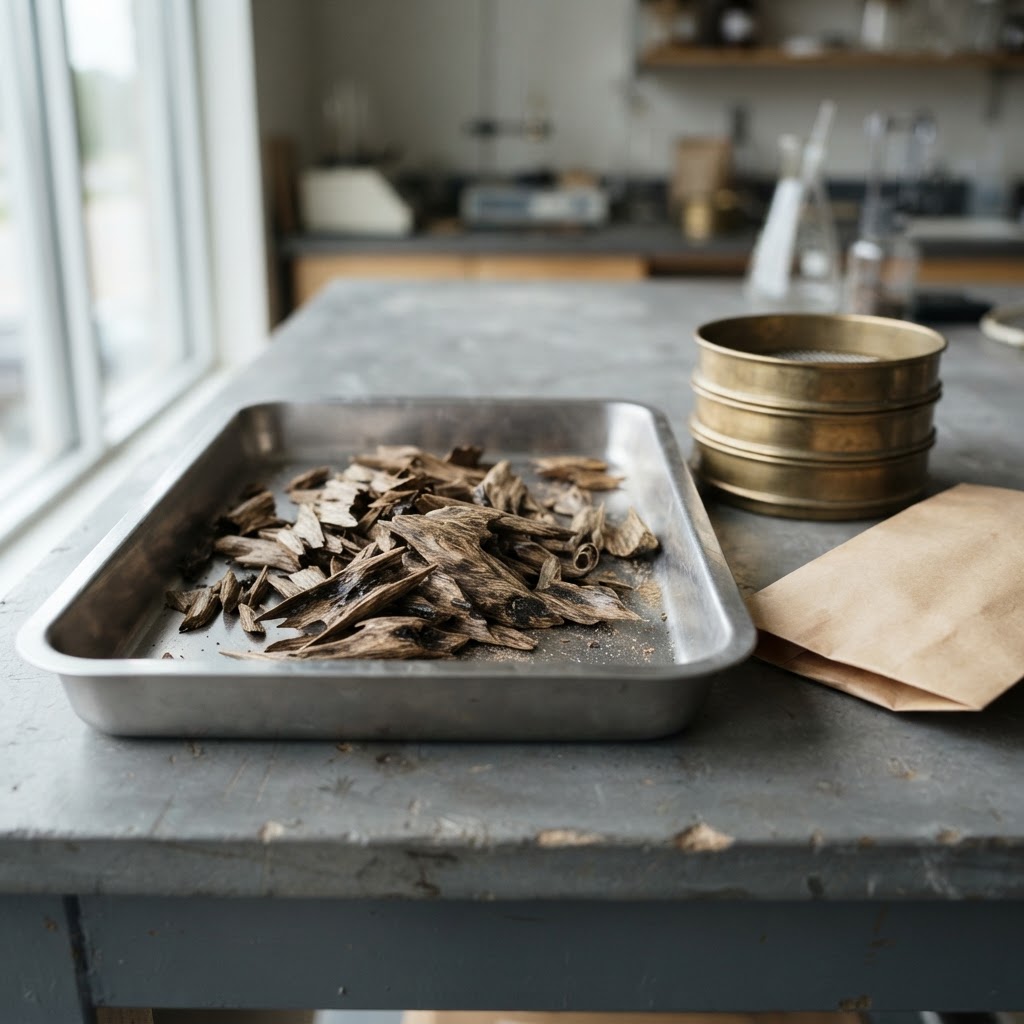
Short answer: an oud wood shavings wholesale programme is proved on the third shipment, not the first. One container only shows that a supplier can fill an order; three to four arrivals show whether the material you approved is the material your line keeps receiving. Three measurements — screen fraction by mass, fines share, and usable share after your own handling — recorded identically on every arrival, turn a form name into a supply programme you can audit.
This guide is written for importers, incense and bakhoor manufacturers, fragrance processors and wood-material wholesalers who have already decided they want a fine, sliver-type raw material and now need that supply to behave predictably. If you are still weighing broad forms, start with the site’s comparison of agarwood chips, granules and powder; if your immediate problem is how to write a size specification at all, the particle size guide covers that ground. This article assumes the form decision is made and addresses the harder question: how do you prove, lot after lot, that nothing important has quietly changed?
Why the word “shavings” cannot carry a specification
Agarwood is traded in four common physical forms, and each name describes geometry, not quality:
- Chips — distinct pieces of wood, irregular in shape, with visible grain and darker resin-bearing areas.
- Shavings — thin slivers, curls or shreds removed by planing, slicing, sawing or shaping.
- Granules — small cut or crushed pieces with a more block-like profile than slivers.
- Powder — milled material passing a fine screen.
No standards body assigns these words a resin content, aroma class or species, and suppliers use them loosely: the same geometry may be sold as shavings, shreds, slivers or curls by different sellers, and two quotations using identical wording can describe material with different thickness, length, dust load and cleanliness. That is a vocabulary problem rather than a moral one, but it becomes a commercial problem the moment you place a repeat order and discover that the supplier’s definition changed without the product name changing.
Shavings add a risk that deliberately cut chips do not carry. Sliver material is frequently a by-product of another operation — dimensioning blocks, shaping bead blanks, trimming pieces for retail. A sidestream inherits whatever the upstream job required, so its geometry can shift when that job changes, on a schedule that has nothing to do with your purchase. Three questions resolve most of that ambiguity before price is discussed: what production step created the material, whether it is a primary product or a sidestream, and which measured characteristics will be written into the purchase terms.
Agarwood Raw Material Specification Comparison Table
The table compares the four forms by what they physically are, which items a buyer must confirm in writing, where each tends to fit in production, and — the column most buyers never ask about — where drift typically appears between shipments. It deliberately contains no universal size numbers, resin percentages or price levels: those depend on species, source, batch and supplier, and inventing them creates exactly the disputes this guide exists to prevent.
| Form | Physical character | Items to confirm in writing | Likely process fit | Where repeat orders usually drift |
|---|---|---|---|---|
| Chips | Distinct irregular pieces; visible grain and darker resinous areas; sortable by hand | Piece size range and thickness, share below the target size, visible foreign matter, moisture basis, net weight, packing | Direct heating and bakhoor blends where pieces must stay visible; feedstock for milling or extraction | Average piece size creeps up or down as the cut changes; photographs come from a better lot than the one shipped |
| Shavings | Thin slivers or curls; high surface-to-mass ratio; settles and compresses in the bag; often a by-product of shaping | Sliver thickness and length, screen fractions by mass, fines and dust share, the method for measuring both, cleanliness, bulk density behaviour, compression and net weight | Blending and bulking a formulation; feed material for further grinding; applications wanting fast, even heating of small pieces | Form name substitutes for a grade; geometry shifts when the upstream production job changes; dust is paid for at wood price |
| Granules | Small cut or crushed pieces, block-like rather than slivery; flow behaviour matters | Screen range and the opening in millimetres, oversize and undersize limits, fines share, segregation in transit, cleanliness | Feeding and dosing where a consistent small piece is easier to handle than irregular chips | Segregation in the container, so the top of a bag differs from the bottom; “mesh” quoted without stating the opening |
| Powder | Milled material; fineness and flow decide usability | Sieve or measurement convention, permitted oversize, clumping and flow, moisture condition, barrier packaging | Incense formulation and binding, where material must disperse through a mix | Fineness quoted as a single mesh number; a powder that disperses in one binder fails in another |
Read the table as a list of questions, not a ranking. No form is inherently more aromatic or better value; the same source wood can become chips or shavings depending on how it is cut, and the cut is chosen for a downstream job.
The three measurements that decide whether a repeat lot is the same material
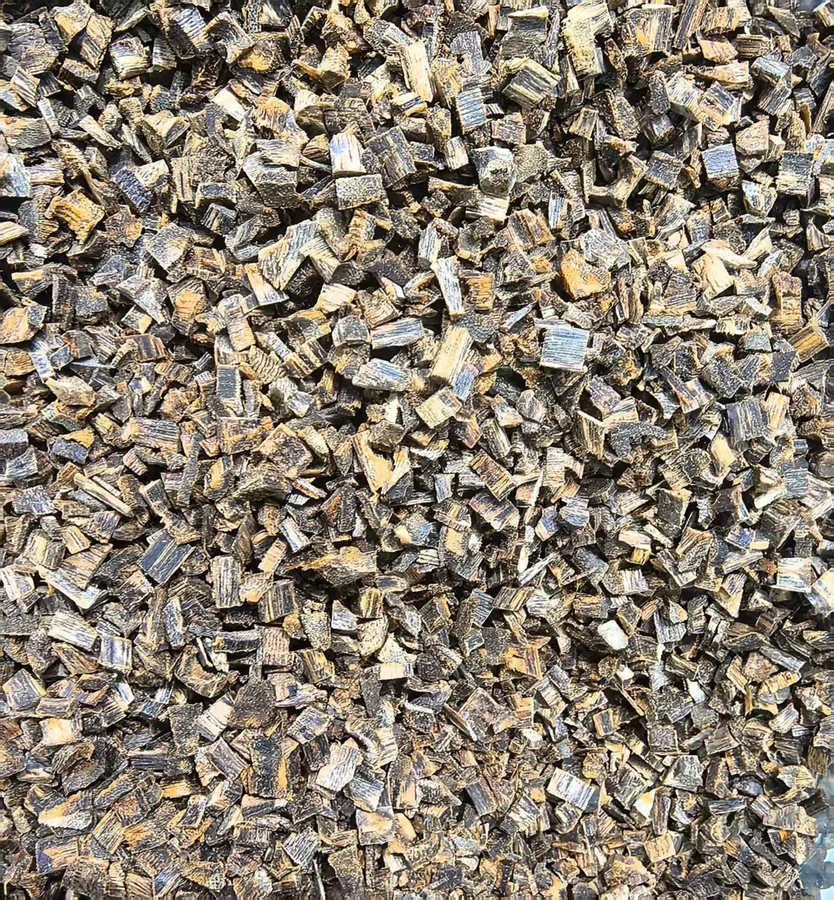
Price per kilogram is easy to compare and tells you almost nothing across shipments. These three figures do, provided they are produced the same way every time.
1. Screen fraction by mass, not by eye
Agree the openings in millimetres, then report retained mass at each opening as a share of the sample, not as an adjective. ASTM E11 specifies woven wire test sieve cloth and sieve construction, including opening tolerances, which is useful because two buyers using different sieve grades can obtain different results from the same material; it does not assign an agarwood grade or certify a lot. State whether results come from a single sieve or a stack, and whether vibration time and amplitude are fixed.
2. Fines and dust share
Every shavings lot contains a fraction below your useful size. Define three things and the argument largely disappears: the opening below which material counts as fines, whether loose dust in the bag is included in that figure, and the maximum acceptable share by mass. Then fix where it is measured — at dispatch, on arrival, or both — because handling and transport generate additional fines after the supplier’s own check. A supplier who can quote a retained mass on an agreed opening has a process; one who says “minimal dust” has an opinion.
3. Usable share in your own process
The only fraction that matters commercially is the share your line can actually convert. A blender that tolerates short slivers may use 90 percent of a lot that a portioning line rejects at 75 percent. Measure it once, in your own process, and keep the method fixed: weighed input, weighed output, weighed rejects, and a note of where rejects came from. That figure, not the supplier’s yield claim, belongs in your cost model.
Supporting numbers: water, foreign matter and net weight
Agree how moisture is expressed (as-received or oven-dry basis), the method used and the point in the chain where it is measured; thin material picks up and loses water faster than chips, and water is paid for at the price of resinous wood. Define foreign matter classes — bark, sand and grit, packing fibre, string, metal from tooling, insect debris — with the sample mass inspected and the consequence of a finding. Finally, weigh units on arrival: shavings settle, so a bag filled by volume can look full and weigh less than the label promises, and compression changes the fines profile.
A drift record: comparing three shipments on one page
Keep one sheet per supplier, with the method column frozen once and never renegotiated mid-programme. A blank row is a finding, not a neutral result.
| Item | Fixed method | What you record each arrival | Action if it moves beyond the agreed limit |
|---|---|---|---|
| Screen fraction | Stated openings in mm, sample mass, sieve time | Share retained per opening | Hold the lot, re-sample from several positions, notify supplier in writing |
| Fines share | Opening defining fines, dust included or excluded, sieve time | Share by mass at dispatch and on arrival | Separate transport-generated fines from supplier-side fines before claiming |
| Usable share | Weighed input and output in your own process | Usable percentage, reject reason | Recalculate cost per usable kilogram before the next order |
| Moisture | Agreed basis and method, same instrument | Result and measurement point | Adjust net-weight settlement if the contract allows it |
| Foreign matter | Inspection mass and method | Count or mass found, type | Apply the remedy ladder: re-screen, credit, replace, reject |
| Net weight | Sample units weighed on a calibrated scale | Actual versus declared | Claim on short weight with photographs and scale readings |
Sampling and inspection on a repeat order
The first order needs a lot-linked sample and a proper approval; the site’s guide to verifying an agarwood shavings supplier sets out that first-lot protocol. Repeat orders need something slightly different: the same procedure applied again, unaltered, so the numbers are comparable.
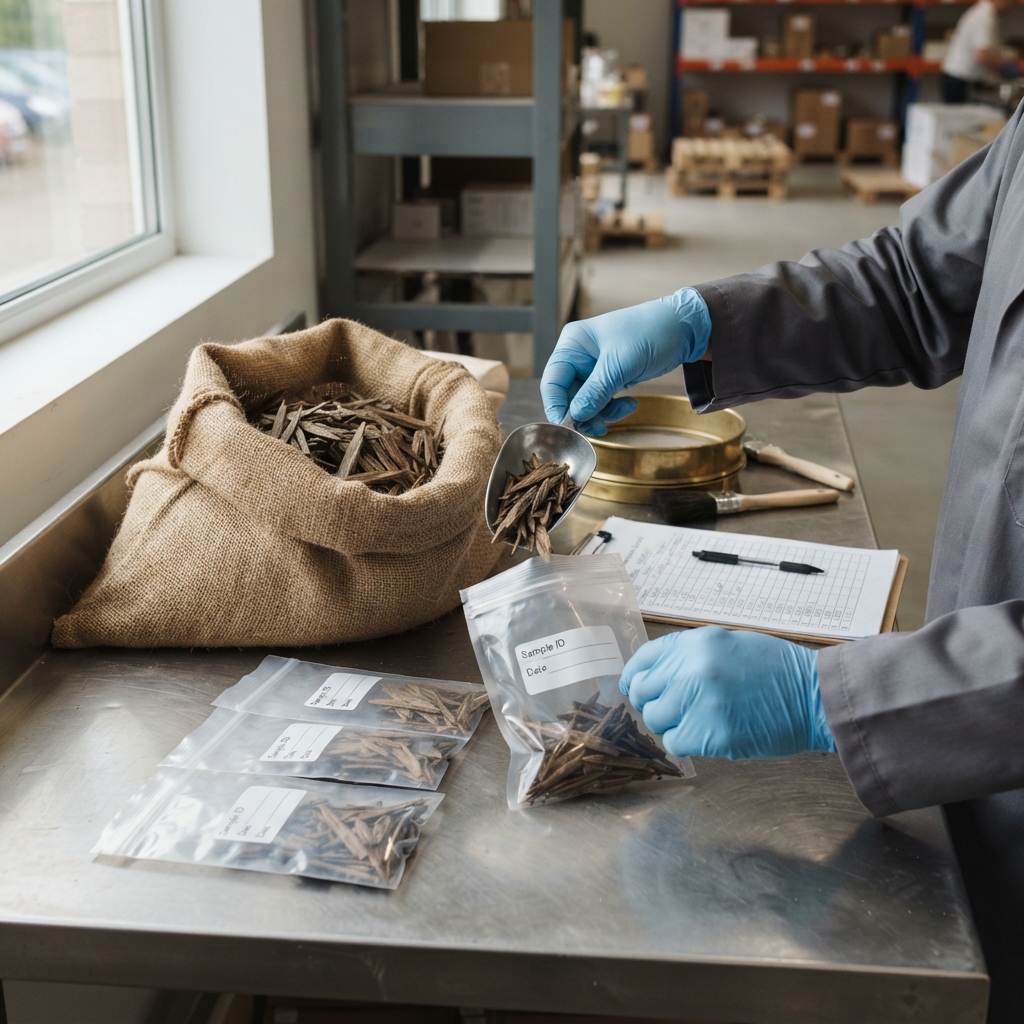
- Take increments, then divide. Draw portions from several positions in the container, combine them into a gross sample, and reduce representatively. Record how many increments, their approximate mass and where they came from; there is no universal increment count, but the method must be written down and repeated identically.
- Keep the reference sample. Retain a labelled portion of every approved lot in the packaging you expect to receive, and store it under the same conditions. Without it, “this is not what we approved” is an assertion rather than a comparison.
- Compare candidates blind where practical. Code the samples, use the same mass, the same sieve openings, the same vessel and the same observation time across suppliers, and record counts and masses rather than impressions.
- Run a small process trial, not a photograph review. Feed the material through the real mixer, binder and forming step at small scale and note dust, distribution, drying and burn behaviour. For a trader, portion and repack a few units and watch what the material does to pack presentation and to fines at the bottom of the bag.
From quotation to cost per usable kilogram
A quoted price is not a purchasing cost. The comparable figure is landed cost divided by the share of the lot you can use:
Cost per usable kilogram = (material + screening or handling + packing + freight + duty and compliance + inspection) ÷ usable fraction
For shavings, the denominator moves more than it does for chips, because a meaningful share of the weight may fall below your useful size. Include rejected material, off-spec deductions and any re-screening labour in the numerator as well, since they are real costs of that lot.
As an arithmetic illustration only — hypothetical numbers, not a market price and not a supplier quotation — a lot quoted at 100 per kilogram with 80 percent usable material costs 125 per usable kilogram before freight. Add 10 for freight, duty and inspection and the figure is 137.5. The same arithmetic on a lot quoted at 110 with 92 percent usable material gives about 119.6 plus the same 10, or roughly 129.6. The cheaper quotation is the more expensive material. Run this on your own measured figures; there is no defensible universal loss rate for agarwood shavings, and any supplier who offers one without a method is guessing on your behalf.
Four costs stay hidden unless you ask. Custom screening usually carries a higher unit price but can lower total cost, because you stop paying wood prices for material you would screen out yourself — provided each supplier quotes the same screening basis. Re-screening labour and line downtime from non-conforming material usually cost more than the material itself. Currency and payment terms change the landed figure between quotation and settlement. And packaging that does not limit moisture pick-up converts into weight and quality loss somewhere between the factory gate and your store.
Screening a supplier for repeatability
Legal identity and real supply capability
Match the company name on the quotation to the bank account, the export documents and the permit holder. Trading companies are legitimate, but you need to know which party controls the material and the processing, because that party determines consistency. Ask what volume the supplier can sustain across a year, and how many lots of your specification it can assemble in a quarter — a single shipment answer is not a supply answer.
Does the quotation restate your form?
A credible quote echoes your specification: form and production route, size or screen basis, fines and dust treatment, cleanliness criteria, moisture basis, packing and net weight. If the reply is a price and a photograph, the specification was not read. Ask for the measurement method in writing rather than a verbal assurance, and ask which openings the supplier can actually screen to.
Sample-to-order consistency and claim terms
Ask directly what happens when an arriving lot does not match the approved sample: who inspects, within what period, using which method, and what remedy applies — replacement, credit, re-screening at whose cost, or rejection. A supplier who answers this calmly has usually handled it before. The inspection window, sample retention and defect definition belong in the purchase terms, not in a later argument.
Species and trade compliance
Agarwood-producing taxa are regulated internationally. The CITES Secretariat’s working document for CoP20 on agarwood-producing taxa records that Aquilaria spp. and Gyrinops spp. are included in Appendix II, and FAO’s chapter on CITES, trade and sustainable forest management notes that agarwood and its products are covered by that listing. In practice the exporter must hold the correct documentation before shipment and the importer must confirm what its own authorities require for the exact product, species and route. A plantation origin does not settle the question by itself, and a form name certainly does not. Confirm species, source and paperwork with your customs adviser and national authority before committing.
MOQ, lead time and offers of custom screening
Custom screening is a service only if the supplier can name the equipment, the openings used, the resulting fines level, and how it affects price and lead time. If those answers stay vague, treat “we can screen to your requirement” as a sales phrase. Equally, ask what the lead time is made of — material allocation, drying, processing, documentation, freight — so you know which part you are waiting for when an order slips.
Agarwood Shavings Supplier Evaluation Checklist
Score two or three candidates on the same sheet. The middle column is the one that separates a first order from a supply programme.
| Area | Question that matters on a repeat order | Evidence to keep | Red flag |
|---|---|---|---|
| Sample | Was the sample drawn from the lot offered, and is a retained portion stored for comparison on arrival? | Sample ID, date, photos with a scale, written statement of lot linkage | Sample “from a similar run” with no lot reference |
| Specification | Are form, screen openings in mm, fines definition and moisture basis stated, with the method for each? | Signed specification sheet or the specification section of the quotation | Adjectives such as “clean”, “premium” or “low dust” with no measurement |
| Batch | How is a lot assembled, how much variation is normal between runs, and who is notified when the upstream job changes? | Lot records, previous shipment data, written change-notification commitment | Claims of perfect uniformity from natural material |
| Packing | Net weight per unit, liner and moisture barrier, compression, odour isolation, lot labelling | Packing specification, photos of a real shipping unit, arrival weights | Volume-filled bags presented as a fixed weight |
| Logistics | Incoterm, lead time by stage, document set, CITES and phytosanitary papers, routing, insurance | Quotation terms, draft documents, broker confirmation | Permit questions deflected to “our agent handles it” |
| After-sales | Inspection window, defect definitions, who pays for re-screening or return, named contact for a claim | Written claim clause, remedy ladder, record of a past dispute | Remedies only discussed after a problem appears |
What NanjaOud can and cannot confirm today
Precision here protects both sides. Our published range covers agarwood wood fragments for incense and fragrance manufacturing — irregular pieces with natural grain and varying brown tones, positioned for sorting, blending, further grinding and incense-related processing — together with small agarwood chips that are easier to portion, blend, repack and grind, and an incense-grade agarwood powder for stick, coil, cone and loose formulations. We do not publish a separate product line labelled “shavings”, so we will not present any current item as a shavings SKU before the cut and geometry have been checked against a buyer’s brief.
On the supply side, our quality and supply page states more than ten years of agarwood cultivation experience, a managed plantation base of over 160 acres in Jiangmen, Guangdong, in-house processing, and cultivation without chemical resin-induction agents. It also states plainly that internal A, B and C labels are supplier references rather than a universal grading standard, and that the working framework does not imply a certified quality system or laboratory testing of every batch. We do not publish sieve fractions, fines limits or usable-yield figures as standard product data; where a buyer needs those numbers, they have to be established against a physical sample and agreed in writing.
Common mistakes in shavings procurement
- Approving a supplier instead of a specification. The approval that matters is a measured reference sample plus a written method, not a supplier relationship.
- Comparing quotations with different screening bases. One price includes screening and one does not; the comparison then measures the paperwork, not the material.
- Testing only on arrival. Measure at dispatch and on arrival, otherwise transport-generated fines get argued rather than accounted for.
- Ignoring bulk density. Thin material compresses, so container volume and pallet counts can mislead before anyone weighs anything.
- Leaving the remedy undefined. A claim clause written after the dispute is a negotiation; one written before it is a procedure.
- Assuming paperwork follows the product name. Species, source and route decide the permit requirement, not the label on the bag.
Frequently asked questions
Are oud wood shavings the same product as agarwood chips?
No. Chips are distinct pieces cut to a usable size; shavings are thin slivers, often produced as a by-product of shaping or planing. They behave differently in storage, screening and processing and should be specified and sampled separately, even when both come from the same wood.
How should particle size be written for shavings?
State sliver thickness and length limits plus the screen openings used to measure fractions, in millimetres, with the permitted share passing the lower opening. Sieve openings alone describe shavings poorly, because a long sliver can pass an opening and still be awkward to dose.
What sample should a wholesale buyer request?
A sample drawn from the lot being offered, with the drawing method and lot reference stated, plus confirmation that bulk supply will come from the same material. Keep a labelled portion of anything you approve and store it as the arrival reference.
Is there a typical MOQ for oud wood shavings wholesale?
There is no universal figure; it depends on how the supplier assembles lots and what your trial needs. Ask what quantity allows a representative sample and a genuine processing trial, and treat an MOQ that prevents proper testing as a reason to start smaller.
What moisture information should be in a quotation?
The basis of the figure, the method used and where in the chain it was measured. Consistency between the approved sample and the arriving lot matters more than a single impressive number.
How do buyers verify quality without a lab?
Visual and format checks, sieve fractions by mass, fines and foreign-matter counts on a stated sample mass, arrival weighing and a small process trial. These are acceptance checks, not a substitute for laboratory analysis if your customer requires it.
Do shavings need CITES documents?
Agarwood-producing taxa are subject to international trade regulation, and the applicable permits depend on species, source, product and route. Confirm the requirement for your exact shipment with the supplier, your broker and your national authority before ordering.
Why audit the third shipment rather than the first?
Because a first order can be assembled specially, while a third and fourth reveal the supplier’s normal lot assembly, its sidestream dependence and whether its screening really holds. The drift record is what makes that visible.
Conclusion
Oud wood shavings wholesale is bought successfully when the buyer treats the form name as a starting question, fixes three measurements and repeats them identically, and writes the remedy before the dispute. Suppliers who work this way welcome the structure, because it turns a conversation about adjectives into a comparison of numbers both sides can check.
Start from your end use: how the material will be fed, blended, burned or milled, and what your process cannot tolerate. Then send NanjaOud the target material form, your sample requirement, the specification items you need confirmed, your expected purchase quantity and your destination market through the contact page, and we can tell you which current cut and sample options can be matched to that brief — and which points still need verification before a quotation means anything.


