
Chips, granules and powder describe the physical form of agarwood material, not a universal grade. Choose the form according to what your equipment and finished product require, then agree on particle size, fines, cleanliness, moisture condition, sample method and acceptable variation. A small controlled trial is more informative than a product name alone.
For an incense manufacturer, the best-looking chip may be too coarse for the formula. For a reseller of loose burning wood, a fine powder would be the wrong product even if it comes from the same botanical source. The process sets the specification.
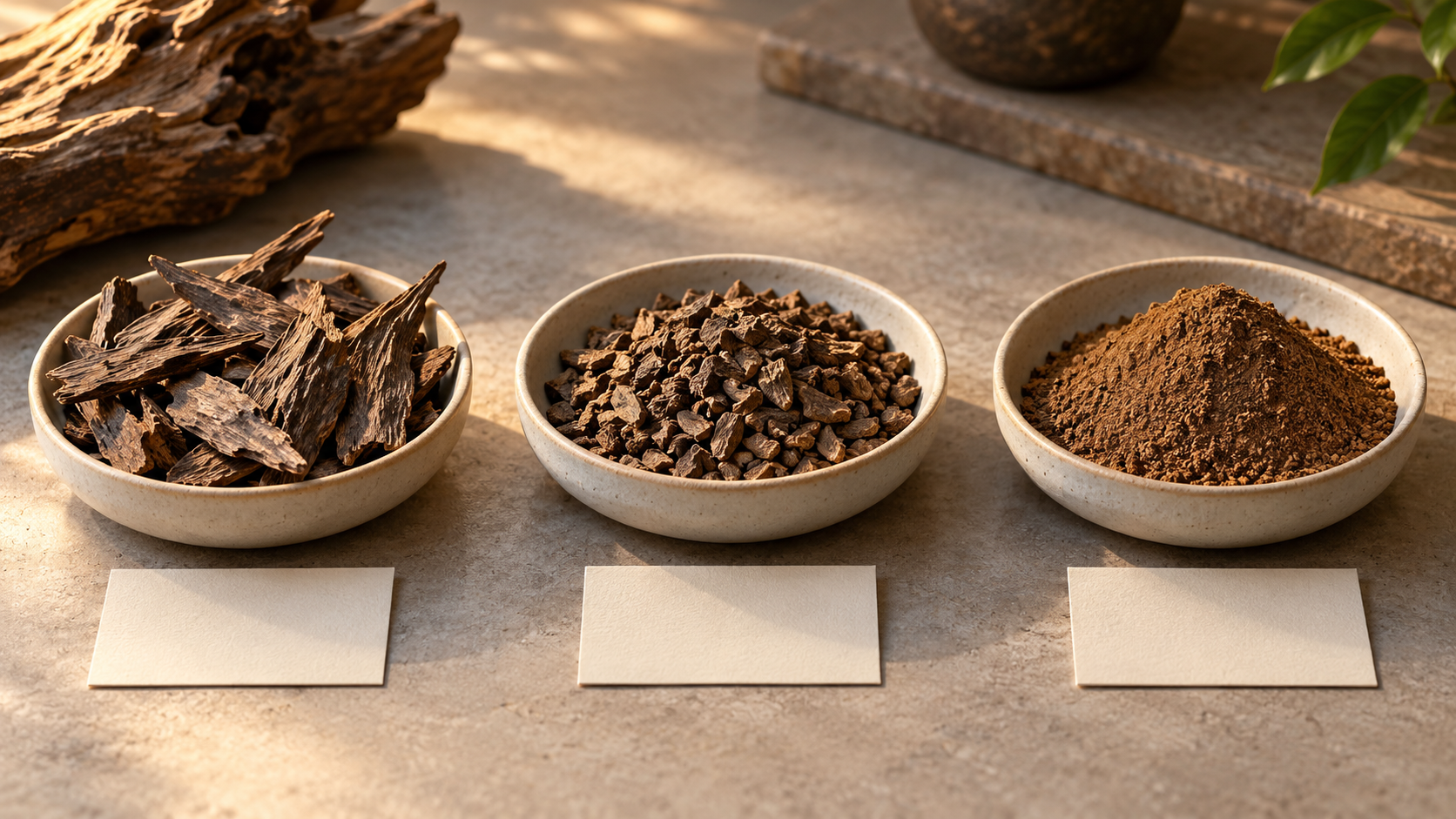
Illustrative scene. The three bowls are conceptual examples, not measured NanjaOud lots or certified particle sizes.
What the form names usually describe
Suppliers do not always use “chip” and “granule” in precisely the same way. A photograph helps, but a written size range and retained sample prevent ambiguity.
| Form | Practical description | Typical buyer question | Main trial |
|---|---|---|---|
| Chips | Irregular, visibly distinct wood pieces | Is the cut suitable for the intended burn, blend or extraction feed? | Inspect size distribution and test in the actual process. |
| Granules | Smaller cut or crushed pieces | Will the material feed and mix consistently without excessive dust? | Test handling, flow and behavior in the blend. |
| Powder | Milled fine material | Is the fineness compatible with the formula and equipment? | Test dispersion, binding, processing and finished-product performance. |
These are selection principles, not claims that any one form is better or more aromatic. The source material, processing method and batch still matter. For NanjaOud’s public product range, see Agarwood Raw Materials & Chips and Agarwood Powder.
When chips make sense
Choose chips when the finished product or process needs recognizable pieces of wood. That may include loose incense, a bakhoor blend that intentionally shows wood pieces, sample kits, or an extraction process designed for cut feedstock. The exact size and cut should follow the buyer’s burner, blending method or equipment—not a generic grade label.
Ask for the approximate size range and the proportion of very small fragments or dust. Inspect the pieces for foreign matter and excessive breakage on arrival. If aroma when heated is important, use the same vessel, heating schedule and sample mass for each candidate. A room-temperature sniff is useful, but it answers a different question.
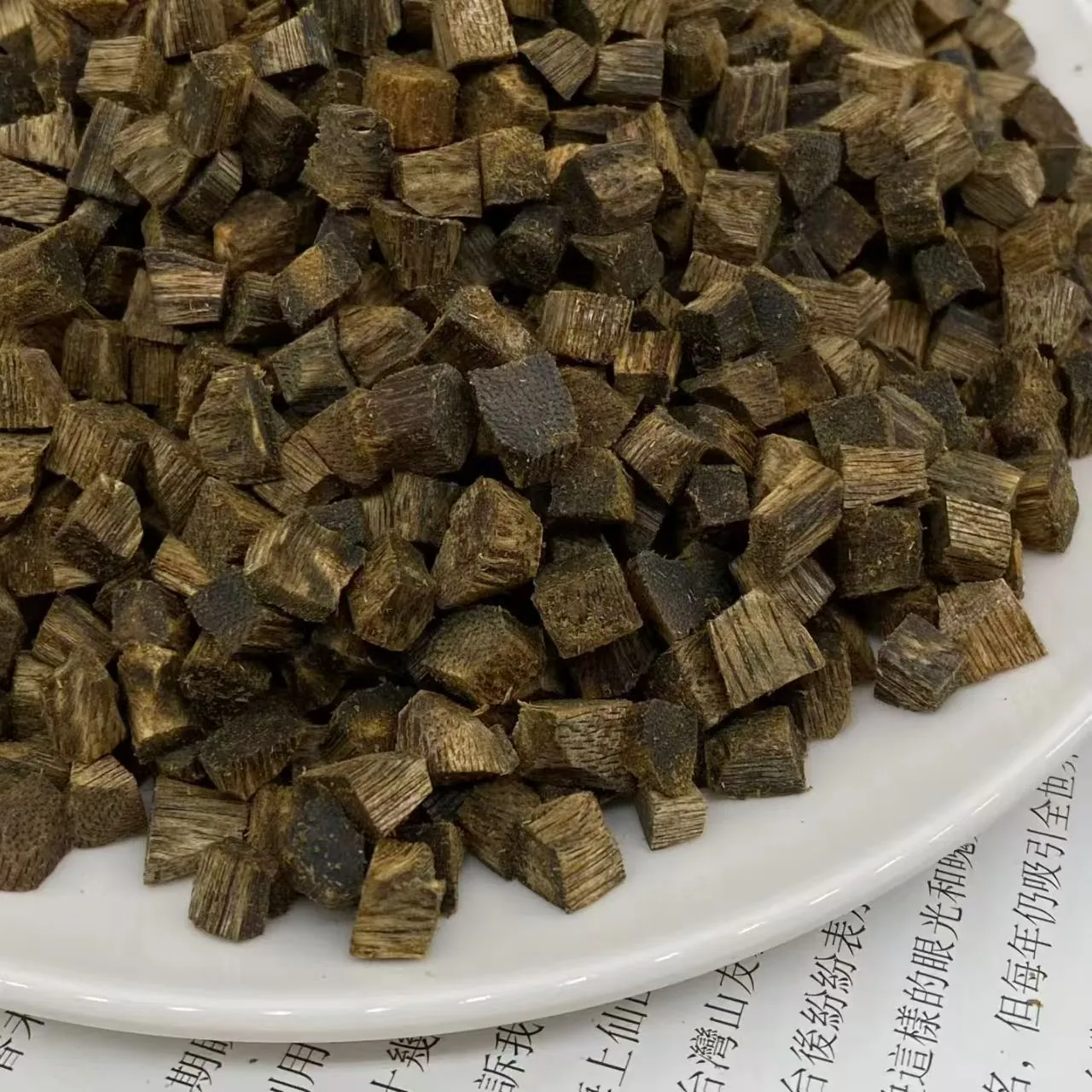
The public-site image below shows small cut pieces. It is a visual example of one form; it does not establish the dimensions, resin content or origin of an offered future lot.
When granules may work better
Smaller granules can be easier to distribute through a blend than large irregular chips. That does not automatically mean better uniformity: a lot with many fines can segregate, create dust or behave differently from the approved sample. Define the particle range and an acceptable fines proportion using a method both parties understand.
If a supplier calls a product “granules,” ask for a close image beside a scale and a physical sample. Record whether the quoted weight includes loose dust and whether the material changes noticeably during ordinary handling and transport. In a manufacturing trial, observe how it feeds, mixes and appears in the finished product.
“Granule” should not become a shortcut for an untested recipe change. If you switch from chips to granules, recheck the formula and process because surface area, handling and distribution have changed.
When powder is the right input
Powder is relevant when the process needs fine material dispersed through a formulation, such as certain incense products. Its useful specification is more than a mesh number. Ask which sieve or measurement method defines the fineness, how much oversize material is permitted, and how the powder behaves in your binder and process.
Check whether the sample clumps, flows, mixes and forms the intended finished product under your working conditions. Moisture condition and storage can affect handling; agree on packaging and a practical receiving check. A very fine powder may be unsuitable if it causes excessive dust in the buyer’s equipment, even when a sample smells attractive.
The agarwood powder category is the appropriate product route for a powder enquiry. Do not assume a chip specification can simply be copied into a powder RFQ.
Specify a measurable range, not an adjective
“Fine,” “large,” “premium” and “clean” are too open-ended for repeat purchase. A buyer can instead provide a reference sample, a target size range and a test method. Exact tolerance values should be agreed with the supplier after a trial; there is no universal particle range suitable for every incense or extraction process.
The buyer’s brief can include:
- Application: loose burning material, bakhoor, incense formulation, extraction or resale.
- Form: chips, granules or powder, with a photo and retained reference sample.
- Size: target range and measurement method; for powder, state the sieve or mesh convention.
- Fines and oversize: acceptable range and how it will be measured.
- Cleanliness: visible foreign matter and handling condition.
- Moisture and packing: condition on receipt, inner packaging and storage expectations.
- Lot: sample and bulk identifiers, plus a plan for a replacement or repeat lot.
- Documents: botanical identity, source and transaction-specific trade papers where applicable.
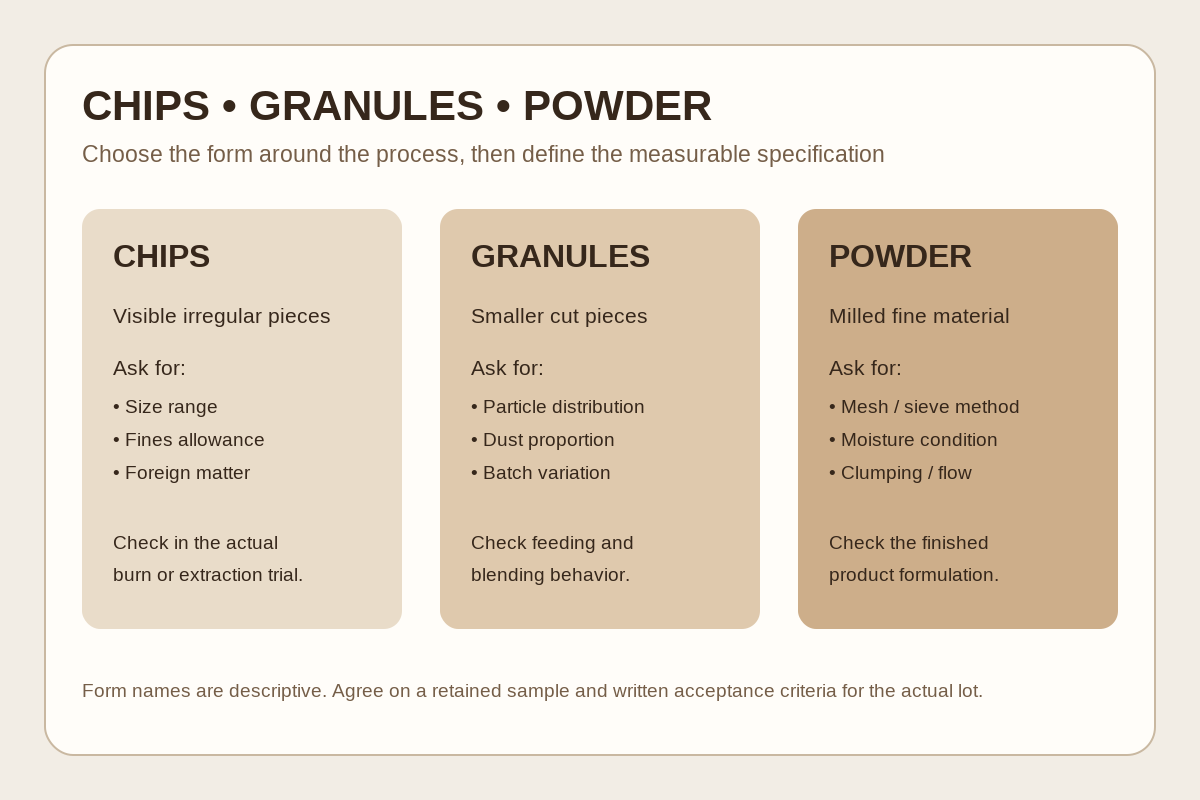
Test the material in the buyer’s own process
A good sample trial should answer a specific production question. For loose burning chips, compare the burn or heating behavior in the vessel the customer will actually use. For granules in a blend, observe feeding, distribution and dust under normal handling. For powder, evaluate mixing, binding, shaping and finished-product behavior. Keep the sample mass, test method and observation time consistent across candidates.
Record the result in plain terms: “Material accumulated in the feeder,” “Visible dust increased during transfer,” or “The finished stick cracked after drying” is more actionable than “quality was poor.” The cause of a failed trial may involve the recipe, equipment or handling as well as the raw material, so investigate before rejecting or approving a supplier.
Retain a labeled portion of the approved sample. When the bulk lot arrives, compare the same characteristics using the same method. Natural agarwood may show variation; the purchase agreement should define what variation is acceptable for the intended process.
Avoid a compliance shortcut
Chips and powder are material forms that may be subject to species- and product-specific trade requirements. CITES addresses agarwood-producing Aquilaria and Gyrinops taxa in its current Appendices. Ask your supplier and customs adviser which papers apply to your exact product, source, route and shipment date. A form name or a “plantation” claim does not determine the answer by itself.
Frequently asked questions
Are granules simply higher-quality powder?
No. Granules and powder differ mainly in physical form and processing. Quality must be defined against the botanical material, cleanliness, agreed specification and intended use.
Can I replace chips with granules in the same formula?
Only after a trial. The changed particle form may alter feeding, mixing, appearance and performance. Record the old and new specifications and compare finished products.
Is a mesh number enough to buy agarwood powder?
No. Confirm the measurement method, permitted oversize and fines, sample behavior, cleanliness, moisture condition, packing and lot identity.
How do I compare samples from two suppliers?
Use the same sample mass, equipment and evaluation method, then record particle distribution, dust, foreign matter and performance in the intended process. Keep the candidates coded until the technical review is complete.
What should I send with an RFQ?
Send the application, target form, size or mesh method, sample amount, trial process, anticipated order volume, packaging, destination and documents needed. Ask the supplier to confirm the feasible specification before quoting.
Choose the form by the job it must do
If you need visible wood pieces, begin with chips. If you need a smaller cut material in a blend, trial granules. If you need a fine ingredient for a formulation, test powder. The final selection belongs to the product trial and a written specification, not to the form name alone.
Send NanjaOud your intended process, target form, sample requirement and destination through the contact page. Ask which current material and cut options can be matched to that brief.


