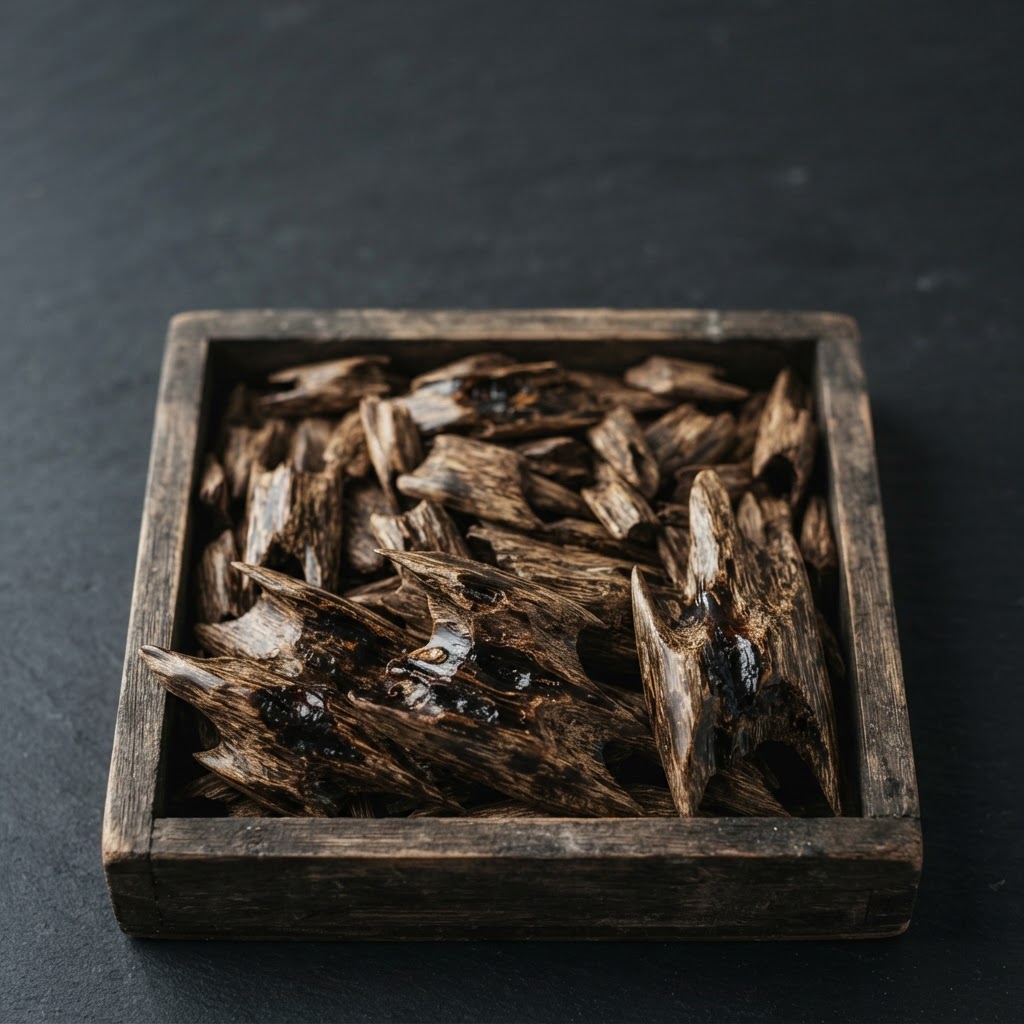
Agarwood shavings supplier selection comes down to one question most quotations never answer: where in the supplier's process did this form come from, and what did that route do to its geometry? Shavings, chips, granules and powder are form descriptions, not international grades, so two suppliers can quote the same word and ship material that behaves differently in your mill, your blend or your burner. This guide shows importers, incense manufacturers and fragrance processors how to trace a form back to its production route, write the measurements that make an agarwood shavings wholesale order testable, and screen a supplier before a bulk commitment.
Why "shavings" is a route description, not a grade
In agarwood trading, a form name describes how wood was reduced, not how good it is. "Shavings" tells you that material was cut, sliced or planed into thin pieces at some point in the process. It does not tell you the species, the resin basis, the screen band, the fines share, the moisture state or which lot the material came from. Those are the fields that decide what your process can actually use.
This is why a shavings quotation and a chips quotation can look comparable per kilogram and behave nothing alike. The word travels easily between markets; the material behind it does not. Buyers who compare agarwood wood shavings offers side by side usually discover that the only shared element is the noun.
Four forms, four geometries
Most bulk agarwood raw material falls into four described forms, and each one has a different physical behaviour:
- Chips — pieces cut from blocks or larger sections, with a recognisable wood structure and a size range that is usually quoted loosely ("small", "large") unless a screen band is written.
- Shavings and slices — thin, elongated pieces produced by planing, slicing or trimming. They pack down, bridge in feeders and generate fines quickly when handled.
- Granules — crushed and screened material, usually with a stated upper and lower size limit, sold for blending, filling or further grinding.
- Powder — milled material defined mainly by mesh or screen passage, where the fines share is effectively the product.
None of these forms is inherently better. A form is better or worse only against a process: what your mill accepts, what your blend needs, what your burner or bakhoor pack should look like, and what your customer will accept on arrival. The agarwood chips vs shavings comparison covers that process fit in detail; this guide stays on the sourcing and verification side.
What the word does not tell you
A form name also hides the difference between a primary cut and a derived stream. That distinction matters more than most buyers expect, because it decides how repeatable an oud wood shavings wholesale programme will be across shipments.
Trace the form back to the production route
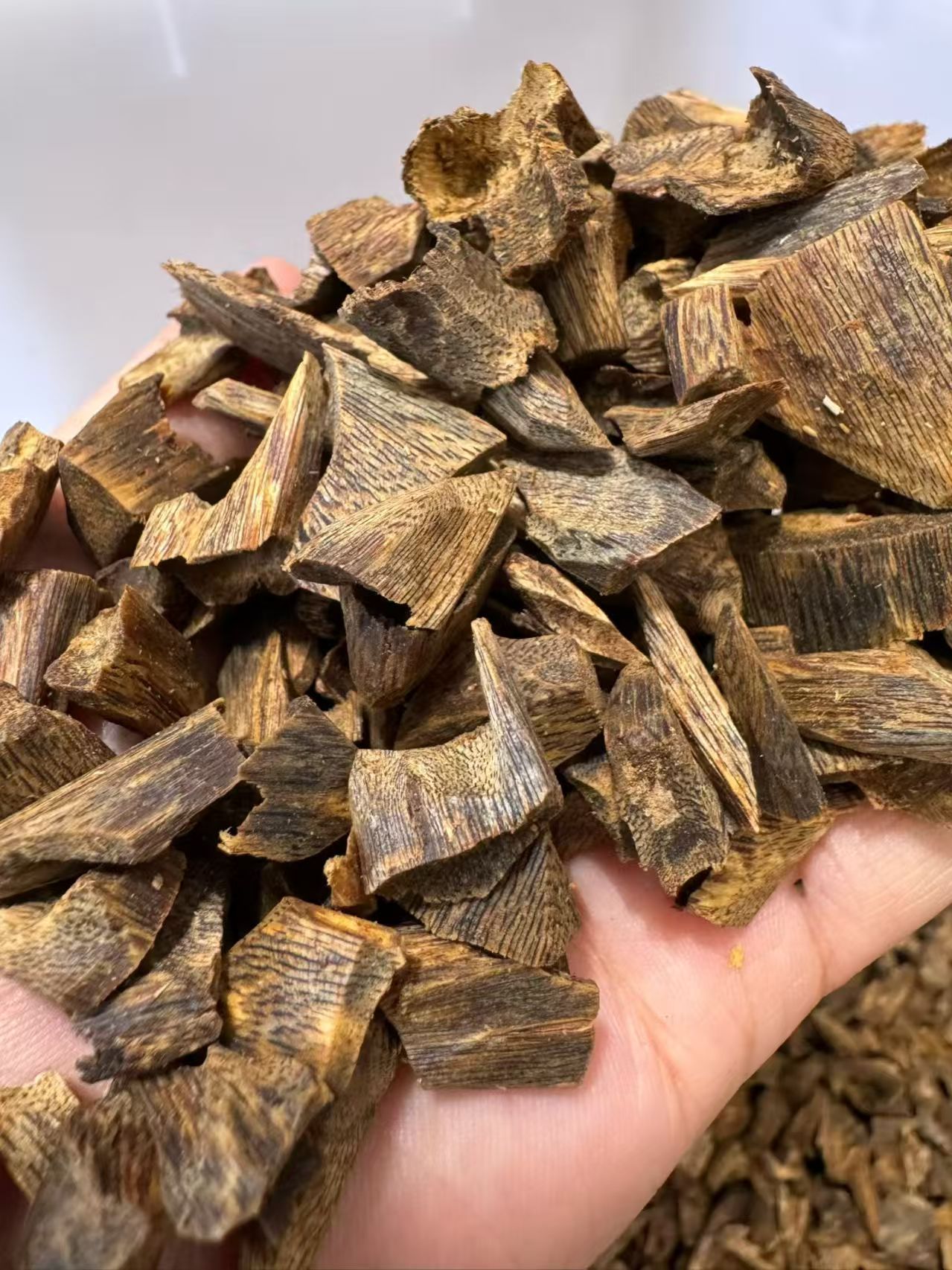
Reference photograph of NanjaOud-listed chips; this is not a photograph of the shavings lot being evaluated.
Primary cuts and derived streams
Chips are usually a primary output: blocks or sections are trimmed, cut and graded, and the chip is the product being made. Shavings, granules and dust are often secondary outputs of that same programme — material removed while producing chips, blocks or finished pieces, then collected and screened for sale.
That has three practical consequences for a wholesale buyer:
- Volume follows the primary programme. A supplier's shavings availability is tied to how much chip and block production is running. When the chip programme slows, the derived stream changes or stops.
- Composition drifts with what was cut that week. A derived lot can blend material from several cutting runs unless the supplier segregates by lot and records it.
- Cleanliness depends on collection discipline. Sweepings, floor material and offcuts from different grades end up in the same stream unless collection points are separated.
None of this makes derived forms unusable — plenty of incense and bakhoor production is built on them. It means the questions you ask have to be about the route, not only the sample.
Three questions that expose the route
- "Is this material collected from a defined cutting run, or from general workshop recovery?"
- "Which lot of chips or blocks was being produced when this lot was generated, and can you link the two?"
- "At which point is fines removed — before packing, after screening, or not at all?"
Weak answers are vague ("all our material is premium"). Strong answers name a collection point, a screening step and a record. You are not looking for a certification; you are looking for someone who knows their own process well enough to describe it.
Agarwood Raw Material Specification Comparison Table
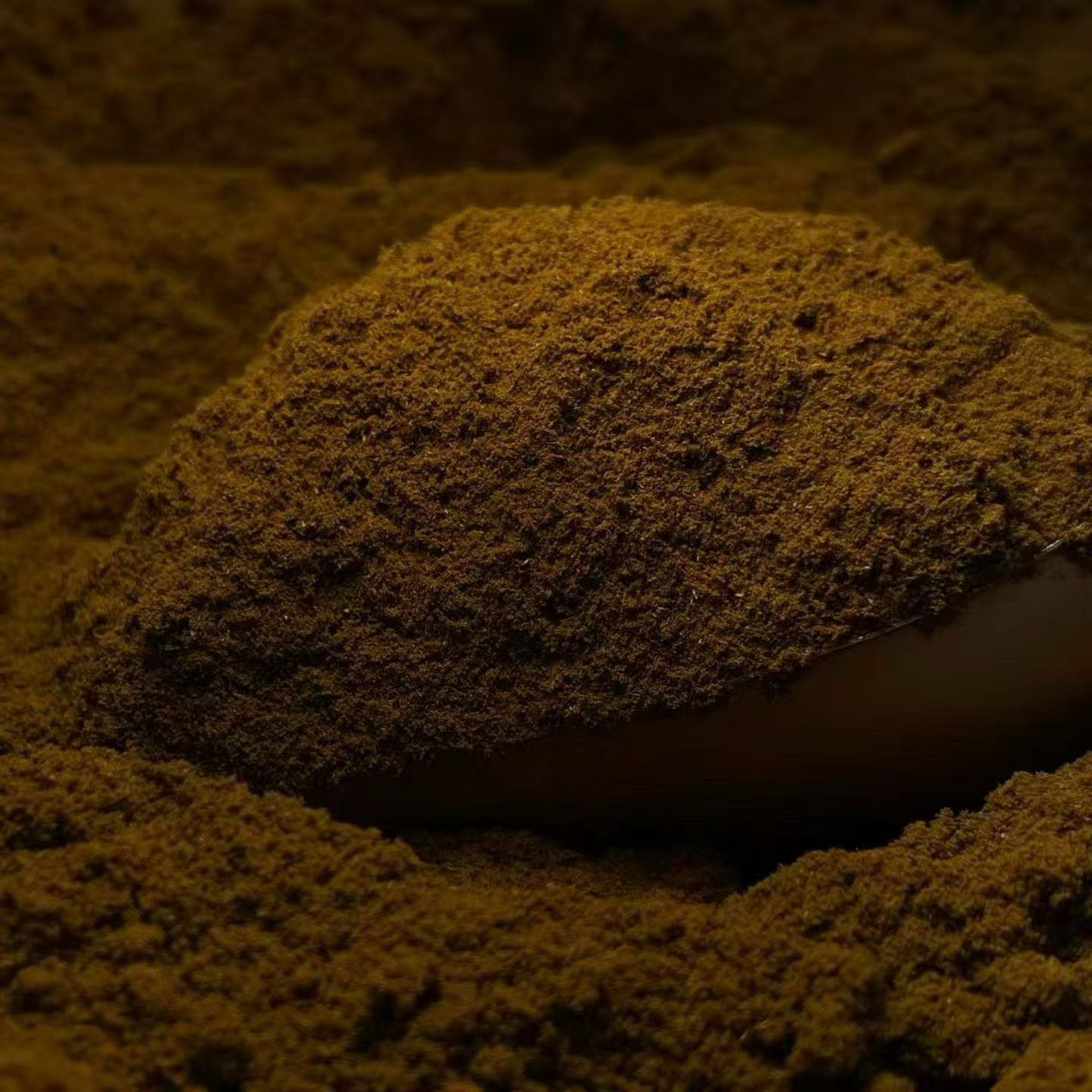
Reference photograph of NanjaOud-listed powder, a different form from the shavings discussed here.
The table below is a briefing tool, not a standard. Use it to decide which fields to demand in writing for the form you are buying, and treat any bulk agarwood shavings quotation that cannot fill the third column as an incomplete offer rather than a cheap one.
| Form | Typical geometry | Fields to declare in the order | Process it may suit | Main procurement risk |
|---|---|---|---|---|
| Agarwood chips | Block-cut or split pieces, visible grain, mixed sizes unless screened | Size band and screen openings; oversize and undersize limits; fines share; moisture basis; lot reference; foreign matter | Burning, bakhoor packs, retail repacking, grinding feedstock | Grade letters that mean different things between suppliers; size quoted as a word |
| Agarwood shavings / slices | Thin, elongated strips and curls; low bulk density; high surface area | Thickness and length range; fines share; collection point; lot linkage; moisture basis; packing compression | Loose incense blends, bakhoor base, rapid extraction or maceration feedstock, further milling | Derived stream with drifting composition; fines generated in transit; volume tied to another product's schedule |
| Agarwood granules | Crushed, screened particles with a stated upper and lower limit | Screen pair (retained / passing); fines below the lower screen; moisture basis; uniformity; foreign matter | Blending, filling, incense formulation, grinding feedstock | Screen pair omitted and replaced by "medium"; dust share rising between lots |
| Agarwood powder | Milled material defined by mesh or screen passage | Mesh or passing specification; fines distribution; moisture basis; agglomeration; lot reference | Incense stick and cone formulation, blends, sachets | Mesh claims without a test method; moisture pickup in storage; dust losses in handling |
Six figures that make a wholesale form order testable
A specification only works if both sides agree how it will be measured. For each figure below, write the method, the sample size and the allowed deviation into the order — not just a target number. The aim is a specification that two labs, or two warehouses, can measure the same way.
Screen band and oversize
Define the form by what passes and what is retained. A single sieve opening is not enough: state the upper screen (what must not pass), the lower screen (what must pass through), and the share of material allowed outside the band. Then agree the sieve type, the shaking time and the sample mass used for the test, so two labs produce comparable results.
Fines share
Fines are the fraction below your working minimum, and they are the most common source of "it looked right in the sample" disputes. Agree the cut-off screen, the allowed percentage by weight, and — critically — when the test is run: at loading, on arrival, or both. Shavings and granules generate fines during handling, so an arrival test without a loading baseline measures the freight, not the supplier.
Foreign matter
Define what counts as foreign: bark, sand, stone, fibre, packaging remnants, non-agarwood wood. Agree a visual inspection method on a defined sample mass and a limit above which the lot can be rejected or re-screened. Naming the categories in advance is what turns a complaint into a claim.
Moisture state and basis
Moisture is paid for at the price of aromatic wood, and it changes weight between the supplier's scale and yours. State whether the figure is wet basis or dry basis, the test method, the sample preparation, and whether price is adjusted above a stated threshold. For resin-rich material, agree with the supplier and, where needed, a laboratory which method is realistic before you write a percentage into a contract.
Uniformity and lot linkage
Ask how a lot is defined: one cutting run, one drying batch, one screening pass, or a blend. Then ask for the lot reference to appear on the packing list, the sample label and the invoice. A form specification without lot linkage cannot be enforced, because there is nothing to compare the next shipment against — which is why serious buyers ask for the records of the last 3 lots, not the best one.
Packed condition
Forms behave differently in a bag. Shavings compress and settle; powder migrates and cakes; granules segregate by size during vibration. Agree the pack type, liner, unit weight, compression or fill level, and how the material will be presented on arrival. Note also that weight bought and volume shipped are two different numbers — the same mass of shavings occupies far more container space than chips.
Sampling and inspection: compare like with like
A sample that represents the lot
A hand-picked sample proves nothing about a bulk lot. Ask for a sample drawn from the production lot you will receive, packed the same way, labelled with the lot reference, and accompanied by a retention sample held by the supplier. If the sample comes from stock rather than from your lot, treat it as a catalogue reference, not an approval. Two sealed bags — one for you, one for the supplier — cost almost nothing and decide most arguments later.
A record sheet instead of a photograph
Photographs are useful for orientation and useless for arbitration. Record instead, on the same day and with the same screens: retained and passing shares, fines percentage, visible foreign matter, moisture reading and method, and the usable share after your own screening. Keep the sheet with the sample bag and the lot number. Two suppliers compared on that sheet are comparable; two suppliers compared on images are not.
The process trial that settles the argument
Where the form feeds a mill, a blender or a former, a small trial on your own equipment is worth more than any description. Run a defined mass through the process, record throughput, dust, blockages, blend behaviour and the finished product result, and keep the trial conditions attached to the material reference. This is the point where "shavings" either fits your line or does not.
Quotation and hidden cost: convert every bid to cost per usable kilogram
A price per kilogram is a starting point. The number that decides the order is cost per usable kilogram after your own screening and losses. Build it from these lines:
- Material price at the stated form, screen band and moisture basis.
- Screening and handling — the premium for pre-screened material, or your own cost to screen it.
- Off-specification loss — the share you cannot use, valued at what you paid for it.
- Packing — liner, unit weight, palletisation, and any compression needed for a light form.
- Freight and volume — charged on space for a low-density form, not on weight alone.
- Duty, tax and compliance — classification, permits and destination requirements, which follow the form and treatment, not just the species.
- Currency, payment and inspection — the cost of the payment route, and of a pre-shipment check if you use one.
Quotations that omit the screen band, moisture basis or packing unit cannot be compared, however precise the price looks. Ask each supplier to restate the same fields, then convert. Two bids that differ by a few percent per kilogram can invert once screening loss and volume are carried into the same table.
Supplier screening and international purchase
Identity, capacity and route
Confirm who you are buying from, who produces the material and who holds the export documents. A trading company can be a perfectly good supplier, but the answers to route questions usually come from the producer. Ask what limits their output of the specific form you need — cut capacity, drying, screening, or the chip programme that generates the stream — and what happens to your allocation when that programme changes. An agarwood raw material supplier that can name those limits is easier to plan around than one that promises unlimited volume of every form.
Documents that must match the form
Agarwood-producing species of Aquilaria and Gyrinops are listed in CITES Appendix II, and the listing status of a species can be checked in the CITES species checklist. In practice this means the permit description, the invoice description and the physical form have to agree: a shipment described one way and packed another creates a clearance problem regardless of the wood inside. Ask which species and origin the lot is declared under, which permit applies, and whether the form in the box matches the paperwork. The FAO review of CITES and forest trade sets out the Appendix II context for these genera.
MOQ, lead time and custom screening
Minimum order quantity for a derived form is usually set by the batch size needed to screen and pack it properly, not by sales preference. Ask what drives the minimum, and whether a custom screen band is a standing capability or a one-off arrangement. Then ask what the lead time covers: allocation, screening, drying, documents and booking. Suppliers who can name those steps can usually also tell you what delays them.
The same logic applies to an agarwood granules supplier or a powder supplier: a screen pair is easy to promise and harder to repeat, so ask which sieve set the material was actually run over and whether the same set will be used on your order.
Agarwood Shavings Supplier Evaluation Checklist
| Area | Evidence to request | What a pass looks like |
|---|---|---|
| Sample | Lot-linked sample, packing identical to bulk, retention sample held by supplier | Sample reference matches the lot offered; both sides keep sealed retention material |
| Specification | Written form definition: screen band, fines cut-off, foreign matter categories, moisture basis and method | Every field has a number, a method and an allowed deviation |
| Batch | Lot definition, collection point, screening step, records for the last 3 lots | Lots are segregable and traceable; variation between lots is explained, not denied |
| Packing | Pack type, liner, unit weight, compression or fill level, labelling with lot reference | Packing unit matches how you will store and issue the material |
| Logistics | Packed density, pallet and container loading plan, freight basis, documents list | Volume and documents are quoted, not assumed |
| Compliance | Species and origin declaration, CITES permit held by the exporter, invoice and packing list wording | Paperwork description matches the physical form and the destination requirement |
| After-sales | Claims window, inspection method, remedy options (replacement, re-screening, credit), escalation contact | Remedy ladder is written into the order, not negotiated after a dispute |
Common buying mistakes
- Treating the form name as a grade. "Shavings" and "chips" say nothing about species, resin basis or screen band.
- Approving a catalogue sample. A stock sample cannot be compared with a lot you have not seen.
- Omitting the fines cut-off. Without it, every fines argument becomes a matter of opinion.
- Ignoring volume. A light form can cost more to ship per usable kilogram than a denser one with a higher price.
- Buying a derived stream without asking what generates it. Repeatability depends on the programme behind the stream.
- Leaving compliance to the forwarder. The form description in the documents has to match what is in the box.
How NanjaOud fits a form-sourcing brief
NanjaOud publicly lists natural small agarwood chips and incense-grade agarwood powder. Those listed products show two different physical forms; neither photograph proves the geometry, moisture, species or availability of a proposed shavings lot. Ask for a current, lot-linked sample and written specification before comparing a shavings quotation with either format.
For a form-sourcing enquiry, send the intended use, target cut or screen band, acceptable fines, moisture test method, sample quantity and destination. NanjaOud can then confirm which current material and documentation it can offer. Any origin, grade, stock, MOQ and lead time should be verified for the specific quoted lot rather than inferred from a category page.
FAQ
Are agarwood shavings the same as agarwood chips?
No. Chips are usually cut pieces with a recognisable block or split geometry; shavings are thin strips produced by planing, slicing or trimming. They differ in bulk density, fines generation and how they feed a mill or a blend, so they should be specified and priced as different forms.
Do shavings, granules and powder share a quality standard?
No international standard defines these form names for agarwood. Suppliers use them as trade descriptions, so the specification, the measurement method and the tolerance band have to be agreed between buyer and seller, in writing, for each order.
What particle size should I specify?
Specify the band your process needs, not a number borrowed from another buyer. Define an upper screen, a lower screen, the allowed share outside the band and the test method, then verify the band on a lot-linked sample before the bulk order.
How large should a sample be?
Large enough to run your own screen test and a small process trial, packed the same way as the bulk, and drawn from the lot you will receive. Agree the sample size with the supplier at quotation stage, and keep a sealed retention sample from the same draw.
What MOQ should I expect for wholesale shavings?
MOQ is normally driven by the batch size a supplier needs to screen, dry and pack the form consistently, and by the volume the generating production run produces. Ask what sets the figure rather than assuming a market norm, and check whether a custom screen band changes it.
How do I check quality without a laboratory?
Screen the material on agreed sieves, weigh the retained and passing fractions, sort a defined sample for foreign matter, measure moisture with the agreed method, and record the usable share after screening. A small trial on your own equipment adds the process evidence a lab report cannot give.
What documents should accompany an international shipment?
At minimum: species and origin declaration, CITES documentation where the species requires it, commercial invoice, packing list and the certificates your destination market requires. The descriptions must match the physical form, because clearance problems usually start with a mismatch between paperwork and pack.
Can a supplier guarantee the next lot matches this one?
Only within a written tolerance, and only if lots are segregated and recorded. Ask for the lot definition, the records for recent lots, and a clause stating which measurements will be repeated on each shipment and what happens if they fall outside the band.
What are agarwood incense raw materials usually bought in?
Most incense producers buy chips, shavings, granules or powder in bulk and combine them with binders and other woods in their own formulation. The material form, the fines share and the moisture state decide how the batch behaves, which is why those three fields belong in the purchase order rather than in a conversation after arrival.
Conclusion
An agarwood shavings supplier is really supplying a production route and the measurements that come out of it. Form names are only shorthand: what protects a wholesale order is a written screen band, a fines cut-off, a moisture basis, a lot reference and a sample drawn from the lot you will actually receive. Get those four or five fields agreed before price, and most of the disputes that plague this category never start.
Start from your end use — burning, blending, milling or extraction — then send us the target form, the specification points you need verified, your sample requirement, the estimated volume and your destination market. Our team will confirm what can actually be supplied against that brief through the contact page. For the measurement side in more detail, see our guides to writing a shavings specification for an RFQ, buying by measured form rather than name and specifying chip and granule particle size.