
Short answer: describe the cut shape and a measurable distribution, not only a label such as “small chips” or “granules.” State your intended process, the screen openings or measurement method, how much oversize and fine material you can tolerate, and how the sample will represent the proposed lot. Approve a physical reference and put its code in the RFQ. A supplier can then quote the form you can actually feed, burn, blend or pack.
This article addresses size specification within wood pieces. Our published chips vs granules vs powder guide helps choose the broad material form. Powder is a separate, finer material choice for formulation. Here, the useful decision is how to keep a chip or granule shipment within an agreed handling range, while accepting that cut wood has irregular shapes.
NanjaOud's public raw materials and chips range shows more than one cut direction. The small agarwood chips listing is a product reference for a buyer enquiry. Neither page publishes one universal particle-size tolerance for every future lot. The size bands in the example below are illustrative buyer inputs, not NanjaOud's standard specification or a claim about available stock.
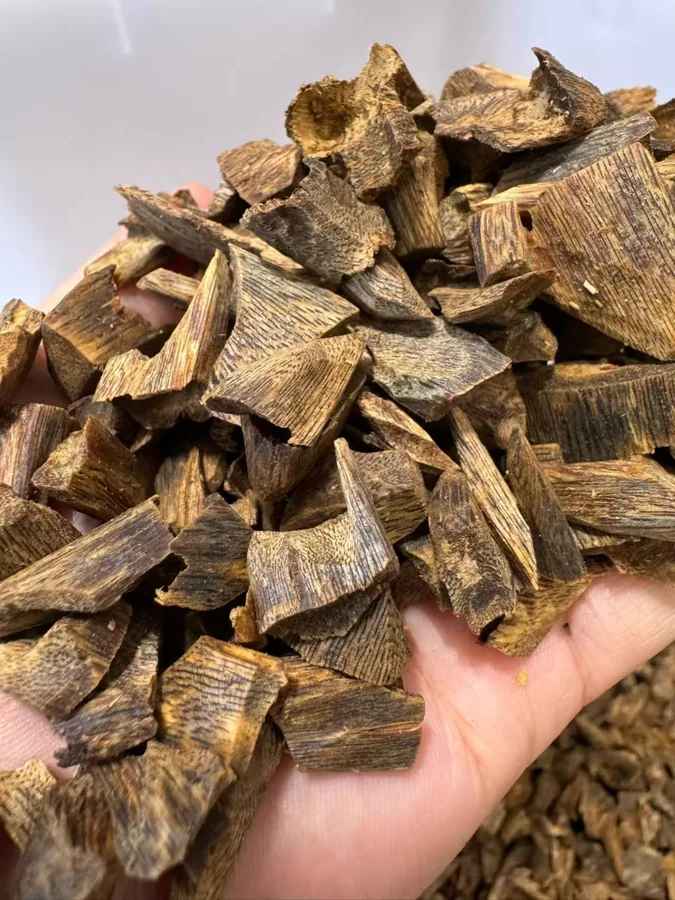
NanjaOud site photograph showing the shape of small wood pieces. The image has no scale and cannot prove a particle-size distribution or a future shipment grade.
First identify the job the material must do
The process determines which sizes matter. Direct-heating buyers may need pieces that can be portioned consistently. A Bakhoor maker may need an even-looking blend. A mill or extractor may need to avoid bridging or excessive fines. Equipment and handling decide the useful cut.
Write down how the material enters the process. Will a person dose pieces by hand, will a hopper feed them, or will the wood be milled again? Is the appearance visible in the finished retail pack? Which problem has appeared in a past trial: pieces too large, too much dust, or a mix that separates in transit? These answers tell the supplier why the size band matters and help the buyer avoid paying for a narrower range that provides no benefit.
Also distinguish cut profile from screen size. A long, thin sliver may pass a screen despite being longer than the aperture in one direction. A squat block may be retained even when its mass is similar. That is why photographs with a ruler and a short shape description belong beside any sieve result. The buyer should state whether maximum length, thickness, screen passage or a combination is the controlling requirement.
Turn “small” into a distribution
For an irregular wood lot, specify an acceptable central range plus the material outside it. A screen method can report the mass retained on each opening after a stated sample preparation. ASTM E11-24 covers the construction and opening tolerances of woven-wire test sieves; ISO 3310-1:2016 likewise covers technical requirements for metal-wire test sieves. These standards describe test sieves. They do not by themselves assign a quality grade to agarwood or prove that NanjaOud uses a particular sieve procedure.
The buyer and supplier still need to agree on the openings, sample mass, whether loose dust is included, how fragile pieces are handled, and how the retained mass is reported. If the material is wet enough to clump, a simple screen result may be misleading. If the pieces break during handling, record that before assuming the production cut is inconsistent. A sample photograph before and after screening can make a later dispute easier to resolve.
| RFQ field | Buyer example to define | What must be agreed |
|---|---|---|
| Material form | Irregular chips or shorter granules | Shape words and reference photographs |
| Intended use | Direct heating, Bakhoor blend, milling or extraction feed | Which constraint the size supports |
| Measurement basis | Screens, caliper dimensions or both | Equipment, method and units |
| Main fraction | Buyer-selected range between two openings | Target share by mass and test method |
| Oversize | Material retained above the upper opening | Maximum allowed share and rework rule |
| Fines | Material passing the lower opening | Maximum allowed share, including loose dust |
| Sample | Identified sample with date and lot status | How it represents the material offered |
| Packing | Inner pack, quantity per pack, protection from breakage | Whether transport may create extra fines |
The table has no generic numeric tolerance. Set the limits after an equipment trial with an identified sample. For example, request the mass retained on agreed upper and lower screens, with a photograph of the oversize fraction, then agree the acceptable shares in writing. If screen series differ, compare physical openings in millimetres or micrometres rather than relying on a “mesh” label.
Sample the proposed lot, not the prettiest handful
A display photograph may feature attractive pieces from a separate batch. For a production decision, ask how the sample is tied to the lot being offered. Take portions from more than one position in a container where practical, note the container or lot IDs, and combine or compare them according to an agreed sampling plan. Avoid cherry-picking only the surface. The number of increments, sample mass and method should reflect the order size and the consequence of a failure; this article does not prescribe a universal sampling standard for all agarwood orders.
Keep part of the approved sample in the same kind of protective packaging used for the trial record. Photograph it with a scale and label. Record whether the supplier's proposed order will come from the same lot, a later processed lot, or a future production run. If the source changes, do not silently transfer approval: request a fresh representative sample and compare its size and handling against the reference.
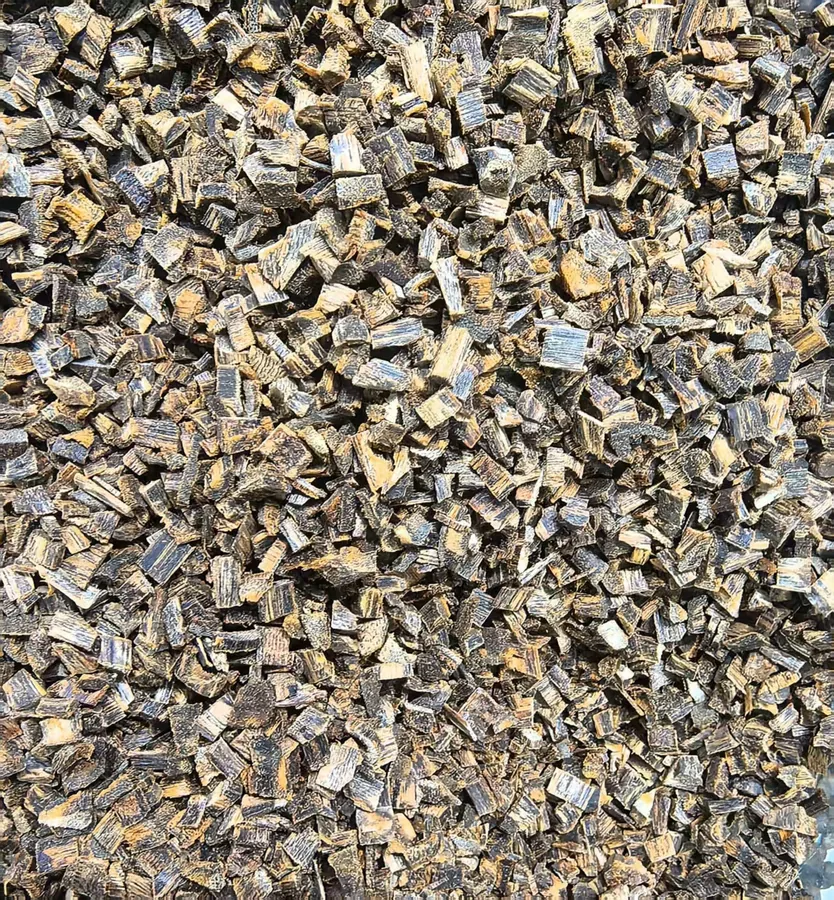
NanjaOud site photograph illustrating a different cut profile. It is a visual comparison, not a measured granule grade or a sample from a new RFQ.
Run one trial that answers the buying question
For an incense maker, use the proposed material in a small formulation or preparation trial, then record feed, mixing and visible inclusions. For direct-heating buyers, record how easy it is to portion a repeatable amount and whether the pieces behave as expected on the intended heater. For a mill or extraction process, note bridging, dust generation and whether a pre-screening step is needed. These are buyer-side observations, not claims that a particular NanjaOud lot has passed a test.
Do not change the material, equipment setting and recipe all at once. If an initial trial fails, tell the supplier what failed in measurable terms. “Too much powder below the agreed screen” or “long slivers jam the feed throat” gives a clearer next step than “quality is low.” A second sample may need a different cut, a tighter screen range or a different packing method. Record what changed so the comparison remains fair.
Packaging can alter what reaches the buyer. A lot screened at dispatch may gain fines after rough handling. Ask whether the acceptance check will be performed before packing, on receipt or both. If you need a receiving inspection, define how many packs to open and how to reconcile the result with the approved sample. Do not assume that one photograph of the production line establishes the condition of every packed unit.
Keep other quality questions separate
Particle size is one dimension of a purchase, not a substitute for material identity, aroma, cleanliness or moisture management. A tight size range can still be the wrong material for your application. Record visible foreign matter separately and ask how it will be assessed. If aroma is a decision factor, use an agreed sensory method and sample code rather than inferring fragrance strength from dark color. If the target market requires source or trade documents, confirm the identified material and applicable requirements through the appropriate official channels before shipment.
In the RFQ, replace “premium fine chips” with separate requirements for cut size, appearance and aroma. A local grade name can start a conversation; the agreed specification and approved sample should decide acceptance.
Buyer FAQ
Is a mesh number enough to specify agarwood chips?
No. State the physical opening and test method, plus shape and acceptable oversize and fines. Mesh terms can be used differently; an irregular sliver may pass an opening even when it looks long.
Should granules and chips use the same size band?
Only if the buyer's process and the agreed cut profile make that sensible. “Chip” and “granule” are commercial descriptions; confirm what each supplier means through photographs, measurements and a sample.
Can I approve a shipment from a photograph with a ruler?
A photograph helps explain shape and approximate scale. It does not reveal the full size distribution or how much dust is in the lot. Pair photographs with a representative sample and an agreed measurement record.
How should I handle material below the lower screen?
Define whether it is a usable fraction, an allowed amount of fines or a reason to reject or rework. Set the threshold through your own trial and the supplier's confirmed process, then state where acceptance is measured.
What if a repeat shipment has a different cut?
Keep the approved reference and test the new lot against the same method. Ask for a new sample and a written explanation of the change before assuming that the previous approval applies.
Write the RFQ around the process
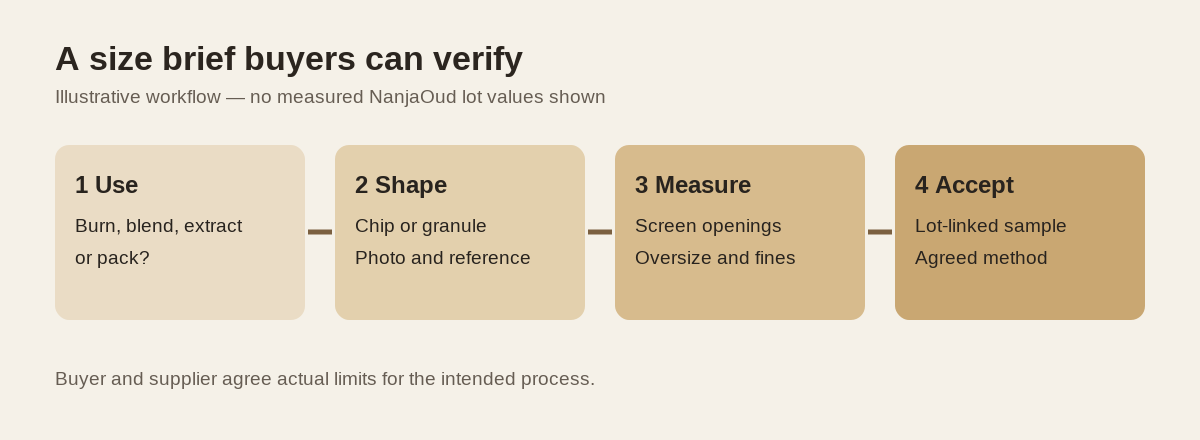
Illustrative specification workflow. No measured NanjaOud lot values are shown.
Tell NanjaOud whether you need the small-chip direction or another form in its raw-material range. Include the intended process, quantity, destination, reference photo or sample, desired measurement basis and the problem your current material creates. Ask which actual cut, sample and lot information can be offered. The result should be a quotation for a defined material, not an argument later about what “small” was meant to describe.


