
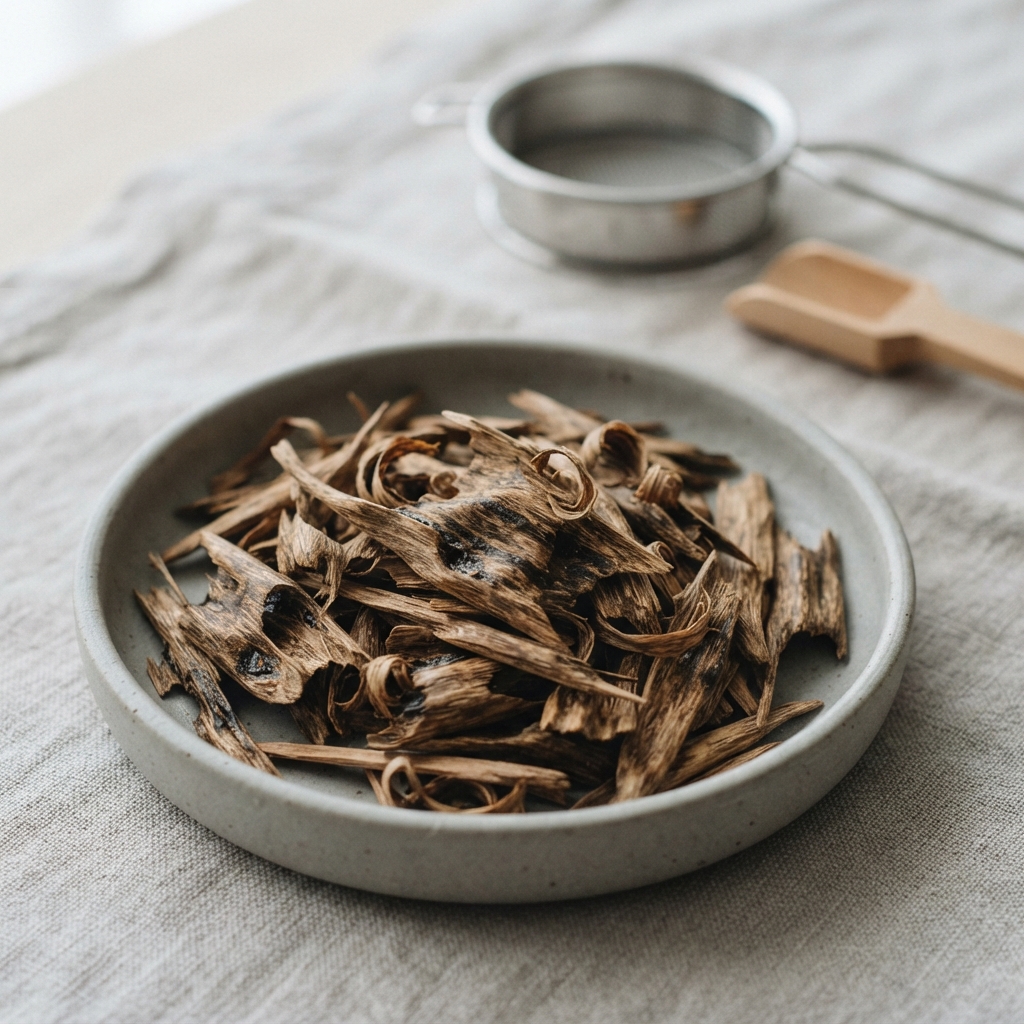
Short answer: an agarwood shavings supplier is quoting a physical form, not a quality grade. Before you compare prices, settle four things in writing: what production step created the shavings, how sliver size and fines are measured, how the sample represents the lot you will receive, and what happens if the bulk delivery does not match. Buyers who fix those four points pay for material they can process. Buyers who compare only the word “shavings” and a price per kilogram usually find the difference later, in their own yield figures.
This guide is written for importers, incense and bakhoor manufacturers, and wood wholesalers buying agarwood raw material in bulk. It treats shavings as a distinct form with its own specification and inspection problems. Buyers searching for oud wood shavings and buyers searching for shavings from a Chinese plantation supplier are usually asking the same commercial question, just with different words, and that vocabulary gap is where most of the risk sits. If your real question is which broad form suits your process, start with the site’s chips vs granules vs powder comparison instead; this article assumes you have chosen a fine, sliver-type material and now need to buy it without surprises.
What “shavings” usually means, and why it is the least standardized term in the trade
Agarwood reaches buyers in several physical forms, and the names describe geometry rather than quality:
- Chips — distinct pieces of wood, irregular in shape, retaining visible grain and resin-bearing areas.
- Shavings — thin slivers or curls removed by planing, slicing, sawing or shaping. They are usually narrow in one dimension and can be long in another.
- Granules — smaller cut or crushed pieces with a more block-like profile than shavings.
- Powder — milled material passing a fine screen.
None of these words is an international grade, and no standard body assigns them a resin content, aroma class or species. Two suppliers can both write “shavings” on a quotation and ship material with different thickness, length, dust load and cleanliness. That is not necessarily dishonesty; it is an unstandardized vocabulary. Agarwood’s own grading language is notoriously local, and even suppliers who publish A/B/C labels often note that those labels are internal references rather than a universal scale.
Shavings carry one extra risk that chips do not. Chips are usually cut deliberately to a size. Shavings are frequently a by-product of another operation — dimensioning blocks, shaping bead blanks, trimming pieces for retail. A by-product stream inherits whatever the upstream job required, so its geometry can shift when that job changes. A buyer who assumes “shavings” is a stable catalogue item may receive a very different material six months later, from the same supplier, without any change in the product name.
Three questions resolve most of that ambiguity before a price is even discussed:
- What produced this material? Planing, sawing, slicing or crushing each leave a different sliver profile and a different dust fraction.
- Is it a primary product or a sidestream? A sidestream can be excellent value, but its consistency depends on another production schedule, not on your order.
- Which measured characteristics will be written into the contract? A photograph is a description; a screen fraction and a fines limit are a specification.
Agarwood Raw Material Specification Comparison Table
The table below compares the four common forms by what they physically are, which items a buyer must confirm, where they tend to fit in production, and where sourcing risk concentrates. It deliberately contains no universal size numbers, resin percentages or price levels: those depend on the species, source, batch and supplier, and inventing them would create exactly the disputes this guide is meant to prevent.
| Form | Physical character | Specification items to confirm | Likely process fit | Common sourcing risk |
|---|---|---|---|---|
| Chips | Distinct, irregular wood pieces; visible grain and darker resinous areas; can be sorted by hand | Piece size range and thickness, share of fragments below the target size, visible foreign matter, moisture condition, packing, net weight | Direct heating and bakhoor blends where pieces must be visible; feedstock for further milling or extraction | Size described only as “small” or “large”; photographs from a better batch than the offered lot |
| Shavings | Thin slivers or curls; high surface-to-mass ratio; compresses and settles in a bag; often a by-product of shaping or planing | Sliver thickness and length, screen fractions by mass, fines and dust share, method of measuring both, loose dust included or excluded, cleanliness, bulk density behaviour, packing pressure | Blending and bulking out a formulation; material intended for further grinding; applications where fast, even heating of small pieces is wanted | Form name used as if it were a grade; invisible shift when the upstream production job changes; dust paid for at wood price |
| Granules | Small cut or crushed pieces, more block-like than slivers; flow behaviour matters | Screen range and method, oversize and undersize limits, fines share, segregation in transit, cleanliness | Feeding and blending where a consistent small piece is easier to dose than irregular chips | Segregation during shipping so the top of the bag differs from the bottom; “mesh” used without stating the opening |
| Powder | Milled material; fineness and flow decide usability | Sieve or measurement convention, permitted oversize, clumping and flow behaviour, moisture condition, packaging barrier | Incense formulation and binding, where the material must disperse through a mix | Fineness quoted as a single mesh number; a powder that disperses well in one binder fails in another |
Read the table as a set of questions to ask, not as a ranking. No form is inherently better or more aromatic. The same source material can become chips or shavings depending on how it is cut, and the cut is chosen for a downstream job.
Agarwood chips vs shavings: a short decision test
Buyers often reach this question after seeing both words on supplier pages, and the useful answer is not about which is superior. Three practical questions separate the two cases:
- Must each piece stay visible and separate? If the finished pack should show distinct pieces of wood, you need chips. Slivers settle, interleave and compress, which changes how a retail pack reads.
- Does your process tolerate a high surface-to-mass ratio? Thin material heats and dries faster and generates more dust when handled. If your line is sensitive to dust or to fast heat release, shavings may create work that chips do not.
- Do you need a by-product price or a stable catalogue specification? A by-product stream can be cheaper, but its consistency is inherited from someone else’s production schedule.
A fair agarwood chips vs shavings comparison holds the species, source and lot logic constant and varies only the physical form. If a supplier changes the source between the two options, you are comparing two variables at once and the result tells you very little about either form.
How to write a shavings specification that can actually be tested
Sliver geometry before screen numbers
Screen apertures alone describe shavings poorly. A long thin sliver can pass an opening while remaining awkward to feed or dose, and a compact piece of similar mass may be retained. State what controls acceptance: maximum length, maximum thickness, screen passage, or a combination. Ask for the measurement in millimetres rather than a mesh label, and ask which direction of the sliver is measured. Test sieve requirements themselves are covered by standards such as ASTM E11 and ISO 3310-1, which concern sieve construction and opening tolerance — they do not assign an agarwood grade, and citing them does not make a supplier’s result certified.
Fines: the number that quietly changes your yield
Every shavings lot contains a fraction below your useful size. That fraction is usually the cheapest material in the bag and the most expensive thing you pay for, because it is weighed at the price of wood. Define three things: the opening below which material counts as fines, whether loose dust is included in that figure, and the maximum acceptable share by mass. Then agree where it is measured — at dispatch, on arrival, or both — because handling and transport generate additional fines after the supplier’s check.
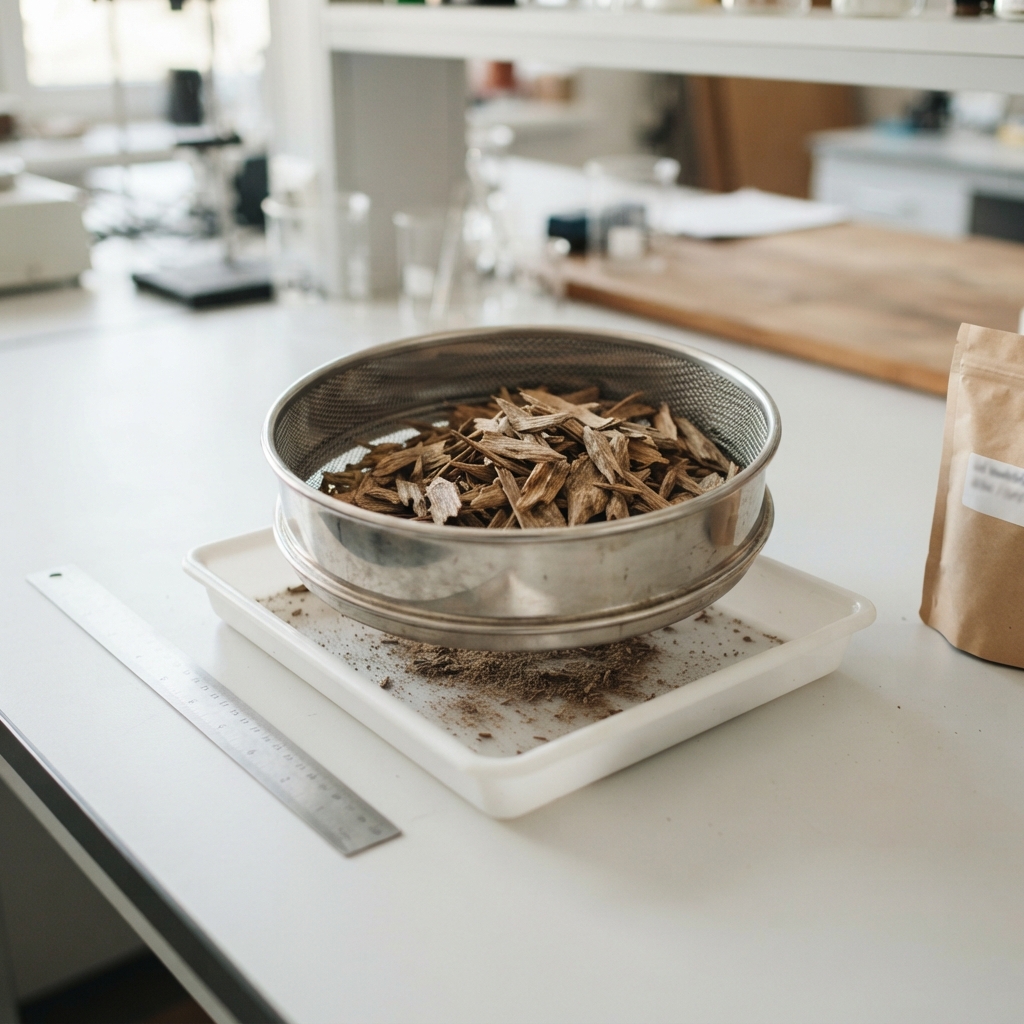
Illustrative scene: sieved fractions with the finer material collected for weighing. It is not a measured NanjaOud lot and does not represent a certified screen result.
Do not accept an agarwood shavings supplier’s assurance that fines are “minimal.” Ask for the retained mass on each agreed opening from a sample of the offered lot, and repeat the same measurement yourself on arrival. Two numbers taken the same way are a basis for a claim; two adjectives are not.
Foreign matter and cleanliness
Shavings are hard to inspect piece by piece, which is exactly why cleanliness has to be defined. Agree what counts as foreign matter — bark and sand, packing fibre, string, metal fragments from tooling, insect debris — and how it will be assessed: visual inspection of a stated sample mass, a magnet check, or washing and decanting for mineral grit. State the consequence of finding it. A clause that says “clean” without a method is unenforceable at the port.
Moisture condition, not a claimed percentage
Water is paid for at the price of resinous wood, and shavings expose far more surface area to humid air than chips do. Rather than accepting a bare number, agree how moisture is expressed (as-received or oven-dry basis), at what point in the chain it is measured, and how the material is packed to limit pick-up in transit. Agarwood’s resin content complicates simple oven-drying figures, so the practical approach is a consistent method applied to both the approved sample and the arriving lot — not a single impressive number in a brochure. The site’s guide to oud chips moisture content sets out the reasoning in more detail.
Uniformity and batch behaviour
Ask how the supplier assembles a lot: single production run, blended across runs, or accumulated over weeks. Accumulated material is legitimate but varies more, and shavings from a sidestream can change when the upstream job changes. Write down what variation you can tolerate and what triggers a new sample and a new approval. A supplier who can describe its lot assembly honestly is easier to work with than one who claims perfect uniformity from natural material.
Packing, compression and net weight
Shavings settle. A bag filled by volume can arrive looking full and weigh less than expected, and compression changes the fines profile. Specify the net weight per unit, the inner liner, whether material is compressed, and how the bag is protected from moisture and odour transfer. Weigh a sample of units on arrival rather than trusting the label; a scale check is the cheapest inspection you will ever run.
Sampling and inspection: build a method you can repeat
Ask for a lot-linked sample, not a display handful
The first question about any sample is what it represents. A photograph or a small bag chosen from the surface tells you the material exists; it does not tell you what is in the container you are buying. Ask a prospective agarwood shavings supplier how the sample was drawn, from which container or production run, and whether the bulk order will come from that same lot. If the answer is “a later run,” treat the sample as a form reference rather than an approval of the shipment.
Sample in increments, then divide
Take or request portions from several positions in the container rather than one scoop, combine them into a gross sample, then reduce that gross sample representatively for testing and retention. Record how many increments were taken, their approximate mass and where they came from. There is no universal increment count that suits every order; the number should reflect the quantity and the cost of being wrong. What matters is that the method is written down and repeated identically on the next lot.
Compare candidates under identical conditions
When you evaluate two suppliers, code the samples and evaluate them blind where practical. Use the same sample mass, the same sieve openings, the same heating vessel and the same observation time. Record results in counts and masses rather than impressions: grams passing the lower opening, number of visible foreign particles in a stated mass, net weight per bag, and the outcome of a small process run.
Run a small processing trial, not a photograph review
Images and product names are the weakest evidence available. A modest trial is far more informative. Agarwood shavings for incense production are usually judged on how they feed, blend and appear in the finished stick or cone, so run the material through the actual mixer, binder and forming step at small scale and note dust, distribution and how the product dries and burns. For a trader, portion and repack a few units and see what the material does to your pack presentation and to the fines level at the bottom of the bag. Keep a labelled retained portion of anything you approve, and store it in the same packaging you expect to receive.
From quoted price to cost per usable kilogram
A price per kilogram is not a purchasing cost. The comparable figure is landed cost divided by the share of the lot you can actually use:
Cost per usable kilogram = (material + screening or handling + packing + freight + duty and compliance + inspection) ÷ usable fraction
The usable fraction is where shavings differ from chips. Bulk agarwood shavings are sold by weight, but a meaningful share of that weight may fall below your useful size and cannot be sold or reworked. If a fifth of the bag is unusable, you have bought five kilograms to use four, and the effective price is a quarter higher than the quotation suggests. Include rejected material, off-spec deductions and any re-screening labour in the numerator as well, because they are real costs of that lot.
As an arithmetic illustration only — these are made-up numbers, not a market price or a supplier quote — a lot quoted at 100 per kilogram with 80 percent usable material costs 125 per usable kilogram before freight. Add 10 of freight, duty and inspection and the figure is 137.5. The same arithmetic applied to a lot quoted at 110 with 92 percent usable material gives about 119.6 plus the same 10, or roughly 129.6. The cheaper quotation is the more expensive material. Run this on your own measured figures rather than any published loss rate; there is no defensible universal wastage percentage for agarwood shavings.
Two further costs are easy to forget. Non-conforming material consumes management time and can stall a production line, which is usually more expensive than the material itself. And a tight custom screening specification may carry a higher unit price while lowering your total cost, because you are no longer paying wood prices for material you will screen out yourself. Ask each agarwood shavings supplier to quote the same screening basis so the comparison stays like for like.
Screening an agarwood shavings supplier
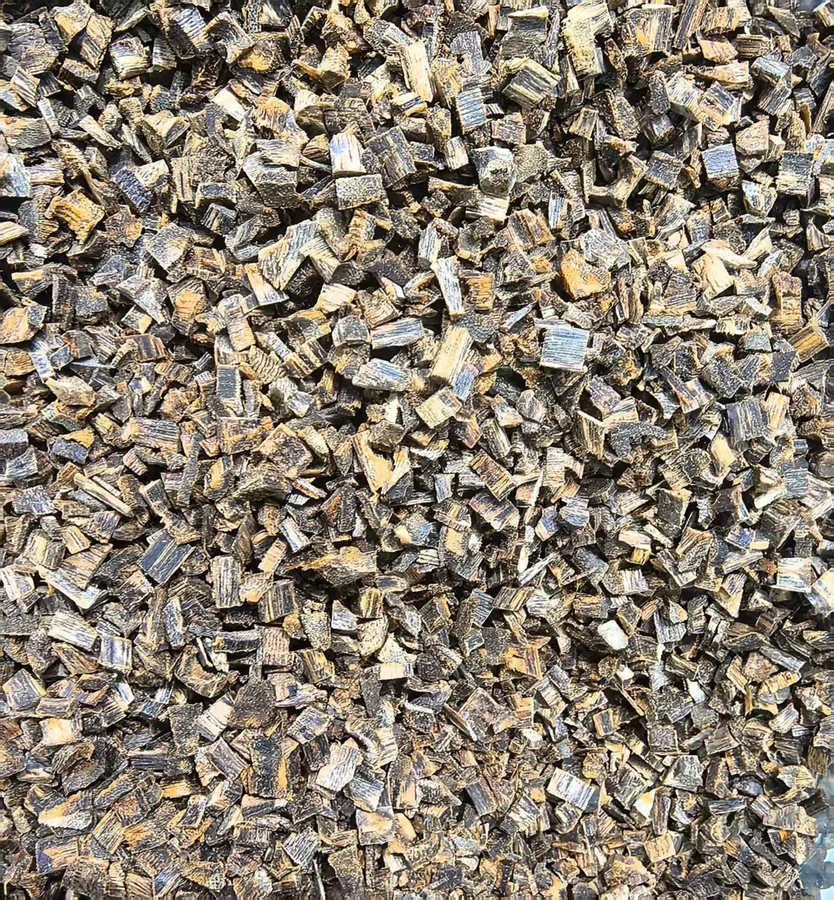
Choosing an agarwood shavings supplier is a document and sample exercise before it is a price negotiation. Any agarwood raw material supplier can send a photograph; fewer can answer a specification question in writing.
Legal identity and real supply capability
Match the company name on the quotation to the name on the bank account, the export documents and the permit holder. Trading companies are legitimate, but you should know which party actually controls the material and the processing, because that party determines consistency. Ask what volume the supplier can sustain across a year, not what it can ship once.
Does the quotation map to the form you asked for?
A credible quote restates your specification: form and production route, size or screen basis, fines and dust treatment, cleanliness, moisture basis, packing and net weight. If the reply is a price and a photograph, the specification has not been read. Ask for confirmation of the measurement method in writing, not a verbal assurance.
Sample-to-order consistency and claim terms
Ask directly what happens if the arriving lot does not match the approved sample: who inspects, within what period, using which method, and what remedy applies — replacement, credit, re-screening at whose cost, or rejection. A supplier who answers this calmly has usually handled it before. Inspection windows, sample retention and the definition of a defect belong in the purchase terms, not in a later argument. The site’s guide to agarwood chips for incense manufacturing shows how process requirements translate into acceptance criteria.
Species and trade compliance
Agarwood-producing taxa are treated as regulated material internationally. The CITES Secretariat’s working documents on agarwood-producing taxa record that Aquilaria and related genera are included in Appendix II, and FAO guidance on CITES and forest trade notes that trade in wild, captive-bred and artificially propagated specimens is permitted subject to permit requirements. In practice this means the exporter must hold the appropriate CITES documentation before shipment, and the importer must confirm what its own authorities require for the exact product and species. A plantation origin does not by itself settle the question, and a product name certainly does not. Confirm species, source and paperwork for your specific route with your customs adviser and the relevant authority before you commit.
MOQ, lead time and offers of custom screening
Custom screening is a real service only if the agarwood shavings supplier can state the equipment, the openings used, the resulting fines level and how it affects price and lead time. If those answers are vague, treat “we can screen to your requirement” as a sales phrase rather than a capability. Likewise, ask what the lead time consists of — material allocation, processing, documentation, freight — so you can see which part you are actually waiting for.
Agarwood Shavings Supplier Evaluation Checklist
Use this as a scoring sheet across two or three candidates for any agarwood shavings wholesale programme. A blank answer is a finding, not a neutral result.
| Area | What to verify | Evidence to keep |
|---|---|---|
| Sample | How the sample was drawn, which lot or run it represents, whether the bulk order comes from that same material, retained portion labelled and stored | Sample ID, date, photos with a scale, the supplier’s written statement of lot linkage |
| Specification | Form and production route stated, size or screen basis in millimetres, fines definition and limit, cleanliness criteria, moisture basis, method for each | Signed specification sheet or specification section of the quotation; your own repeat measurements |
| Batch | How lots are assembled, expected variation between runs, procedure when the upstream production changes, notice given to the buyer | Lot records, previous shipment data, written change-notification commitment |
| Packing | Net weight per unit, liner and moisture barrier, compression, odour isolation, labelling of lot and grade, pallet condition | Packing specification, photos of an actual shipping unit, arrival weights |
| Logistics | Incoterm, lead time by stage, documentation set, CITES and phytosanitary papers, routing and transhipment risk, insurance | Quotation terms, draft documents, freight quote, broker confirmation |
| After-sales | Inspection window, defect definitions, who pays for re-screening or return, replacement availability, response route and named contact | Written claim clause, remedy ladder, record of how a past dispute was handled |
Common buying mistakes with agarwood shavings
- Treating the form name as a grade. “Shavings” says nothing about species, resin, cleanliness or size, and no standard defines it.
- Buying from a photograph. A styled image cannot show fines share, dust, foreign matter or the difference between the top and bottom of a bag.
- Ignoring the sidestream question. If the material is a by-product, its geometry follows someone else’s production schedule.
- Comparing price per kilogram only. Without a usable-fraction measurement, the cheaper quotation can be the dearer material.
- Leaving inspection to the port. Define the inspection point, sample size and remedy before the container is loaded.
- Assuming paperwork. Species and permit requirements are product- and route-specific; confirm them rather than relying on a “plantation” claim.
What NanjaOud can and cannot confirm about this form today
Being precise here protects both sides of a purchase. Our public product range lists agarwood raw materials and chips, including irregular wood fragments and small and large chip formats, and incense-grade agarwood powder. We do not publish a separate product line labelled “shavings,” so we will not describe any current item as a shavings SKU before the cut and geometry have been confirmed against a buyer’s brief. If your requirement is a thin sliver material, the honest starting point is a conversation about which existing cut can be matched, supported by a physical sample.
What the published material information does show: the wood fragments are supplied as irregular pieces with natural grain and varying brown tones, suited to sorting, blending, further grinding and incense-related processing; the smaller chip format is presented as convenient for portioning, blending, repacking and further grinding. On the supply side, the company reports more than ten years of agarwood cultivation experience and a managed plantation base of more than 160 acres in Jiangmen, Guangdong, with in-house processing and no chemical resin-induction agents in its cultivation approach. Our quality and supply page states plainly that internal A, B and C labels are supplier references rather than a universal grading standard, and that the working framework does not imply a certified quality system or laboratory testing of every batch. Any purchase decision should rest on an approved sample and a written specification, not on a label.
Frequently asked questions
Is agarwood shavings the same product as agarwood chips?
No. Chips are distinct pieces cut to a usable size; shavings are thin slivers, often produced as a by-product of shaping or planing. They behave differently in storage, screening and processing, and they should be specified and sampled separately even when they come from the same wood.
Are shavings cheaper because they are a by-product?
Sometimes the quotation is lower, but the comparable figure is cost per usable kilogram. A high fines share, extra dust and lower bulk density can erase the apparent saving. Measure the usable fraction before deciding.
How do I state particle size for shavings?
State sliver thickness and length limits plus the screen openings used to measure fractions, in millimetres, along with the permitted share of material passing the lower opening. Screen numbers alone describe shavings poorly because a sliver can pass an opening while remaining long.
What sample should I request from a supplier?
Ask for a sample drawn from the lot being offered, with the drawing method and lot reference stated, and for confirmation that the bulk order will come from the same material. Retain a labelled portion of anything you approve and store it as the reference for arrival checks.
What moisture information should a quotation include?
The basis of the figure (as-received or oven-dry), the method used, and where in the chain it was measured. Consistency between the approved sample and the arriving lot matters more than a single impressive number.
How should foreign matter be handled in the contract?
Define what counts as foreign matter, the sample mass inspected, the method used, and the consequence — re-screening, credit, replacement or rejection. Undefined cleanliness terms are difficult to enforce after shipment.
Do I need CITES documents for agarwood shavings?
Agarwood-producing taxa are subject to international trade regulation, and the applicable permits depend on species, source, product and route. Confirm the requirement for your exact shipment with the exporting supplier, your customs broker and your national authority before ordering; do not rely on the form name or a plantation claim.
What is a realistic MOQ for a first wholesale order?
There is no universal figure; it depends on the supplier’s lot assembly and your trial needs. Ask what quantity allows a representative sample and a genuine processing trial, and treat any MOQ that prevents you from testing the material properly as a reason to look at a smaller trial first.
Conclusion
Agarwood shavings are bought successfully when the buyer defines the form, measures the fractions that affect yield, samples the offered lot rather than a photograph, and agrees in writing what happens when material does not match. A reliable agarwood shavings supplier will welcome that structure, because it turns a conversation about adjectives into a comparison of numbers that both sides can check.
Start from your end use: how the material will be fed, blended, burned or milled, and what your process cannot tolerate. Then send NanjaOud the target material form, your sample requirement, the specification items you need confirmed, your expected purchase quantity and your destination market through the contact page. Our team can tell you which current cut and sample options can be matched to that brief, and which points still need to be verified before a quotation means anything.


