
Introduction
Oud chips moisture content decides how much dry, resin-bearing wood you actually own for every kilogram you pay for, and it is the variable most often missing from a wholesale specification. Two lots can carry the same price per kilogram and still differ by seven or eight percent in the dry wood delivered. This guide shows how moisture is defined and measured on resinous agarwood, how to write a moisture clause into a purchase order, and how to keep water weight from turning into mould, short weight or an unwinnable claim.
What oud chips moisture content measures — and the two bases that cause disputes
Moisture content (MC) is the mass of water held in the wood, expressed as a percentage of mass. The trouble is that two conventions are in everyday use, and they do not produce the same number:
- Wet basis (as-received): water divided by total mass, including the water. This is the normal convention in wood trade and on most invoices.
- Dry basis: water divided by the oven-dry mass of the wood alone. Numbers on this basis are always higher.
A lot at 18% wet basis is roughly 22% on a dry basis. That single difference explains a large share of moisture arguments in this trade: seller and buyer can both be honest, quote "the moisture", and still be comparing two different measurements. So the first question on any quotation is not "what is the moisture" but "on which basis, measured how, on which sample".
There is a second, quieter assumption to check: is the invoiced weight the as-received weight, or is it adjusted to an agreed moisture? Most oud chips are sold on as-received weight, which means the buyer pays the material price for water.
Why water weight is a pricing problem, not a technicality
Steam-distilled oud oil yields, incense blending ratios and powder milling all consume dry wood, not water. When a price is quoted per kilogram as received, every point of moisture is paid for at the price of resinous agarwood. The table below holds the invoice price constant at 100 per kilogram purely to make the arithmetic visible; the figures are illustrative and are not market prices.
| Moisture (wet basis) | Dry wood in 1,000 kg as received | Water paid for | Effective cost per kg of dry wood at an invoice price of 100/kg |
|---|---|---|---|
| 10% | 900 kg | 100 kg | 111 |
| 14% | 860 kg | 140 kg | 116 |
| 18% | 820 kg | 180 kg | 122 |
| 22% | 780 kg | 220 kg | 128 |
At the same quoted price, the 22% lot costs about 15% more per kilogram of actual wood than the 10% lot. That is usually larger than the discount a buyer negotiates by comparing three suppliers on headline price. It also explains why a supplier who is vague about moisture can appear cheaper without being cheaper.
Freight compounds the effect. Chips are bulky and light relative to their value per cubic metre, so chargeable weight and container utilisation matter, but water is the one input that adds weight without adding product.
What moisture band should you specify?
Wood is hygroscopic: it exchanges water with the air around it until it reaches an equilibrium moisture content (EMC) determined by temperature and relative humidity. The USDA Forest Products Laboratory treats this relationship as the basis for drying, storage and dimensional control of wood, and notes that moisture in wood tends toward equilibrium with the surrounding air (USDA Forest Service, Forest Products Laboratory, Drying and control of moisture content and dimensional changes). Practical consequence: a lot dried to a low figure in a dry inland factory will drift upward in a humid port, a non-climate-controlled warehouse or a sea container, and a lot shipped wet will not dry in transit.
Because of that, "the lower the better" is not a useful instruction either. Very dry chips are more brittle, generate more fines during handling, and may crack; very wet chips risk mould, musty odour and short weight on arrival. The right band follows the process:
- Grinding or powder milling: too much moisture causes smearing and screen blocking; too little generates dust and heat.
- Incense blending and stick production: moisture affects how the material mixes, extrudes and burns, so the band should be set with the finished-product trial, not copied from a competitor's page.
- Long storage or re-export: the band must survive the destination climate, not just the factory gate.
- Oil extraction: moisture affects preparation and the water content of the charge, even where the extraction route is solvent-based.
A workable approach is to measure the material you already run successfully, then write that measured band into the RFQ with a tolerance (for example plus or minus two percentage points) and a stated remedy for material outside it. A tolerance without a remedy is only a comment.
How to measure moisture in resin-rich oud chips without creating an argument
The reference method in wood is oven drying: a specimen is weighed, dried until constant mass, and reweighed, and the mass loss is treated as water. ASTM D4442 sets out the direct measurement methods for wood and wood-based materials (ASTM D4442-20), and the comparable solid-biofuel reference method, ISO 18134-1, dries at 105 ± 2 °C to constant mass (ISO 18134-1:2015).
Agarwood adds a complication that generic timber testing does not: it is resin-rich, and oven drying can drive off volatile compounds as well as water. This is a recognised limitation of the method, and it means a resinous chip can lose more mass than the water it actually contained. The result is best treated as a comparative index between the same method, temperature and time — not as an absolute statement about water. Agree the temperature, the hold time and the laboratory in advance, and describe the result as "moisture by the agreed method" rather than "water content".
| Method | What it gives you | Best used for | Limitation |
|---|---|---|---|
| Oven-dry (ASTM D4442 / ISO 18134-1 principle) | Mass loss at a stated temperature to constant mass | Contractual reference, arbitration, retained sample records | Also drives off volatile resin compounds; needs agreed temperature and time |
| Pin or pinless moisture meter | Instant electrical reading | Rapid screening of many cartons, ranking within one lot | Calibration is species- and density-dependent; resin, mineral content and temperature distort readings |
| Weight loss in transit | Difference between dispatch and arrival weight | Detecting short weight and condensation damage | Confounded by packaging, spillage and humidity gain or loss; not a moisture measurement |
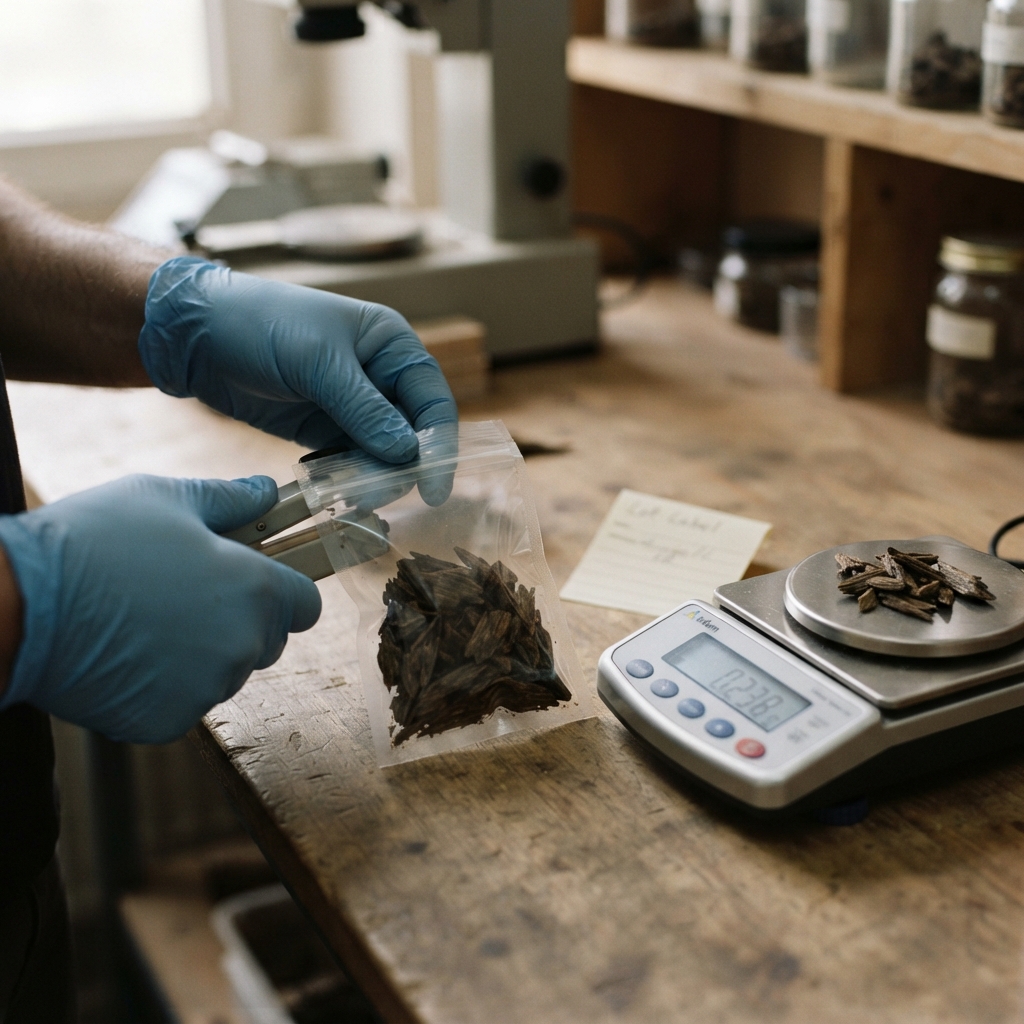
Sampling discipline matters as much as the instrument. Take at least three increments per lot from different cartons or positions, seal them in moisture-barrier bags immediately, label them with lot, date and time, and weigh them promptly. Record the ambient temperature and humidity at sampling, because both move the reading. If buyer and seller test the same lot from different positions and different days, a two-point gap proves nothing except that sampling was not controlled.
The moisture clause: what to put in the purchase order
Most moisture disputes are lost before shipment, in a purchase order that named a number but not a method. The clause below is a structure to adapt with your own advisers, not legal advice.
| Clause element | What it should settle |
|---|---|
| Basis and band | Wet or dry basis, target band, and tolerance in percentage points |
| Method and temperature | Oven-dry reference, stated temperature and hold time, or the named meter model and calibration method |
| Sampling plan | Number of increments, cartons sampled, sealing and labelling, who witnesses |
| Weight basis for invoicing | As-received weight, or weight adjusted to the agreed moisture, with the adjustment formula written out |
| Arrival re-check | Days after arrival in which a re-test may be requested, and who may attend |
| Retest and cost | Named laboratory or agreed method, who pays, and how a disputed result is broken |
| Remedy | Price adjustment, re-drying at whose cost, replacement or rejection, in a stated order |
If the invoice is to be adjusted rather than accepted as received, the usual arithmetic is adjusted weight = invoiced weight × (100 − measured moisture) ÷ (100 − agreed moisture), using the same basis throughout. Write the formula into the order so neither side has to interpret it at the moment of a dispute.
Mould, condensation and scent loss between factory and warehouse
Moisture damage on oud chips usually happens after the factory gate, and it is rarely caused by rain. Warm, humid air loaded into a container cools at night or at sea, condenses on the roof and drips onto cartons — the phenomenon commonly called container rain. Chips packed at high moisture, or packed warm in humid weather, are the ones that arrive with musty odour, discoloured patches or softened cartons.
- Pack at a measured moisture, not at "dry enough". The measurement should be taken close to packing, not weeks earlier on a different sub-lot.
- Use liners and desiccant deliberately. A sealed plastic liner can trap moisture as effectively as it excludes it; the combination of barrier, desiccant quantity and carton ventilation should be agreed for the transit duration and destination climate.
- Load dry. Avoid loading during rain or in the most humid part of the day, and keep cartons off damp floors and away from container walls.
- Plan for the destination, not the departure. Gulf and South Asian summers, and monsoon-season arrivals, are the harshest tests; air freight shortens exposure but does not eliminate the humidity swing.
- Store away from odours. Agarwood adsorbs surrounding smells. Diesel, paint, perfume and cleaning agents in the same warehouse can be detected in the wood later, and no moisture clause will cover it.
Turning moisture data into a claim that holds
A moisture claim succeeds on evidence collected before the argument starts. Keep five things for every lot:
- A retained sealed sample from the approved lot, held by both parties and referenced in the purchase order.
- The dispatch measurement, with method, temperature, sampling positions and the name of the person who took it.
- Arrival weights per carton, not only the total, taken before cartons are opened and re-packed.
- Photographs of labels, seals, carton condition and any mould or condensation, taken in sequence.
- The agreed limit and remedy, quoted from the order rather than reconstructed from emails.
Then apply the remedy ladder in the agreed order: price adjustment for a small overage, re-drying or re-screening where the material is recoverable, replacement for a failed lot, and rejection only where the material is unusable. A claim that asks for a refund before anyone has measured anything is easy to refuse. A claim that quotes the clause, the method and the arrival weight is hard to refuse.
If you are setting up this evidence trail for the first time, the companion guide on comparing oud chips manufacturers sets out the full due-diligence sequence, including sample-to-lot linkage and inspection standards, so the moisture clause sits inside a wider commercial framework rather than standing alone.
Ten questions to ask an oud chips manufacturer about moisture
- What moisture do you state for the lot you are offering, on a wet or dry basis, and how was it measured?
- Which laboratory or instrument, at what temperature and hold time, and can I see the record?
- Is the invoiced weight as received, or adjusted to an agreed moisture? If adjusted, what is the formula?
- How many increments do you draw per lot, and from which positions?
- Do you dry the material, or is the figure simply what the ambient conditions give?
- How do you pack for a humid destination, and what desiccant or liner do you use?
- What moisture-related complaints have you had in the last two years, and what changed afterwards?
- Will you accept my retained sample and my re-test window in the purchase order?
- If arrival moisture exceeds the agreed band, what remedy do you offer first?
- Can you quote on a dry-weight basis as well as an as-received basis, so I can compare both?
A supplier who answers these in writing is describing a process. A supplier who answers only the first one is describing a hope.
Common mistakes buyers make with oud chips moisture content
- Comparing moisture numbers without asking for the basis. Wet and dry basis figures differ by several points on the same lot.
- Accepting a single meter reading as the contract value. Meters are screening tools with species and resin sensitivity.
- Sampling from the top carton only. Moisture stratifies in a stack; the top layer is usually the driest.
- Ignoring the destination climate. A band that works in a temperate warehouse may fail in a Gulf summer.
- Buying on as-received weight with no adjustment mechanism. This quietly transfers the water cost to the buyer on every order.
- Treating oven-dry results on resin-rich wood as pure water. Volatile resin compounds are lost too, which is why the method must be agreed and applied consistently.
- Leaving the remedy out of the order. A limit with no consequence is a suggestion.
How our oud chips are supplied
We are Jiangmen Nangjiaxiang Agarwood Development Co., Ltd., based in Jiangmen, Guangdong. Our product pages describe a managed plantation base of more than 1,000 mu of standardized agarwood resources and our own processing factory, with integrated supply from cultivation through processing. Our stated cultivation practice is natural, without chemical agents used to artificially accelerate resin formation, and we supply overseas B2B buyers in the Middle East, Southeast Asia, Europe and the Americas, with ODM cooperation available for specifications, packaging and custom processing.
For chip buyers the current range includes natural large agarwood chips with relatively intact pieces, visible grain and resinous streaks, suited to incense use, further cutting, grinding and distribution; natural small agarwood chips for portioning, blending, repacking and further grinding; and agarwood wood fragments in an irregular format for sorting, blending and incense processing. If you are still choosing between formats, the guide to chips, granules and powder compares how each behaves in production, and the incense manufacturing specification guide covers the process side in more depth.
Our product pages do not publish a single moisture figure, because the workable band depends on your process, your packaging and your destination. If you tell us the intended use and the arrival climate, we will confirm what applies to your order and quote on the weight basis you specify. Our quality and supply framework describes the selection, format, weight and packaging checks we apply; it does not claim a certified quality system or laboratory testing of every batch, and we would rather say that plainly than imply a number we cannot support.
FAQ
What is a normal moisture content for oud chips?
There is no single industry figure. The workable band depends on whether the chips will be ground, blended, burned or stored, and on the humidity of the destination. Set the band from your own successful process, then write it into the order with a tolerance, a method and a remedy.
Is moisture content measured on a wet or dry basis?
Both are used, and they give different numbers for the same wood. Wet basis divides water by total mass; dry basis divides water by oven-dry wood mass. Always state the basis, because an 18% wet-basis lot is roughly 22% on a dry basis.
Why does oven-dry testing overstate moisture in agarwood?
Oven drying drives off volatile compounds as well as water, and resin-rich agarwood contains aromatic volatiles. The result is still useful for comparison, provided both parties use the same temperature, hold time and laboratory, and treat it as an index rather than an absolute water figure.
Can I use a pin moisture meter for incoming inspection?
Yes, for screening and for ranking cartons within a lot. It is a poor basis for a contractual claim, because readings shift with species, density, resin content and temperature, and calibration differs between instruments.
How do I stop oud chips from moulding in a sea container?
Pack at a measured moisture close to loading, avoid loading warm humid air, use an agreed combination of liner and desiccant sized to the transit and destination, and keep cartons off the container floor and away from the walls. Condensation on the container roof, not rain, is the usual cause.
Should the invoice be adjusted for moisture?
If you buy on as-received weight, you pay the material price for water. Many buyers either negotiate a dry-weight adjustment formula or set a band with a price adjustment for material outside it. Either approach works if it is written into the order before shipment.
What is an acceptable moisture tolerance?
It depends on your process and the measurement method's repeatability. The point is not the exact number but that tolerance, sampling plan and remedy are agreed together; a tolerance without a remedy will not resolve a dispute.
Does moisture affect the scent of oud chips?
Moisture itself is not the scent, but wet material can develop musty or sour notes, and storage near strong odours is readily absorbed by the wood. Controlling moisture and storage conditions protects the aromatic profile you paid for.
Conclusion
Oud chips moisture content is a commercial variable before it is a technical one. Ask for the basis, the method and the sampling plan; convert quotations to the same weight basis; write a band, a tolerance and a remedy into the purchase order; and keep a retained sample with a dispatch measurement. Those four habits remove most of the quiet loss in this category, and they make every supplier quotation genuinely comparable.
If you are specifying oud chips for incense, grinding, distribution or private label, send your intended use, target moisture band, quantity and destination through our contact page, and we will confirm what applies to your order.


