
Comparing oud chips manufacturers is a specification and evidence exercise, not a price exercise. The suppliers that look cheapest in a one-line quotation are often the ones that leave grading, moisture, screening loss and documentation to the buyer's risk. This guide gives B2B buyers a repeatable way to compare oud chips manufacturers on material definition, source control, sampling, quotation structure, inspection, CITES paperwork, lead time and after-sales terms.
What "oud chips manufacturer" actually means in the trade
The phrase covers at least four different business models, and they carry different risks:
- Plantation operator with in-house processing. Controls raw material access and the cutting, drying and screening steps. Easier to trace a lot back to a source, harder to switch grades quickly.
- Processor only. Buys raw wood from farmers or collectors, then cuts, sorts and packs. Capability depends entirely on its inbound material discipline.
- Trader or exporter. Aggregates from several factories. Useful for wide assortments and small mixed orders, but lot-to-lot consistency depends on how well it documents its own suppliers.
- Finished-goods manufacturer. Converts chips into incense, beads, oil or blends. Relevant if you are buying oud chips as an input to a downstream product and want one partner for both.
None of these is automatically better. The mistake is comparing a trader's price against a plantation's price without comparing what each one is responsible for. Ask every candidate to describe, in one paragraph, where the wood is grown, who cuts it, who sorts it, and who prepares the export documents. Vague answers at this stage usually predict vague answers later.
The eight-criteria comparison framework
Use the same eight questions with every supplier so the answers can be placed side by side. If a search for an oud chips manufacturer China listing returns forty near-identical pages, these are the eight answers that separate them. The table below shows what a weak answer and a workable answer look like.
| Criterion | Question to ask | Weak answer | Workable answer |
|---|---|---|---|
| Material definition | How do you describe the piece size, shape and resin appearance in writing? | "Premium grade, dark resin" | Written size band, screening method, allowance for fines, reference photo of the approved lot |
| Source control | Who grows or collects the wood, and where? | "Sourced from many origins" | Named region, named plantation or supplier group, stated cultivation practice |
| Processing | Which steps happen in your own facility? | "We have a factory" | Specific steps: cutting, drying, screening, sorting, packing, with equipment named |
| Grading | Is your A/B/C scale a published standard or your own? | "Grade A is our best" | Explicit statement that grades are internal, plus the physical criteria behind them |
| Sampling | Does the sample come from the offered lot? | "Sample is representative" | Sample drawn from a named lot, with cost, shipping and approval validity stated |
| Quotation | Which cost lines are included and which are not? | One price per kilogram | Itemised material, processing, packing, documentation, freight basis and Incoterm |
| Inspection | What is checked before shipment, by whom, against what record? | "We check quality" | Named checks, sampling basis, photo or video record, retained sample |
| Compliance | Which permits and certificates apply to my destination? | "All certificates available" | Document list per destination, stated before the order, not after |
Score each supplier 1 to 5 on every row. A supplier that scores well on price but cannot answer rows one, four and seven is not a cheaper supplier; it is an unpriced risk.
Step 1: Define the material before you compare the supplier
Most failed oud chip comparisons start with the buyer's own RFQ. "500 kg of good quality agarwood chips" cannot be quoted consistently, because every agarwood chips supplier will interpret "good" differently and one will quote a smaller, lighter, more screened product than another.
Write a specification, not an adjective
At minimum, your RFQ should state:
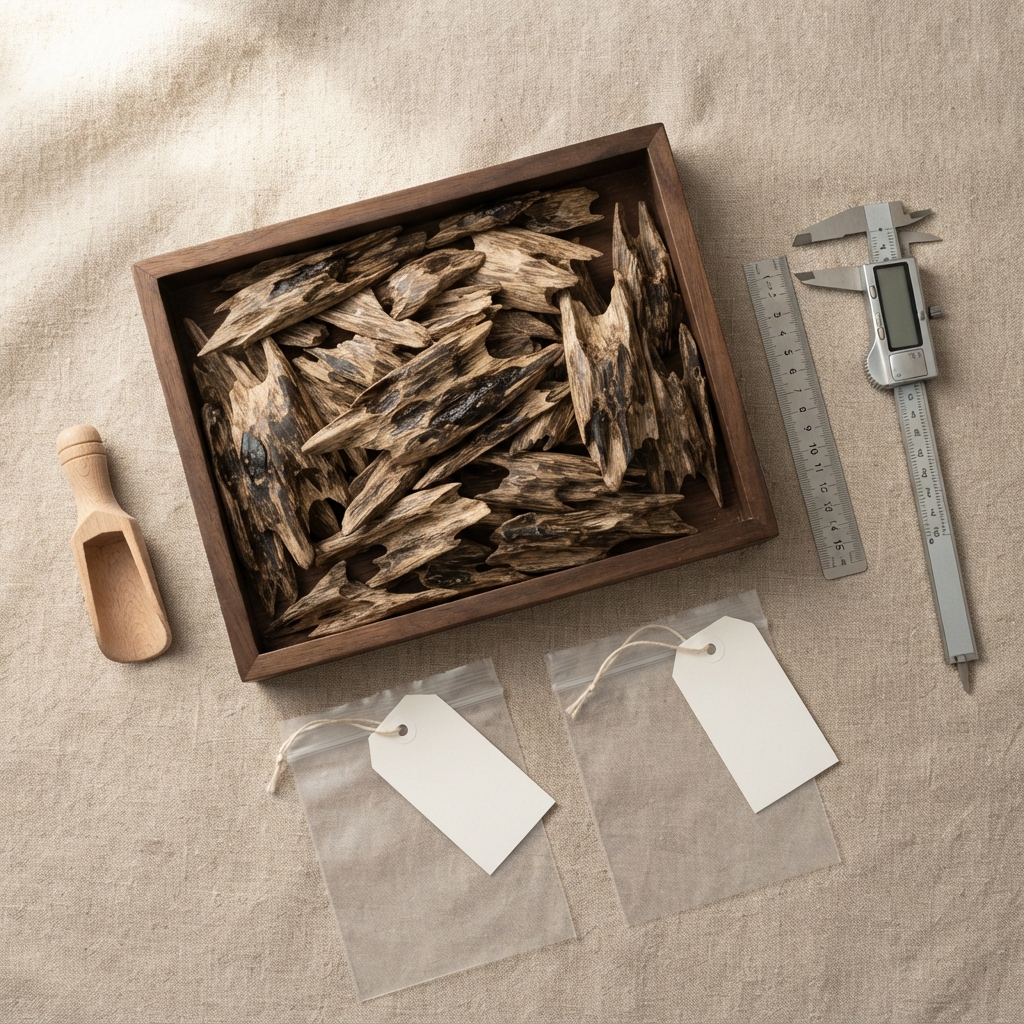
- Format: whole chips, broken chips, fragments, granules or powder.
- Size band: a lower and upper limit, plus how material outside the band is treated.
- Screening: the mesh or opening used, and the acceptable share of fines.
- Moisture basis: whether the quoted weight is as-received or on a stated dry basis.
- Appearance: resin coloration, grain visibility, and whether pale or hollow pieces are acceptable.
- Intended use: direct burning, incense blending, grinding, extraction or repacking.
- Packaging: inner bag, outer carton or sack, net weight per unit, labelling.
If you already know the size band you need, the companion guide on specifying agarwood chip and granule particle size walks through how to write screen openings, oversize and fines into a wholesale RFQ. Getting this right is the single highest-leverage step in the whole comparison, because it makes every subsequent quotation comparable.
Treat grade letters as internal labels
There is no internationally administered A/B/C grading system for oud chips. Factories use these letters as internal commercial shorthand, and one factory's "A" is routinely another factory's "B". A supplier that is candid about this is easier to work with than one that implies a universal standard exists.
For example, our own quality and supply framework states that A, B and C labels are internal supplier references where listed and are not presented as a universal or international grading standard. That is the right posture for a buyer to demand from every candidate: the letter is a shortcut, the physical criteria are the contract.
Step 2: Verify the source and the resin claim
Agarwood forms when Aquilaria trees produce resin in response to injury or infection. Because resin content drives both scent and price, the way a supplier obtains resin-rich wood is a core commercial question, not a botanical curiosity. Any wholesale oud chips supplier that cannot answer the first three questions below is unlikely to answer the rest consistently.
Questions that produce verifiable answers
- Do you own or manage plantations, or buy from named farmer groups? How many acres or hectares, and in which province or region?
- How long have you been cultivating, and what is your typical tree age at harvest?
- Do you use any chemical agent to induce resin formation? If not, how do you describe your cultivation practice in writing?
- Can you separate lots by origin, or is material blended across regions?
- What proportion of your annual volume is your own material versus purchased material?
"No chemical induction" is a claim worth having in writing, but treat it as a claim until you can connect it to a lot. Ask whether the statement applies to the specific material offered or to the company's general practice. For reference, our company profile states that our cultivation approach does not use chemical resin-induction agents, alongside 10+ years of cultivation experience and a managed plantation base of more than 160 acres in Jiangmen, Guangdong. A competing supplier should be able to give you an equivalent, equally specific statement.
Step 3: Audit the factory, remotely or in person
Oud chip processing is not complicated equipment, which is exactly why it is easy to overstate. A short video call is often more informative than a certificate.
What to look at on a factory walkthrough
- Inbound material: how raw wood is stored, labelled and separated by lot. Mixed piles with no tags mean mixed lots in your carton.
- Cutting and screening: whether size control is done by a screen or by eye, and whether fines are collected and re-sold.
- Drying: whether there is any controlled drying step, since moisture drives weight loss and mould risk in transit.
- Sorting area: lighting and benches, because hand sorting is where the grade is actually made.
- Records: a sample of batch or order records. If none can be shown, the inspection step later will be improvised.
Ask for the walkthrough to include the area where your order would be processed, not only the showroom. If a supplier declines a live video walkthrough entirely, mark it down and ask again later in the process.
Step 4: Manage MOQ and sampling deliberately
Oud chips MOQ and sample policy are where small buyers and large buyers get very different treatment, and where hidden cost first appears. When you brief an oud chips supplier for incense production, the MOQ conversation should also cover the size band, because a fine-screened chip and a large intact piece are different production runs.
Sample questions to settle in writing
- Is the sample drawn from the actual lot offered, or from a generic reference stock?
- What quantity is supplied, and is it free, charged, or charged and then credited against the first order?
- Who pays courier and any import charges on the sample?
- How long is the sample price valid?
- If the bulk lot differs from the sample, what is the remedy?
A sample that cannot be tied to a lot is a scent impression, not a specification approval. Photograph the sample on a plain background with a scale reference, record its weight, and keep a sealed retained portion. Our own contact and FAQ states that sample availability, cost and shipping are confirmed according to the product, requested format and destination — which is normal practice, but it means you should get those three variables in writing before you plan a production trial around a sample.
If your order is below a factory's stated MOQ, ask what the two realistic options are: pay a small-order surcharge, or buy from stock of an existing production run. Avoid the third option, which is a supplier quietly substituting a different lot to fill a small order.
Step 5: Read the quotation as a cost structure, not a number
Two quotations at the same price per kilogram can differ by 15 to 30 percent in landed cost once moisture, screening loss, packing and documentation are accounted for. Compare line by line.
| Cost line | What to confirm | Why it matters |
|---|---|---|
| Material price | Currency, weight basis, price validity period | A price without a validity window cannot be budgeted |
| Grade and size basis | Which specification the price refers to | Prevents a quote being "adjusted" after the sample is approved |
| Processing | Cutting, screening, sorting, drying included or extra | Custom size bands are usually a separate operation |
| Packing | Inner and outer packaging, labelling, palletisation | Retail-ready packing is a different cost from bulk sacks |
| Documentation | CITES permits, certificates of origin, phytosanitary certificates | Frequently excluded and then invoiced at shipment |
| Inland and port charges | Ex-works, FOB or CIF basis, named port | Incoterm changes who pays and who carries risk |
| Freight and insurance | Mode, transit time, volumetric weight | Chips are bulky; chargeable weight often exceeds actual weight |
| Payment terms | Deposit percentage, balance trigger, currency | Deposit size is a real cost of capital, especially on repeat orders |
Ask each supplier to state, explicitly, what is not included. That single question surfaces more hidden cost than any negotiation tactic.
Step 6: Agree the inspection standard before production
"We have strict QC" is not an inspection standard. A usable standard names the check, the sampling basis, the acceptance limit and the record.
A practical pre-shipment check for oud chips
- Identity and lot: carton labels match the approved lot reference.
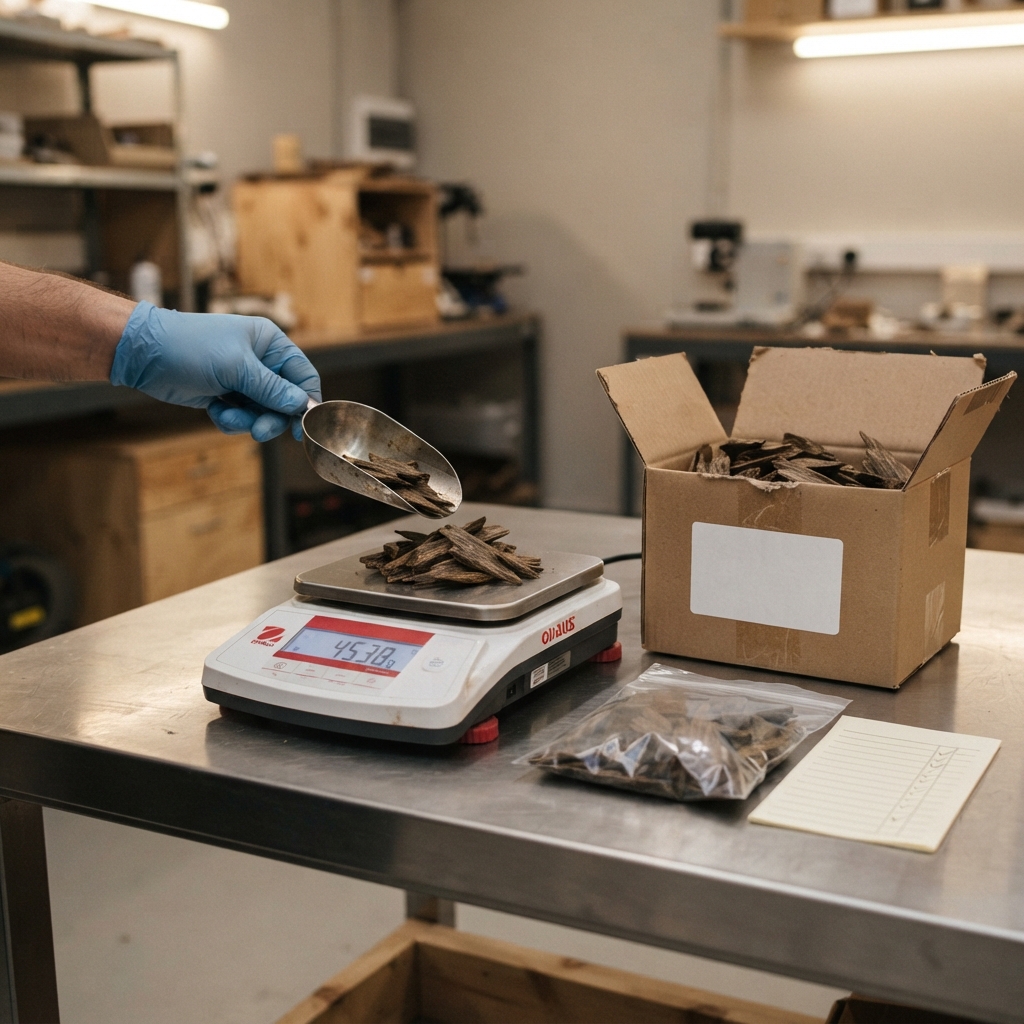
- Net weight: weighed per unit, with packaging tare deducted.
- Size distribution: a scoop sample screened against the agreed band; record oversize and fines percentages.
- Moisture: measured by the method agreed in the specification, on a stated number of units.
- Appearance: comparison against the retained approved sample under consistent lighting.
- Foreign matter: visual check for stone, soil, bark excess and non-agarwood material.
- Packaging integrity: seal, inner liner, carton strength, labelling accuracy.
Decide in advance what happens at each outcome. If fines exceed the agreed limit, is the remedy a price adjustment, a re-screen, or rejection? Put the answer in the purchase order, not in a later email thread.
Third-party inspection is worth considering for a first order above a certain value. Instruct the inspector with your own checklist rather than a generic report, and require photographs of the sealed cartons and their labels.
Step 7: Get compliance and documentation right before you book freight
Agarwood is a regulated trade material, and this is the step where inexperienced buyers lose the most time.
All agarwood-producing species in the genera Aquilaria and Gyrinops are listed in CITES Appendix II. Aquilaria malaccensis was listed in 1995, and the remaining agarwood-producing species were added at the thirteenth Conference of the Parties, according to a TRAFFIC-authored review published by the FAO (FAO, "CITES, trade and sustainable forest management"). In practice this means CITES agarwood export documentation must be issued by the exporting country's management authority, and your destination may require an import permit before the shipment leaves.
Document checklist to confirm per shipment
- CITES export permit, and import permit where your country requires one.
- Certificate of origin.
- Phytosanitary certificate, where required by the destination.
- Commercial invoice, packing list and bill of lading or airway bill consistent with the permit descriptions.
- Any destination-specific declaration for processed wood products.
Two practical warnings. First, the species and product description on the permit must match the invoice; a mismatch is a customs problem, not a paperwork detail. Second, permit lead time is usually longer than production lead time, so confirm who applies and when. If a supplier says documentation is "no problem" without naming the permits for your country, ask for the specific list in writing.
Step 8: Compare lead time, logistics and Incoterms on the same basis
Lead time answers are only comparable if they start from the same event. Ask each supplier to break the timeline into stages:
- Sample dispatch and approval.
- Production slot after deposit and specification sign-off.
- Processing and packing.
- Permit issuance.
- Inland transit to port and vessel or flight departure.
- Ocean or air transit to your port.
Then ask which stage they are quoting. A "25-day lead time" that excludes permit issuance and transit is not the same promise as a 25-day door-to-door estimate. Our published position is that lead time is confirmed after the sample, specification, packaging direction and order quantity have been reviewed and approved, and that MOQ, freight, ports and Incoterms are confirmed in the quotation rather than fixed on a web page — a structure that makes the quote, not the website, the reference document.
For chips, also confirm whether the price is based on actual or volumetric weight, and whether the supplier packs to minimise dead space. Loose-filled sacks and tightly compressed cartons can carry materially different freight cost for the same tonnage.
Step 9: Scope OEM and private-label work precisely
If you intend to sell private label oud chips under your own brand, separate three different requests that are often bundled into one word:
- Custom processing: a size band, screening, sorting or blend made to your specification.
- Private label: your brand on the existing product format and packaging.
- ODM: product development where the supplier proposes format, presentation or blend.
For each, confirm who owns the artwork, who approves the dieline, what the minimum run is per SKU, whether plates or tooling are charged, and what happens to unused packaging if you reorder. Our OEM and private-label page describes discussion of product formats, bottles, labels, boxes, gift presentation and shipping packaging against project needs — a scope statement rather than a price list, which is the correct level of detail before a specification exists.
Step 10: Define after-sales and claims before the first shipment
Claims on agricultural material are almost always argued on two points: what was the agreed standard, and when was the defect discoverable. Ask every oud chips manufacturer on your shortlist the same five questions and compare the answers in writing.
- Retained samples: one sealed set held by each party, referenced in the purchase order.
- Inspection window: a stated number of days after arrival to raise a quantity or quality claim.
- Claim evidence: photographs, weighing records, and a third-party report if disputed.
- Remedy ladder: replacement, credit note, price adjustment, or return, in that order of preference.
- Repeat-order basis: whether the next order is produced to the same lot reference or to a fresh lot, and how any change is disclosed.
A supplier that resists a retained-sample clause is telling you something useful. On natural material, some variation between lots is unavoidable; undisclosed variation is not.
Common mistakes when comparing oud chips manufacturers
These errors show up in almost every shortlist of oud chips manufacturer candidates, and most are avoidable at the RFQ stage.
- Comparing price per kilogram across different size bands. Smaller, more screened material is cheaper to produce and behaves differently in use.
- Approving a sample without recording it. A memory of a smell is not an inspection reference.
- Assuming grade letters travel. They do not; get the physical criteria.
- Ignoring moisture. Buying water weight is the most common quiet loss in this category.
- Leaving documentation to the supplier's discretion. Confirm the permit list for your own country.
- Accepting a verbal lead time. Get the stage breakdown and the event it starts from.
- Testing one lot and ordering three. Ask how repeat lots are matched to the approved reference.
- Choosing the lowest quote without a claims clause. The cheapest quote with no remedy is the most expensive outcome.
A weighted supplier scorecard you can copy
Weight the criteria to your own risk profile. A first-time importer should weight documentation and inspection heavily; a repeat buyer with an established inspection routine can weight price and lead time higher. Use one scorecard per oud chips manufacturer, and score only after the specification is fixed, otherwise the comparison drifts.
| Criterion | Suggested weight | Score (1-5) | Weighted score |
|---|---|---|---|
| Specification clarity | 15% | ||
| Source traceability | 15% | ||
| Processing capability | 10% | ||
| Sample-to-lot linkage | 10% | ||
| Quotation transparency | 10% | ||
| Inspection and records | 15% | ||
| Compliance and documentation | 15% | ||
| Lead time and logistics | 5% | ||
| After-sales and claims terms | 5% |
Multiply score by weight and total. Anything below 3.5 on compliance should be treated as a disqualification regardless of total, because a documentation failure stops the shipment entirely.
How NanjaOud fits this checklist
We publish this framework because it is the one we prefer to be measured against. On the criteria above, the facts we can state are specific:
- Source: more than ten years of agarwood cultivation experience and a managed plantation base of more than 160 acres in Jiangmen, Guangdong, with a stated practice of no chemical resin-induction agents.
- Processing: in-house processing equipment, including stainless steel tanks and production line equipment, supporting wood, powder, oil, incense and related formats.
- Grading: A, B and C labels are internal references, not a universal standard; final requirements are confirmed through specification, visual review, quotation and approved sample.
- Inspection: material selection, visual and format checks, weight and packaging confirmation, batch and order records where applicable, and pre-shipment confirmation. Our framework states plainly that it does not imply a certified quality system or laboratory testing of every batch.
- Commercial terms: MOQ, lead time, freight, ports, Incoterms and stock quantities are confirmed in the quotation.
For chip buyers specifically, our current range includes natural large agarwood chips with intact pieces and visible grain, suited to incense use, further cutting, grinding and distribution; natural small agarwood chips for portioning, blending, repacking and further grinding; and agarwood wood fragments in an irregular format for sorting, blending and incense processing. If you are still deciding between block, chip and fragment formats, the guide to agarwood wood blocks for B2B buyers covers the RFQ side in more depth.
We do not claim certificates or laboratory testing that our published documentation does not show. If your program requires a specific certificate, permit list or test report, state it in the inquiry and we will confirm what applies to your order rather than assume it.
FAQ
How do I compare oud chips manufacturers fairly?
Send the same written specification to every candidate, ask for the same eight answers, and compare quotations line by line on the same Incoterm. Fair comparison is a process design problem, not a negotiation skill.
Is there an official A, B, C grade for agarwood chips?
No internationally administered grading scale exists for oud chips. Grade letters are internal commercial labels, so the physical criteria — size band, screening, resin appearance, moisture — must be written into the specification.
What MOQ should I expect from an oud chips manufacturer?
MOQ depends on whether the supplier is filling from existing production stock or scheduling a new run, and on whether custom size bands or packaging are involved. Ask for the MOQ per specification and per SKU, and confirm whether a small-order surcharge is available.
Should the sample be free?
Either model is normal. What matters is whether the sample comes from the offered lot, who pays courier and import charges, whether any sample charge is credited against the first order, and how long the sample price is valid.
Do oud chips need CITES documents?
All agarwood-producing species in Aquilaria and Gyrinops are listed in CITES Appendix II, so export requires CITES documentation from the exporting country, and your destination may require an import permit. Confirm the exact permit list for your country before booking freight.
How do I check for hidden costs in a quotation?
Ask what is excluded. Documentation, custom screening, retail packaging, inland haulage and volumetric freight are the usual omissions. Convert every quote to a landed cost on the same Incoterm before comparing.
How is quality normally inspected before shipment?
A workable inspection confirms lot identity, net weight, size distribution, moisture, appearance against a retained sample, foreign matter and packaging integrity. The sampling basis and acceptance limits should be agreed before production starts.
Can I get private-label or ODM oud chips?
Yes, but scope it precisely: custom processing, private label on an existing format, and full ODM development have different minimums, artwork ownership and tooling implications. Confirm each separately.
How should repeat orders be handled?
Reference the approved lot and retained sample in the purchase order, ask how the new lot is matched to that reference, and require disclosure of any material change before shipment.
Conclusion
Comparing oud chips manufacturers comes down to four documents: a written specification, a lot-linked sample record, an itemised quotation and an inspection standard with a remedy clause. Suppliers that can produce all four are comparable; suppliers that cannot are being compared on price alone, which is the least reliable variable in this trade. Start with the specification, score every candidate on the same eight criteria, and treat documentation as a pass-or-fail gate rather than a detail.
If you are sourcing oud chips for incense, fragrance processing, distribution or private label, send your specification, estimated quantity, target market and packaging direction through our contact page, and we will confirm what applies to your order.


