
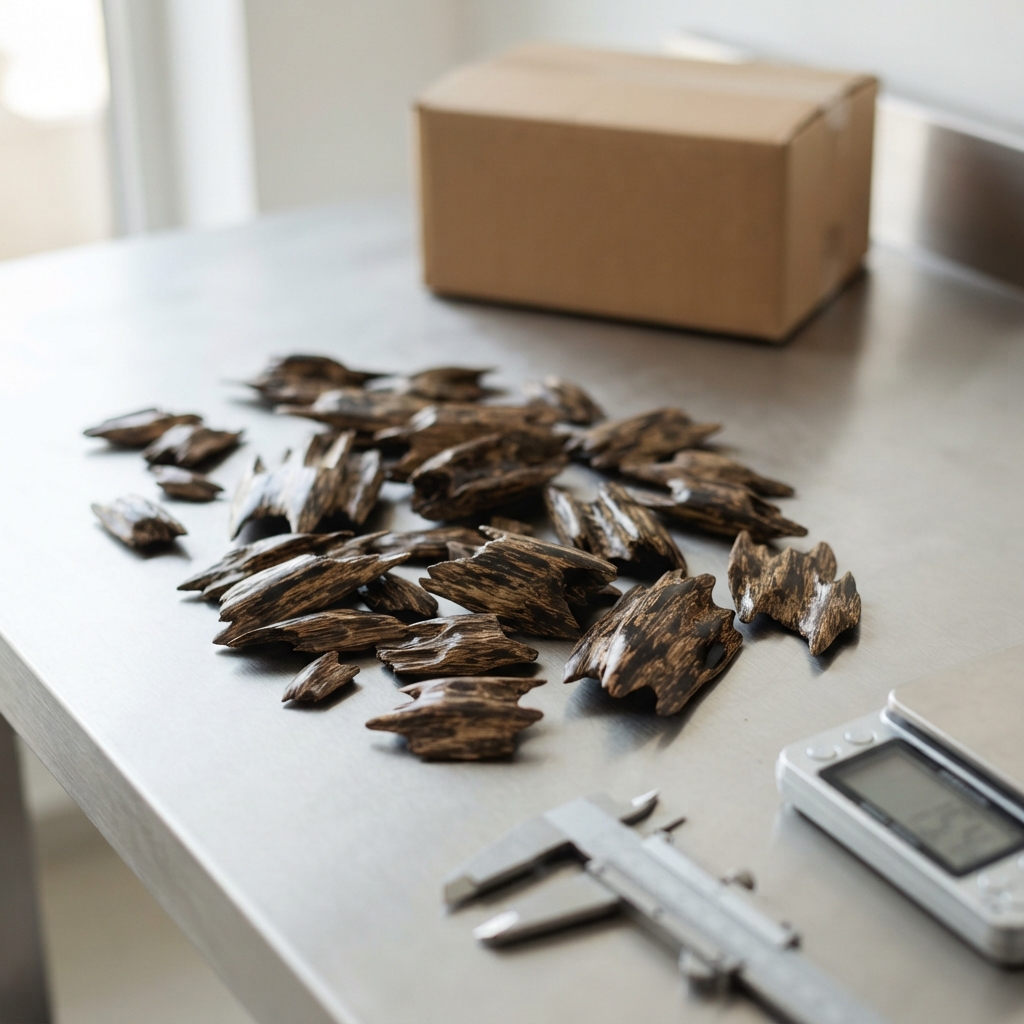
An agarwood chips quality claim is usually decided in the first 48 hours after the container is opened, not in the argument that follows. If the acceptance standard was never written down, no reference sample was retained, or the cartons sat in a warehouse for a week before anyone weighed them, the buyer carries the loss even when the wood is genuinely below specification. This guide gives sourcing and quality teams buying wholesale oud chips a repeatable arrival inspection and claim process, written from the buyer's side of the table, and shows what a serious oud chips manufacturer should be willing to put in writing before the first shipment.
Why most oud chips manufacturer claims fail before anyone inspects the wood
In disputes over natural material with any oud chips supplier, three gaps account for most lost claims. They are all created before shipment, which is why they cannot be fixed after arrival.
The standard was an adjective. "Good quality", "premium grade" and "dark resin" cannot be measured by an inspector, a laboratory or an arbitrator. A claim needs a number, a method and a tolerance.
The sample was never retained. A photograph of a sample is not a reference. Without a sealed, labelled portion held by both parties, "this is not what we approved" becomes one opinion against another.
The inspection was late and undocumented. Claims windows are short by design. If the first weighing happens after the material has been repacked, blended or partly consumed, causation cannot be established and the file is weak regardless of the merits.
The practical conclusion is uncomfortable but useful: the quality of your claim is decided at the RFQ and purchase order stage, long before you see the cartons.
Step 1: Convert the specification into pass or fail criteria
An acceptance table does two jobs. It tells your inspector exactly what to measure, and it tells the oud chips manufacturer exactly what will be rejected. Every row should have a method, a record and a failure mode, so the conversation after arrival is about facts rather than impressions.
| Specification item | How to measure it | Record to keep | Typical failure that triggers a claim |
|---|---|---|---|
| Piece size band | Screen a weighed sub-sample through the agreed opening; caliper the oversize pieces | Percentage oversize, percentage undersize and fines, per sample | Material delivered as "small chips" when the PO named a band |
| Moisture | Oven-dry a sealed sub-sample at the agreed temperature and time; state the basis | Result per unit, method, date, laboratory or in-house reference | Weight loss after drying, mould during storage, paying for water |
| Resin appearance | Visual comparison with the retained approved sample under consistent lighting | Photograph with a scale reference plus a written description | Pale, hollow or lightly resinated pieces inside an approved-looking carton |
| Foreign matter | Hand-sort a weighed sub-sample; weigh the removed material | Percentage by weight, photographed | Stone, soil, excess bark, non-agarwood wood |
| Net weight | Calibrated scale, packaging tare deducted, several units per pallet | Gross, tare and net per carton, plus total | Short weight beyond the agreed tolerance |
| Packaging | Inspect liner, seal, carton strength and pallet wrap | Photographs before opening, carton count | Split seams, missing liner, wet or crushed cartons |
| Lot identity | Cross-check carton labels, packing list and PO reference | Photograph of each distinct label | Mixed lots or a lot reference that does not exist on the paperwork |
If the size band needs more detail, the companion guide on specifying agarwood chip and granule particle size shows how to write screen openings, oversize and fines into a wholesale RFQ so that this table has real numbers in it.
Step 2: Classify defects before you open the first carton
Inspectors disagree most when they are deciding severity in the moment. Agree the classes in advance and the disposition follows almost automatically.
| Class | Examples on oud chips | Usual disposition |
|---|---|---|
| Critical | Live insect activity, visible mould with hyphae, substitution with non-agarwood wood, documentation that does not match the goods | Stop unloading, quarantine the lot, notify the supplier the same day, consider rejection |
| Major | Moisture above the agreed limit, size distribution outside the band, short weight beyond tolerance, wrong grade or lot | Claim on the affected quantity, remedy chosen from the ladder below |
| Minor | Label typo, scuffed cartons, fines slightly above the tolerance but within a stated allowance | Note and monitor; usually handled at the next order rather than as a claim |
Two rules make this work. First, severity is judged against the written specification, never against how the wood looks compared with last year's lot. Second, any critical defect pauses acceptance entirely; sorting good cartons while a suspected infestation is present spreads the problem and weakens the file.
Step 3: The 48-hour oud chips inspection protocol
This sequence is deliberately ordered. Evidence that is destroyed in step two cannot be reconstructed in step six.
- Photograph before you touch anything. Container or truck seal, door interior, condensation, water staining, crushed cartons and pallet wrap. If a data logger travelled with the load, download it before the container warms up.
- Count and reconcile. Cartons, pallets and units against the packing list and bill of lading. Record discrepancies immediately; a short count discovered on day five is hard to attribute.
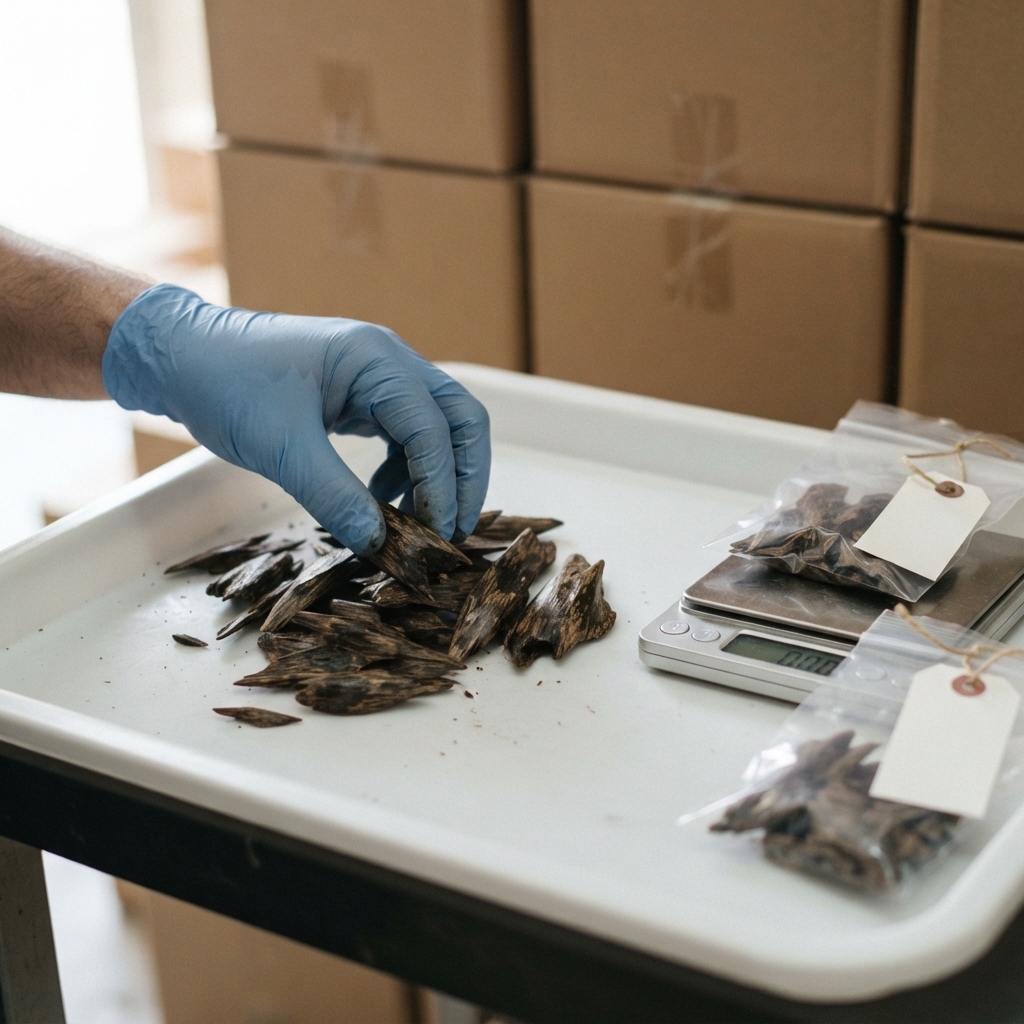
- Weigh a sample, not the story. Gross weight of at least five to ten percent of units, spread across pallet positions, then net weight on a smaller number with the tare deducted. Extrapolate only within the tolerance the PO allows.
- Draw a defensible sample. Take increments from cartons at the top, middle and bottom of different pallets, combine them, and split into three sealed portions: one for you, one retained for the supplier or a third party, one for testing. Label with date, lot, order number and the initials of two people.
- Screen for size distribution. Weigh a sub-sample, screen it through the agreed opening, and record oversize, in-band and fines as percentages by weight.
- Test moisture within 24 hours. Use the method in the specification, on a sealed sub-sample, and record the basis. Moisture drifts as material sits in a warm warehouse, so a late reading is contestable in both directions.
- Sort visually for foreign matter and resin appearance. Same bench, same lighting, sample beside the retained approved reference. Photograph anything you intend to claim on, with a ruler or coin for scale.
- Write one sheet and sign it. Date, time, participants, measurements, photographs by file name, and the disposition decision. Send the notification to the supplier within the contractual window, with the sheet attached, and keep the goods available for inspection.
Do not discard, burn or resell rejected material until the supplier has had a reasonable chance to inspect it or appoint an agent. Disposal before that point is the fastest way to turn a valid claim into a negotiation about your own conduct.
Step 4: Moisture is usually the claim that decides the rest
Moisture is the single most common source of quiet loss in this category, because it changes weight, price and shelf life at the same time. It also produces the most defensive supplier responses, since "the wood was dry when it left" may be true.
The arithmetic is simple enough to put in front of a supplier. Take 500 kg invoiced at 12 percent moisture: the dry matter is 440 kg. If the same consignment actually arrives at 18 percent, that 440 kg of dry matter now sits inside roughly 537 kg of material, which means about 37 kg of the invoice was water. That is why the purchase order must state whether weight is as-received or on a stated dry basis, and which test method applies.
Moisture also explains most mould claims. Sealed material packed at high moisture, then exposed to a temperature drop in transit, condenses water on the inside of the liner. The defect appears at destination but originates at packing. The full method, including how to write a moisture clause, is set out in the guide to oud chips moisture content.
Step 5: Assemble a claim pack the factory can actually answer
An oud chips manufacturer ignores claims that arrive as complaint emails and answers claims that arrive as a file. A complete pack contains:
- The purchase order, the signed specification and any approved change notes.
- The approved sample record: date, lot reference, photographs with scale, and who approved it.
- Arrival photographs of the seal, container interior and cartons before opening.
- Weighing records showing gross, tare and net, with the scale identification.
- Moisture results with the method, the basis and the testing party.
- Size distribution results with the screen opening used.
- Foreign matter weight and photographs of what was removed.
- A third-party inspection report, if one was appointed, commissioned against your checklist rather than a generic template.
- The dated notice of claim, listing the affected quantity and the remedy requested.
Agree in advance who pays for third-party inspection. A common structure is that the buyer commissions and pays, and the cost is recharged or credited if the claim is upheld. What matters is that the rule is written down before a dispute exists, not negotiated while a container sits on demurrage.
Step 6: Use a remedy ladder instead of a single demand
Buyers who open with rejection often get nothing, because rejection is expensive for both sides. A ladder gives the oud chips manufacturer a cheaper way to settle and gives you a documented escalation path.
| Remedy | When to ask for it | Commercial reality |
|---|---|---|
| Re-screen or re-sort at destination, with a credit for the labour and the loss | Fines or oversize outside the band | Fastest option; no second ocean freight and no new permits |
| Replacement of the affected kilograms from the next production | Moisture, mould or a clear lot mismatch | Costs a full shipping cycle and may need fresh export documentation |
| Credit note on the affected kilograms | Partial shortfall or a defect you can still use | Simplest to document; keeps the material in your production plan |
| Price adjustment to the next grade down | Appearance below the approved reference but functionally usable | Preserves the relationship; requires an honest internal use decision |
| Return or rejection | Critical defect, substitution or unusable material | Freight, permits and disposal usually exceed the value recovered |
| Third-party laboratory or arbitration | The cause itself is disputed | Slow and costly; use only where the amount justifies it |
Keep three failure types separate in the file, because they have different owners: a quality defect belongs to the supplier, transit damage belongs to the insurer or carrier, and a documentation error belongs to whoever prepared the papers. Mixing them lets each party point at the other.
Step 7: Risk transfer explains why "it arrived wet" is not automatically a factory fault
Under Incoterms 2020, risk passes from seller to buyer when the goods are delivered according to the agreed term, which for FOB and CIF means on board the vessel at the port of shipment. A buyer who opens a container of mouldy cartons therefore cannot rely on the Incoterm alone; the claim has to rest on a contractual promise from the oud chips manufacturer about packing and loading moisture.
Two clauses close that gap. The first sets a maximum moisture at loading, evidenced by a record the supplier signs. The second requires packaging fit for a sea voyage: an inner liner, adequate desiccant where agreed, and cartons rated for the stacked load. Ask for the loading record with the shipping documents, and compare it with your arrival reading. If the two are close and the material is wet on arrival, the conversation moves to transit conditions and insurance, which is a different claim with a different evidence standard.
This is also where cheap packaging shows up as cost. A carton that crushes in a stack, or a liner that tears at the seam, produces a defect that looks like a quality problem and is really a packing specification problem. Packing is quoted separately for a reason, and the guide to what drives the wholesale price per kilogram shows where those lines sit in a quotation.
Step 8: When the problem is the paperwork, not the wood
Some arrivals cannot be accepted at any quality level, because the documents do not match the goods. Agarwood-producing species in the genera Aquilaria and Gyrinops are listed in CITES Appendix II, and the listing requires export documentation issued by the exporting country's management authority before shipment, with an import permit in destinations that require one (see the CITES CoP20 working document on agarwood).
Buyers comparing an oud chips manufacturer China shortlist often concentrate on price and skip this step. The failure mode to watch is a mismatch between the species and product description on the CITES agarwood permit, the commercial invoice and the packing list. That is a customs problem, not a quality claim, and it can hold a container long enough to create a genuine quality problem while it waits. Hold copies of the permits before the goods leave, and check the descriptions line by line against the invoice.
Wood packaging is a separate regime. ISPM 15 regulates solid wood packaging such as pallets and crates, requiring approved treatment and the visible IPPC mark; it does not apply to the chips themselves (IPPC, ISPM 15, 2018). A pallet without a legible mark is a phytosanitary risk at the border and, in some destinations, a reason to reject the entire pallet rather than the carton.
Step 9: Put the claim mechanics in the purchase order
Everything above is only enforceable if the purchase order says so, whether you are dealing with one oud chips manufacturer or an oud chips wholesale supplier aggregating several factories. These clauses are worth arguing about before you place an order, because they are almost impossible to add afterwards.
| Clause | What it must contain |
|---|---|
| Reference standard | Lot reference and the sealed retained sample held by each party |
| Moisture | Limit, basis, test method and the number of units tested |
| Size | Screen opening, band limits, and allowed percentages of oversize and fines |
| Weight | Net weight per unit, tare basis and the tolerance before a short-weight claim applies |
| Inspection rights | Pre-shipment access, arrival inspection, and the supplier's right to appoint an agent |
| Notice period | A stated number of days after arrival to notify a claim, plus a latent-defect clause for mould discovered later |
| Remedy and costs | The ladder above, who pays freight on replacements, and who pays for third-party inspection |
| Documents | The permit and certificate list for your destination, named individually |
| Governing law | The forum and the language of the contract |
A typical notice period in this trade falls somewhere between seven and fourteen days, but the number matters less than the fact that both sides agreed it. If your own inbound QC queue takes three weeks, negotiate a longer window rather than discovering the mismatch during your first claim.
What this oud chips manufacturer can and cannot confirm
We write this section because a claim process is only as good as the disclosures that precede it. As an agarwood chips supplier working with importers, incense producers, distributors and private-label brands, Jiangmen Nangjiaxiang Agarwood Development Co., Ltd. cultivates and processes agarwood in Jiangmen, Guangdong, with more than ten years of cultivation experience and over 1,000 mu of standardized plantation resources. According to our company information, cultivation follows natural standards without chemical agents used to accelerate resin formation, and our own deep-processing facility supports wood, powder, oil and incense formats for buyers in the Middle East, Southeast Asia, Europe and the Americas.
Three limits are worth stating plainly. First, A, B and C labels are internal commercial references, not a published or international grading standard; the physical criteria in your specification are what we can be held to. Second, MOQ, lead time, packing, freight, Incoterms and the applicable permit list are confirmed in the quotation for your specific order rather than published as fixed figures. Third, we do not present a certified quality-management system or laboratory testing of every batch unless it is stated for your order; if your programme requires a specific certificate, test report or inspection protocol, put it in the inquiry and we will confirm what applies.
For claim purposes, the products most often discussed are natural large agarwood chips, supplied as comparatively large, intact pieces with visible natural grain and resinous streaks for incense use, further cutting, grinding and distribution; natural small agarwood chips, cut into smaller irregular pieces for portioning, blending, repacking and further grinding; and agarwood wood fragments, an irregular format for sorting, blending and incense processing. Each is described on its product page with the characteristics we actually publish, and those pages, not an email, are the reference for what the format includes.
FAQ
How long do I have to raise an oud chips claim?
It is set by your purchase order, not by custom. Seven to fourteen days after arrival is common, but the window must match your real inspection capacity. Add a latent-defect clause for mould or infestation that could not reasonably be seen on arrival.
Can I claim for moisture if the wood was dry at loading?
Only if the contract sets an arrival moisture limit or a packing specification that makes the supplier responsible for transport conditions. Otherwise the loss sits with transit risk and your cargo insurance, which is why the loading moisture record matters.
Who pays for a third-party inspection?
Agree it before shipment. The usual arrangement is that the buyer commissions and pays, with the cost credited or recharged if the claim is upheld. An inspector working from your checklist produces far more useful evidence than a generic report.
Is short weight a valid claim?
Yes, when net weight is below the packing list beyond the agreed tolerance. Separate short shipment from moisture loss: the first is a quantity claim, the second is a specification claim, and they need different evidence.
What evidence does an oud chips manufacturer usually accept?
Photographs with a scale reference, weighing records, moisture results with a stated method, a size distribution result, the sealed retained sample and, where appointed, a third-party report. A complaint email with no measurements is easy to defer.
Do I have to return rejected goods?
Rarely. Return freight, re-export permits and disposal usually cost more than the material is worth, so a credit or replacement is normally the practical remedy. Get the disposal or destruction instruction in writing before you act.
Does ISPM 15 apply to oud chips themselves?
No. ISPM 15 covers solid wood packaging such as pallets and crates, which must be treated and marked. The chips are regulated instead through CITES documentation for Aquilaria and Gyrinops species.
Can I claim against a grade letter?
Not usefully. Grade letters are internal labels and vary between factories. Claim against the written physical criteria: size band, moisture, resin appearance against the retained sample, and foreign matter.
Conclusion
Choosing an oud chips manufacturer comes down to four documents and one habit: a specification with numbers, a sealed reference sample tied to the lot, an arrival inspection completed inside the window, a remedy ladder written into the purchase order, and the habit of recording before opening. Suppliers who accept those terms are telling you they can meet them; suppliers who resist a retained-sample or notice clause are telling you something equally useful.
If you are sourcing bulk oud chips for incense production, fragrance processing, distribution or private label, send your specification, target quantity, destination and any inspection or documentation requirements through our contact page, and we will confirm what applies to your order before you commit.


