
Wholesale oud chips do not have a single market price per kilogram. The number on a quotation is the output of four separate cost layers: the material basis you specified, the processing and screening that produced it, the packing and export documentation attached to it, and the freight and duty that carry it to your door. A directory listing for "oud chips manufacturer China" will return dozens of per-kilogram figures, and almost none of them are comparable, because each is built on a different specification. This guide shows how to take a wholesale oud chips quotation apart, rebuild it as a landed cost, and compare suppliers on the number that actually reaches your production floor.
Why two quotations at the same price per kilogram are not the same price
A quotation of USD 10.00 per kilogram and a quotation of USD 11.20 per kilogram can reverse order once you convert both to landed cost per usable kilogram. In the worked example further down, the cheaper headline price ends up costing more per usable kilogram. The gap comes from four things that are easy to leave out of a comparison and hard to recover after the container arrives.
- Weight basis. Chips are sold by weight, and part of that weight is water. A lot at 16 percent moisture carries six percentage points more water than an agreed 10 percent basis, and you pay material price for all of it.
- Size compliance. Material outside the agreed size band still weighs the same on the invoice. If 8 percent of the lot is oversize or fines you cannot use, your usable yield is 92 percent, not 100.
- Quotation scope. Documentation, custom screening, retail-ready packing, inland haulage and insurance are the lines most often left out of a per-kilogram figure and invoiced later.
- Freight basis. Chips are bulky and low density. On air and on many LCL sea routes, chargeable weight is calculated on volume, so the freight line can exceed what the tonnage suggests.
None of these is a trick by itself. The problem is that they are invisible in a single number, so a buyer ends up comparing a complete offer against an incomplete one.
The six variables that set the material price
Before you can judge whether a price is high or low, you need to know which specification it refers to. These six variables move the agarwood chips wholesale price more than negotiation does.
| Variable | What changes | What to ask for in writing |
|---|---|---|
| Species and origin | Different Aquilaria species and growing regions carry different commercial expectations and different documentation routes | Genus and species if known, country and region of harvest, whether lots are origin-separated or blended |
| Resin content and appearance | Darker, denser, more resin-bearing pieces command a premium; pale or hollow pieces do not | The physical criteria behind the grade letter: colour range, density impression, acceptable share of pale pieces |
| Piece format and size band | Large intact pieces, small chips, irregular fragments and powder are different production runs with different yields | Lower and upper size limit, screening opening, treatment of oversize and fines |
| Moisture basis | Water is priced as material unless the basis is stated | Measured moisture at dispatch, the test method, and whether weight is as-received or on a stated dry basis |
| Screening and cleanliness | Re-screening, dust removal and hand sorting add cost but change usable yield | Whether the price includes screening to your band, and what foreign-matter allowance applies |
| Volume and lot consistency | Larger volumes and repeat lots spread setup cost; one-off small lots carry a surcharge | Price breaks by quantity, and whether repeat orders are produced to the same lot reference |
Two suppliers quoting "grade A oud chips" are not quoting the same product until all six are fixed. Every agarwood chips supplier uses its own shorthand, and an oud chips grade letter tells you nothing until you know the physical criteria behind it. The companion guide on specifying agarwood chip and granule particle size covers the size and screening half of this in detail.
How to read a wholesale oud chips quotation line by line
Ask every candidate to quote on the same Incoterm and to state explicitly what is excluded. An oud chips price per kg figure is only one row of a longer table, and a quotation that cannot survive the comparison below is not a cheaper quotation; it is an unfinished one.
| Quotation line | What to confirm | Common pitfall |
|---|---|---|
| Unit price and currency | Price per kilogram, currency, and how long the price holds | No validity window, so the price is re-set after your sample is approved |
| Specification reference | The exact size band, grade criteria and moisture basis the price applies to | Price quoted against a looser specification than the sample you approved |
| Processing | Cutting, screening, sorting and drying included or charged separately | Custom size bands quoted as material price, then surcharged |
| Packing | Inner liner, outer carton or sack, net weight per unit, labelling, palletisation | Retail-ready packing assumed but priced as bulk |
| Documentation | CITES permit, certificate of origin, phytosanitary certificate, consular or legalisation fees | "Documents included" that turns out to mean only the commercial invoice and packing list |
| Incoterm and named place | EXW, FOB, CIF or DAP, with the port or door named | Comparing an EXW price with a CIF price and treating the difference as supplier efficiency |
| Freight and insurance | Mode, transit time, chargeable weight basis, insurance cover and who arranges it | Volumetric freight on loosely filled sacks |
| Payment terms | Deposit percentage, balance trigger, payment method, currency risk | Deposit size treated as free when it is a real cost of capital |
| Inspection | Who inspects, against what checklist, who pays for a third party | Inspection cost discovered only at shipment |
One question does more work than any other: what is not included? Ask it in writing, for every line, before you negotiate anything.
Converting a price per kilogram into landed cost per usable kilogram
The formula is short enough to put in a spreadsheet and use on every quote you receive.
Landed cost per usable kilogram = (material + freight + insurance + duty and taxes + broker and port charges + inland delivery + documentation) ÷ usable kilograms received.
Usable kilograms are not the invoiced weight. They are the invoiced weight minus excess moisture above the agreed basis, minus material outside the agreed size band, minus foreign matter, and minus any weight lost in your own re-screening.
A worked example with hypothetical figures
The figures below are chosen to show the arithmetic, not to represent a market quote. Substitute your own.
| Line | Supplier A | Supplier B |
|---|---|---|
| Invoiced quantity | 1,000 kg | 1,000 kg |
| Unit price, FOB | USD 10.00/kg = 10,000 | USD 11.20/kg = 11,200 |
| Freight and insurance | 1,400 | 1,450 |
| Duty at an assumed 5% of CIF | 570 | 632.50 |
| Broker, port and inland delivery | 430 | 430 |
| Documentation | 300 | 300 |
| Total landed | 12,700 | 14,012.50 |
| Moisture measured against a 10% basis | 16% (60 kg excess water) | 9% (none) |
| Material outside the agreed band | 80 kg | 15 kg |
| Usable kilograms | 860 kg | 985 kg |
| Landed cost per usable kg | USD 14.77 | USD 14.23 |
Supplier B's headline price is 12 percent higher and its real cost is 3.6 percent lower. It also delivers 125 more usable kilograms from the same nominal order. That difference is the entire argument for costing by usable weight: on this arithmetic, the "cheaper" quote costs more per kilogram of product you can actually sell.
Moisture: the cost you pay by weight and cannot see
Agarwood is hygroscopic. It takes up and releases water with the surrounding air, which means the weight of a sealed carton depends on where it was packed, how it was dried, and how long it sat before shipment. Agarwood moisture content is therefore a commercial figure, not a laboratory detail: because the invoice is priced per kilogram, every percentage point above the agreed basis is material price paid for water.
What to put in the specification
- A target moisture range and a maximum, expressed as a percentage of oven-dry weight.
- The test method. ASTM D4442, Standard Test Methods for Direct Moisture Content Measurement of Wood and Wood-Based Materials, describes oven-drying as the primary reference method and secondary methods derived from it; naming a method prevents a pin meter reading being argued against an oven result.
- The measurement point: at dispatch, at arrival, or both, and on how many units.
- The remedy if the maximum is exceeded: price adjustment on the excess water, re-drying, or rejection.
Practical checks at receiving
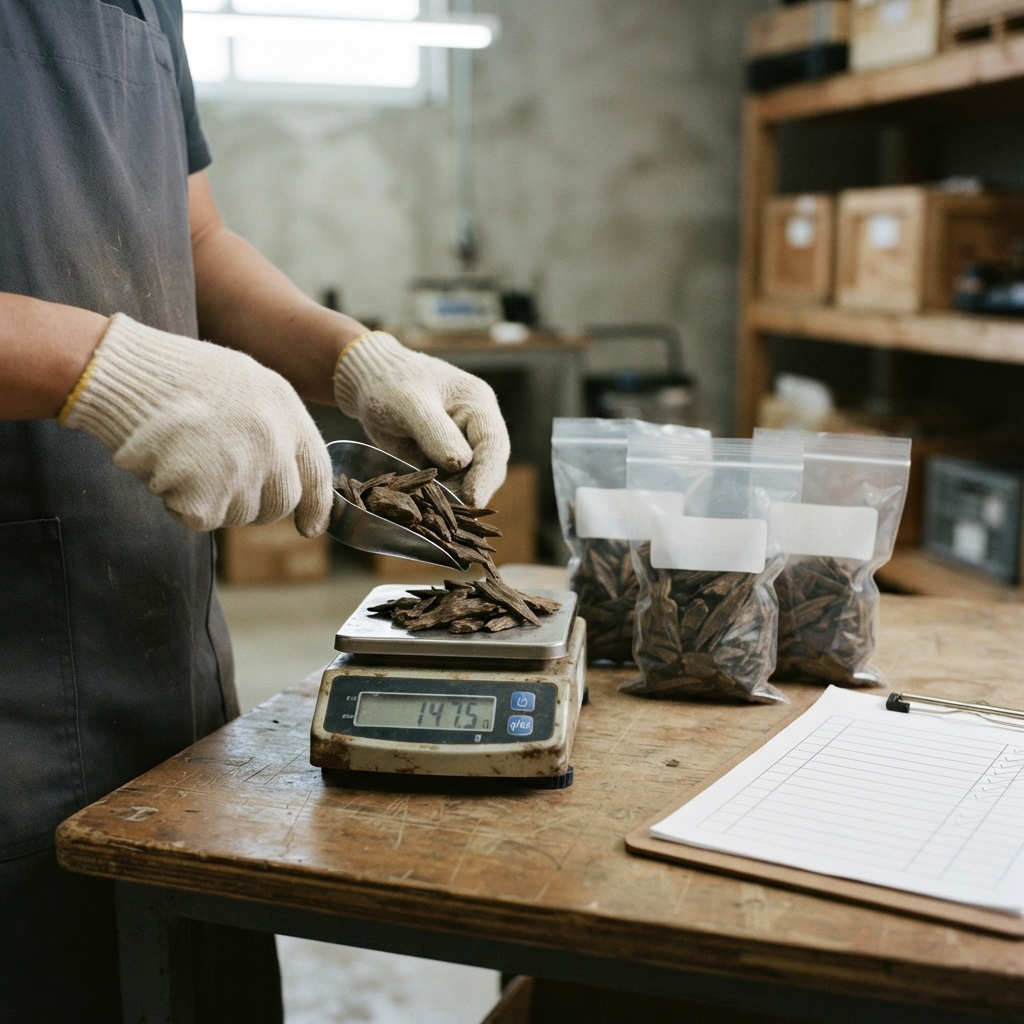
Weigh a sealed unit before opening, then weigh again after opening and equilibration. Record carton weight, net weight and packaging tare separately. Keep a sealed retained sample from each lot so a later dispute has a reference. If your volume justifies it, have an independent inspector measure moisture on a defined sample rather than accepting a supplier's own reading.
Yield: what screening loss does to your real cost
Chips are not a uniform product. A lot screened to a 10–30 mm band will normally contain some oversize pieces, some fines and some dust. If your process needs a narrow band, you will re-screen, and the removed fraction is either sold at a lower price or written off.
Calculate yield before you calculate margin
- Take a representative sample of at least several kilograms, not a handful.
- Screen it with the opening you will use in production and weigh each fraction.
- Record oversize, in-band, fines and foreign matter as percentages of the sample weight.
- Apply those percentages to the full order, then recalculate landed cost per usable kilogram.
This is also the point where "cheap" small chips stop being cheap. A finer, more heavily screened material usually costs less per kilogram because it is a lower-yield fraction of the same raw wood. If your process needs larger pieces, buying the cheaper fraction and discarding half of it is a more expensive route to the same output.
Documentation and compliance costs that belong in the model
Agarwood is a regulated trade material. All agarwood-producing species in the genera Aquilaria and Gyrinops are listed in CITES Appendix II, according to a review of the agarwood-producing genera published under the CITES Tree Species Programme (2022). In practice that means CITES agarwood export documentation must be issued by the exporting country's management authority, and many destinations require an import permit before the goods can be cleared.
The UK Government guidance on CITES imports and exports is a useful example of how destination rules are written: permits, exemptions and the specific descriptions that must match the shipment. Your own country's management authority is the authority that matters for your order.
Cost lines to confirm, not assume
- Who applies for the export permit, and whether the fee is included in the unit price.
- Whether your destination needs an import permit, and what it costs and takes to obtain.
- Certificate of origin and phytosanitary certificate fees.
- Courier or legalisation costs for original documents.
- The working-capital cost of permit lead time, which is often longer than production time.
Two failures cost more than the fees. A permit description that does not match the commercial invoice stops the shipment at customs, and a permit that arrives after the vessel sails leaves you paying storage. Confirm the document list for your destination before you book freight, not after.
The wider due-diligence sequence, including how to verify a source and audit a factory, is set out in how to compare oud chips manufacturers.
MOQ, sampling and the cost of being a small buyer
MOQ is a cost structure, not a number to negotiate down. A factory that has to stop, reset and run a small custom batch carries the same setup cost as a large one, which is why small orders attract a surcharge or a minimum specification.
- Sample cost. Ask whether the sample is free, charged, or charged and credited against the first order, and who pays courier and import charges on it.
- Sample-to-lot link. A sample drawn from the actual offered lot supports a specification decision. A sample from general reference stock supports only a scent impression.
- Per-SKU minimums. If you need three size bands, you may be facing three minimums, not one.
- Custom tooling and packaging. Plates, dies, artwork and unused packaging are real costs with their own minimum runs.
- Small-order surcharge versus stock lot. Buying from an existing production run is usually cheaper than a custom small batch, provided the specification genuinely fits.
Model the surcharge against your selling price before you decide it is unacceptable. A 10 percent small-order surcharge on a first trial is often cheaper than committing to a full minimum quantity of a specification you have not yet validated.
Freight, insurance and the volumetric trap
Oud chips are light for their volume. Loose-filled sacks and oversized cartons can be charged on volumetric weight rather than actual weight, and the difference appears only on the freight invoice.
- Ask how the supplier packs: compressed bales, lined cartons, or loose sacks, and the packed volume per tonne.
- Get freight quoted on the packed dimensions, not an assumed density.
- Confirm whether insurance covers the full CIF value and what exclusions apply to natural wood products.
- Compare transit time and total cost together. Air freight shortens the working-capital cycle but rarely lowers total cost on bulk chips.
Common pricing mistakes in wholesale oud chips buying
- Comparing price per kilogram across different size bands. You are comparing two different products.
- Ignoring the moisture basis. The most common quiet loss in this category.
- Treating grade letters as comparable. No international grading authority administers A/B/C for oud chips; the physical criteria are the contract.
- Leaving documentation out of the model. Permit fees and permit delay are both costs.
- Quoting EXW against CIF. The Incoterm changes who pays and who carries risk.
- Assuming bulk packing is retail packing. Packaging scope is a separate line.
- Approving a sample without a retained reference. Then arguing about a lot you cannot compare.
- Choosing the lowest headline price with no remedy clause. The cheapest quote without a claims route is the most expensive outcome.
A copyable RFQ cost checklist
Send this list with your inquiry so that every wholesale oud chips quotation comes back on the same basis.
- Format: whole chips, small chips, fragments, granules or powder.
- Size band: lower and upper limit, screening opening, oversize and fines policy.
- Moisture: target range, maximum, test method, measurement point.
- Appearance: colour range, acceptable share of pale or hollow pieces, reference photo.
- Quantity: total and per size band, with price breaks.
- Packing: inner liner, outer unit, net weight, labelling, palletisation, packed volume per tonne.
- Incoterm and named port or door; freight and insurance basis.
- Documentation: full list for my destination, who applies and who pays.
- Sample: source lot, quantity, cost, courier and import charges, validity.
- Inspection: checklist, sampling basis, who attends, acceptance limits, remedy.
- Lead time broken into stages, starting from deposit and specification sign-off.
- Payment terms, currency and price validity.
For the sampling basis itself, ISO 2859-1 describes an acceptance sampling system indexed by acceptance quality limit for inspection by attributes. You do not need the full standard to write a workable clause, but naming a sampling basis and an acceptance limit in the purchase order is what turns an inspection into a decision rule.
How our oud chips are supplied
We are Jiangmen Nangjiaxiang Agarwood Development Co., Ltd., a grower and processor rather than a trading intermediary. Our published product information states more than ten years of agarwood cultivation experience, a managed plantation base of over 1,000 mu, our own deep-processing facility, and a cultivation practice that does not use chemical agents to accelerate resin formation. We supply buyers in the Middle East, Southeast Asia, Europe and the Americas, and ODM cooperation is available for overseas B2B customers.
For chip buyers, the current range includes:
- Natural large agarwood chips — comparatively large, intact pieces with visible wood grain and resinous streaks, suited to incense use, further cutting, grinding and distribution.
- Natural small agarwood chips — smaller irregular pieces for portioning, blending, repacking, further grinding and distribution.
- Agarwood wood fragments — an irregular format for sorting, blending, powder processing and incense manufacturing.
We do not publish fixed prices, MOQ or lead times, because they depend on the specification, quantity, packaging and destination. Those terms are confirmed in the quotation for your order, alongside the documentation that applies to your market. Our quality and supply framework describes what our inspection does and does not cover, and the OEM and private-label page sets out how custom and ODM projects are scoped.
FAQ
How much do wholesale oud chips cost per kilogram?
There is no single market price. The range is wide because species, resin content, piece size, moisture and documentation route all move the number, and a quotation is only meaningful against a written specification. Ask for a price against your specification, on a named Incoterm, with the exclusions listed.
Why is the bulk price different from the sample price?
Usually because the sample was drawn from a different lot, a different size band, or a small hand-selected quantity. Ask whether the sample came from the offered lot and whether the bulk price refers to the same specification.
Is the lowest price per kilogram ever the right choice?
Only when the specification, moisture basis, size compliance and documentation scope are identical. Once those are equal, price is a fair comparison. Before then, it is a comparison of different products.
How should moisture be measured on oud chips?
Name a method in the specification and apply it consistently. Oven-drying is the reference approach described in ASTM D4442; hand-held meters are useful for screening but should not be the contractual method unless both parties agree to it and to the correction applied.
What hidden costs appear most often in oud chips quotations?
Export documentation, custom screening, retail packaging, inland haulage, volumetric freight and third-party inspection. All six are legitimate costs; the problem is only when they arrive after the price has been agreed.
Who pays for CITES documents?
That is commercial, not regulatory. What matters is that the quotation states whether permit fees, certificates and document courier costs are included, and that the permit description matches the invoice before shipment.
How does MOQ affect the unit price?
Small or custom batches carry setup cost that has to be recovered, so unit price usually falls as quantity rises and as the specification becomes standard rather than bespoke. Ask for price breaks and for the surcharge that applies below the minimum.
How do I compare two wholesale oud chips suppliers fairly?
Send the same written specification, require the same Incoterm and the same document list, then convert both quotations to landed cost per usable kilogram using measured moisture and screening yield. Compare the resulting number, not the headline.
Conclusion
Wholesale oud chips are priced per kilogram but bought per usable kilogram, and the gap between those two numbers is where most sourcing budget is lost. Fix the specification, require an itemised quotation on a named Incoterm, measure moisture and screening yield, and convert every offer to landed cost per usable kilogram before you compare. Do that and the cheapest supplier and the best-value supplier stop being the same question.
If you are building a costing model for an upcoming order, send your intended format, size band, quantity, destination and packaging direction through our contact page. We will confirm the specification points that need deciding and quote against them, so the numbers you compare are numbers you can actually use.


