
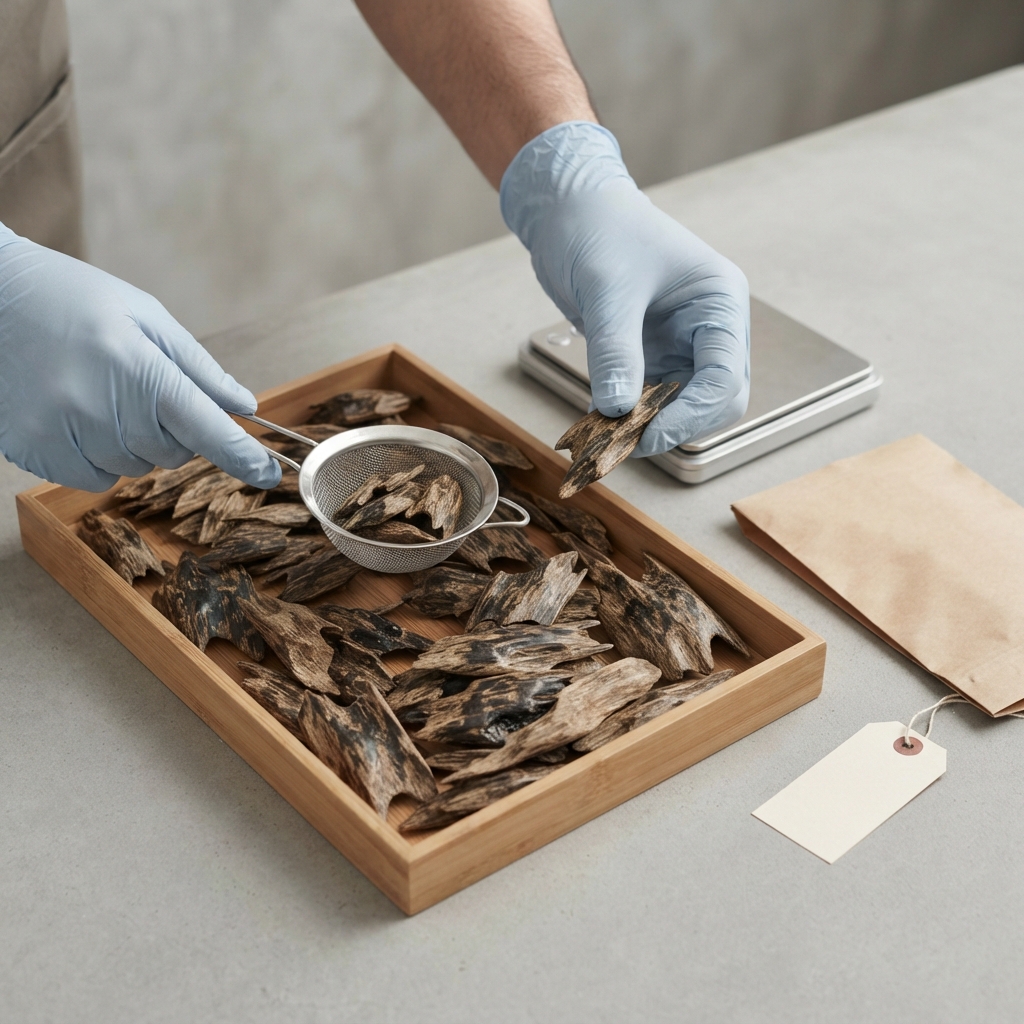
An oud chip sample is only useful when it is tied to a lot, a method and a record. Most B2B buyers request oud chip samples, burn them once, and place the order — then find that the bulk lot came from a different sub-lot, at a different moisture level, screened on a different size band. The protocol below turns a set of oud chip samples into a working procurement document instead of a scent impression, so that what you approve is what you can actually enforce.
Why an approved sample is not yet a specification
A sample proves what a material looked, felt and smelled like on one day. It does not prove the size distribution, the moisture basis, the resin consistency across pieces, or that the next run will come from the same trees. That gap is where most first orders go wrong, and it is closed with documents, not with better smelling.
The failure usually looks like this: buyer approves a small bag of dark, heavy pieces; supplier produces 500 kg from a blend of several sub-lots to meet the quantity; the buyer opens the cartons and finds smaller pieces, paler material and more fines than the reference suggested. Both sides believe they acted in good faith, because nobody wrote down what the sample represented.
This is why a sample approval should have four parts: a lot reference, a stated test method, an acceptance record, and a clause that says what happens when the bulk differs. Without the fourth part the first three are decoration. Buyers who already use a supplier comparison framework will recognise the pattern — a documented specification is what makes suppliers comparable at all, as set out in our guide to comparing oud chips manufacturers.
Four types of oud chip samples buyers confuse
Most disputes start with the word “sample” doing four different jobs. Oud chip samples arrive as reference material, as an offer, as a pre-production run and as a retained portion, and only three of those four belong in a purchase order. Name the type explicitly in every message.
| Sample type | What it represents | What it can prove | What it cannot prove |
|---|---|---|---|
| Reference sample | A grade or look the supplier keeps for general discussion | Whether the supplier’s material family is in the right territory | Anything about your order |
| Offer sample | The specific lot the supplier intends to ship | Size band, appearance, moisture, burn behaviour of that lot | That the lot will still be available when you order |
| Pre-production sample | Material after your requested cutting, screening or blending | Whether your custom specification is achievable | That a later production run repeats it |
| Retained sample | A sealed portion held by both parties after approval | The agreed baseline for inspection and claims | Nothing — this one is the evidence |
A reference sample is useful for a first conversation and should never be attached to a purchase order. What you want from a serious supplier is an agarwood chips sample drawn from a named lot, then a pre-production sample after your cut or screen, then a sealed retained portion. The retained sample is what you open when cartons arrive and something looks different.
How to design a sampling plan for oud chip samples
Sampling is a plan, not a request for “some photos and a small bag”. Decide three things before you contact anyone: how many distinct specifications you are testing, what each sample must be large enough to do, and who holds the record.
Size the sample by use, not by habit. A single approved specification should give you enough material for at least three separate burn sessions on the equipment you will actually use, one moisture check, one screening check against your size band, and one sealed portion that never gets opened. If you are comparing three size bands, that is three sample sets — not one set split three ways, which destroys comparability.
This is the step where most oud chip samples fail before they arrive: the buyer receives one small bag for three specifications, or receives material that the supplier describes as “similar to” the offer. Neither can support a decision, and both make the later inspection argument unwinnable.
| Stage | What you should hold | Decision it supports | Record to keep |
|---|---|---|---|
| Shortlisting | Reference material from two or three suppliers | Which suppliers reach the second round | Photos with scale, supplier, date, origin stated |
| Offer review | Lot-linked sample per specification | Whether the offer matches your application | Lot ID, quantity offered, price validity, Incoterm |
| Pre-production | Sample after your custom cut, screen or blend | Whether to release the production run | Signed approval sheet, retained sealed portion |
| Arrival | Cartons sampled against the retained portion | Accept, claim or renegotiate | Inspection record with photos and weights |
Keep the same evaluators, the same burner and the same room across all stages. A sample approved on a charcoal disc in a ventilated workshop and inspected on an electric heater in an air-conditioned office has not been tested under the same conditions, and the difference will be argued later.
The sample request: eight lines that get a usable answer
Suppliers answer the question they are asked. A vague request produces a polite reply and a generic bag of oud chip samples. Write the request so that a “yes” already commits the supplier to something checkable.
- Product and format: chips, fragments, granules or powder, and the intended use — direct burning, incense blending, grinding or repacking.
- Size band: a lower and upper limit plus how you will screen it, not the word “medium”. The method matters as much as the number, and is covered in detail in our guide to specifying agarwood chip particle size.
- Moisture basis: whether the sample is described as-received or on a stated dry basis, and whether the bulk will be sold on the same basis.
- Lot linkage: the lot or batch reference the sample was drawn from, and how much of that lot is available.
- Quantity and cost: how much material, whether the sample is free or charged, whether courier and import charges are included, and whether a sample charge is credited against the first order.
- Approval validity: how long the sample price and specification remain open.
- Documentation: which permits and certificates the supplier would issue for your destination, stated before the order rather than after.
- Remedy: what the supplier offers if the bulk lot does not match the approved sample.
Line eight is the one buyers skip. It is also the only line that changes supplier behaviour, because it moves the conversation from appearance to obligation.
Physical checks: what to measure and what to record
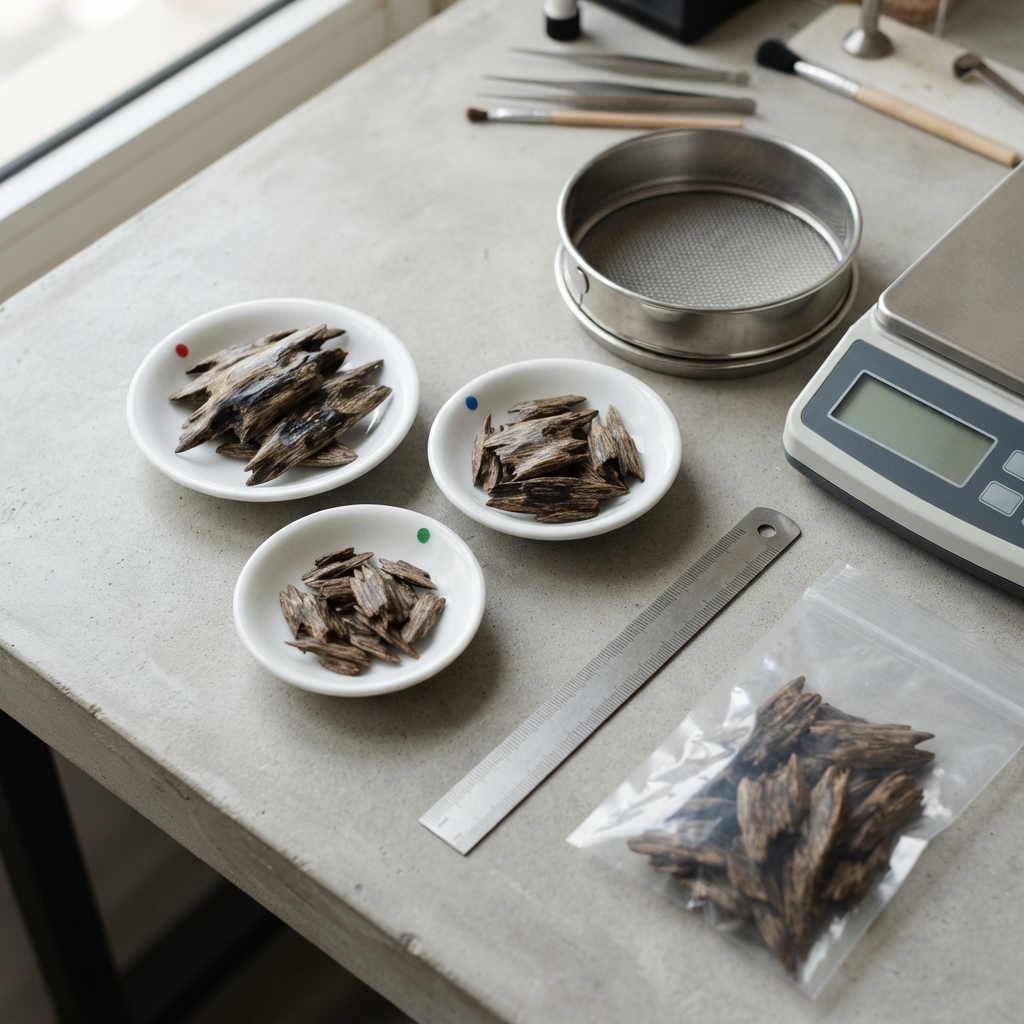
Oud chip evaluation is often described as sensory, which is used as an excuse for not measuring anything. Half of the decision is physical and can be recorded in numbers. Spread the full set of oud chip samples on a tray and work through the checks below before anyone burns anything.
| Check | How to run it on a sample | What to write down | Common error |
|---|---|---|---|
| Piece size | Spread the full sample on a plain tray and screen it against your agreed band | Share of oversize, in-band and fines, by weight | Judging from the top layer of the bag |
| Moisture | Weigh, dry by the method agreed in the specification, weigh again | Method, temperature, duration, before and after weights | Comparing an as-received sample with a dry-basis quote |
| Density and sink behaviour | Water test on a representative set of pieces, not one showpiece | How many pieces sank, floated, or sank then rose | Treating a sink result as an oud chip grade certificate |
| Resin appearance | Inspect cut faces under consistent light, not only outer surfaces | Photo set with scale, notes on streaks and pale zones | Reading colour as resin content without a method |
| Burn behaviour | Burn a fixed quantity on your own equipment and time the aroma curve | Ignition time, smoke character, aroma duration, residue | One burn, one evaluator, no record |
| Foreign matter | Hand-sort a portion for stone, soil, bark excess and non-agarwood material | Approximate share and description of what was found | Assuming fines are always agarwood dust |
Size and screening
Screening is where a sample and a bulk lot diverge most often, because screening is labour, and labour is what a supplier trims when volume rises. Ask how the size band is controlled: by screen opening, by hand sorting, or by eye. Then check the sample the same way. If your oud chips specification allows a fines share, state the share and the remedy when it is exceeded.
Moisture
Agarwood chip moisture content is paid for at the price of resinous wood, so it belongs in the sample record. A sample that feels heavy may simply be wet, and a bulk lot packed in a humid month can arrive heavier than the reference without any change in the wood. Our guide to oud chips moisture content explains why the basis must be written into the quotation, not inferred at arrival.
Density and the sink test
The water test is a useful, cheap indicator and a poor certificate. Resin is denser than water, so heavily resinated pieces tend to sink — but density also depends on wood structure, piece size, internal voids and moisture. Test a representative handful, record how many pieces behaved each way, and treat the result as one line in the file. A single sinking showpiece in a bag of floaters tells you about the showpiece.
Resin claims deserve the same treatment. If a supplier states a resin percentage, ask for the method, the moisture basis and the sample it refers to; the checks are set out in our article on verifying oud chips resin content.
Burn behaviour and aroma
Burn the sample the way your customer will. Incense manufacturers, bakhoor producers and retail repackers heat chips differently, and a chip that performs on charcoal can behave differently on an electric heater. Record the equipment, the quantity, the ignition time and how long the aroma persists. This is the part of the evaluation that photographs cannot replace, and the part most likely to be disputed later if it was never written down.
Foreign matter and condition
Sort a portion by hand. Stone, soil, excess bark and non-agarwood material are easy to miss in a photograph and expensive to discover in a production batch. Note mould, musty odour or condensation in the bag as well — these are condition issues that worsen in transit and are usually excluded from claims unless noted on arrival.
Running a blind sensory comparison
If you are comparing suppliers, remove the labels. Ask a colleague to code the samples, then evaluate them in the same session, on the same equipment, with water and a neutral break between each. Score each coded sample on four dimensions: opening note, body, duration and residue. Two or three evaluators are enough to expose a sample that only one person finds acceptable.
Write the scores before you look at the price list. Buyers who see the price first tend to smell the discount, and the record then justifies a decision that was already made. A blind sheet also gives you something rare in this trade: evidence that your preference was consistent across evaluators, which is useful when a later lot is “the same material”.
Writing the approval into the purchase order
An agarwood sample approval that lives only in an email thread is not approval. The approval sheet is only as strong as the sentence that carries it into the order, so the purchase order should reference the approved sample by an identifier both parties hold, state the specification it represents, and name the checks that will be repeated at pre-shipment.
- Reference: sample ID, date of approval, lot or batch the sample came from.
- Specification: format, size band, screening method, moisture basis, packaging.
- Tolerance: which variations are acceptable and at what level — stated as a share or a range, not as “minor differences”.
- Inspection: who checks, when, against which record, and what evidence is produced.
- Remedy ladder: re-screen, price adjustment, replacement, credit or return, in the order you prefer them.
- Validity: how long the approval covers, and what triggers re-approval.
The remedy ladder is the clause that decides whether a claim is a conversation or a negotiation. Ask for it in writing before the deposit, and make sure the retained sample is named in it. Our guide to inspecting an arrival and documenting a quality dispute covers the evidence pack that makes a claim answerable.
Where sample-to-bulk drift comes from
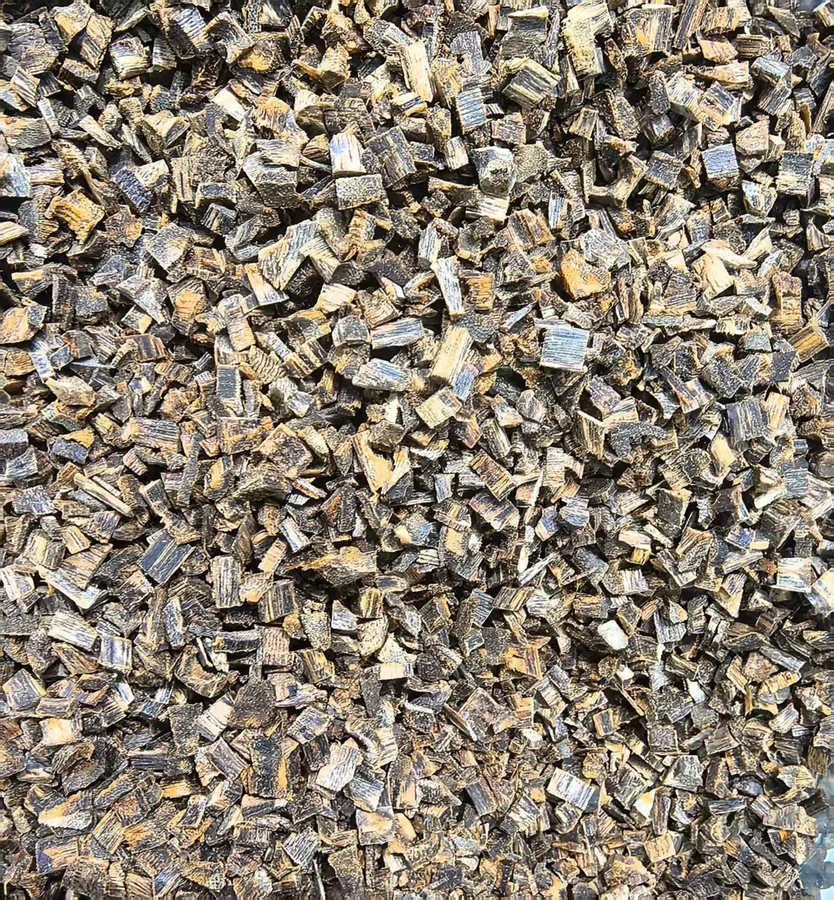
Sample-to-bulk consistency is rarely lost to one dramatic substitution. It erodes through four ordinary pressures, and each has a control.
- Sub-lot blending to fill volume. A sample drawn from one pile cannot represent a shipment drawn from five. Control: name the lot, ask how much of it exists, and require disclosure if the order exceeds that quantity.
- Screening shortcuts under time pressure. Fines and oversize creep in when a run is rushed. Control: state the screen opening, the acceptable fines share, and check it at pre-shipment.
- Moisture change between approval and packing. Humid packing weeks change weight and behaviour. Control: fix the moisture basis in the quotation and re-check at loading.
- Storage and handling after approval. Oud chip samples kept in a warm office and bulk stored in a warehouse do not age the same way. Control: note storage conditions in the approval record and inspect packaging integrity.
None of these require a laboratory to detect. They require a written baseline and someone who compares against it.
Oud chips MOQ, sample cost and the negotiation that follows
Sample policy and MOQ are linked, and buyers usually negotiate them in the wrong order. Ask for the oud chips MOQ per specification and per SKU first, then discuss the sample, because a sample that cannot convert into an order at your volume is a cost rather than a step.
Either sample model is normal: free with courier charged to the buyer, or paid and credited against the first order. What matters is that the model is stated before dispatch and that the sample is drawn from the offered lot. A free sample from generic stock is worth less than a paid sample with a lot reference.
If your volume sits below the stated minimum, ask for the two honest options: a small-order surcharge, or supply from existing production stock. Resist the third option, which is a supplier quietly substituting a different lot to make the quantity work. On custom cutting, screening or private-label packing, the minimum usually applies per specification and per packaging SKU, so confirm both.
Common mistakes in oud chip sampling
- Approving a reference sample as if it were an offer sample. The bag proves the supplier’s range, not your lot.
- Testing one piece. A sample is a distribution; evaluate a spread, not a showpiece.
- Not sealing a retained portion. Without it, inspection has no baseline and claims become opinions.
- Comparing samples on different equipment. The equipment changes the result more than the material sometimes does.
- Leaving moisture unstated. Weight bought as resinous wood can be mostly water.
- Reading an oud chip grade letter as a specification. A, B and C labels are internal supplier references, not a universal scale — ask for the physical criteria behind the letter.
- Ignoring the remedy clause. A perfect sample with no remedy is a discount, not an approval.
- Approving under time pressure without validity dates. Prices and lots move; an open-ended approval invites a re-quote.
How NanjaOud supports sample-based approval
We work from a managed plantation base of more than 160 acres in Jiangmen, Guangdong, with more than ten years of cultivation experience and in-house processing, which means the material offered for a sample can be traced back to our own supply rather than aggregated from unnamed sources. Our published cultivation practice states that no chemical resin-induction agents are used.
For chip programs, our current range includes natural large agarwood chips with intact pieces and visible grain and resinous streaks, suited to incense use, further cutting, grinding and distribution, and natural small agarwood chips processed into smaller irregular pieces for portioning, blending, repacking and further grinding. Both are supplied directly from our plantation and processing factory, with ODM support for custom processing, specifications and packaging.
Two limits are worth stating plainly, because they affect how you should read a sample. First, the A, B and C labels used in our listings are internal supplier references, not a universal or international grading standard; final requirements are confirmed through the specification, visual review, quotation and an approved sample. Our quality and supply framework says this explicitly. Second, our checks cover material selection, visual and format confirmation, weight and packaging, and pre-shipment confirmation — this framework does not imply a certified quality system or laboratory testing of every batch.
MOQ, lead time, freight, ports, Incoterms and stock quantities are confirmed in the quotation rather than fixed on a web page. If your program needs a specific test report, permit list or approval format, put it in the inquiry and we will confirm what applies to your order instead of assuming it.
FAQ
How much material should an oud chip sample contain?
Size it by use rather than by habit: enough for at least three burn sessions on your own equipment, one moisture check, one screening check against your size band, and one sealed portion that stays closed. If you are comparing several specifications, request a separate set for each.
How should I store oud chip samples after approval?
Keep the sealed retained portion away from heat, direct sun and strong odours, and store it under the same conditions you would accept for the bulk material. Record where and when it was sealed, because a retained sample that has been stored badly cannot settle a dispute.
Should I pay for an oud chip sample?
Both free and paid models are normal. What matters is whether the sample is drawn from the offered lot, who pays courier and import charges, whether a charge is credited against the first order, and how long the sample price is valid.
How do I compare two suppliers’ samples fairly?
Code the samples, evaluate them in one session on the same equipment with the same evaluators, and score before you see the prices. Fair comparison is a method, not an instinct.
Does a sample that sinks in water guarantee a sinking bulk lot?
No. Density depends on wood structure, piece size, internal voids and moisture as well as resin. The water test is a supporting indicator, so record how many pieces behaved each way rather than treating one result as a grade.
What if the bulk lot does not match the approved sample?
That is what the retained sample and the remedy ladder are for. Compare against the sealed portion under consistent conditions, document weights, screening results and photographs, and invoke the remedy you agreed before the deposit.
How long should a sample approval stay valid?
Long enough to cover your order window and no longer. State a validity period in the approval sheet, and treat any price or lot change after that date as a new offer requiring re-approval.
Can I get a sample before agreeing to an MOQ?
Often yes, but the sequence should be MOQ first, sample second. Ask for the minimum per specification and per packaging SKU so the sample you approve can actually convert into an order at your volume.
Which tests belong on an oud chip sample record?
Piece size distribution against your band, moisture by a stated method, density and sink behaviour across a representative set, resin appearance on cut faces, burn behaviour on your equipment, and a foreign-matter check. Record the method as well as the result.
Do oud chips need CITES documents?
Yes. All agarwood-producing species in the genera Aquilaria and Gyrinops are listed in CITES Appendix II. A CITES agarwood export permit is issued by the exporting country’s management authority, and your destination may require an import permit before the shipment leaves; the US Fish & Wildlife Service explains how the CITES Appendices and permit requirements work for US imports. Confirm the exact permit list for your own country before booking freight.
Conclusion
Oud chip samples do their job when they carry a lot reference, a test method, an acceptance record and a remedy clause. Approve the material on paper as carefully as you approve it on the burner, and the bulk lot has a defined relationship to what you chose. Skip those four parts and you are buying a memory of a smell.
If you are sourcing chips for incense, fragrance processing, repacking or private label, send the specification, size band, estimated quantity, destination and packaging direction through our contact page. We will confirm sample availability, the commercial terms that apply and the documentation your market requires, so your approval record starts from real information.


