
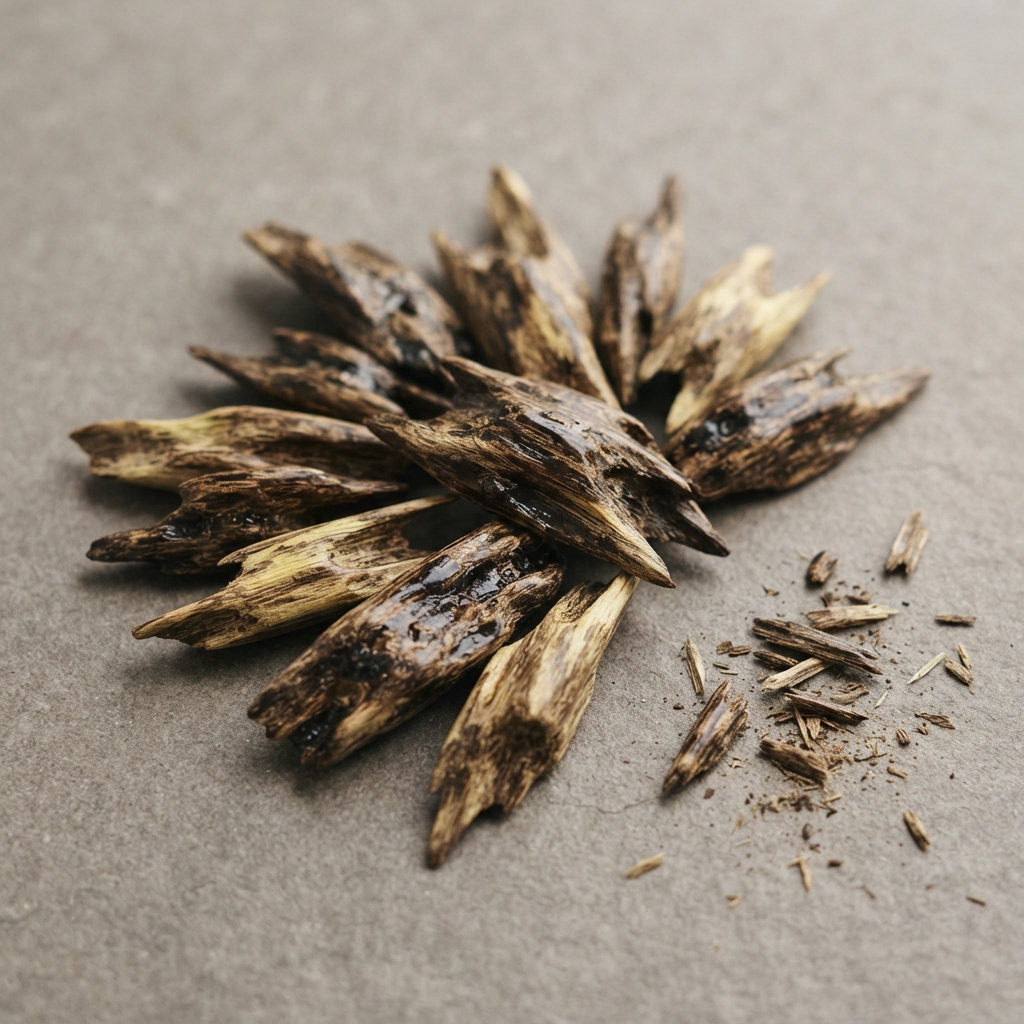
Oud chips resin content is the number that decides price in this trade, and it is also the number buyers can least reliably verify. A grade letter or a percentage is only meaningful when it is tied to a test method, a moisture basis and the sample it came from: without those three, two suppliers can both claim "12% resin" and mean different things. This guide shows B2B buyers how to define, sample and check oud chips resin content before and after shipment, and how to write the requirement into an RFQ and a purchase order.
Why oud chips resin content is the most abused number in sourcing
Agarwood is not a uniform material. It is the resin-bearing heartwood that forms in Aquilaria and Gyrinops trees after wounding or infection, and it forms unevenly: a single piece can be heavily resinous on one face and pale a centimetre away. Because resin is what the buyer is paying for, every supplier is tempted to express quality as one impressive number. When a search for an oud chips manufacturer China returns dozens of near-identical pages, that resin figure is often the only differentiator quoted — and the least comparable one.
Three things make those numbers hard to use:
- There is no single international grading standard. Grade letters such as A, B and C are internal commercial shorthand. Some countries publish national standards that use measured resin content bands, but those bands are national, not global, and a letter does not travel between suppliers.
- The test method is usually unstated. "Resin content" can mean solvent extract, resinous heartwood fraction, density-derived estimate or a visual estimate. These produce different numbers on the same piece of wood.
- Moisture is bundled into the weight. A percentage calculated on as-received weight falls when the wood dries, without any change in the resin itself.
The practical consequence is simple: a resin percentage is only meaningful when it is attached to a method, a basis and a sample. Without those three, it is a marketing figure rather than a specification.
What oud chips resin content actually measures
Before comparing two claims, establish which of the following the supplier means.
1. Solvent extract versus resinous tissue
In research and in commercial laboratories, resin content is often approximated by extracting milled wood with a solvent and weighing the residue. A published 2019 study on agarwood grading used Soxhlet extraction with diethyl ether on a 2 g milled sample and cross-checked the results against density-based grades (Ahmed et al., Journal of Advanced Biotechnology and Experimental Therapeutics, 2019). That is one defensible agarwood resin content test. Ethanol or other solvents will extract a different fraction and return a different number. If a supplier quotes a percentage without naming the solvent, the extraction time and the sample preparation, you cannot compare it with anyone else's figure.
Solvent extract is also not the same thing as aroma quality. Extract yield tells you how much soluble material is present; it does not tell you whether the sesquiterpene profile produces the scent your market wants. A high-extract chip that smells flat is still a commercial failure.
2. As-received weight versus dry basis
A resin percentage calculated on wet wood is diluted by water. Ten percent on an as-received basis can become a materially higher figure once the same sample is dried to a consistent moisture level. Ask for the moisture content of the sample and whether the resin result is reported on a dry-wood basis. If the answer is "we always report the same way", ask what that way is in writing.
3. Whole-piece versus composite sample
Because resin distribution inside a single piece is uneven, a result depends on how the laboratory subsampled it. Milling one dark corner gives a very different answer from milling a cross-section. Ask how the laboratory prepared the sample: number of pieces, portion of each piece, whether dark and pale material were both included.
4. Species, origin and tree age
Resin formation differs by species, environment and tree age, and plantation material is not wild-collected material. A percentage quoted for one origin cannot be transferred to another. This matters commercially because plantation supply now dominates legal trade, and CITES parties have been reviewing agarwood management practices for both wild and planted resources (ITTO, 2022). When a supplier mixes origins, the resin figure is an average of things that behave differently in your process.
Why agarwood chips grade letters do not travel between manufacturers
Buyers routinely shortlist three factories and compare "Grade A" against "Grade A" as if the letters were a unit of measure. They are not.
Take three common industry positions. One supplier defines Grade A as more than 15% resin, Grade B as 8–15% and Grade C as plantation grade. Another treats A, B and C purely as internal references and states openly that they are not a universal standard. A third uses a sinking/non-sinking split instead of letters at all. All three can be honest, and none of the three is comparable to the others without the underlying physical criteria.
National standards exist and are useful reference points, but they are still national. Indonesia, for example, maintains a standard that assigns grades using measured resin content; in one published evaluation of Aquilaria malaccensis from Bintan Island, measured resin contents of 6.01–16.24% fell within that standard's C and D grades. That tells you something real about how the bands work — and it also tells you that an agarwood chip grade A claim from a supplier using a different scheme may correspond to a much lower measured figure.
The correct move is not to demand that a supplier abandon its letters. It is to require that the letter be defined by physical criteria in the quotation and confirmed against an approved sample.
Four evidence layers a buyer can actually check
No single test settles quality. Used together, four layers give a buyer a defensible position in a dispute.
Layer 1: Visual and physical inspection — useful, but colour is not proof
Visual inspection remains the first filter: visible grain, darker resinous streaks, density in the hand, the proportion of pale or hollow pieces, and the amount of fines in the bag. Photograph the approved reference under consistent lighting and keep it with the lot number.
Colour alone is weak evidence. A 2019 study noted that in some markets chips are polished and coloured to attract buyers, and that immature wood is sometimes buried in soil to darken it so it can be sold as a higher grade, which has made identification by colour increasingly unreliable (Ahmed et al., 2019). Dark does not automatically mean resin-rich, and pale does not automatically mean low grade. Treat colour as a consistency check against your approved sample, not as a measurement.
Layer 2: Density and the sink test — a fast screen with real limits
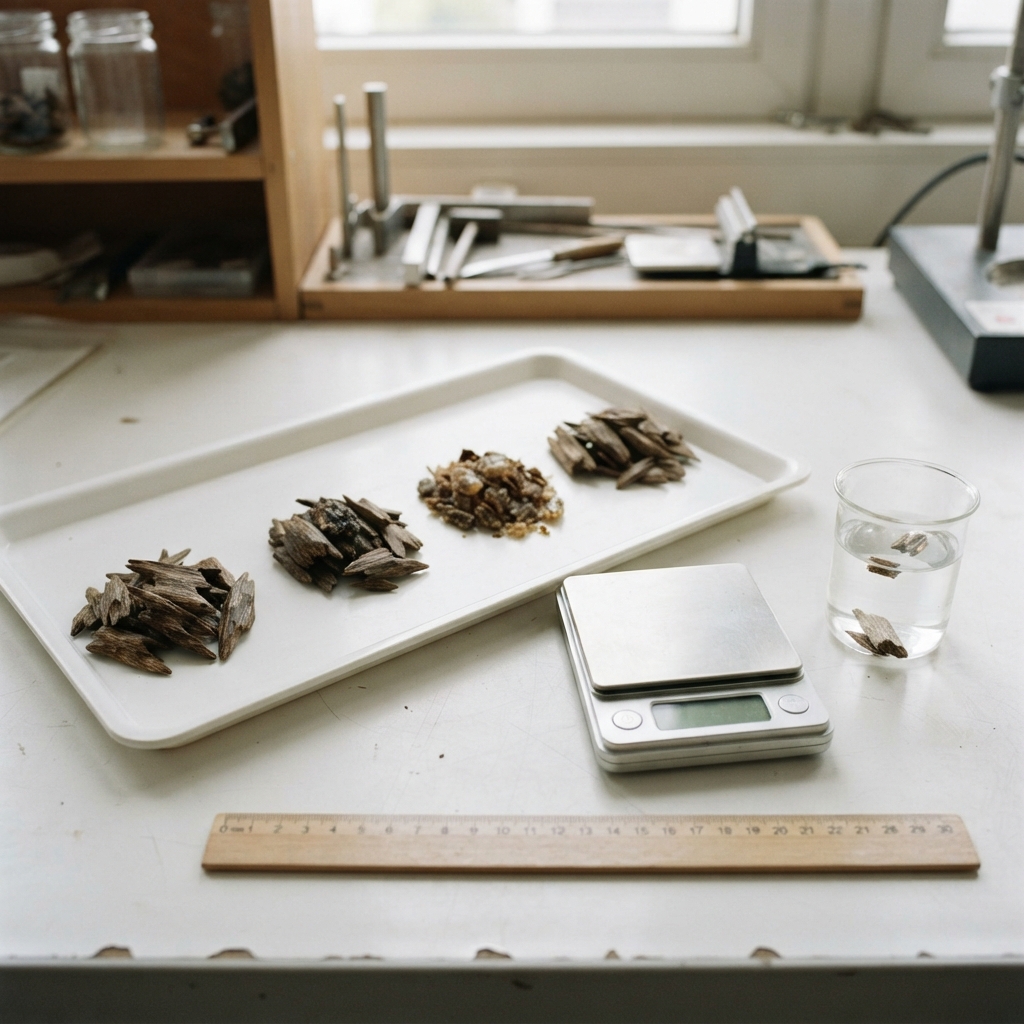
Agarwood chips density is the cheapest quantitative screen available. Weigh a piece, measure its volume by water displacement, and calculate grams per cubic centimetre. Research on density-based grading has cross-checked these results against solvent extract, and a 2019 study reported a Grade-1 sample at a calculated density of 0.641 g/cm³ with an ether extract of 18.90 ± 0.60%.
The sink test is a simplified version: resin-rich pieces tend to sink, partially resinous pieces may float or hang, and pale pieces float. So-called sinking grade agarwood is simply material dense enough to sink, and a 2026 study in RSC Advances reported that sinking-grade agarwood with higher density had significantly greater resin content than partially sinking and non-sinking grades. That supports density as a screen — but the same study and common workshop experience show it is not a complete quality verdict.
Four limits to keep in mind:
- Trapped air and geometry. Irregular pieces trap air and read lighter than they are; a quick soak and a tap remove most of the error.
- Moisture. Wet wood is denser. Compare pieces at similar moisture, or dry them first.
- Species density. Different species have different baseline densities, so a threshold that works for one origin will misclassify another.
- Sinking is not scent. A piece can be dense and still have an aroma profile your customers reject. Density ranks resin loading, not olfactory quality.
Layer 3: Laboratory extraction — the only number worth writing into a contract
If resin content is a contractual term, it needs a laboratory method. Specify the method rather than the number: solvent, extraction technique, sample mass, grinding and subsampling procedure, moisture determination, and whether the result is reported on a dry basis. Ask whether the laboratory is accredited and whether the report names the sample as received, with a date and a lot reference.
Rapid instrumental methods are also in use. Near-infrared spectroscopy has been evaluated as a non-destructive way to predict agarwood quality against a national standard, which makes it attractive for screening large lots. NIR is a prediction against a calibration set, not a primary measurement, so ask what calibration it uses and treat its output as an indicative screen rather than a contract term.
One honest note about cost: per-lot laboratory testing is not free, and many suppliers do not perform it routinely. A supplier that tells you it does not test every batch is more useful to you than one that implies laboratory verification it cannot document. If you need tested lots, say so in the inquiry and expect the testing to be scoped, priced and scheduled as part of the order.
Layer 4: A defined burn trial — the check that matches the end use
Most oud chips are bought to be heated, blended or processed, so the sensory trial belongs in the approval decision. The mistake is running it informally and then arguing about the memory of a smell.
Write a short protocol and reuse it for every sample and every repeat lot:
- Record the sample reference, the lot it represents and the date.
- Use a fixed mass of material — for example 0.5 g or 1 g — and a fixed heating method: charcoal, electric burner or a controlled hot plate at a stated setting.
- Keep the distance from the heat source and the room conditions consistent.
- Record time to first aroma, intensity at fixed intervals, character (sweet, woody, balsamic, animalic, medicinal), longevity and residue.
- Score against your approved reference, not against a description.
- Keep a sealed retained portion of the same sample.
If your chips are an input to incense rather than a burn-at-home product, the more relevant trial is the one described in the guide to specifying agarwood chips for incense manufacturing, because burn behaviour in a blend is not the same as burn behaviour on a heater.
Matching the claim to the check
The table below translates each common quotation claim into a check, so that an oud chips resin content statement from one supplier can be placed beside another's on equal terms.
| Claim on the quotation | What it usually means | How to verify it | What it does not tell you |
|---|---|---|---|
| "Grade A" | Supplier's internal top band | Ask for the physical criteria behind the letter and an approved sample | Comparability with another supplier's Grade A |
| "12% resin" | Unstated method, usually a supplier estimate | Request method, solvent, moisture basis and laboratory report | Whether the figure applies to your lot |
| "Sinking grade" | High density, often high resin loading | Density test or sink test on a defined sample | Aroma quality or consistency across pieces |
| "Wild" or "plantation" | Source category | Lot documentation, species and origin statement | Resin content, which varies within both categories |
| "Natural, no chemical induction" | Cultivation practice claim | Written statement tied to the specific lot | Resin percentage or scent profile |
| "CITES compliant" | Permits exist for the shipment | Permit copy checked against invoice description and species | Quality of the material inside the carton |
How to write resin requirements into an RFQ
The RFQ is where this stops being a conversation and becomes a specification. Any wholesale agarwood chips supplier should be able to answer the lines below in writing; if it cannot, the quotation is not comparable.
| Parameter | Usable RFQ wording | How it will be checked |
|---|---|---|
| Format | Whole chips / broken chips / irregular fragments; no powder except as declared fines | Visual inspection of the delivered lot against the approved sample |
| Size band | Stated lower and upper limits, screening opening, maximum fines percentage | Scoop sample screened; oversize and fines recorded |
| Resin basis | "Resin content reported as solvent extract on a dry-wood basis, method to be stated" | Laboratory report naming method, sample mass and moisture |
| Density reference | Minimum density on a defined subsample, measured by water displacement | Buyer's own check on a random subsample |
| Appearance | Resin coloration and grain visibility described; maximum share of pale or hollow pieces | Comparison against retained approved sample under fixed lighting |
| Moisture | Maximum moisture at packing, with the test method named | Moisture measurement at pre-shipment and on arrival |
| Lot identity | Each carton labelled with lot reference matching the approved sample | Label check against the purchase order and the sample record |
| Retained samples | One sealed set held by each party, referenced in the purchase order | Physical comparison in the event of a claim |
Two of these lines do most of the work. "Solvent extract on a dry-wood basis" removes the moisture ambiguity. "One sealed set held by each party" removes the argument about what was approved. If a supplier will not accept either, that is information about how a claim will be handled later.
Sampling: the step that decides whether the test means anything
A test result is only as good as the sample it came from. Oud chips are not homogeneous, so sampling has to be deliberate.
- Sample from the lot, not from the showroom. Ask which lot the sample represents and record the reference.
- Take pieces, not dust. A sample drawn from fines at the bottom of a sack will not represent the cartons.
- Cover the range. Include large and small pieces, dark and pale faces, and pieces from more than one carton. Resin variation inside a lot is normal; a sample that hides it is not representative.
- Split and seal. Divide the sample into three: one for the supplier, one for your laboratory or bench, one retained sealed and untouched.
- Photograph with a scale. A plain background and a ruler give a size and colour record that survives the loss of the physical sample.
Sampling quantity depends on lot size and the value of the decision, but the principle is constant: enough pieces to see the distribution, drawn from enough cartons to catch a mixed lot. For a first order, a third-party inspection instructed with your own checklist is usually better value than a generic report, because the inspector will follow your sampling plan rather than a template.
Red flags in manufacturer resin claims
- A percentage with no method. The most common warning sign, and the easiest to test with one question.
- Every piece described as sinking grade. Resin forms unevenly; a lot where nothing floats is either unusually uniform or sorted to the top of the range for the sample only.
- A certificate of analysis from an unnamed laboratory. Ask for the laboratory name, the report number, the sample reference and the date.
- Approval by photograph only. Colour-managed photographs are useful for consistency, but they cannot substitute for a physical sample on a graded material.
- Polish and dye. Surface treatment that darkens the appearance is documented in the trade literature; ask whether pieces are polished, and compare a cut face with the outer surface.
- Origin blending presented as single-origin. If the resin figure is an average across origins, say so, because your process will see the variation.
- A price far below the market for the stated grade. On a graded natural material, an outlier price is usually an outlier specification, not an arbitrage.
- Resistance to a retained-sample clause. A supplier confident in its grading has no reason to refuse one.
What factory answers explain resin variation
Resin content is not only a laboratory question; it is a production question. The answers below explain why two lots from the same supplier differ, and they are worth asking on a call or during a walkthrough.
- Cultivation and induction practice. Does the supplier use chemical resin-induction agents, and does the answer apply to the specific lot or to the company in general? Get the statement in writing and tie it to the lot.
- Tree age and harvest selection. How old is the material at harvest, and who decides which trees or which parts of a tree are cut?
- Inbound segregation. Are raw wood piles tagged and separated by lot, or blended? Mixed piles become mixed cartons.
- Drying control. Is there a controlled drying step, and is moisture measured before packing? Uncontrolled moisture is a weight and mould risk in transit.
- Sorting. Is grading done on a lit bench by trained sorters, and what happens to the rejects?
- Records. Can the supplier show a batch record linking raw material, processing date and packed lot?
None of these answers replaces a test, but together they tell you whether the supplier can reproduce a lot — which is the real question behind a resin claim.
Landed cost and yield: why a resin percentage is not a price
Buyers often compare price per kilogram at the quotation stage and discover the real difference only after the first production run. Three adjustments matter.
Moisture. You pay for water. Convert every quote to a dry-weight basis, or at least compare moisture declarations, before comparing price.
Screening loss. If your process needs a size band, the fines and oversize you cannot use are part of the cost of the material you can use. Calculate the usable yield from a trial screening rather than assuming the whole bag is usable.
Burn or blend yield. For direct-burning chips, the useful comparison is cost per unit of aroma delivered — cost per burn session at a fixed mass. For incense input, it is cost per unit of finished batch after accounting for the share of chips in the formulation. Neither can be read off a price list.
A simple working formula for each candidate lot:
Usable cost per kg = quoted price per kg ÷ (usable fraction after screening × dry-matter fraction)
Then divide by the number of burn sessions or batches that kilogram actually delivers in your trial. This is the only comparison that survives contact with production, and it usually reorders a shortlist that was built on price alone.
How NanjaOud handles grade and resin questions
We publish this framework because it is the standard we expect to be held to, and because it is more useful to a buyer than a number we cannot substantiate.
What we can state from our own documentation:
- Source. More than ten years of agarwood cultivation experience and a managed plantation base of more than 160 acres in Jiangmen, Guangdong, with a stated cultivation practice that does not use chemical resin-induction agents.
- Processing. In-house processing equipment, including stainless steel tanks and production line equipment, supporting wood, powder, oil, incense and related formats.
- Grading. A, B and C labels are internal supplier references where listed. They are not presented as a universal or international grading standard, and final requirements are confirmed through the specification, visual review, quotation and approved sample.
- Quality checks. Our framework covers material selection, visual and format checks, weight and packaging confirmation, batch and order records where applicable, and pre-shipment confirmation. It does not imply a certified quality system or laboratory testing of every batch.
- Commercial terms. MOQ, lead time, freight, ports, Incoterms and stock quantities are confirmed in the quotation rather than fixed on a web page.
We do not publish a single oud chips resin content figure. On a material where the method, moisture basis and sampling unit change the answer, one headline number would be a claim we could not tie to your lot. What we can do is agree a written specification, supply a sample that represents an identified lot, and confirm what applies to your order — including any testing you require — before production.
For chip buyers, our current range includes natural large agarwood chips with intact pieces and visible grain, suited to incense use, further cutting, grinding and distribution; natural small agarwood chips for portioning, blending, repacking and further grinding; and agarwood wood fragments in an irregular format for sorting, blending and incense processing. Our quality and supply framework sets out how material selection, grading and pre-shipment checks are handled.
Common mistakes when verifying resin claims
- Comparing percentages from different methods. Ether extract, ethanol extract and visual estimates are not the same measurement.
- Ignoring moisture. An as-received figure flatters wet material.
- Approving a sample without recording it. Without a retained portion and a photograph with a scale, there is nothing to compare a claim against.
- Testing one piece and generalising to the lot. Resin varies within and between pieces.
- Treating the sink test as a grade certificate. It is a screen, and it says nothing about aroma.
- Assuming a national standard applies everywhere. National bands exist, but they are not international and they are not interchangeable.
- Leaving the resin term out of the purchase order. If it is not in the PO with a method and a remedy, it is a conversation, not a term.
- Buying on colour. Polishing, dyeing and burying practices make colour an unreliable primary signal.
- Testing after the goods are paid for. Inspection and testing belong before the balance payment, not after arrival.
Frequently asked questions
What is a good oud chips resin content?
There is no universal threshold, because the acceptable figure depends on your application, your market's price point and the test method used. A buyer sourcing for premium direct burning will accept a different band from a buyer formulating incense. Fix the method and the moisture basis first, then set the minimum against your own trial results rather than against a supplier's headline figure.
Is resin content the same as grade?
No. Grade letters are commercial labels that may combine resin loading, size, appearance and intended use. Resin content is one measurable input to that label. A supplier's Grade A can be defined by several criteria at once, which is why the physical criteria matter more than the letter.
Does sinking mean high quality?
Sinking indicates high density, which is generally associated with higher resin loading, and research has reported greater resin content in sinking-grade material than in partially sinking or non-sinking grades. It does not indicate aroma quality, and a dense piece can still be rejected on scent. Use it as one screen among several.
Can I test resin content myself?
You can run a density check and a controlled burn trial with basic equipment, and both are worth doing on every incoming lot. Solvent extraction requires laboratory equipment, solvents and trained handling; for a contractual figure, commission an accredited laboratory and specify the method in the purchase order.
Why do two suppliers quote different resin percentages for similar-looking chips?
Usually because they are measuring different things: different solvents, different moisture bases, different sampling, or a visual estimate rather than a test. Occasionally because one figure is a marketing number. Asking for method, basis and sample reference resolves most discrepancies before they become a dispute.
Should the resin percentage be in the purchase order?
If you are paying a premium for it, yes — together with the method, the moisture basis and the consequence of a shortfall. A number in a brochure is not a contractual term.
How many pieces should I sample?
Enough to see the distribution, drawn from several cartons rather than one. The exact count should follow lot size and order value. The non-negotiable part is that the sample is split, sealed and referenced to the lot, so the test can be repeated on the same material.
Does CITES documentation confirm quality?
No. CITES permits confirm that the trade is authorised and that the species and product description match the shipment. All agarwood-producing Aquilaria and Gyrinops species are listed in CITES Appendix II, so permits are a compliance requirement, not a quality certificate (FAO, "CITES, trade and sustainable forest management").
Can plantation chips have high resin content?
Yes. Plantation material can be graded and selected for resin loading, and cultivation practice affects the result. The relevant questions are the induction method, tree age at harvest, how material is selected and how lots are segregated — not simply whether the wood is planted or wild.
Conclusion
Oud chips resin content is worth verifying because it drives both price and performance, and it is the variable most often stated without the information needed to check it. Build your approval around four layers — visual consistency against a retained reference, a density screen, a named laboratory method where the number is contractual, and a burn trial that matches the end use — then write the method and the moisture basis into the RFQ and the purchase order. A supplier that can answer those questions precisely is comparable with another that can; a supplier that cannot is being compared on price alone.
If you are sourcing oud chips for incense, fragrance processing, distribution or private label, send your specification, estimated quantity, target market and any testing requirement through our contact page. We will confirm what applies to your order, including sample arrangements and the documentation available for your destination. For the wider supplier comparison, the guide on comparing oud chips manufacturers sets out the full due-diligence checklist, and the guide to requesting an agarwood sample covers how to structure the approval step.


