
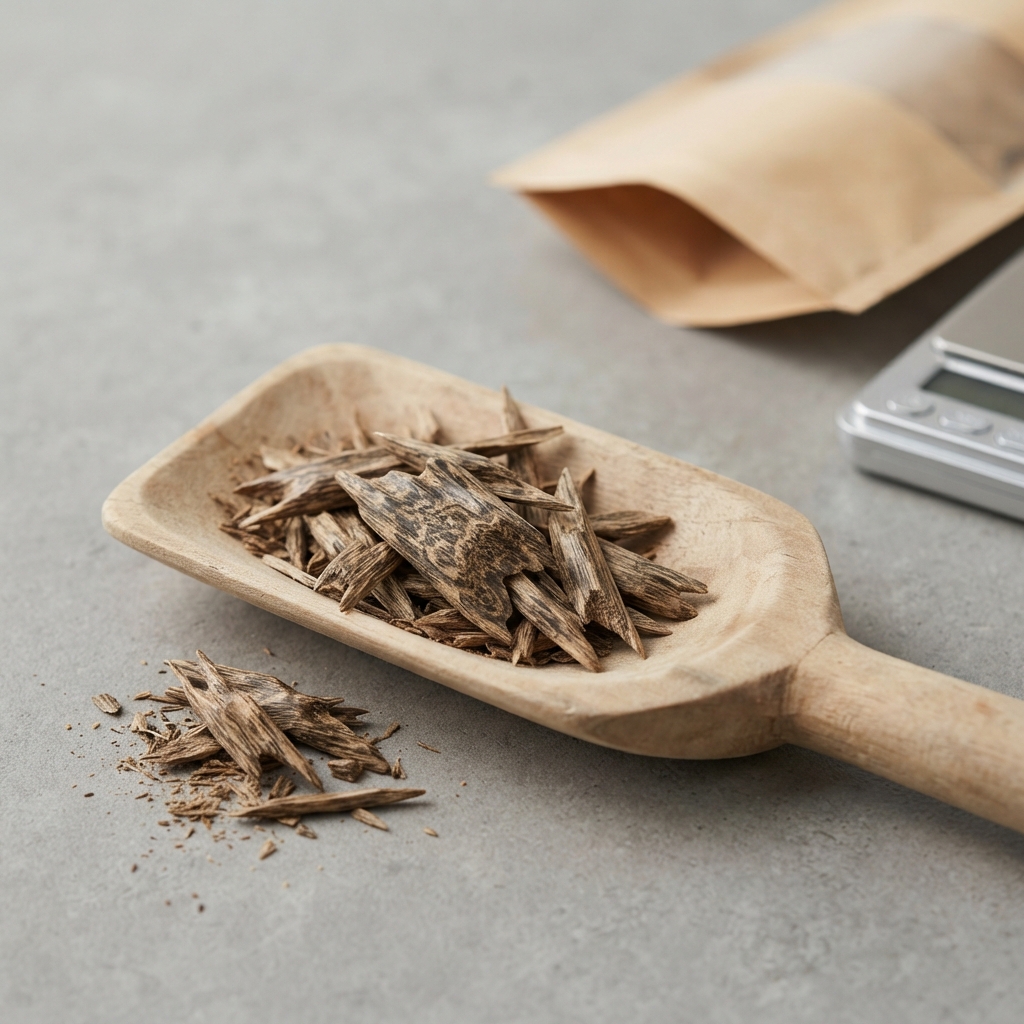
Short answer: agarwood shavings wholesale is priced per kilogram but paid for by volume, so the figure that decides your landed cost is packed bulk density, not the number on the quotation. Measure density loose, tapped and compressed; write the packing, compression and net-weight clauses into the order; and convert every bid to cost per usable kilogram delivered. A supplier who cannot state a density figure is selling you air and calling it wood.
This guide is written for importers, incense and bakhoor manufacturers, fragrance processors and wood-material wholesalers who have already chosen a thin, sliver-type raw material and now have to move it profitably. It does not re-argue which form to buy: the site’s guide to buying agarwood shavings by measured form covers form selection, the supplier comparison framework covers how to normalize competing quotations, and the repeat-order audit covers drift across shipments. The gap this article fills sits between all three: the physics of a low-density material in a container, and the money that physics moves.
Why shavings are the most freight-sensitive agarwood form
Agarwood is traded in four common physical forms, and each name describes geometry rather than quality. Chips are distinct pieces cut to a usable size. Shavings are thin slivers or curls, usually removed by planing, slicing, sawing or shaping. Granules are small cut or crushed pieces with a more block-like profile. Powder is milled material defined by what passes a screen. No standards body assigns any of those words a resin content, an aroma class or a species, and two suppliers can use the same word for material that behaves differently on your line.
What the words do describe, reliably, is how much space a tonne occupies. Shavings have the highest surface-to-mass ratio of the four, which is exactly what makes them useful in a blend and exactly what makes them expensive to ship. A container has a payload limit and a volume limit, and shavings hit the volume limit first. Once that happens, every additional kilogram you load is free of freight cost and every kilogram you cannot load is freight you pay for nothing.
The number that decides your landed cost
Packed bulk density is mass divided by the volume the material occupies in its shipping condition — not in a laboratory beaker, and not as it looks in a photograph. It is usually expressed in kilograms per cubic metre or grams per litre. Two lots of identical wood, cut to different sliver thicknesses and packed at different pressures, can differ substantially in density, and the difference shows up as freight, warehouse space and pallet count long before it shows up in your finished product.
This is why a shavings quotation compared on price per kilogram alone is not a comparison at all. The number that ranks suppliers is cost per cubic metre of usable material delivered, or its equivalent, cost per usable kilogram after freight. Both require one input that most quotations omit: a density figure with a stated method.
What a density figure has to say to be usable
Three things. First, the condition: loose-poured, tapped to a stated number of drops, or compressed at a stated force. Second, the container: a calibrated cylinder or a production bag, with its dimensions. Third, the moisture condition at the time of measurement, because water adds mass without adding wood and a damp lot will always appear denser than a dry one. A supplier who quotes “about 200 kilos per bag” has told you a packing decision, not a material property.
Agarwood Raw Material Specification Comparison Table
The table compares the four forms by how they behave in a container, what you are really paying freight on, which specification items decide acceptance, where each tends to fit in production, and where the handling risk concentrates. It deliberately contains no universal density figures, size numbers or price levels: those depend on species, cut, moisture and packing, and inventing them would create exactly the disputes this guide exists to prevent.
| Form | Packed bulk behaviour | What you actually pay freight on | Specification items that decide acceptance | Typical process fit | Freight and handling risk |
|---|---|---|---|---|---|
| Chips | Discrete pieces that stay separate; little compression under normal packing; void space between pieces dominates | Volume, but with predictable voids and stable pallet build | Piece size and thickness range, share below target size, visible foreign matter, moisture basis, net weight per unit | Direct heating and bakhoor blends where pieces must stay visible; feedstock for milling or extraction | Size described only as “small” or “large”; photographs from a better lot than the one shipped |
| Shavings | Thin slivers with high surface-to-mass ratio; settles and compresses in the bag; density rises sharply once pressed | Volume first, then compression — you buy the space, not the wood | Sliver thickness and length limits, screen fractions by mass, fines and dust share, density condition and method, compression, net weight, packing | Blending and bulking a formulation; feed for further grinding; applications wanting fast, even heating of small pieces | Form name treated as a grade; silent drift when the upstream production job changes; dust paid for at wood price |
| Granules | Block-like pieces with better flow than slivers; moderate compression; segregation in transit | Volume, with a more even fill than shavings | Screen range and opening in millimetres, oversize and undersize limits, fines share, segregation, cleanliness | Dosing and blending where a consistent small piece feeds better than irregular chips | “Mesh” quoted without an opening; top of the bag differs from the bottom on arrival |
| Powder | Milled material; compacts easily; flow and clumping decide both density and usability | Weight more than volume, but compaction and clumping change the fill | Sieve convention, permitted oversize, clumping and flow behaviour, moisture condition, barrier packaging | Incense formulation and binding, where the material must disperse through a mix | Fineness given as one mesh number; a powder that disperses in one binder fails in another |
Reading the table as a freight question
Do not read the rows as a ranking of quality. Read the second column as a warning: for shavings, the density you are quoted depends more on how the supplier packs than on what the supplier grows. That is unusual in raw materials, and it is the reason a density clause belongs in the purchase order next to the specification.
How to measure packed bulk density repeatably
Density measurement is not laboratory science, and it does not need to be. It needs to be identical every time, so that two containers can be compared. A calibrated cylinder, a scale, a straight edge and a written procedure are enough.
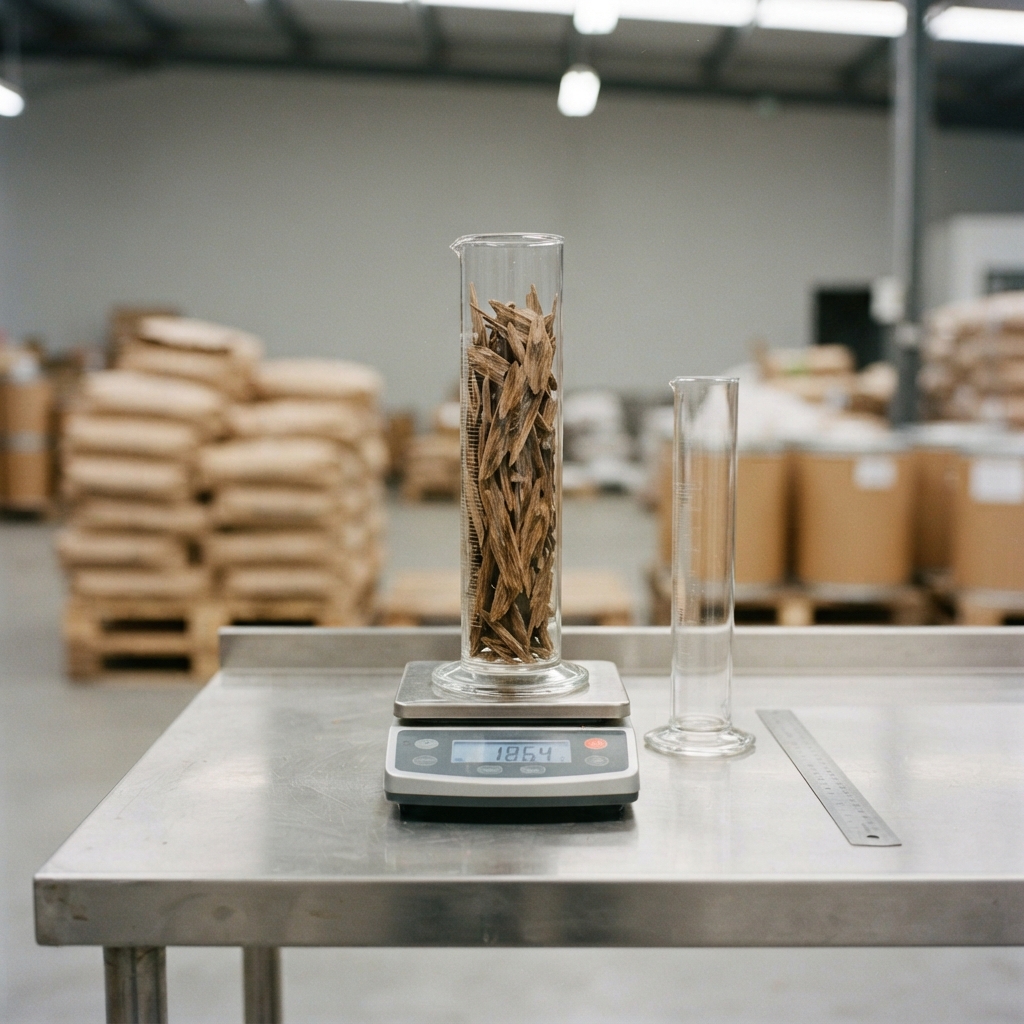
Loose, tapped and compressed: three different numbers
Pour the material into the cylinder from a fixed height and strike it level without shaking: that is the loose or poured density, and it is the closest thing to what happens when a bag is filled by gravity. Tap the cylinder a stated number of times and top it up: that is the tapped density, and it approximates what the material does after a week on a pallet in a container. Press the material to a stated force or to a marked volume and weigh what fits: that is the compressed density, and it is the number that decides how much you can actually load.
Report all three, or at minimum report which one you measured and how. A single figure with no condition attached is not a measurement; it is a preference expressed as a number.
The measurement record
For each lot, record the cylinder or container dimensions, the fill method, the number of taps or the compression force, the mass, the calculated density, the moisture condition at the time, and the date. Then repeat the same procedure on arrival. Two records made the same way let you see whether a supplier changed the cut, the packing or the drying — and a change in density with no change in price per kilogram is a price increase you did not negotiate.
Compression is not free: what pressing a bag does to the material
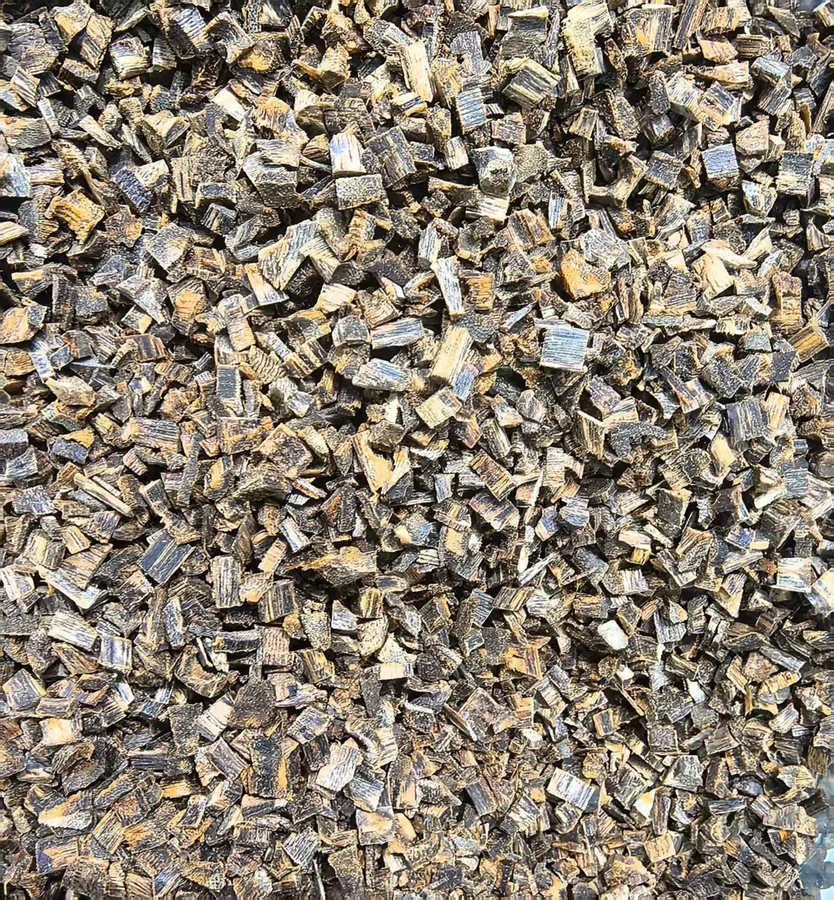
Compression is the obvious answer to a volume-limited container, and it works — up to a point. Pressing a bag of shavings increases the mass per cubic metre, which lowers freight per kilogram, which is real money on a full container. What it also does is change the material.
Where the fines go
Thin slivers break. Every handling step generates some material below your useful size, and compression concentrates that breakage at the points where slivers bear load against each other. The result is a lot that measures acceptably at dispatch and arrives with a higher fines share than the sample suggested, because the pressing happened after the supplier’s check. This is not dishonesty; it is physics, and it is why the clause you want names the arrival figure as the one that governs, not the dispatch figure.
The commercial consequence is straightforward. If compression raises your usable share by a few points but raises fines by more, you have paid freight on material you will screen out. Measure both on the same lot, in the same condition, before you accept a compression level as a saving.
The compression clause
Write down whether the material is compressed, to what extent, by what method, and what the acceptable fines share is after compression. Then state the consequence of exceeding it. “Compressed for container optimisation” is a description; “compressed to a stated density, with fines passing the agreed opening not to exceed an agreed share on arrival” is a clause. The difference between those two sentences is the difference between a claim you can make and a conversation you will lose.
Writing the packing specification
Packing is where density, moisture and contamination are decided, and it is the part of the specification buyers most often leave to the supplier’s judgement. Four items carry most of the value.
Unit, liner and pallet
State the net weight per unit and the tolerance, the inner liner and whether it is a moisture barrier, whether the material is compressed, how the unit is closed, and how units are stacked. Shavings settle, so a bag filled by volume can look full and weigh short; specify net weight and weigh a sample of units on arrival, which is the cheapest inspection available. Odour isolation matters more than buyers expect, because agarwood is bought for its smell and a liner that transfers the smell of a container or a neighbouring cargo has destroyed value without changing any measurable specification. The site’s guide to oud chips packaging and storage sets out the pack-specification structure in more detail; the principles carry across to sliver material.
Container load plan and the volume trap
Ask for the load plan: how many units per pallet, how many pallets per container, and what the planned gross and net weights are against the container’s payload limit. A load plan that reaches the volume limit with tonnes of payload unused is normal for this material, and it is the single most useful document a supplier can send you, because it tells you what you are actually buying per container. A supplier who cannot produce one is loading by experience, which is fine until the experience is someone else’s.
Moisture and shelf life in the pack
Agree whether moisture is expressed as received or oven-dry, which method is used, and where in the chain it is measured. Thin material picks up and loses water faster than chips, so a pack that is adequate for a chip lot may be inadequate for a shavings lot on a long route. Water is bought at the price of resinous wood, and it also changes density, which changes the freight arithmetic you just did.
From FOB to cost per usable kilogram
A price per kilogram is not a purchasing cost. The comparable figure is:
Cost per usable kilogram = (material + screening or handling + packing + freight + duty and compliance + inspection) ÷ usable fraction
For shavings, both the numerator and the denominator move more than they do for chips: freight is higher per kilogram because you are shipping voids, and the usable fraction is lower because a meaningful share of the weight falls below your useful size. As an arithmetic illustration only — invented numbers, not a market price — a lot quoted at 100 per kilogram with 78 per cent usable material costs about 128 per usable kilogram before freight. A second lot at 112 with 93 per cent usable costs about 120. Add the same 12 per kilogram of freight, duty and inspection and the figures become roughly 140 and 132. The cheaper quotation is the more expensive material, and no published wastage rate would have told you so, because the usable fraction is a property of your process and that lot, not of the trade.
Costs that never appear on the quotation
- Warehouse volume. Low-density material occupies space for months; storage is charged by volume, so a bulky lot costs more to hold even at the same tonnage.
- Dust in your building. Fine sliver material generates airborne dust in handling, and extraction and cleaning are real costs that a bag price hides.
- Bag-to-bag variation. If fines concentrate in the last units of a pallet, your average usable share is worse than the sample suggested.
- Stopped production. A lot that fails at the mixer costs more than the material, because the line and the schedule are already committed.
- Re-screening labour and disposal. Material you screen out has to go somewhere, and the labour and the disposal both appear in your accounts, not the supplier’s.
Ask every supplier to quote on the same screening and packing basis, so the comparison stays like for like. A bid priced on unscreened, uncompressed material is not competing with one priced on screened, compressed material, even when both numbers sit in the same column.
Documents, form and compliance
Agarwood-producing species are regulated in international trade. The CITES working document on agarwood-producing taxa records that the species concerned — Aquilaria spp. and Gyrinops spp. — are listed in Appendix II, and the IUCN and TRAFFIC review of agarwood trade notes that the listing requires permits before export or re-export. In practice the exporter must hold the correct documentation before shipment, the permit description must match the actual product form, and the importer must confirm what its own authority requires for that species, source and route. Plantation origin does not settle the question by itself, and a product name certainly does not. Confirm the requirement for your exact shipment with your supplier, your customs broker and the relevant national authority. See the CITES CoP20 working document on agarwood-producing taxa.
Two practical points follow. First, customs classification follows the form and treatment of the goods, so a shavings shipment is not automatically classified like a chips shipment, and the declared description has to agree with the permit. Second, the net weight on the packing list is a commercial document: if it disagrees with what you weigh on arrival, that disagreement is your evidence, and it is worth photographing the scale reading rather than describing it later.
Agarwood Shavings Supplier Evaluation Checklist
Score two to four candidates on the same sheet, and weight the criteria so that a strong answer on price cannot outvote a weak answer on lot linkage. The weights below are a starting structure, not a rule; what matters is that you apply the same ones to every candidate and record the evidence behind each score.
| Criterion | Weight | What to verify | Evidence to keep | Red flag |
|---|---|---|---|---|
| Density and packing data | 20 | Density condition, method and container stated; load plan with units per pallet and per container; compression level and its effect on fines | Density record sheet, load plan, packing specification, arrival weights from a sample of units | “About 200 kilos per bag” with no method or load plan |
| Specification and method | 20 | Form and production route, thickness and length limits in millimetres, screen fractions, fines definition and limit, moisture basis, method for each | Signed specification sheet or the specification section of the quotation; your own repeat measurements | Adjectives such as “clean” or “premium” with no measurement |
| Sample and lot linkage | 15 | How the sample was drawn, which lot it represents, whether bulk supply comes from the same material, retained portion stored | Sample ID and date, scaled photographs, written lot-linkage statement | Sample “from a similar run” with no lot reference |
| Batch consistency | 15 | How lots are assembled, expected run-to-run variation, notice given when the upstream cut or packing changes | Lot records, previous shipment data, written change-notification commitment | Claim of perfect uniformity from natural material |
| Documentation and compliance | 10 | Company identity matching bank and permit holder, species and source, CITES and phytosanitary papers, declared description against actual form | Draft document set, broker confirmation, permit copies | Permit questions deferred until after payment |
| Logistics and lead time | 10 | Incoterm, lead time by stage, routing and transhipment, insurance, container utilisation | Quotation terms, freight quote, load plan | Lead time given as one number with no stages |
| After-sales and remedy | 10 | Inspection window, defect definitions, who pays for re-screening or return, replacement availability, named contact | Written claim clause, remedy ladder, record of a past dispute | No remedy beyond “we will check with the factory” |
Multiply weight by score and total to 100. Band the result: 80 and above, approve for a trial order; 60 to 79, approve conditionally with the weak areas written into the order; below 60, develop or decline. A blank answer is a finding, not a neutral result — a supplier who cannot answer one area should not be ranked above one who can.
What NanjaOud publishes today
Precision here protects both sides. The public range covers agarwood raw materials and chips — irregular wood fragments with natural grain and varying brown tones, described for sorting, blending, further grinding and incense-related processing, plus a smaller chip format presented for portioning, blending, repacking and grinding — and incense-grade agarwood powder for stick, coil and cone production. There is no separate published product named “shavings”, and no published density figure, sieve range, fines limit or moisture figure for a shavings item. A buyer with a genuine sliver requirement should treat it as a specification conversation: send the cut, the measured size range, the density condition you need, the fines and moisture basis, your sample requirement and your intended process, and ask which existing cut can be matched and sampled.
What the published material information does support: the company reports more than ten years of agarwood cultivation experience and a managed plantation base of more than 1,000 mu in Jiangmen, Guangdong, with its own processing facility, no chemical agents used to accelerate resin formation in cultivation, and ODM cooperation covering custom processing, specifications and packaging for overseas buyers, with supply to the Middle East, Southeast Asia, Europe and the Americas. The quality and supply page states that internal grade labels are supplier references rather than a universal standard. Any purchase should rest on an approved sample and a written specification, not on a label or a form name.
Six mistakes that cost more than the price difference
- Comparing price per kilogram across different packing. One bid is compressed and one is not; the comparison measures the bag, not the wood.
- Accepting a density figure with no condition. Loose, tapped and compressed are three different numbers, and only one of them describes your container.
- Optimising compression without measuring fines. The freight saving and the screening loss land in different budgets, which is why one gets approved and the other gets discovered.
- Ignoring warehouse volume. A bulky lot can be cheap per kilogram and expensive per square metre of the space you pay for.
- Leaving the remedy undefined. A claim clause written after the dispute is a negotiation; one written before it is a procedure.
- Assuming paperwork follows the product name. Species, source and route decide the permit requirement, not the label on the bag.
Frequently asked questions
Are agarwood shavings the same product as agarwood chips?
No. Chips are distinct pieces cut to a usable size; shavings are thin slivers, often a by-product of planing, slicing or shaping. They pack, settle and process differently, and they occupy very different volumes per tonne, so they should be specified, sampled and priced separately even when both come from the same wood.
How should particle size be stated for shavings?
Give thickness and length limits in millimetres plus the screen openings used to measure fractions, and the permitted share passing the lower opening. A single mesh number describes sliver material poorly, because a long thin piece can pass an opening while still being awkward to feed and dose.
Why does bulk density matter if I buy by weight?
Because freight, storage and container space are charged on volume. At a fixed price per kilogram, a lower-density lot costs more to move and to hold, so the effective price rises. Density is the input that converts a quotation into a landed cost.
What sample should I request before a wholesale order?
A sample drawn from the lot being offered, with the drawing method and lot reference stated, plus written confirmation that bulk supply will come from the same material. Keep a labelled retained portion and store it in the packaging you expect to receive, so the arrival comparison is like for like.
Is there a standard MOQ for agarwood shavings?
No. Minimums follow lot assembly, cleaning batches, packing runs and the document set for the destination, and they differ by supplier and by form. Ask what quantity allows a representative sample and a genuine processing trial, and treat a minimum that prevents proper testing as a reason to start smaller elsewhere.
How do I verify quality without a laboratory?
Measure what you can repeat: mass passing each agreed opening, visible foreign particles in a stated sample mass, net weight per unit, moisture by one consistent method, packed density in a stated condition, and the usable share recovered from a small production run. A laboratory result is useful when the method and sample are identified, but a supplier’s adjective is not evidence.
What documents matter for an international shavings shipment?
The set depends on species, source and destination, and normally involves CITES permits where the taxa are listed, a commercial invoice, a packing list, a bill of lading and any phytosanitary certificate your market requires. The permit description must match the form actually shipped, so confirm the requirement for your exact consignment with your supplier, broker and national authority.
Conclusion
Agarwood shavings wholesale is bought well when the buyer treats density as a specification item, measures it the same way on every lot, writes the packing and compression clauses before the container is loaded, and compares bids on cost per usable kilogram delivered rather than on the number in the price column. That structure turns a conversation about bags into a comparison of numbers both sides can check.
Start from your end use: how the material will be fed, blended, burned or milled, what your process cannot tolerate, and how much space a tonne of it will occupy in your warehouse. Then send NanjaOud the target material form, your sample requirement, the specification items you need confirmed, your expected purchase quantity and your destination market through the contact page, and the team can tell you which current cut and sample options can be matched to that brief — and which points still need verification before a quotation means anything.


