

Oud chips packaging is the part of a purchase order that decides whether the kilogram you bought is still the kilogram you receive. Moisture regain, mould, crushing, fines and aroma loss all happen between the packing bench and your warehouse, and none of them show up in a price per kilogram. A workable pack specification fixes the barrier, the desiccant, the carton, the label and the receiving check before production starts — so the pack is quoted like the material instead of being improvised at shipment.
This guide is written for importers, distributors, incense manufacturers and private-label brands buying wholesale oud chips. It sets out what a bulk pack has to do, the fields to specify in an RFQ, how bulk, retail-ready and private-label packs differ, what happens to wood in a container, and how to store and receive chips without losing the margin you negotiated.
Why the pack decides more than the unit price
Agarwood chips are a hygroscopic material sold by weight at a high price per kilogram. That combination creates a specific commercial exposure: the product takes on and gives off water with the surrounding air, so the weight you pay for and the weight that arrives can differ without anyone changing the cargo.
Wood does not hold a fixed moisture content. It settles at an equilibrium moisture content (EMC) that rises and falls with the relative humidity around it, which is why kiln-dried or conditioned material stored in the wrong environment simply regains moisture (Oregon State University Extension, “Wood and Moisture Relationships”; Purdue Extension, “Controlling Moisture Content in Stored Lumber”). Oud chips are not lumber, but the mechanism is the same, and it explains most of the arguments that begin with “the bags were heavier at loading”.
Three losses follow from a weak pack, and each one is paid for by the buyer:
- Weight you cannot invoice. Water is bought at chip price. A 1,000 kg lot declared at 12% moisture carries about 120 kg of water; if that lot equilibrates to 8% in a dry warehouse, roughly 43 kg of the weight you paid for has evaporated. The dry wood is unchanged; your cost per usable kilogram is not.
- Surface mould and staining. Wood held in a damp, poorly ventilated pack can develop surface growth long before structural decay becomes an issue. Mould is a rejection reason in most markets, and it is usually a storage and packing failure rather than a material failure.
- Aroma contamination and loss. Agarwood is bought for its scent. Chips packed next to detergent, spice or solvent cargo can pick up foreign odours, and volatile aromatic compounds move out of the wood into any headspace that keeps exchanging with the outside air.
None of these is visible on a supplier’s product page. All of them are addressable with four or five lines in an RFQ, which is the cheapest quality intervention available to a chip buyer.
The four jobs a bulk pack has to do
1. Control moisture exchange, not just “keep it dry”
A pack is not a sealed vault. It is a barrier with a measurable transmission rate, and it works together with the desiccant, the headspace and the temperature history of the shipment. The objective is to limit how much water vapour reaches the wood during transit and storage, and to give yourself a way to see whether it worked.
2. Protect the aroma
Two rules cover most of the risk: the pack should be odour-neutral (no solvent-based inks on the inner surface, no recycled liner with printing residue, no perfumed desiccant), and the outer carton should carry a handling instruction that keeps the goods away from strongly scented cargo. Buyers who repack should apply the same rule in their own warehouse.
3. Survive handling and stacking
Chips are dense, angular and abrasive. In a stack, the bottom cartons carry the load of everything above them, and vibration abrades edges into fines. A pack that arrives intact in a palletised air shipment can fail in a 40-foot container where cartons are double-stacked and handled repeatedly. Carton grade, fill level and compression matter more than the printed design.
4. Satisfy documents, labels and traceability
The pack is also a document carrier. Agarwood-producing Aquilaria and Gyrinops species are listed in CITES Appendix II, so the commercial shipment travels with permits that describe the goods and the quantity (FAO, “CITES, trade and sustainable forest management”). If the carton label, packing list and permit description disagree, the problem surfaces at the border, not at the factory. Labels also carry the lot reference that connects the delivered cartons to the sample you approved.
A bulk pack specification you can paste into an RFQ
The table below is a specification skeleton, not a fixed recipe. Agree the values against your destination, transit time and storage plan, then confirm them on the pre-production sample. What matters is that every field is answered in writing instead of being left to the packing bench.
| Specification field | What to agree | Why it decides the outcome |
|---|---|---|
| Primary liner | Food-contact-grade polyethylene bag inside each carton; gauge stated in microns | The liner is the main vapour barrier; an unstated gauge is an unstated barrier |
| Closure | Heat-sealed or tightly tied, with the method named | A folded bag is not a closure; loose necks leak moisture and odour |
| Desiccant | Food-safe sachet, type, grams per carton, and whether it is visible at opening | Handles the headspace moisture the liner traps at packing |
| Carton | Double-wall corrugated with a stated edge crush test (ECT) grade, taped or strapped | Stacking strength and abrasion resistance under container loading |
| Inner protection | No printing on the inner face; optional food-grade liner sheet against the bag | Prevents ink and recycled-fibre odour transfer to the chips |
| Net weight per unit | Declared net weight, tare allowance and the scale basis used | Connects the invoice weight to a checkable unit |
| Palletisation | Pallet type, cartons per layer, layers per pallet, stretch-wrap and corner protection | Drives both damage rates and chargeable volume |
| Label content | Product, internal grade reference, lot number, net weight, packing date, destination, handling instruction | The lot number is the only link back to your approved sample |
| Document consistency | Goods description on the label matches the packing list and permit description | Mismatches stop shipments at destination |
| Repack option | Whether the supplier can pack to your unit weight and format, and at what minimum | Repacking later adds labour, new liners and a second moisture cycle |
Two fields do most of the work in a dispute: the lot number on the label and the stated liner and desiccant. Without them, a moisture or mould claim becomes a conversation about the weather.
Bulk, retail-ready and private-label packs are three different products
Buyers often brief one pack and expect three outcomes. They are separate projects with separate minimums, and conflating them is why packaging quotations arrive late or incomplete.
| Pack type | What it is for | Commercial implications |
|---|---|---|
| Bulk pack | Material moving to a factory, distiller or distributor who will process or repack | Lowest cost per kilogram; the buyer owns moisture control after opening; minimums are stated per kilogram |
| Retail-ready pack | Finished unit for shelf or e-commerce, with fixed unit weight and printed information | Minimums per SKU, artwork and dieline approval, unit-level label compliance, and a pack that must protect the product through retail handling |
| Private-label pack | Your brand on the supplier’s format, or a format developed for you | Artwork ownership, pre-production sample approval, barcode and language requirements, and a decision on who holds the print tooling |
One customs point is easy to miss. A retail-ready or private-label pack can be classified and described differently from bulk chips, which affects both duty treatment and the goods description on the permit. Confirm the retail pack with your import broker before you approve print, not after the cartons are made.
For the program side of this decision — minimum runs, artwork ownership and how a private-label brief is structured — see the guide to oud chips private-label manufacturing.
What actually happens to chips inside a shipping container
Two mechanisms cause most transit damage, and neither is visible in a loading photograph.
Condensation from temperature cycling
A container loaded in warm, humid air and then cooled at night or at sea creates condensation on cool internal surfaces. Water that forms on the roof and walls drips onto the top layer of cartons, and a carton that absorbs water passes it inward. This is a general freight phenomenon rather than an agarwood-specific one, and it is why the outer carton, the pallet wrap and the liner are all part of one system rather than three separate line items.
Compression and abrasion
Chips settle during transit. The cartons at the bottom of a stack carry a load they were not tested for, corners collapse, and edges rub against each other. The visible result is deformed cartons; the commercial result is fines and broken pieces at the bottom of the bag, which can breach a maximum-fines term in your specification even though the material was correct at loading.
Both mechanisms argue for the same thing: specify carton grade and palletisation explicitly, and photograph the stack before the doors close.
Storage after arrival: a storage plan, not a shelf
Once the goods are in your warehouse, the pack continues to work or fail. A practical storage plan covers five points.
- A stable, dry store. The specific temperature and relative humidity band matters less than the fact that you have chosen one, can measure it, and keep it stable. Wide swings move the wood between moisture states repeatedly, which is harder on the material than a steady condition at the same average.
- Keep the liner closed until use. An opened bag in a humid store is an open invitation for the wood to equilibrate upward. Reseal partially used units and record the opening date.
- Segregate odours and pests. Chips should not share space with cleaning chemicals, spices, solvents, or goods that harbour insects. Use sealed units and periodic inspection rather than relying on repellents that could taint the material.
- Stack within the carton’s capability. Rebuild pallets to a height the carton grade supports, keep cartons off a bare concrete floor, and avoid point loads that crush the bottom layer.
- Run FIFO with a written log. Lot, receipt date, moisture reading at receipt, unit count and any repack event. The log is what makes a claim possible months later.
For the pricing side of moisture — as-received versus dry basis and how water changes the number you are quoting against — the guide to oud chips moisture content sets out the measurement logic in more detail. Storage and moisture are the same conversation seen from two ends of the shipment.
Receiving check: eight steps before you sign
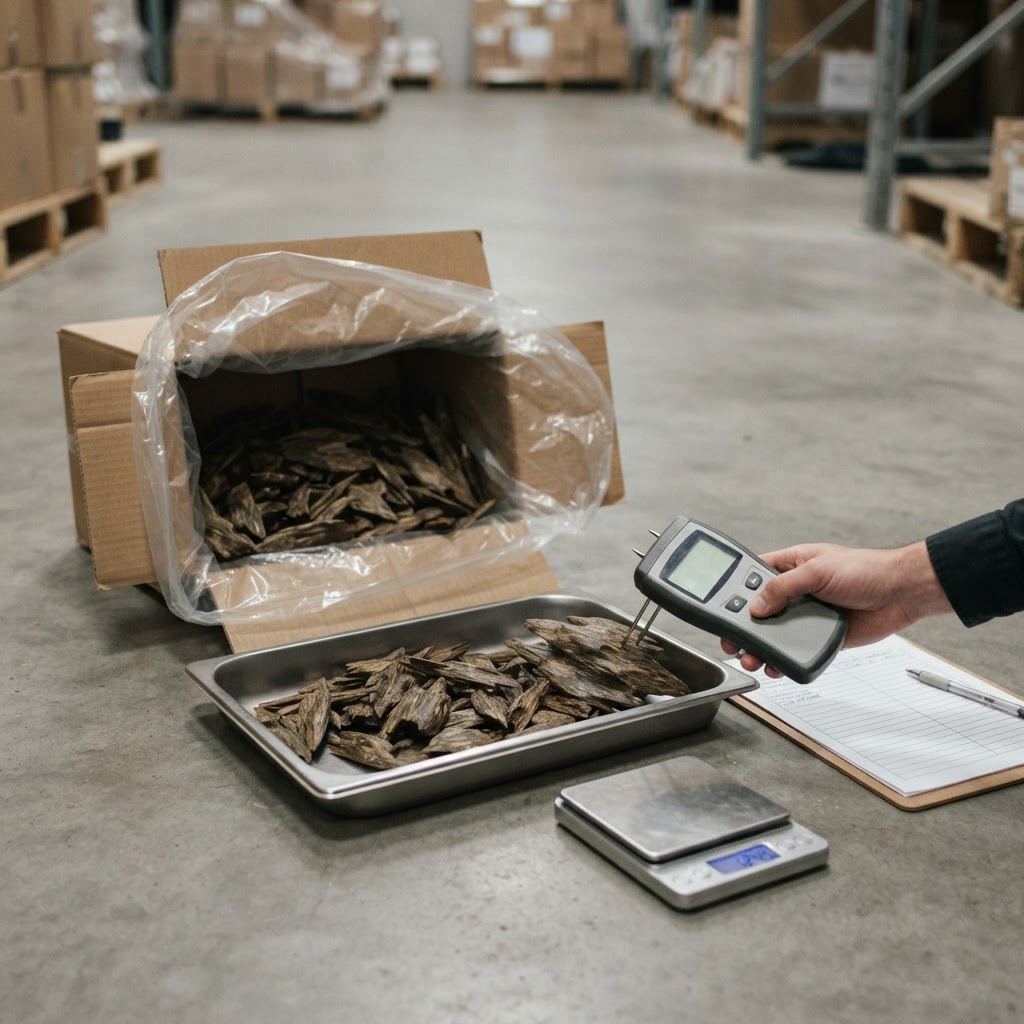
- Count and weigh. Cartons against the packing list, and net weight against the invoice, with tare deducted.
- Inspect the outside first. Damp patches, staining, crushed corners, broken tape and a damaged stretch-wrap are all indicators of what is inside.
- Check seal integrity. Open a sample of cartons, not all of them; record whether liners were sealed or merely folded.
- Confirm the desiccant. Presence, quantity and condition. A saturated sachet at opening tells you the pack worked hard or the closure failed.
- Take a moisture reading on an agreed number of units using the method named in your specification, and write the figures down.
- Inspect for mould, staining and foreign matter under consistent lighting, against the retained approved sample.
- Screen a scoop sample for fines and oversize against the size band you agreed.
- Photograph and retain. Sealed cartons, labels, damaged units and the sample you drew — then start the claim clock if anything fails.
Step eight matters because most quality claims are lost on evidence rather than on facts. The protocol for documenting an arrival and escalating a defect is covered in the guide to oud chips claims and arrival inspection.
What a bad pack costs, in a form you can calculate
Packaging decisions are usually argued on unit cost, which is the smallest number in the equation. A more useful calculation for each candidate pack is:
Pack failure cost = rejected kg × landed cost per kg + rework labour + replacement freight + delay cost of the dependent production run
Then compare that with the difference in pack cost per kilogram between the two options. In most programmes the gap between a basic pack and a specified one is a small fraction of the landed cost, while a single rejected container carries the whole landed cost plus replacement freight. That asymmetry, not the unit price, is the argument for specifying the pack.
Eight questions to put to an oud chips manufacturer
- What liner and gauge do you use as standard, and can it be upgraded for a long transit?
- Do you seal the liner, and how do you verify the seal?
- What carton grade do you pack in, and what stacking height does it support?
- How do you control moisture before packing, and do you record it?
- Can you label every carton with a lot number that matches my approved sample?
- What is the minimum for a retail-ready or private-label pack, separate from the bulk minimum?
- Who owns the artwork and dielines, and can I move them to another supplier?
- Which packaging and documentation costs are included in the quotation, and which are added at shipment?
A supplier who answers these in writing is describing a production process. A supplier who answers them after the order is describing an intention.
How NanjaOud approaches packaging and storage questions
We treat the pack as part of the product specification, because that is where most avoidable losses occur. What we can state from our own documentation:
- Packaging scope. Bulk packaging, retail-ready packaging, private-label packaging, product protection during shipment and international B2B delivery coordination are all part of our published supply framework. Packaging is defined per project against the product, quantity, target market and private-label direction.
- Source and processing. More than ten years of agarwood cultivation experience and a managed plantation base of more than 160 acres in Jiangmen, Guangdong, with product documentation referring to more than 1,000 mu of standardized plantation resources; an in-house processing factory covering wood, powder, oil and incense formats; a stated cultivation practice with no chemical resin-induction agents.
- Grading. A, B and C labels are internal supplier references where listed. They are not presented as a universal or international grading standard, and final requirements are confirmed through the specification, visual review, quotation and approved sample.
- Quality checks. Our framework covers material selection, visual and format checks, weight and packaging confirmation, batch and order records where applicable, and pre-shipment confirmation. It does not imply a certified quality system or laboratory testing of every batch.
- Commercial terms. MOQ, lead time, freight, ports, Incoterms and stock quantities are confirmed in the quotation rather than fixed on a web page.
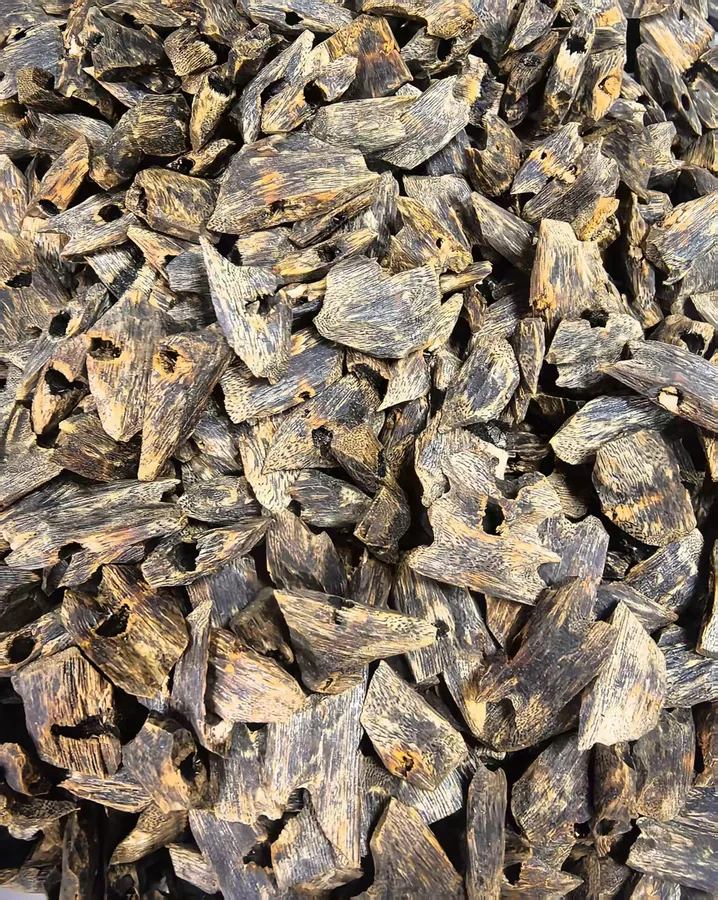
On chips specifically, our current range covers agarwood raw materials and chips, including natural large chips with intact pieces and visible grain for incense use, further cutting, grinding and distribution, and natural small chips suited to portioning, blending, repacking and further grinding. Formats, internal grade references and pack direction are confirmed against your application and approved sample rather than assumed from a catalogue page. If you need a specific liner, carton grade, unit weight or private-label format for your market, state it in the inquiry and we will confirm what applies to your order.
Common mistakes in oud chips packaging and storage
- Treating packaging as a free extra. If it is not itemised in the quotation, it is either basic or unpriced — and you will meet the difference at shipment.
- Specifying a bag without specifying the closure. The barrier is only as good as the seal.
- Approving a retail pack without checking customs treatment. Classification and permit description can differ from bulk chips.
- Storing opened bags in a humid room. The wood will find the ambient equilibrium, and the weight loss is yours.
- Stacking to the limit of the warehouse rather than the carton. Crushed bottom layers turn into fines and claims.
- No lot number on the carton. Without it, the approved sample cannot be matched to the delivered goods.
- Photographing only the best cartons. Loading photos are only useful if they show the actual stack and the label.
- Waiting for the goods to fail before writing the storage plan. Storage discipline is cheapest before the first container arrives.
Frequently asked questions
What packaging do wholesale oud chips normally ship in?
Most bulk chips move in a plastic liner inside a corrugated carton, sometimes with a desiccant sachet, palletised and stretch-wrapped. The variation is in the details that matter: liner gauge, whether the bag is sealed, carton grade, desiccant quantity and label content. Those details should be written into the specification rather than assumed.
Does packaging affect the declared weight of oud chips?
Packaging affects the tare, and the liner and desiccant affect how much moisture the wood gains or loses after packing. Declare net weight explicitly, state the tare allowance, and agree the moisture basis so the invoice weight and the delivered weight can be compared on the same terms.
How should I store oud chips after arrival?
Keep them sealed in a stable, dry, odour-free store, off the floor, away from chemicals, spices and pest risk, and reseal opened units. Record receipt moisture and monitor the store. The specific conditions matter less than stability, measurement and consistent handling.
Can oud chips go mouldy in transit?
Yes. Wood packed with elevated moisture, in a liner that is not sealed, through a transit with large temperature swings, is at risk of surface mould and staining. The controls are moisture at packing, a sealed liner with desiccant, a sound carton and a receiving check that documents the condition at opening.
Is there a standard moisture level for oud chips?
There is no single international figure for oud chips, and a number without a test method and a basis is not a specification. Agree a maximum at packing, name the method, and state whether the result is reported on an as-received or dry-wood basis. Your own trial and market requirements should set the value.
Should I ask for retail-ready packaging on a small order?
Ask, but expect a separate minimum. Retail-ready and private-label packs involve artwork, print setup and unit-level labelling, so the minimum run per SKU is usually different from the bulk-chip minimum. Separating the two questions early avoids a quotation that stalls at the packaging stage.
Who should pay for packaging damage in transit?
It depends on the Incoterm and on what the specification required. If the pack met an agreed specification and the damage came from handling after risk transferred, the claim sits with the carrier or insurer. If the pack did not meet the specification, it is a supplier issue. That is why the pack specification belongs in the purchase order, next to the price.
Does a CITES permit cover packaging details?
The permit describes the goods and quantity, so the carton label, packing list and permit description need to agree. Packaging that changes the nature of the goods — for example a retail-ready finished pack rather than bulk chips — should be confirmed with your broker before production.
Conclusion
Oud chips packaging is a specification problem before it is a purchasing problem. Fix the liner, the closure, the desiccant, the carton grade, the unit weight, the label and the receiving check while the quotation is still open, and the material you approve is the material you can still sell after a month in a container and a season in a warehouse. Leave those fields blank, and the cheapest pack quietly becomes the most expensive line in the order.
For the full buying context, the guide to what drives the wholesale oud chips price per kilogram shows how packaging, documentation and freight sit inside a landed cost, and our quality and supply framework sets out how material selection, grading, order checks and packaging confirmation are handled.
If you are sourcing chips for incense production, fragrance processing, distribution or private label, send your product format, estimated quantity, target market and packaging direction through our contact page. We will confirm what applies to your order, including the pack specification and the documentation available for your destination.


