
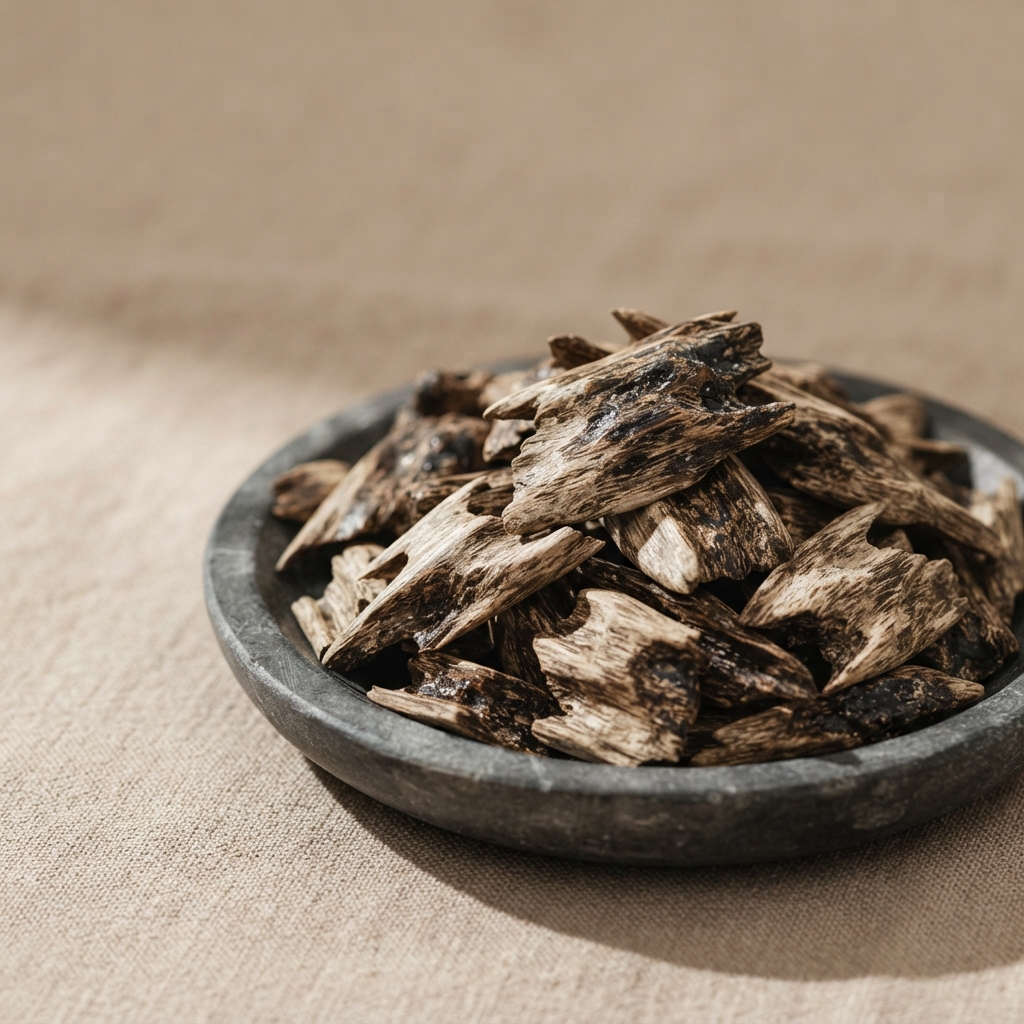
Direct answer: A private-label oud chips program succeeds when the buyer treats it as a specification project rather than a packaging order. You define the material, format, grade reference, acceptance method and packaging in writing, approve a sealed sample, and only then ask an oud chips manufacturer to quote and schedule production. The brand on the carton is the last step, not the first.
Most first orders go wrong in a predictable way: the buyer sends a reference photo and a target price, the supplier replies with a one-line quotation, and both sides discover at shipment that they meant different sizes, different moisture, different sorting loss or different packaging. This guide sets out a program path that keeps those assumptions visible before money and material move.
What “private label” means for a raw material like oud chips
Oud chips are not a formulated consumer product. You cannot reformulate the wood. What you can control is how the material is selected, cut, sorted, packed, labelled and documented. That is what a private-label program actually governs, and it is why the vocabulary matters when you brief a supplier.
| Model | Who defines the specification | What the buyer owns | Typical fit |
|---|---|---|---|
| White label | Supplier | Brand and sales only | Fast market test with a standard item |
| Private label | Buyer, within the supplier’s existing capability | Brand, packaging, grade definition, approval records | Retail or distribution ranges built on existing formats |
| OEM | Buyer | Specification, artwork, acceptance criteria | Buyers who already know exactly what they need made |
| ODM | Supplier proposes, buyer approves | Brand and final approval | Brands that want a developed product rather than a commodity |
The distinction is commercial, not decorative. In a private-label arrangement the supplier’s standard grade range stays in place and your brand is applied to a defined selection of it. In an OEM arrangement you are asking the factory to work to your written specification, which usually means more sampling, more documentation and a slower first run.
What can actually carry your brand
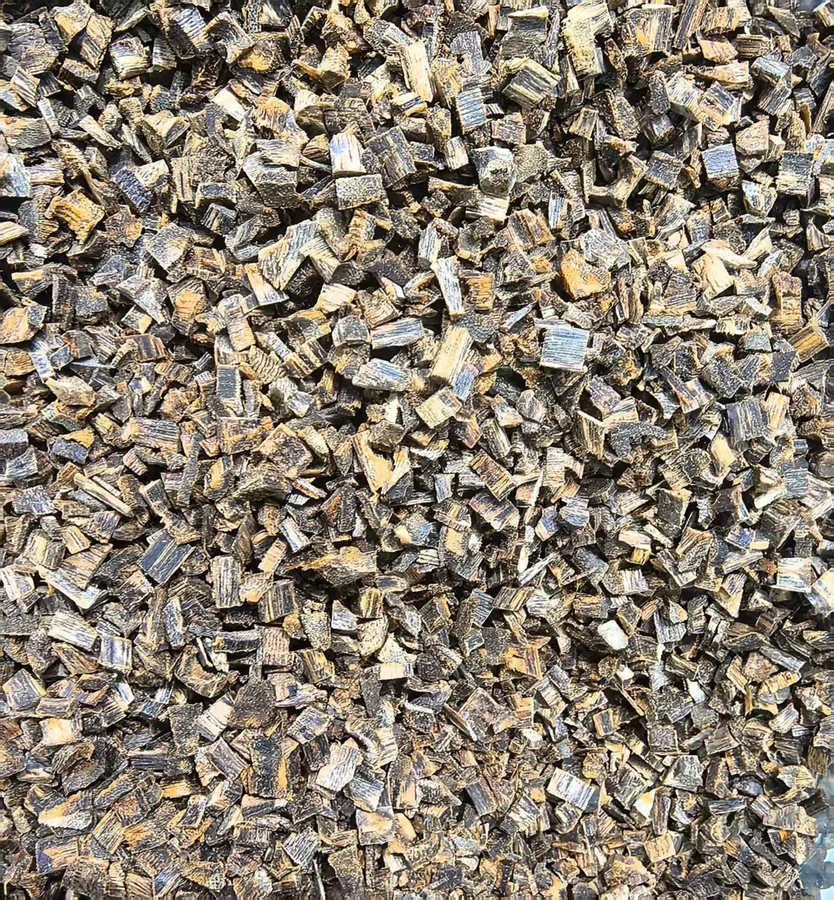
With oud chips, branding applies to four things: the grade definition, the physical format, the packaging, and the paperwork that travels with the lot. It does not change what the wood is. A buyer who expects a private-label order to produce a materially different chip from the supplier’s standard output, at the same price, is usually buying an expectation rather than a product.
- Chips and pieces — large chips, small chips, fragments and slices, each with a different piece profile and downstream use. The site’s agarwood raw materials and chips range illustrates how format is treated as a product family rather than a single SKU.
- Powder — a milling specification, not a chip specification; screen size and fines matter more than appearance.
- Incense — the format where private label is most developed, because scent briefs, stick dimensions and retail packaging all change.
- Oils and blends — where the buyer’s brief has the largest effect on the finished product.
One caution on grade names. Labels such as A, B and C are often internal supplier references, not an international standard. NanjaOud states this explicitly on its quality and supply page: internal grades are scoped to the supplier, and final requirements are confirmed through specification, visual review, quotation and an approved sample. Any supplier that presents a letter grade as if it were a certified classification is telling you something about its documentation discipline.
The six-stage program path
| Stage | Output you should hold | Buyer decision | Common failure |
|---|---|---|---|
| 1. Brief | Written use case, format, target market, volume range | Is this a test or a range? | Brief written around a photo instead of an application |
| 2. Sample | Identified sample with date and lot reference | Approve, reject or re-sample | No record of what was approved |
| 3. Specification lock | Signed spec sheet with acceptance criteria | Freeze the spec | Verbal agreement on size and moisture |
| 4. Packaging and artwork | Approved dieline, label copy, barcode placement | Approve print-ready artwork | Artwork approved after production starts |
| 5. Production | Schedule, batch references, in-process checks | Approve pre-shipment sample | No agreed inspection point |
| 6. Shipment | Packing list, invoice, transport and CITES documents | Release balance payment per terms | Document responsibility left unassigned |
Each stage should produce a document. If a supplier cannot show you what stage you are in, you are not running a program; you are waiting.
Build the specification sheet before you ask for a price
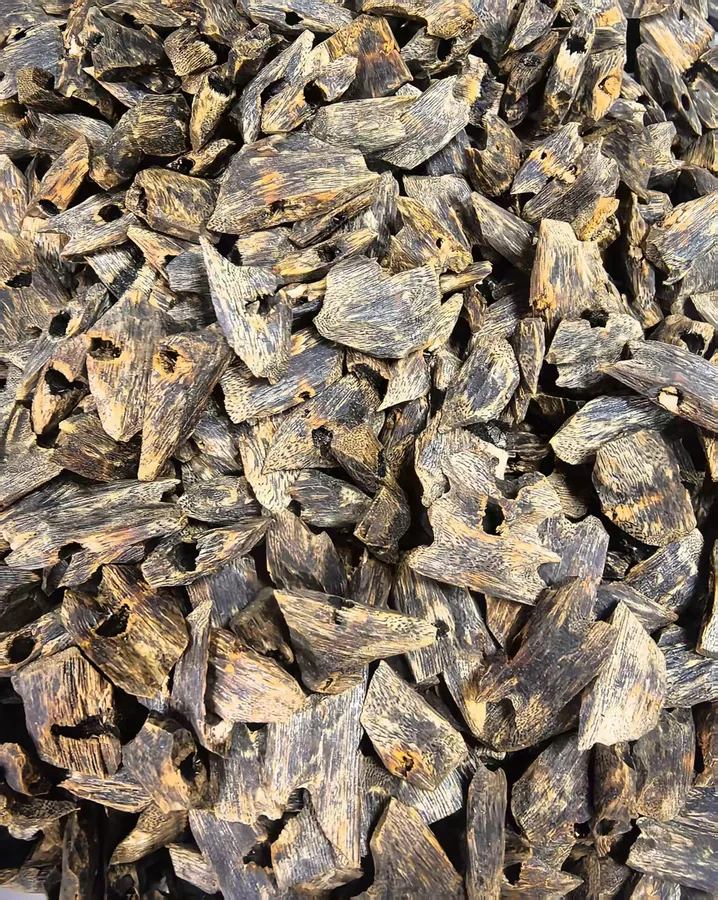
A quotation is only comparable against a specification. Send the same sheet to every candidate and ask each one to quote against it line by line.
| Field | What to state | Why it changes the quote |
|---|---|---|
| Material and genus | Species or genus claim, cultivated or wild origin statement | Different material classes carry different legal and cost profiles |
| Format | Chip, fragment, slice, powder, stick; piece size range | Cutting and screening losses differ by format |
| Grade reference | Your description plus an approved sample ID | Sorting yield drives the real cost per kilogram |
| Moisture basis | How moisture will be stated and, if tested, by which method | Water weight is paid for at material price |
| Foreign matter and fines | Acceptance limits and how they are checked | Determines whether you buy wood or wood plus dust |
| Packaging unit | Inner bag, desiccant, carton weight, retail unit | Packaging is a separate cost line, not a free extra |
| Artwork and labels | Dieline, copy, barcode, language requirements | Print setup and approval time affect the schedule |
| Quantity and shipment plan | Trial quantity, repeat volume, shipment frequency | Volume and repetition change the commercial terms |
| Delivery terms | Incoterm and named place | Defines who pays freight, insurance and import clearance |
| Documents | CITES permit, certificate of origin, packing list, invoice | Documentation effort and lead time sit with a named party |
| Acceptance method | Who inspects, when, against what criteria | Turns a disagreement into a defined process |
MOQ, sampling and the real cost drivers
Minimum order quantities for oud chips are usually production constraints before they are sales rules. A narrow grade has to be sorted out of a larger volume of material, so a small order of one grade can cost more per kilogram than a larger order of the same grade. That is why “MOQ” and “price” should never be negotiated separately.
Ask for a price at two or three volumes against the same specification. A supplier that can only quote one volume is either unwilling to expose its cost structure or unable to plan production. NanjaOud confirms MOQ, lead time and delivery terms in the quotation rather than publishing fixed numbers, which is the correct place for them: they depend on the material, format, quantity and destination.
Make the sample do real work
- Ask whether the sample is drawn from the offered lot or is a representative reference. These are different promises.
- Record the sample ID, date received and the exact observations you approved.
- Keep a sealed counter-sample, stored the same way as the bulk material.
- Test the sample in your actual process — burn, mill, blend or repack — not only by eye.
The sample request guide sets out a fuller record-keeping method that applies equally to chips.
What actually moves the price
Grade yield and hand sorting, moisture content, screening loss, packaging type, artwork setup, third-party testing, freight mode and destination documentation. A quotation that lists only a price per kilogram has collapsed most of those into one number, which makes it impossible to see what happens when your volume or packaging changes.
Packaging, labels and CITES documents
Private-label packaging is where brand expectations and regulatory reality meet. For bulk chips, the practical questions are barrier protection, desiccant, carton strength and net weight declaration. For retail-ready packs, they are the dieline, label copy, barcode placement and any destination-specific labelling requirement.
The buyer normally owns the compliance decision for the destination market. The supplier’s job is to supply accurate product information and the documents it is responsible for. Put that split in writing rather than assuming it.
Agarwood is a CITES-regulated material. All Aquilaria and Gyrinops species have been listed in CITES Appendix II since 2005, which means export generally requires a permit issued by the exporting country’s management authority (FAO, CITES and sustainable forest management). Practical questions for any manufacturer:
- Which entity applies for the export permit, and how far in advance?
- What species and origin statement will appear on the documents?
- Has the destination country imposed additional import requirements?
- Who bears the cost and delay if a permit is refused or amended?
Quality control: what a factory can and cannot check
Be precise about what “QC” covers. NanjaOud describes a working framework built around material selection, visual and format checks, weight and packaging confirmation, batch and order records where applicable, and pre-shipment confirmation — and states plainly that this does not imply a certified quality system or laboratory testing of every batch. That is an honest scope, and it is the right model for a raw material.
If you need more, specify it: resin or oil content testing, moisture testing, microbial limits for downstream applications, or third-party pre-shipment inspection. Each of those needs an agreed sampling method, an accepting laboratory, a cost bearer and a decision rule before the first lot is produced.
Lead time and logistics planning
Treat lead time as five separate clocks, because a single promised number hides where the delay will appear:
| Clock | What happens | Who controls it |
|---|---|---|
| Material selection | Sorting to the approved grade and format | Supplier |
| Production | Cutting, drying, screening, packing | Supplier |
| Packaging | Artwork approval, print run, packing | Shared |
| Documentation | CITES permit, certificates, invoice | Supplier and authorities |
| Transit and clearance | Freight, import procedures, final delivery | Buyer’s forwarder or supplier, per Incoterm |
Under EXW the buyer controls almost everything after the factory gate. Under FOB the supplier handles export clearance and loading. Under CIF the supplier arranges freight and insurance to the named port, but the buyer still carries import clearance. Under DDP the supplier takes on the most, usually at the highest price. None is inherently better; the mistake is comparing a DDP price with an EXW price and concluding that one supplier is cheaper.
Seven mistakes that stall a first private-label run
- Briefing by photo. A photograph shows colour and general shape, not piece size distribution, moisture or fines.
- Approving a sample without recording it. Without a sample ID and written observations, “as approved” means nothing at shipment.
- Negotiating MOQ before specification. You cannot know whether an MOQ is reasonable until the grade and format are fixed.
- Leaving packaging to the end. Artwork approval is often the longest buyer-side delay in the whole schedule.
- Assuming certification. Ask what is certified, by whom, for which scope, and request the document.
- Ignoring documentation ownership. CITES and origin paperwork need a named responsible party and a time buffer.
- Comparing landed cost on ex-works prices. Freight, insurance, duty and clearance can reverse the ranking.
A simple scorecard for comparing private-label suppliers
| Criterion | Evidence to request | Score 1–5 |
|---|---|---|
| Specification discipline | Written spec sheet and acceptance criteria | |
| Sample traceability | Sample ID, lot reference, retained counter-sample | |
| Grade honesty | Internal grade clearly described as internal | |
| Packaging capability | Dieline, materials, print process, approval workflow | |
| Quality scope | Named checks, records, and what is excluded | |
| Documentation | CITES and origin process, responsible party, timing | |
| Commercial clarity | Quote broken into material, packaging, freight, documentation | |
| Claims terms | Written process for shortage, damage or grade dispute |
Score every supplier on the same sheet, and keep the evidence attached. The manufacturer comparison checklist covers the due-diligence questions behind each row.
Inside a manufacturer-run private-label program
NanjaOud is the trading identity of Jiangmen Nangjiaxiang Agarwood Development Co., Ltd., based in Jiangmen, Guangdong. The company describes more than ten years of agarwood cultivation experience and a managed plantation base of over 160 acres, with cultivation that does not use chemical resin-induction agents. Processing is in-house, covering wood, powder, oil and incense formats, and the company supplies B2B buyers in the Middle East, Southeast Asia, Europe and the Americas.
For private-label work, the relevant capabilities are: bulk, retail-ready and private-label packaging directions discussed per project; sample and specification coordination; and ODM support where the buyer wants a developed product rather than a standard item. The company’s OEM and private-label page sets out the service scope, and commercial terms — MOQ, lead time and delivery — are confirmed in the quotation for the specific enquiry rather than published as fixed figures.
That last point matters when you compare suppliers. A manufacturer that publishes a universal MOQ is describing a policy; one that quotes against your specification is describing your order. The second is more useful, provided the answer arrives in writing.
Frequently asked questions
What is private-label oud chips?
It is an arrangement where oud chips selected, cut and packed to an agreed specification are sold under the buyer’s brand. The buyer typically controls the grade definition, packaging, artwork and acceptance criteria; the supplier controls material selection and processing.
Can raw agarwood chips be private-labelled?
Yes, but the brand is carried by the packaging, the grade definition and the documentation, not by the wood itself. Expect the supplier to apply your label to a defined selection of its existing material rather than to create a new material category.
What is the difference between private label, OEM and ODM?
Private label applies your brand to an existing supplier product. OEM means the supplier manufactures to your specification. ODM means the supplier develops the product and you brand it. The three carry different sampling burdens and different levels of buyer control.
What MOQ should I expect for oud chips?
There is no universal figure. MOQ depends on grade, format, sorting yield, packaging and destination, and it should be quoted for your specific specification. Ask for the MOQ at two volumes and ask what changes it.
Should I pay for samples?
Policies vary. Ask whether the sample is free, charged, or credited against the first order, and get the answer before the sample ships. A charged, lot-identified sample is often more useful than a free unidentified one.
How do I verify grade before bulk production?
Use a written specification plus a sealed, identified approved sample, and define the acceptance method. If resin content or moisture is critical, agree a testing method and laboratory in advance rather than relying on visual inspection alone.
Who is responsible for CITES documents?
The exporter normally applies for the export permit in the country of export, and the importer is responsible for checking destination requirements. Confirm the responsible party, the timing and the cost in the order documents.
How long does a first production run take?
It depends on grade availability, quantity, packaging complexity and permit timing. Ask for a written schedule broken into material selection, production, packaging, documentation and transit, then hold the supplier to the milestones rather than a single total.
Conclusion
A private-label oud chips program is decided long before the first carton is printed. Fix the specification, approve and record a sample, agree how the material will be checked, assign responsibility for documentation, and compare quotations on landed cost rather than headline price. Do that, and the brand on the pack becomes a commercial asset instead of a source of disputes.
If you are planning a first run, share the product family, intended format, estimated quantity, target market and packaging direction with our team through the contact page, and we will help define the sample, specification and next commercial step.


