
Short answer: “Agarwood shavings” is a shape, not a specification. Two suppliers can use the same word for materials that behave differently on your line: a 0.5 mm hand-peeled slice, a planer curl left over from shaping bead blanks, or a milled filament sold for sachet filling. Before you compare a wholesale quotation, fix the cut, the measured size range, the fines share, the moisture basis and the packing — and confirm that the sample in your hand represents the lot you will actually receive.
This guide is written for importers, incense and bakhoor manufacturers, and wood wholesalers buying agarwood raw material in bulk. It covers how form labels are used in the trade, how each form behaves once it reaches a production line, and how to turn a vague quotation into an order that can be checked on arrival. If your question is narrower — how to audit one supplier’s documents, sampling method and claim terms — the site’s agarwood shavings supplier verification guide goes deeper on that process. This article concentrates on the earlier decision: which physical form to buy, and how to describe it.
Why the name on the quotation tells you almost nothing
Agarwood is sold under a vocabulary that grew out of local trade rather than any international standard. Chips, shavings, granules, slices, fragments, offcuts and powder are descriptions of geometry. None of them assigns a species, a resin content, an aroma class or a quality tier, and no authority enforces what a supplier may put on a bag.
The practical result is visible in current wholesale catalogues. One Vietnamese grower lists hand-peeled slices of 0.5 mm and 1 mm thickness as chips, and treats that thickness as the axis between its grades. A Qinan-focused Chinese supplier separates shavings from chips as its own category of “fine wood filaments”, and recommends them for bead care, sachet filling and gentle electric heating rather than for incense production. A third supplier publishes only chips and chunks, and tells buyers plainly that sizes vary by lot and should be confirmed before ordering. Three honest suppliers, three different physical materials, one overlapping set of words.
That is not a reason to distrust the trade; it is a reason to stop treating a form name as a purchase specification. A quotation that says “agarwood shavings, grade A” has told you the shape someone chose to write down and nothing you can measure.
Form is not a quality ladder
It is tempting to read a fine material as a better one. Suppliers themselves do not support that: in one published grade table, the shavings line sits at the low end of the supplier’s own resin scale, while its chunks line sits at the top. That is a description of what that supplier puts in each bag, not a law of nature — and it is a useful warning. Form describes how the wood was cut. Whether a given lot is resin-rich, clean and suited to your process is a separate question that only a sample and a measurement can answer. Do not infer oil content, grade or aromatic quality from the word on the label, in either direction.
Match the form to the step that touches it
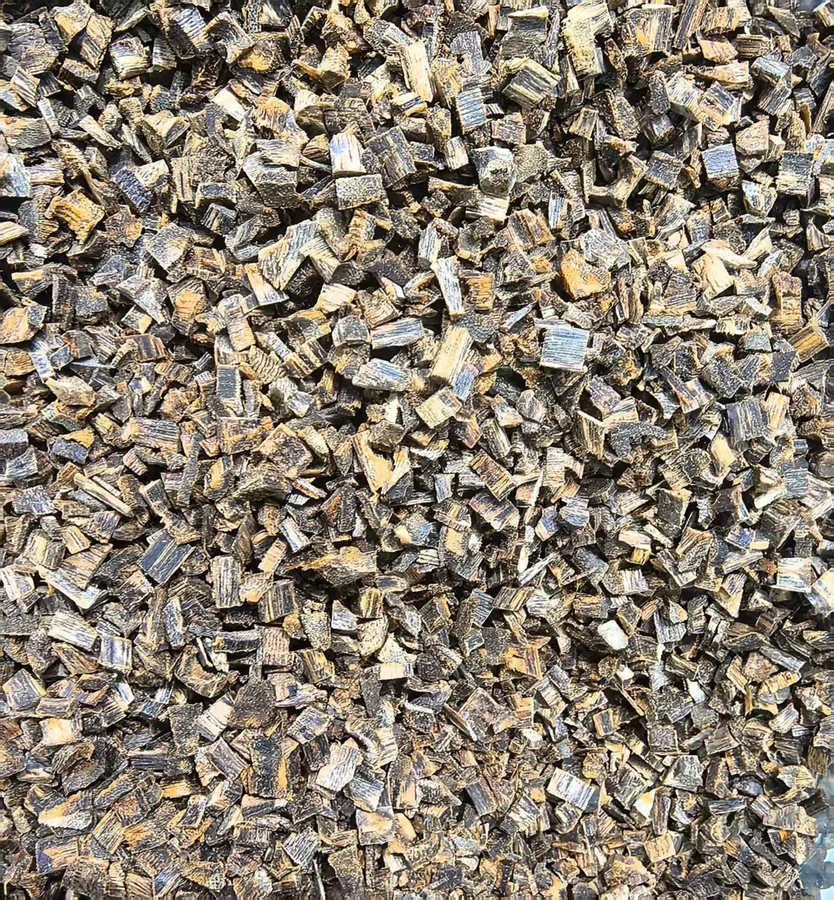
The most reliable way to choose a form is to start from the machine or the hand that will handle it, then work backwards. The same wood, cut differently, creates different work: dust, feed behaviour, drying time, packing volume and the amount of material that never reaches your product.
What each form does once it reaches the line
- Chips. Discrete, irregular pieces that stay separate and can be picked up, sorted and shown. They heat more slowly than thin material because less surface is exposed, and they hold their shape in a retail pack or a bakhoor blend. If you mill or grind them yourself, the milling cost and the dust move to your side of the ledger.
- Shavings. Thin slivers or curls with a high surface-to-mass ratio. They dry and heat quickly, settle and compress in a bag, and generate more loose dust each time they are handled or poured. In a blend they can draw binder differently from a coarser cut, so the forming step is worth testing rather than assuming.
- Granules. Small cut or crushed pieces with a more block-like profile than slivers. They dose and flow more predictably than irregular chips, which helps where consistency per batch matters, but they can segregate in transit so that the top of a bag is not the bottom.
- Powder. Milled material defined mainly by what passes a screen. It disperses through a mix, which is what incense formulation needs, but fineness and flow have to be stated with a convention, and clumping in humid conditions changes how it behaves in the mixer.
The buy-coarse-or-buy-fine calculation
Buyers often assume the fine material is the value-added one. Sometimes it is; sometimes you are paying a supplier to screen out material you could have used. Two routes end at the same place:
- Buy pre-screened fine material. You pay for the supplier’s screening labour and for the fraction they removed, and you receive a bag you can use almost as it arrives.
- Buy coarser material and process it in house. You accept a lower unit price, then spend your own milling time, dust control, screening capacity and yield loss to reach the same size.
Which is cheaper depends on facts only you hold: your mill capacity in a normal week, how well your extraction handles fine dust, how accurately you can measure your own output, and how large your order is. A small buyer with no screening equipment is usually better served by paying for a defined fine cut. A manufacturer already running a mill may find the coarse route cheaper — but only after measuring its own losses, not by assuming them.
Agarwood Raw Material Specification Comparison Table
The table below compares the four forms by what they physically are, which items decide acceptance, where they tend to fit, and where the commercial risk sits. It deliberately contains no universal size numbers, resin percentages or price levels: those depend on species, source, batch and supplier, and writing invented figures into a buying guide is how disputes begin.
| Form | What it physically is | Specification items that decide acceptance | Where it usually fits | Wholesale risk to price in |
|---|---|---|---|---|
| Chips | Distinct irregular pieces, hand-sortable, grain and darker resinous areas visible | Piece size and thickness range, share below target size, visible foreign matter, moisture basis, net weight per unit | Direct heating and bakhoor blends where pieces must show; feedstock for in-house milling or extraction | Size described only as “small” or “large”; photographs from a better lot than the one offered |
| Shavings | Thin slivers or curls, often a by-product of planing, peeling or shaping; compresses in the bag | Thickness and length limits, screen fractions by mass, fines and loose dust treatment, measurement method, cleanliness, bulk density behaviour, packing pressure | Blending and bulking where fast, even heating of small pieces is wanted; material intended for further grinding | Form name used as if it were a grade; silent change when the upstream production job changes; dust bought at wood price |
| Granules | Small cut or crushed pieces, block-like rather than sliver-like; flow behaviour matters | Screen range and method, oversize and undersize limits, fines share, segregation in transit, cleanliness | Dosing and blending where a consistent small piece feeds better than irregular chips | “Mesh” quoted without the opening in millimetres; top and bottom of the bag differ on arrival |
| Powder | Milled material; fineness and flow decide usability | Sieve convention, permitted oversize, clumping and flow, moisture condition, barrier packaging | Incense formulation and binding, where the material must disperse through a mix | Fineness given as one mesh number; a powder that disperses in one binder fails in another |
Read the table as a list of questions, not a ranking. A buyer who asks all five columns’ worth of questions of two suppliers learns more in one exchange than from a month of catalogue comparison.
The six numbers to fix in a wholesale specification
1. Size, on a stated basis
State the measurement, not the adjective: maximum thickness and length for slivers, screen openings in millimetres for fractions, and which dimension is being measured. A long thin sliver can pass an opening while still being awkward to feed, so screen aperture alone is a poor description of shavings. Test sieve construction and opening tolerances are covered by published standards such as ASTM E11 and ISO 3310-1 — those standards describe the equipment, not the agarwood, and citing them does not make a supplier’s result certified.
2. Fines, and where they are measured
Every lot contains material below your useful size. Agree the opening below which it counts as fines, whether loose dust is included in that figure, the maximum share by mass, and the point in the chain where it is measured. Handling and transport create additional fines after the supplier’s check, so a dispatch figure and an arrival figure are not the same measurement. Ask for the retained mass on each agreed opening from a sample of the offered lot, then repeat it yourself.
3. Foreign matter, defined so it can be enforced
Write down what counts — bark and grit, packing fibre, string, metal from tooling, insect debris — and the method used to look for it: visual inspection of a stated sample mass, a magnet pass, or washing and decanting for mineral grit. Then state the consequence of finding it. “Clean” on its own is not a clause anyone can act on at a port.
4. Moisture, as a basis rather than a boast
Water is bought at the price of resinous wood. Rather than accepting a bare percentage, agree whether it is expressed as received or oven-dry, which method is used, and where it is measured. Agarwood’s resin content complicates simple oven-drying figures, so the workable approach is one consistent method applied to both the approved sample and the arriving lot. The site’s guide to oud chips moisture content sets out why the basis matters more than the number.
5. Uniformity and how a lot was assembled
Ask whether the lot is a single production run, a blend across runs, or material accumulated over weeks. Accumulated stock is legitimate but varies more, and a shavings stream that comes off another job can change shape when that job changes. Agree the variation you can tolerate and the point at which you get a fresh sample and a fresh approval. A supplier who describes lot assembly honestly is easier to work with than one claiming perfect uniformity from a natural material.
6. Packing and net weight
Thin material settles: a bag filled by volume can look full and weigh short, and compression changes the fines profile. Specify net weight per unit, inner liner, whether the material is compressed, and how the pack is protected from moisture and odour transfer. Weigh a sample of units on arrival — it is the cheapest inspection available.
Samples and arrival checks that produce usable evidence
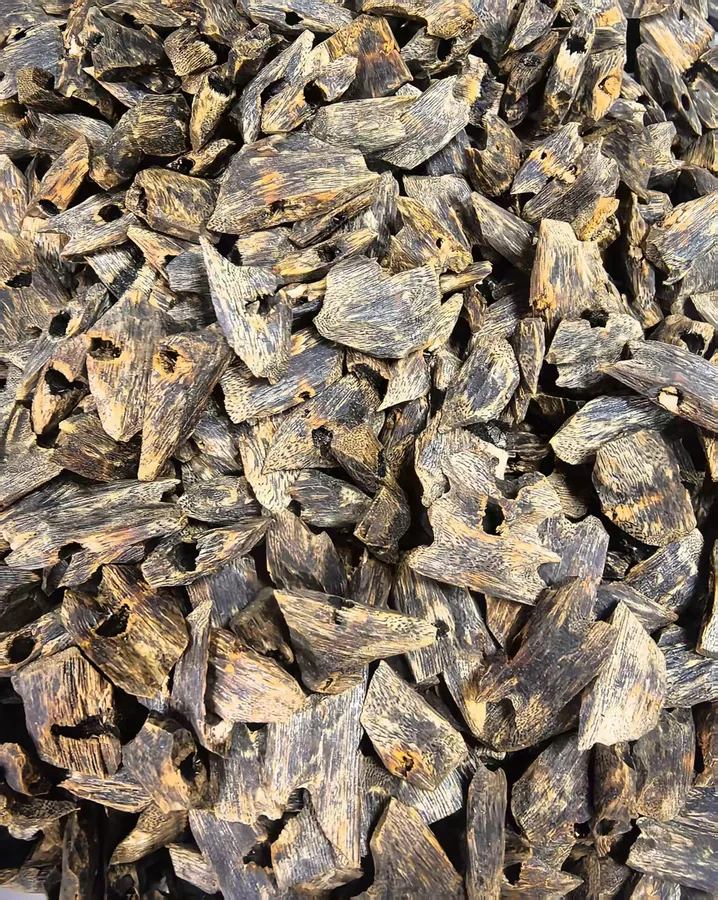
A sample is only useful if you know what it represents. Ask how it was drawn, from which container or run, and whether the bulk order will come from that same material. If the answer is “a later run”, treat the sample as a reference for shape, not an approval of the shipment.
Take or request portions from several positions in the container, combine them into a gross sample, then reduce it representatively for testing and retention. Record how many increments were taken, their approximate mass and their origin. There is no universal increment count; the number should reflect the order size and the cost of being wrong. What matters is that the method is written down, so the next lot is checked the same way.
When two candidates are compared, code the samples and evaluate them blind where practical, using the same mass, the same sieve openings, the same heating vessel and the same observation time. Record grams passing each opening, visible foreign particles in a stated mass, bag weights, and the usable fraction you actually recovered. A small run through your real mixer, binder and forming step, or a repack of a few retail units for a trader, tells you more about fit than any photograph. Keep a labelled retained portion of anything you approve, stored in the packaging you expect to receive.
From quotation to landed cost per usable kilogram
A price per kilogram is not a purchasing cost. The comparable figure is:
Cost per usable kilogram = (material + screening or handling + packing + freight + duty and compliance + inspection) ÷ usable fraction
For shavings, the usable fraction is where quotations separate. As an arithmetic illustration only — these are invented numbers, not a market price — a lot quoted at 100 per kilogram with 78 percent usable material costs about 128 per usable kilogram before freight; a second lot at 112 with 93 percent usable costs about 120. Add the same 12 of freight, duty and inspection and the figures become roughly 140 and 132. The cheaper quotation is the more expensive material. Run the arithmetic on your own measured figures: there is no defensible universal wastage rate for agarwood shavings, and any published one should be treated as someone else’s lot, not yours.
Three lines are routinely forgotten: off-spec material that has to be re-screened or sold down, the labour and management time a non-conforming lot consumes, and the working capital tied up in a larger order taken only to reach a price break. Ask every supplier to quote on the same screening basis so the comparison stays like for like.
Screening a supplier across borders
Identity and real capacity
Match the company name on the quotation to the name on the bank account, the export documents and the permit holder. Trading companies are legitimate, but you should know which party controls the material and the processing, because that party determines consistency. Ask what volume can be sustained across a year, not what can be shipped once.
Does the reply restate your specification?
A credible quotation repeats your form and production route, size or screen basis, fines treatment, cleanliness criteria, moisture basis, packing and net weight. If the reply is a price and a photograph, the specification was not read. Ask for the measurement method in writing.
Sample-to-order consistency and remedies
Ask what happens when the arriving lot does not match the approved sample: who inspects, within what period, by which method, and what remedy applies — replacement, credit, re-screening at whose cost, or rejection. Inspection windows and defect definitions belong in the purchase terms, not in a later argument. The site’s sample approval protocol shows how to tie an approved sample to a purchase order.
Species and trade documents
Agarwood-producing species are regulated internationally. FAO’s guidance on CITES and forest trade records that agarwood-producing Aquilaria and Gyrinops species are all listed in CITES Appendix II, with trade permitted subject to permit. In practice the exporter must hold the correct documentation before shipment, and the importer must confirm what its own authorities require for the exact species, form and route. Plantation origin does not by itself settle the question, and a product name certainly does not. Confirm with your customs adviser and national authority before committing. See the FAO chapter on CITES and forest trade.
MOQ, lead time and offers of custom screening
Custom screening is a service only when the supplier can name the equipment, the openings used, the resulting fines level, and the effect on price and lead time. Vague answers mean the phrase is marketing, not capability. Break the lead time into material allocation, processing, documentation and freight, so you know which part you are waiting for.
Agarwood Shavings Supplier Evaluation Checklist
Score two or three candidates on the same sheet. A blank answer is a finding, not a neutral result.
| Area | What to verify | Evidence to keep | Red flag |
|---|---|---|---|
| Sample | How the sample was drawn, which lot it represents, whether bulk comes from the same material, retained portion labelled and stored | Sample ID and date, scaled photographs, written statement of lot linkage | “All our material is the same” with no lot reference |
| Specification | Form and production route, size or screen basis in millimetres, fines definition and limit, cleanliness criteria, moisture basis, method for each | Signed spec sheet or specification section of the quotation; your own repeat measurements | Adjectives instead of numbers; mesh quoted without an opening |
| Batch | How lots are assembled, expected run-to-run variation, procedure and notice when upstream production changes | Lot records, previous shipment data, written change-notification commitment | Claim of perfect uniformity, or no answer on change notice |
| Packing | Net weight per unit, liner and moisture barrier, compression, odour isolation, lot and grade labelling, pallet condition | Packing specification, photos of an actual shipping unit, arrival weights | Volume-filled bags, unlabelled units, no liner |
| Logistics | Incoterm, lead time by stage, document set, CITES and phytosanitary papers, routing and transhipment, insurance | Quotation terms, draft documents, freight quote, broker confirmation | Permit questions deferred until after payment |
| After-sales | Inspection window, defect definitions, who pays for re-screening or return, replacement availability, named contact | Written claim clause, remedy ladder, record of a past dispute | No remedy beyond “we will check with the factory” |
What NanjaOud publishes today, and what it does not
Precision here protects both sides. The public agarwood raw materials and chips family page describes pieces, chips, fragments, slices and shavings among the cut directions the company works with, and lists formats such as wood fragments, small and large chips and slices. There is no separate published product named “shavings”, no published sieve range, fines limit or moisture figure for a shavings item, and no standing stock figure on the page. Current formats and supply options are confirmed for the specific enquiry, and internal A, B and C labels are described on the site as supplier references rather than an international standard. The agarwood powder family is likewise quoted on a per-order particle basis.
That means a buyer should treat any “shavings” requirement as a specification conversation, not a catalogue selection: send the cut, the measured size range, the fines and moisture basis, your sample requirement and your intended process, and ask which existing cut can be matched and sampled. Nothing on the site should be read as a certified grade, a laboratory result or a guarantee of a particular resin level, and this article does not present it that way.
Frequently asked questions
Are agarwood shavings the same as agarwood chips?
No. Chips are distinct pieces cut to a usable size; shavings are thin slivers, frequently a by-product of planing, peeling or shaping. They store, screen and feed differently, and the trade does not use the words consistently — one supplier’s 0.5 mm slice is another’s shaving. Specify the geometry you need rather than relying on the label.
How should particle size be stated for shavings?
Give thickness and length limits plus the screen openings used to measure fractions, all in millimetres, together with the permitted share passing the lower opening. A single mesh number describes shavings poorly, because a sliver can pass an opening while remaining long enough to cause feeding problems.
What sample should I request before a wholesale order?
A sample drawn from the lot being offered, with the drawing method and lot reference stated, and written confirmation that the bulk order will come from the same material. Keep a labelled retained portion and store it in the packaging you expect to receive.
Is there a standard MOQ for agarwood shavings?
No. Minimums follow lot assembly, cleaning batches, packing runs and documentation for the destination, and they differ by supplier and by form. Ask what quantity allows a representative sample and a genuine processing trial, and treat a minimum that prevents proper testing as a reason to start smaller elsewhere.
How do I verify quality without a lab?
Measure what you can repeat: mass passing each agreed opening, visible foreign particles in a stated mass, bag weights, moisture by one consistent method, and the usable fraction recovered from a small production run. A laboratory result is useful when the method and sample are identified, but a supplier’s adjective is not evidence.
What documents matter for international shipping?
Agarwood-producing Aquilaria and Gyrinops species are listed in CITES Appendix II, so export permits are normally required and the permit description must agree with what is shipped. Confirm the full document set — CITES, commercial invoice, packing list, bill of lading, any phytosanitary certificate your market requires — for your exact species, form and destination before payment.
Conclusion
Wholesale agarwood shavings are bought well when the buyer defines the geometry, measures the fractions that decide yield, samples the offered lot rather than a photograph, and agrees in writing what happens when material does not match. That structure turns a conversation about names into a comparison of numbers both sides can check — and it is the difference between paying for wood and paying for dust.
Start from your end use: how the material will be fed, blended, burned or milled, and what your process cannot tolerate. Then send NanjaOud the target material form, your sample requirement, the specification items you need confirmed, your expected purchase quantity and your destination market through the contact page. The team can tell you which current cut and sample options can be matched to that brief, and which points still need to be verified before a quotation means anything.


