
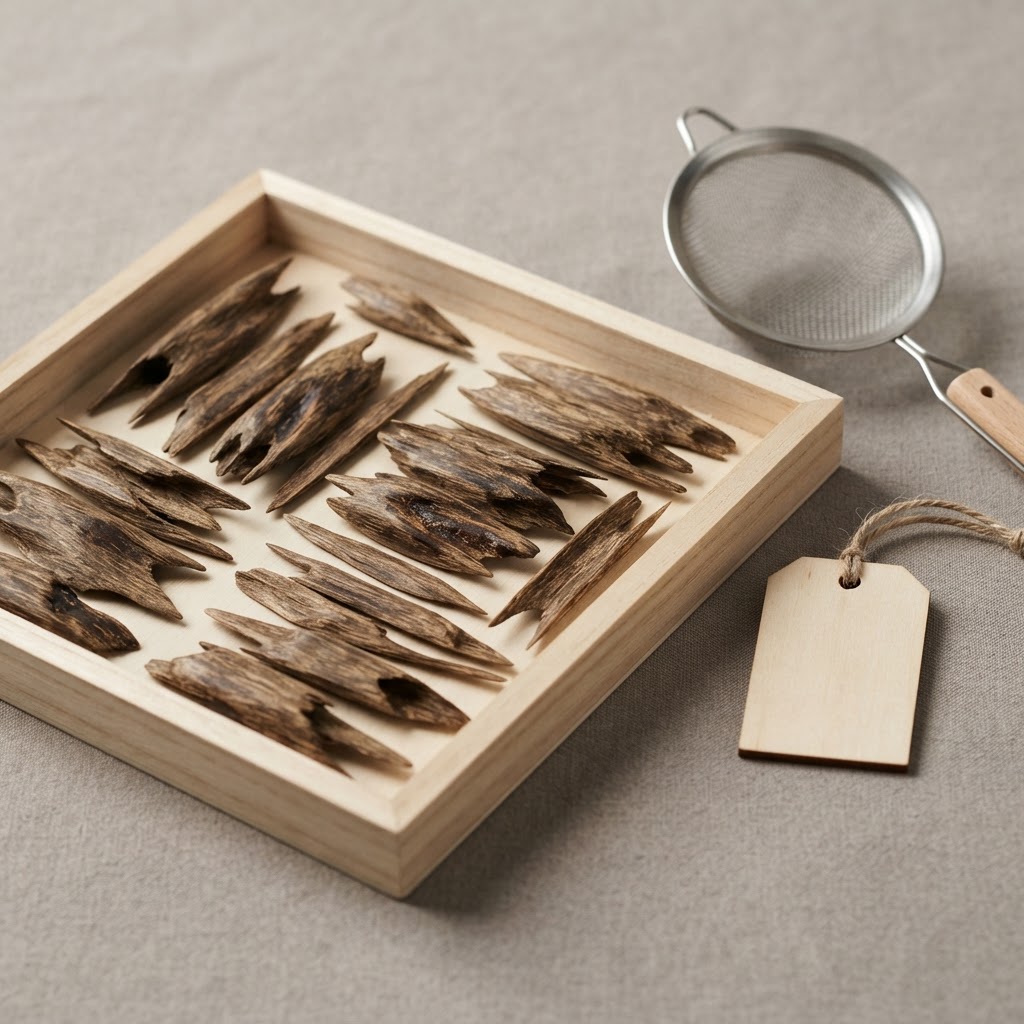
Short answer: bulk agarwood shavings cannot be compared across suppliers until the word “shavings” is replaced by numbers. Ask every candidate the same quantified questions about cut geometry, fines share, foreign matter, moisture basis, packing and usable mass, then convert each reply to a cost per usable kilogram delivered to your door. A supplier who answers in measurements can be shortlisted; a supplier who answers in adjectives cannot.
This guide is written for importers, incense and bakhoor manufacturers, and wood wholesalers who are already shortlisting two to four sources of thin, sliver-type material. It does not repeat the full method for writing a single specification or running a sample approval — that is set out in the site’s guide to specifying, sampling and verifying wholesale shavings. The job here is narrower and more commercial: how to put several suppliers of oud wood shavings on the same footing so that the cheapest quotation stops winning by default.
Why the same word describes different material in different quotations
Agarwood reaches buyers in four broad physical forms, and the names describe geometry rather than quality:
- Chips — distinct pieces of wood, irregular in shape, retaining visible grain and resin-bearing areas.
- Shavings — thin slivers or curls produced by planing, slicing, sawing or shaping; narrow in at least one dimension, often long in another.
- Granules — small cut or crushed pieces with a more block-like profile.
- Powder — milled material passing a fine screen.
No standards body assigns these words a resin content, aroma class or species, and suppliers do not apply them identically. Two quotations can both say “shavings” while describing material with different thickness, length, dust load and cleanliness. An agarwood granules supplier is selling a different cut, not a better one, and a page that mixes the terms tells you nothing about what will arrive in the container.
Shavings carry an extra complication: they are frequently a by-product of another operation — dimensioning blocks, shaping bead blanks, trimming retail pieces — so the geometry follows whatever that upstream job required, and can change when the job changes, with no change in the product name. The agarwood chips vs shavings question is therefore a geometry question first: chips are cut to a size on purpose, while slivers inherit whatever the tool and the upstream job produced.
That is why a comparison built on the form name measures the vocabulary of the sales team, not the material. For a wider view of how the four forms behave in production, the site’s comparison of chips, granules and powder covers the process side; this article assumes you have decided agarwood wood shavings, or a similar fine sliver material, fit your line and now need to buy them from the right source.
Agarwood Raw Material Specification Comparison Table
The table compares the four forms by what they physically are, which items a buyer must confirm, where they tend to fit, and where sourcing risk concentrates. It deliberately contains no universal size figures, resin percentages or price levels: those vary by species, source, batch and supplier, and inventing them would create the disputes this article exists to prevent.
| Form | Physical character | Specification items to confirm | Likely process fit | Common sourcing risk |
|---|---|---|---|---|
| Chips | Distinct, irregular wood pieces; visible grain and darker resinous areas; hand-sortable | Piece size range and thickness, share below target size, visible foreign matter, moisture condition, net weight per unit | Direct heating and bakhoor blends that must show pieces; feedstock for milling or extraction | Size described only as “small” or “large”; photographs taken from a better batch than the one offered |
| Shavings | Thin slivers or curls; high surface-to-mass ratio; compresses and settles in a bag; often a by-product of shaping or planing | Sliver thickness and length limits, screen fractions by mass, fines and loose dust share with the measurement method, cleanliness criteria, moisture basis, compression and packing | Blending and bulking a formulation; feed for further grinding; agarwood shavings for incense blends where small pieces must heat quickly and evenly | Form name treated as a grade; silent drift when upstream production changes; dust paid for at wood price |
| Granules | Small cut or crushed pieces, more block-like than slivers; flow behaviour matters | Screen range and method, oversize and undersize limits, fines share, segregation in transit, cleanliness | Feeding and blending where a consistent small piece doses more evenly than irregular chips | Segregation in the container so the top of a bag differs from the bottom; “mesh” quoted without an opening |
| Powder | Milled material; fineness and flow decide usability | Sieve or measurement convention, permitted oversize, clumping and flow behaviour, moisture condition, barrier packaging | Incense formulation and binding, where the material must disperse through a mix | Fineness quoted as one mesh number; a powder that disperses in one binder fails in another |
Read this as a question set, not a ranking. No form is inherently better or more aromatic; the same source wood becomes chips or shavings depending on how it is cut, and the cut is chosen for a downstream job that is probably not yours.

The normalized RFQ: eight lines every candidate must answer identically
A comparison is only as fair as the questions behind it. Send the same eight lines to every candidate, in the same order, and ask for written answers rather than a call:
- Origin of the cut. Which production step creates this material — planing, slicing, sawing, crushing — and is it a primary product or a by-product of another job?
- Geometry. Maximum and typical thickness and length in millimetres, and which dimension is measured.
- Fractions. Mass retained on each agreed screen opening, plus the opening below which material counts as fines, and whether loose dust is inside that figure.
- Cleanliness. What the supplier counts as foreign matter, the sample mass inspected, and the method used.
- Moisture. The basis of the figure (as-received or oven-dry), the method, and the point in the chain where it is measured.
- Packing. Net weight per unit, inner liner, whether material is compressed, and lot labelling.
- Lot logic. How a lot is assembled, expected variation between runs, and how the buyer is told when the upstream cut changes.
- Commercial frame. Incoterm, lead time by stage, documentation set, and the remedy if the arriving lot misses the approved sample.
Answers to those eight lines can be scored. A price cannot be compared until they exist, because each line changes either the usable share of the lot or the cost of getting it to your door. The site’s guide to particle size specification explains why screen apertures alone describe slivers poorly: a long thin piece can pass an opening while remaining awkward to feed and dose.
Converting three quotations into one comparable number
Normalize on usable mass, not quoted mass
The comparable figure for bulk agarwood shavings is landed cost divided by the share of the lot you can actually process:
Cost per usable kilogram = (material + screening or handling + packing + freight + duty and compliance + inspection) ÷ usable fraction
For shavings the usable fraction moves more than it does for chips, because a meaningful share of the weight can fall below your useful size. Buy five kilograms to use four and the effective price rises by a quarter before any freight is added. Measure the fraction yourself on the approved sample and again on arrival; there is no defensible universal wastage percentage for this material, and any supplier quoting one is describing a specific lot, not a rule.
Build a quote-normalization sheet
The sheet below is the format, not a set of prices. Fill it with your own measurements and ask each supplier to complete the same rows, whether the bid is for shavings, chips or granules.
| Row | What to record | Why it changes the comparison |
|---|---|---|
| Quoted mass | Net kilograms offered, per unit and per shipment | Establishes the denominator before any deduction |
| Measured usable share | Percentage retained above your lower opening, measured the agreed way | Converts quoted mass into material you can sell or process |
| Fines deduction | Whether fines are included, excluded, or credited at a lower price | Two identical prices can differ once dust is priced separately |
| Screening or re-processing | Cost and lead time if you must screen the lot yourself | Moves work and cost from the supplier’s quote to your line |
| Freight, duty, compliance | Incoterm, freight quote, duty estimate, documentation fees | Delivered cost, not FOB, is what competes with your other bids |
| Rejection and claim cost | Off-spec deduction, return freight, line downtime exposure | Prices the risk that the lot does not match the sample |
Costs that never appear on the quotation
- Dust in your building. Fine sliver material generates airborne dust in handling; extraction and cleaning are real costs that a bag price hides.
- Bag-to-bag variation. If fines concentrate in the last units of a pallet, your average usable share is worse than the sample suggested.
- Stopped production. A lot that fails at the mixer costs more than the material, because the line and the schedule are already committed.
- Management time on claims. Undefined acceptance criteria generate correspondence instead of remedies.
As an arithmetic illustration only — hypothetical figures, not a market price — three bids quoted at 100, 104 and 112 per kilogram with usable shares of 78, 88 and 90 percent normalize to roughly 128, 118 and 124 per usable kilogram before freight. The middle bid wins on usable material even though it is not the cheapest quotation. Run the arithmetic on measured figures, never on a published loss rate.
Batch consistency across a twelve-month program
How the lot is assembled
Ask whether a shipment is one production run, blended across runs, or accumulated over weeks. Accumulated material is legitimate but varies more, and a by-product stream inherits variation from someone else’s schedule. A supplier who can describe lot assembly plainly is easier to hold to a specification than one who claims perfect uniformity from natural wood.
What should trigger a new approval
Write down what variation you tolerate and what forces a re-sample: a change of upstream cut, a new species or plantation block, a shift in fines share beyond an agreed band, or a change of packing. Without a trigger list, “same product” quietly means “same product name”, and the first signal is a finished batch that behaves differently.
Program terms worth putting in writing
For a repeat agarwood shavings wholesale program, agree allocation across the year rather than per order, a notice period before a specification change, and what happens if the supplier cannot supply the approved form: substitution requires your written approval, not a similar-looking alternative. Lead time should be broken into material allocation, processing, documentation and freight so you can see which part is actually delaying a shipment.
Keeping the sample comparison fair
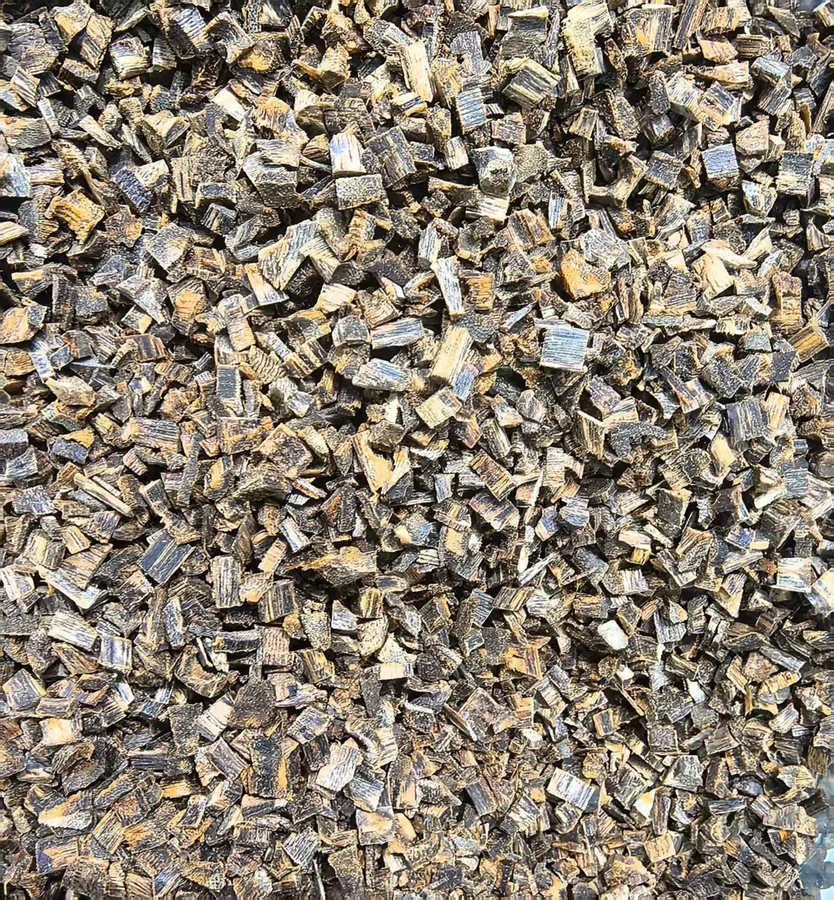
Code the samples so the evaluation is blind where practical, and use the same sample mass, the same sieve openings, the same heating vessel and the same observation time for every candidate. Record counts and masses rather than impressions: grams passing the lower opening, visible foreign particles in a stated mass, net weight per bag, and the outcome of a small run through your own mixer, binder and forming step.
A modest processing trial answers more than any photograph. For an incense line, note how the material feeds, how much dust it creates, how it distributes through the blend, and how the finished stick or cone dries and burns. Retain a labelled portion of anything you approve in the packaging you expect to receive. The site’s sample approval protocol sets out how to tie that approval to a specific lot in the purchase order.
Compliance questions to settle before the comparison ends
Agarwood-producing taxa are regulated in international trade. The CITES Secretariat working document on agarwood-producing taxa records that Aquilaria species are listed in Appendix II, with parts and derivatives covered subject to the applicable annotations. FAO guidance on CITES and forest trade notes that trade in artificially propagated or captive-bred specimens remains subject to permit requirements. In practice the exporter must hold the right permits before shipment, the permit description must match the actual product form, and the importer must confirm what its own authority requires for that species, source and route. A plantation origin does not settle the question by itself, and a product name certainly does not. Confirm the requirement for your exact shipment with your supplier, your customs broker and the relevant national authority.
Agarwood Shavings Supplier Evaluation Checklist
Use this as a scoring sheet across two to four candidates for bulk agarwood shavings. A blank answer is a finding, not a neutral result, and a supplier who cannot answer one area should not be ranked above one who can.
| Area | What to verify | Evidence to keep |
|---|---|---|
| Sample | Drawing method and lot reference, whether the bulk order comes from that material, coded side-by-side comparison under identical conditions, retained portion stored in the expected packaging | Sample ID, date, scaled photographs, written lot-linkage statement, your measurement sheet |
| Specification | Form and production route, thickness and length limits in millimetres, screen fractions, fines definition and limit, cleanliness criteria, moisture basis, method for each | Signed specification sheet or the specification section of the quotation; your repeat measurements |
| Batch | Lot assembly, expected run-to-run variation, trigger list for re-approval, notice given before an upstream cut changes | Lot records, previous shipment data, written change-notification commitment |
| Packing | Net weight per unit, liner and moisture barrier, compression, odour isolation, lot labels, pallet condition | Packing specification, photographs of an actual shipping unit, arrival weights from a sample of bags |
| Logistics | Incoterm, lead time by stage, documentation set including CITES and phytosanitary papers, routing and transhipment risk, insurance | Quotation terms, draft documents, freight quote, broker confirmation |
| After-sales | Inspection window, defect definitions, who pays for re-screening or return, replacement availability, named contact and response route | Written claim clause, remedy ladder, a record of how a past dispute was actually resolved |
Working through that sheet is also how you find out whether an agarwood raw material supplier is really a processor. A trading company that answers all six areas from its own records is a usable partner; one that forwards your questions upstream and returns adjectives has not yet shown it controls the material.
What we can and cannot confirm about shavings today
Precision here protects both sides. Our published range covers agarwood raw materials and chips — irregular wood fragments with natural grain and varying brown tones for sorting, blending, further grinding and incense-related processing, plus a smaller chip format presented for portioning, blending, repacking and grinding — and incense-grade agarwood powder for stick, coil and cone production. We do not publish a separate product line labelled “shavings”, and we will not describe a current item as a shavings SKU until the cut and geometry have been confirmed against a buyer’s brief. If your requirement is genuinely a thin sliver material, the honest starting point is a conversation about which existing cut can be matched, backed by a physical sample.
What the published material information does support: the company reports more than ten years of agarwood cultivation experience and a managed plantation base of more than 1,000 mu in Jiangmen, Guangdong, with its own processing facility, no chemical agents used to accelerate resin formation in cultivation, and ODM cooperation covering custom processing, specifications and packaging for overseas buyers. Our quality and supply page states that internal grade labels are supplier references rather than a universal standard. Any purchase should rest on an approved sample and a written specification, not on a label or a form name.
Common buying mistakes in a supplier comparison
- Comparing quotations that answer different questions. A bid priced on unscreened material is not competing with one priced on screened material.
- Using price per kilogram as the decision metric. Without a usable fraction, the cheapest quote is often the most expensive material.
- Assuming shavings are stable because the name is. A by-product stream changes when the upstream job changes.
- Accepting a sample that is not linked to a lot. It proves the material exists, not that it is in the container you are buying.
- Leaving acceptance criteria to the arrival. Inspection windows, sample size and remedies belong in the purchase terms.
- Assuming paperwork follows the product name. Species, source and route determine the permit requirement, not the label.
Frequently asked questions
Are bulk agarwood shavings the same product as agarwood chips?
No. Chips are distinct pieces cut to a usable size; shavings are thin slivers, often a by-product of shaping or planing. They pack, settle and process differently, so they should be specified, sampled and priced separately even when they come from the same wood.
How do I state a particle size for shavings in an RFQ?
State maximum and typical thickness and length in millimetres, the screen openings used to measure fractions, and the permitted share passing the lower opening. A mesh number alone is ambiguous for sliver-shaped material.
Is a cheaper shavings quotation always the better buy?
Only if the usable share is the same. Convert each bid to cost per usable kilogram delivered, including screening, freight, duty and the cost of rejecting off-spec material, before comparing.
What sample should I request from each supplier?
A portion drawn from the lot being offered, with the drawing method and lot reference stated in writing, and confirmation that the bulk order will come from the same material. Retain a labelled part of anything you approve.
How is MOQ normally set for shavings?
There is no universal figure. It usually reflects how a supplier assembles a lot — screening batch, packing run and document set — so ask which quantity allows a representative sample and a genuine trial, and treat an MOQ that prevents proper testing as a reason to start smaller.
Which quality items cause most disputes?
Fines share, moisture condition and foreign matter, in that order, because they are usually described with adjectives rather than measured. Agree the measurement method, the sample mass and the consequence before the container is loaded.
What documents should accompany an international shavings shipment?
The set depends on species, source and destination, and typically involves CITES permits where the taxa are listed, a certificate of origin and phytosanitary certification on request. Confirm the exact requirement for your shipment with your supplier, broker and national authority.
Conclusion
Bulk agarwood shavings are compared successfully when the buyer fixes the questions before the prices arrive: what produced the material, how its fractions are measured, how the sample links to the lot, how variation is notified, and what happens when a delivery does not match. Suppliers who welcome that structure are usually the ones able to repeat a shipment.
Start from your end use — how the material will be fed, blended, burned or milled, and what your line cannot tolerate — then send us the target material form, your sample requirement, the specification items you need confirmed, your expected purchase quantity and your destination market through the contact page. We can tell you which current cut and sample options can be matched to that brief, and which points still need verification before a quotation means anything.


