
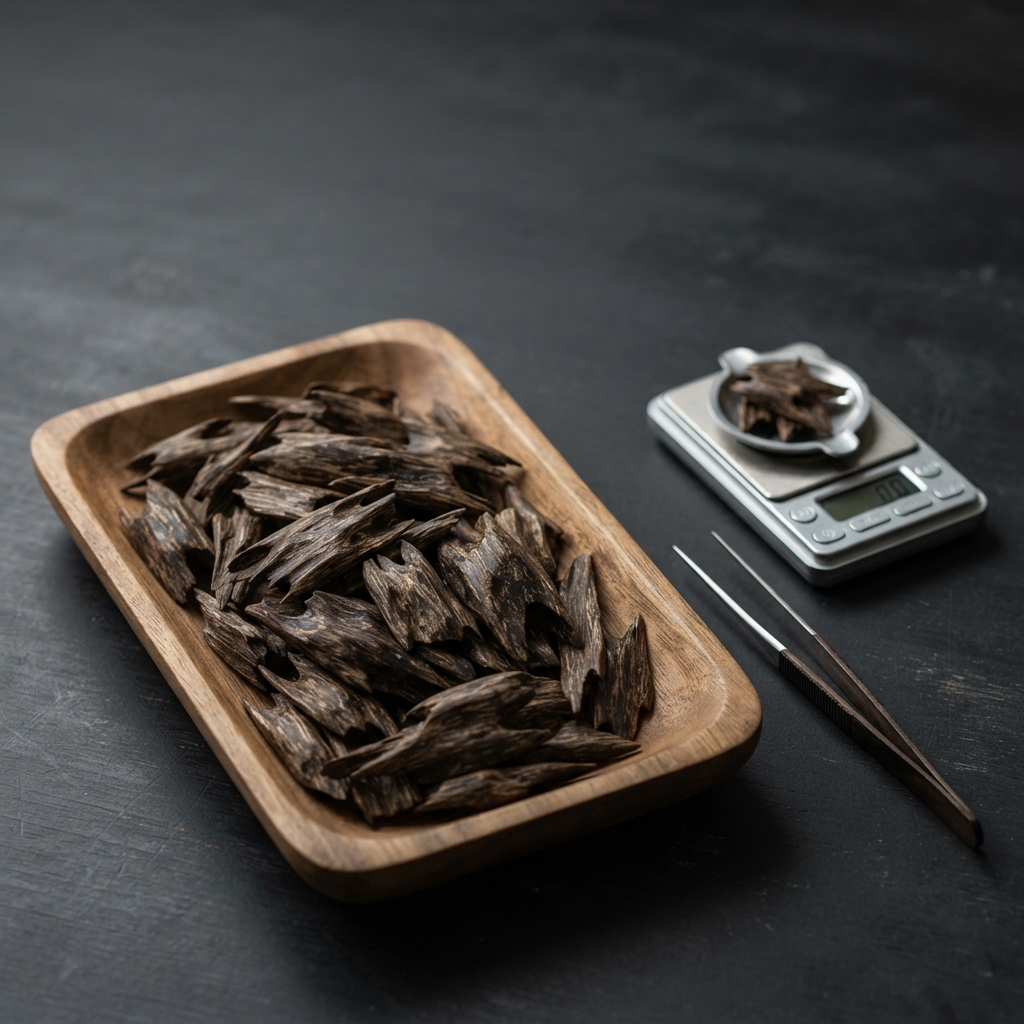
An oud chips manufacturer MOQ is the smallest order a factory can cut, process, pack and ship from a graded lot without being left with material it cannot sell. It is a production and allocation figure, not a negotiating tactic — and because agarwood is sorted by resin, size and defect after it arrives, the minimum usually changes with grade, format, packaging and destination. That is why two quotations for similar-looking chips can carry very different minimums.
What an oud chips manufacturer MOQ actually covers
Before comparing numbers, establish what the number refers to. Suppliers use the same three letters for four different things, and mixing them up is the most common reason a first order stalls:
- Per order — the total weight in one purchase order, whatever the mix of grades.
- Per grade — a minimum for each grade line, so three grades can mean three separate minimums.
- Per SKU or pack — a minimum number of retail units or cartons when labels, tins or gift boxes are customized.
- Per shipment — the quantity that justifies an export permit, pre-shipment inspection and a freight booking.
A quotation that says only "MOQ 5 kg" is not yet a usable quotation. Ask which of the four definitions applies, whether the quantity is net or gross weight, and whether it is measured before or after the buyer-approved sample is matched. Those three answers often explain a gap that looks like a pricing disagreement.
Why minimums exist in oud chips
1. A lot is graded once and sold in parts
Oud chips are not manufactured to a single uniform specification the way a molded part is. A batch of wood is cleaned, sorted and separated into selections, and each selection is then offered as its own line. When a buyer asks for a small quantity of one selection, the supplier has to open a lot, remove that selection and hold the remainder until another buyer takes it. The minimum protects the supplier against being left with the least saleable part of the lot — and it is also the reason a small order is often filled from the tail of a lot rather than from fresh production.
2. Cleaning, drying and sorting are batch operations
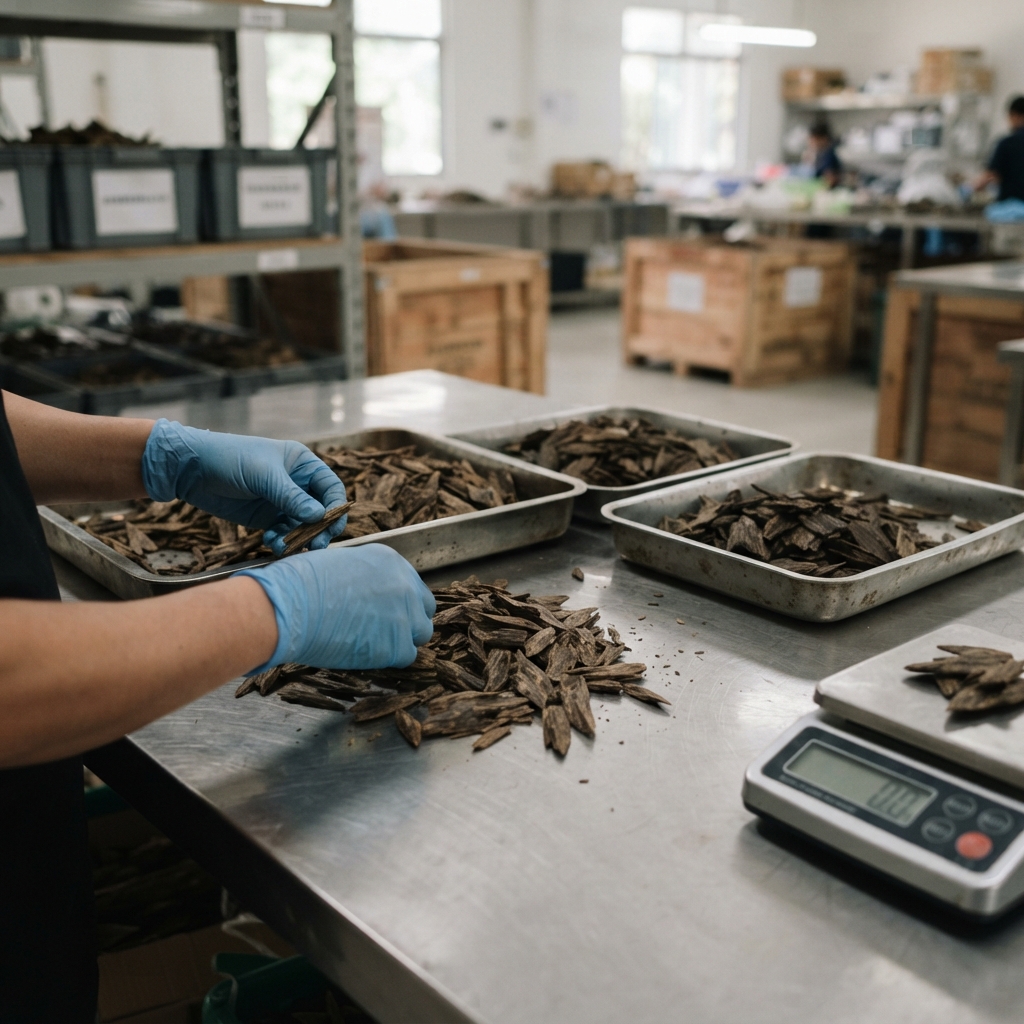
Removing non-resinous white wood, trimming to a consistent piece size, drying to a target moisture level and re-checking the result are done in batches. A batch has a practical floor: the same setup, handling and checking effort applies whether the output is small or large. This is why a supplier may be able to sell a small sample from stock but cannot promise a small production run at the same unit price.
3. Packaging and labels have their own minimums
Once a private-label pack is involved, the constraint moves from wood to packaging. Printed tins, boxes, labels and outer cartons are produced in runs, and artwork approval, proofing and setup are charged once per run. A buyer who wants 200 retail units of a custom pack may find that the packaging minimum, not the wood minimum, is the number that decides the order size. The practical sequence for a first private-label order is set out in our guide to a wholesale oud chips supplier first order.
4. Export paperwork is issued per shipment
Agarwood moves across borders under CITES controls, and permits are tied to a specific shipment rather than to an annual allowance. The UK government's CITES guidance, updated in 2026, states that a permit is required to move a listed specimen into or out of the country, and that a permit issued by the exporting authority does not guarantee the importing country will issue its own (GOV.UK, CITES import and export guidance, 2026). Two authorities, two sets of fees and two processing timelines sit behind each export. That fixed cost and lead time is a real reason a shipment has a practical floor even when the wood itself could be supplied in smaller amounts.
The five variables that move the number
Two suppliers can quote honestly and still land far apart. These are the variables that usually explain the difference, and the question to ask about each one.
| Variable | Why it changes the minimum | Question to put in writing |
|---|---|---|
| Grade and selection | A high-resin selection is a small fraction of any lot, so the minimum for that line is set by how little of it exists | "What is the minimum per grade line, and which lot is it allocated from?" |
| Chip size and format | Large pieces, small chips and fragments come from different parts of the sorting process and cannot be substituted freely | "Is the minimum the same for large chips, small chips and fragments?" |
| Species, origin and lot size | Material from a single origin and harvest is limited by what was actually produced and documented | "Which species and origin, and how large is the lot behind this quotation?" |
| Packaging and private label | Printed packaging, labels and cartons carry their own production run minimums | "Is the minimum driven by wood, by packaging, or by both?" |
| Destination and documents | Permit requirements, inspection and freight routing differ by country and add per-shipment fixed cost | "Which documents are included, and are they priced per shipment?" |
Sample, trial and production are three different quantities
Buyers often ask for "a small order" without saying which of three very different things they need. Separating them makes the conversation concrete and usually produces a better price at each stage.
| Stage | What it is for | What the supplier needs from you | What you should receive |
|---|---|---|---|
| Sample | Deciding whether the material fits your application at all | Intended use, target grade, the property you will judge | Identified pieces linked to a lot reference, plus the specification they represent |
| Trial order | Testing your own process — burn, grind, blend, pack — at a realistic scale | Process details, acceptable variation, packaging plan | The same selection as the approved sample, with a stated tolerance and inspection record |
| Production order | Repeatable supply for sale or manufacturing | Forecast, delivery schedule, document requirements | A written specification, lot reference and pre-shipment confirmation |
A sample is not a miniature production order, and treating it as one is how buyers end up approving material that cannot be repeated. Our guide to requesting an agarwood wood block sample covers how to tie an approval to written observations instead of a memory of a smell.
The real cost of ordering below the minimum
When a supplier offers to break its minimum, the unit price usually rises — but the unit price is not the number that matters. What matters is cost per usable kilogram after freight, documents, inspection and any material that fails your own checks.
Work through cost per usable kilogram
The arithmetic is simple: add goods, freight, documentation, inspection and bank charges, then divide by the kilograms you can actually use. Fixed costs do not shrink with the order, so a small shipment carries a much heavier fixed-cost burden per kilogram. The table below shows the structure with a symbolic goods price (P), not a real quotation:
| Cost line | Small order | Larger order |
|---|---|---|
| Goods at quoted price per kg | 5 × P | 50 × P |
| Export and import permit costs | Fixed per shipment | Fixed per shipment |
| Freight and handling | Minimum charge applies | Spreads across more kilograms |
| Inspection or sampling before shipment | Fixed per shipment | Fixed per shipment |
| Cost per usable kg | Much higher | Lower |
This is why "we will waive the MOQ for a 20% premium" can still be the more expensive route once freight and documents are counted — and why consolidating two grades or two products into one shipment is often a better answer than negotiating the minimum down.
How to negotiate a smaller first order
- Accept a standard grade and a standard pack. Custom selection and custom packaging are two separate minimums; removing one usually lowers the floor immediately.
- Take the tail of a lot. Ask whether a specific lot has a remainder that can be released as a trial quantity, and insist on the lot reference.
- Combine lines into one shipment. Several grades or formats in one order can meet a per-shipment minimum that no single line could meet alone.
- Book alongside production. If the factory is already running a comparable selection, a small addition to that run is cheaper than a dedicated one. Ask when the next run is scheduled.
- Phase the delivery. A committed volume released in two shipments can satisfy a production minimum while limiting your first cash outlay — but confirm that each release still carries valid documents.
- Pay a larger deposit instead of a higher unit price. Some suppliers will accept a smaller quantity against stronger payment security. Get the payment terms and the quantity in the same written quotation.
- Start with one market and one SKU. A narrow first order that sells through is better evidence for a larger second order than a broad, shallow one.
Red flags in an MOQ conversation
- A minimum far below the market, with no lot explanation. If the number is unusually low and nobody can say which lot it comes from, you may be buying repacked material of uncertain origin.
- Quantities quoted in pieces rather than weight. Piece counts hide size variation; a kilogram of thin fragments and a kilogram of thick blocks are not the same purchase.
- The minimum changes after sample approval. That usually means the sample came from stock and the order would come from a new run. Ask for the change in writing and re-confirm the specification.
- No discussion of export documents. A supplier who never raises permits for a CITES-listed material is either inexperienced in export or expecting you to absorb the risk.
- Price "negotiable" only after the minimum is met. A quotation that cannot state a price per grade at a stated quantity is not a quotation.
- No written tolerance. If the quotation does not say how much deviation from the approved sample is acceptable, the minimum is irrelevant — you have no acceptance basis.
What to put in your RFQ
Most MOQ confusion disappears when the first message contains the information a factory needs to allocate material. Include:
- Product format (large chips, small chips, fragments, or a mix) and intended use.
- Grade direction and the property you will judge it on.
- Target quantity, and whether it is a sample, trial or production order.
- Whether the minimum applies per order, per grade or per pack — ask the supplier to state it.
- Packaging: bulk, retail unit, or private label, with artwork status.
- Destination country and who is responsible for import permits.
- Required documents and who arranges them.
- Delivery window and whether a phased release is acceptable.
- Payment terms you can work with.
- The name of the person who will approve the sample.
Full landed-cost planning belongs with the quotation review; the drivers of wholesale oud chips price per kilogram and the lead-time planning guide cover the parts that sit either side of the MOQ decision.
How NanjaOud quotes order quantities
NanjaOud is the B2B brand of Jiangmen Nangjiaxiang Agarwood Development Co., Ltd., based in Jiangmen, Guangdong. Our supply position is built on more than ten years of agarwood cultivation experience and a managed plantation base of more than 1,000 mu (about 160 acres), combined with an in-house processing facility. According to company information, our cultivation follows natural standards and does not use chemical agents to accelerate resin formation.
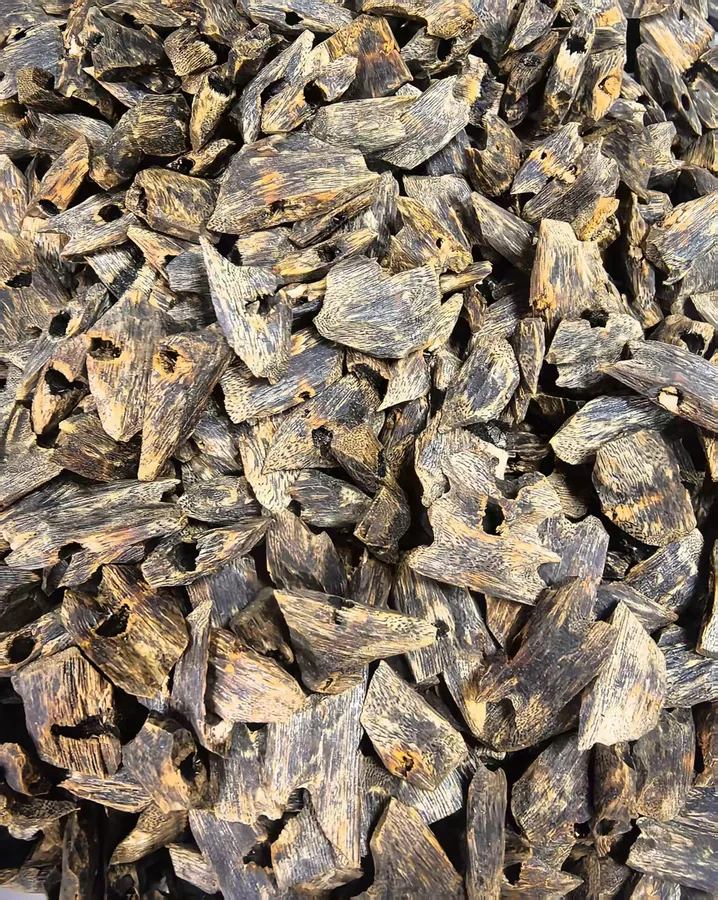
We supply agarwood in several formats that carry different allocation constraints: natural large agarwood chips with visible grain and resinous streaks, natural small agarwood chips for portioning, blending and repacking, and agarwood wood fragments for incense and fragrance processing. Because grading is internal and scoped to the approved sample rather than a universal standard, the quantity discussion and the specification discussion happen together. You can read how we describe that process on our quality and supply page.
We do not publish a single minimum for all products, because the number depends on the format, the grade direction and the destination. Send the ten RFQ points above through our contact page and we will confirm what can be allocated for your case.
FAQ
What is a typical MOQ for oud chips?
There is no industry-wide figure. Minimums differ by supplier, grade, format and whether packaging is customized, and some suppliers publish different minimums for samples and wholesale quantities. Treat any single number quoted without reference to a grade and a lot as a starting point for questions, not a market standard.
Can I order less than the MOQ?
Sometimes. The usual routes are buying the remainder of an existing lot, combining several lines into one shipment, or paying a premium for a dedicated small run. Ask which route the supplier is offering, because each has a different effect on price, documents and lead time.
Is the MOQ per grade or per order?
It depends on the supplier, and this is the single most useful clarification to get in writing. Three grade lines under a per-grade minimum can multiply your order size by three; under a per-order minimum, the same total weight may be acceptable split across grades.
Does a sample count toward the MOQ?
Usually not, and a sample is normally invoiced or charged separately because it is pulled from a different position in the lot. Confirm whether the sample cost is credited against a later order, and get that in the quotation rather than in a message.
Why did the MOQ change after I approved the sample?
Most often because the sample came from existing stock while the order would require a new production run or a new lot. Ask for the lot reference on both the sample and the order, and re-confirm the specification before accepting the new number.
Can I mix grades to reach one minimum?
Often yes, provided the lines ship together and the documents cover the shipment as a whole. The constraint is allocation: a supplier can only mix what is available from the same lot or from lots it is willing to open at the same time.
Does private label increase the MOQ?
It can, because printed packaging, labels and cartons have their own run minimums that sit on top of the wood minimum. If your packaging minimum is the binding constraint, a stock pack for the first order and a custom pack for the second is often the cheaper sequence.
How does CITES affect small orders?
Permits are issued per shipment, and both the exporting and importing sides may need one. That fixed cost and processing time is carried by every shipment regardless of size, which is one reason very small international orders are inefficient even when the wood is available.
Conclusion
An oud chips manufacturer MOQ is best read as an allocation statement: how much of a graded lot can be released, processed and shipped as one order. Compare suppliers on what the minimum covers, which lot it comes from, and what it costs per usable kilogram after documents and freight — not on the headline number alone. If you send your format, grade direction, target quantity and destination in one message, the minimum becomes a specific answer instead of a negotiation. You can start that conversation on our contact page, or compare our agarwood raw materials and chips range first.


