

An oud chips manufacturer lead time is not one number. It is the sum of five sequential clocks — material allocation, drying, processing, CITES documentation and freight — and only two of them sit inside the factory's direct control. Buyers who plan against a single "30-day" figure usually discover the gap at the permit stage, when the cartons are already sealed.
This guide is written for B2B buyers who have already chosen a specification and now need the material to land on a date. It shows where wholesale oud chips schedules actually slip, what to ask a supplier to commit to in writing, and how to build a backward calendar that survives a permit delay.
Why a single lead-time number misleads oud chips buyers
Most commodity lead times describe a production queue: the factory receives material, runs it, and ships it. Agarwood chips behave differently for three reasons.
First, the raw material is biological and selectively harvested, so the lot you approved may not exist as finished stock on the day you order. Second, chips must be conditioned to a moisture level before they can be screened and packed, and rushing that step transfers the risk of weight loss and mould to the buyer. Third, every commercial shipment of Aquilaria or Gyrinops wood requires CITES documentation issued by the exporting country, and that permit is issued to a named exporter for a described quantity.
The practical consequence: the factory's processing time may be the shortest part of your schedule. The two clocks that decide whether your order arrives on time are usually the ones the factory does not fully own — drying conditions and government paperwork.
The five clocks inside every wholesale oud chips order
Break any quotation's lead time into these five stages and ask which ones the number includes. A supplier that cannot separate them is quoting an impression, not a schedule.
| Clock | What it covers | Who controls it | What usually moves it |
|---|---|---|---|
| 1. Material allocation | Reserving a cut lot, or waiting for the next harvest | Grower and factory | Harvest window, available resin grades, whether the lot is already dried |
| 2. Conditioning | Equalising moisture before screening and packing | Factory | Ambient humidity, how recently the wood was cut, the target moisture agreed |
| 3. Processing | Cutting, hand sorting, screening to the agreed band | Factory | Custom size band, sorting labour, position in the production queue |
| 4. Documentation | CITES export permit, certificate of origin, phytosanitary certificate | Exporting entity and issuing authority | Application completeness, whether your import permit must be issued first |
| 5. Freight and clearance | Booking, inland haulage, transit, destination clearance | Forwarder, carrier, buyer's broker | Chargeable volume, port congestion, customs queries on the permit description |
Two of the five are production. The other three are the ones that produce surprise emails.
Clock 1: Material allocation — "in stock" is not one thing
When a supplier says a grade is in stock, ask a second question: is it cut, conditioned and reserved, or is it standing timber allocated to your order? Both answers can be honest, and they imply very different dates.
Agarwood resin forms over years in response to injury or infection, and harvesting is selective rather than a clear-cut operation. That means a plantation-backed supplier may genuinely control its raw material and still need to schedule a harvest to fill a specific grade. A trader with no plantation may have the chips physically on hand but no ability to replace the lot if your inspection rejects it.
Ask for the lot reference, the weight already allocated, and the date the material was last turned or re-bagged. A lot that has been sitting for a long time is not automatically bad, but it should be re-checked for moisture and pest activity before it is packed for export.
Clock 2: Drying and conditioning — the delay that protects the buyer
Chips are sold by weight, and water is weight. A lot packed at high moisture can lose several percent of its mass in transit, and the buyer pays for that water at the material price. The same moisture can also drive mould in a sealed liner during a long ocean voyage.
Conditioning takes as long as local humidity allows, which is why a factory cannot always compress it to suit a purchase order. The useful questions are not "how fast can you dry it" but:
- What target moisture will the lot be packed at, and on what basis is the quoted weight measured — as-received or oven-dry equivalent?
- How is moisture checked, on how many units, and is the result recorded per carton or per lot?
- If the lot arrives above the agreed figure, what is the remedy — re-drying, price adjustment, or rejection?
A supplier that will not state a moisture basis is effectively selling you an unknown quantity of water. The guide to specifying agarwood chip and granule particle size covers how moisture and screening tolerances fit into the same written specification.
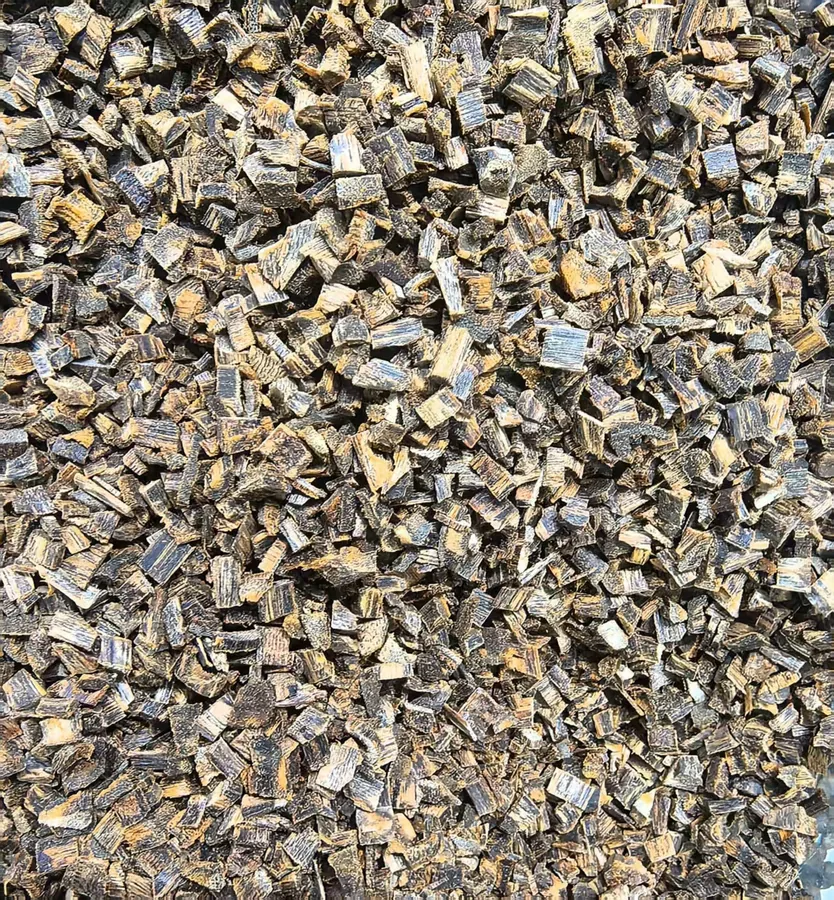
Clock 3: Processing and screening — where custom specifications cost calendar time
Standard grades can often be filled from an existing production run. A custom size band cannot. It needs a setup, a run of its own, and hand sorting after screening, which is why two orders of the same tonnage can sit weeks apart in the calendar.
This is also where MOQ interacts with lead time. A small order below the minimum for a dedicated run is usually filled either from standing stock or by waiting for the next scheduled run of that specification. Ask which of the two applies, because one gives you a date and the other gives you a place in a queue.
| Order type | What drives the date | What to confirm in writing |
|---|---|---|
| Standard grade from stock | Availability of the reserved lot and the packing slot | Lot reference, allocated weight, packing date |
| Custom size band | Setup, run scheduling and post-screen hand sorting | Minimum run quantity, queue position, oversize and fines tolerance |
| Private label or retail packing | Artwork approval, dieline, print and packing labour | Artwork freeze date, who owns the files, packing line slot |
| First order from a new supplier | Sample approval and specification freeze | The exact date the production clock starts |
Clock 4: CITES documentation — the clock most buyers forget
All agarwood-producing species in the genera Aquilaria and Gyrinops are listed in CITES Appendix II. A commercial export therefore needs a CITES export permit issued by the exporting country's management authority, and many destinations require an import permit before the goods may leave. The CITES Tree Species Programme review of the agarwood-producing genera sets out the permit framework and the trade data behind it (CITES Tree Species Programme, 2022).
Three features of that paperwork turn it into a scheduling risk rather than an administrative detail.
- It is issued to a named exporter. If your seller is a trading company and the permit is held by a separate exporting entity, the two names must be reconciled before the order is confirmed, not after production.
- It describes specific goods. Species, product description and quantity on the permit must match the commercial invoice. A late change to the size band, packing format or net weight can force an amendment.
- It is often sequential, not parallel. Where the destination requires an import permit, that document may be needed before the export permit is applied for. Two authorities in two countries do not share a queue.
Permit duration is jurisdiction-specific. As one published reference point, a Philippines-based plantation operator states a standard of 15–30 working days with complete documents (Crown Agarwood Group, CITES export permit page). Treat that as an illustration of magnitude, not a promise for your route; your exporting authority and destination set the real timeline. The UK guidance on CITES imports and exports is a useful example of how destination rules add their own steps (GOV.UK, CITES imports and exports).
The scheduling rule that follows is simple: the permit application should start when the order is confirmed, not when the goods are ready. If a supplier's lead time only begins at packing, the permit sits on the critical path after everything else has finished.
Clock 5: Freight — why bulky chips are priced on volume
Agarwood chips are light for their volume, so chargeable weight is frequently calculated on volumetric dimensions rather than actual mass. Two shipments of the same tonnage can carry different freight costs depending on how tightly the cartons are packed and how much dead space the pallet configuration creates.
Ask for the packed carton dimensions and net weight per carton before booking. Then compare sea and air on landed cost rather than freight rate alone: air shortens transit but multiplies the cost of a bulky, low-density cargo, while sea is cheaper per kilogram but adds weeks and a longer exposure to humidity and handling.
Documentation also has a physical journey. Original permits and certificates may need to travel separately from the goods, and a courier delay can leave a container waiting at destination. Confirm whether documents travel with the shipment, by courier in advance, or electronically where accepted.
A backward order calendar you can copy
Work backwards from the date the goods must be on your shelf, not forwards from the day you send an inquiry. The template below is a planning structure, not a claim about any supplier's standard timing; each interval must be replaced with the figures in your own quotation.
- Shelf date minus freight transit and clearance gives your latest departure date.
- Departure minus inland haulage and booking lead time gives the date the container must be packed.
- Packing date minus permit duration gives the latest date the permit application must be filed — check this against your order confirmation date, not your production date.
- Packing date minus processing and inspection gives the date the lot must be released to production.
- Production release minus conditioning gives the date the lot must be allocated and cut.
- Allocation date minus sample approval and deposit gives the date you actually need to start.
If step three lands before step six, your schedule does not close. The two honest options are to move the shelf date or to ask for a lot that is already permitted and packed. Buyers who discover this at week ten usually accept a worse outcome than buyers who discover it at week one.
Put the schedule in the RFQ, not in an email thread
A delivery promise is only useful if it is attached to a milestone, an owner and an evidence document. Add these lines to your request for quotation and require each one to be answered.
| Milestone | Owner | Evidence required |
|---|---|---|
| Sample dispatch | Supplier | Courier reference and lot the sample was drawn from |
| Specification freeze | Buyer | Signed specification with size band, moisture basis and packing |
| Lot reservation | Supplier | Lot reference and allocated weight |
| Conditioning complete | Supplier | Moisture result and method |
| Pre-shipment inspection | Both or third party | Checklist results, photographs, sealed retained sample |
| Permit issued | Exporter | Permit number, named exporter, species and quantity |
| Booking confirmed | Supplier or forwarder | Booking number, vessel or flight, ETD |
| Documents dispatched | Supplier | Courier tracking for originals |
This is also the point at which payment terms should be tied to evidence. A balance released against a named inspection result and a permit number is a schedule control; a balance released on a calendar date is not.
Ten questions that separate a real lead time from an optimistic one
- Does your quoted lead time start from the deposit, the approved sample, or the packing date?
- Is the lot I am buying already cut and conditioned, or allocated from a future harvest?
- What moisture will it be packed at, and is the quoted weight as-received or dry basis?
- Which processing steps happen in your own facility, and which are subcontracted?
- What is the minimum run for my size band, and when is the next scheduled run?
- Who applies for the CITES permit, and in whose name is it issued?
- Does my destination require an import permit before yours can be issued?
- What is the packed carton dimension and net weight, so I can check chargeable volume?
- What happens to the schedule if the permit is delayed or the lot fails inspection?
- Which of these commitments will appear in the purchase order?
Common lead-time planning mistakes
- Treating the quotation's lead time as door-to-door. Most figures cover production only, and sometimes only the factory's own processing.
- Starting the clock at the deposit. If the sample and specification are not approved, production has not started, whatever the payment date says.
- Assuming permit work runs in parallel. In many routes it runs after your import permit and before booking, which puts it squarely on the critical path.
- Changing the specification after approval. A new size band or pack format can invalidate both the production plan and the permit description.
- Planning to the average transit time. Build a window with a buffer sized to your shelf date, not a best case.
- Ignoring the seasonal retail calendar. Orders aimed at a major gifting or religious season compete for the same production and freight capacity as everyone else's.
- Leaving the remedy unstated. A late shipment with no agreed consequence is a schedule you did not actually buy.
How NanjaOud handles lead-time confirmation
Our published position is deliberately specific about when a date becomes meaningful. Lead time is confirmed after the sample, specification, packaging direction and order quantity have been reviewed and approved. MOQ, lead time, freight, ports, Incoterms and stock quantities are confirmed in the quotation rather than fixed on a web page, because they depend on the material and the route.
On the supply side, the facts we can state are these: more than ten years of agarwood cultivation experience, a managed plantation base of more than 160 acres (over 1,000 mu of standardized plantation resources) in Jiangmen, Guangdong, an in-house processing facility with stainless steel tanks and production line equipment, and a stated cultivation approach that does not use chemical resin-induction agents. Our quality and supply framework describes the material selection, format checks, weight and packaging confirmation and pre-shipment confirmation behind an order; it states plainly that it does not imply a certified quality system or laboratory testing of every batch.
For chip buyers, the current range includes natural large agarwood chips with intact pieces and visible grain for incense use, further cutting, grinding and distribution; natural small agarwood chips for portioning, blending, repacking and further grinding; and agarwood wood fragments in an irregular format for sorting, blending and incense processing. Each is supplied for B2B programs with ODM and custom processing discussion available.
If you are still shortlisting suppliers rather than scheduling a confirmed order, the eight-criteria comparison framework for oud chips manufacturers covers specification, sampling, inspection and claims in more depth, and the guide to requesting an agarwood wood block sample explains how to tie a sample to a lot before a date is agreed.
FAQ
How long does an oud chips manufacturer usually take to deliver?
There is no single figure, because the total combines lot allocation, conditioning, processing, CITES documentation and freight. Ask for each stage separately and for the event each one starts from. A production-only number cannot be used to plan a shelf date.
Does the lead time include CITES permit processing?
Often not. Many quotations cover production and packing only. Confirm who applies for the permit, when the application is filed, and whether your destination's import permit must be issued first.
Why does moisture affect delivery time?
Chips are sold by weight and water is weight. Conditioning to an agreed moisture takes time that depends on ambient humidity, and packing too wet risks weight loss and mould in transit. A realistic schedule includes it.
Can I shorten the lead time by paying more?
Sometimes for processing queue position, rarely for documentation or conditioning. Permit issuance follows an authority's process, and rushing drying shifts risk to you. Ask which specific stage a premium would compress.
What is the difference between a stock lot and a new production run?
A stock lot is already cut and conditioned, so the date depends on packing and paperwork. A new run depends on material allocation, conditioning, processing and then the same packing and paperwork. The gap between the two can be several weeks.
How should I plan around Chinese New Year or peak season?
Work backwards from your shelf date and add buffer for factory closures and freight congestion. Production and booking capacity tighten around major holidays, and a schedule that closes in a quiet month may not close in a busy one.
What should happen if the shipment misses the agreed date?
The purchase order should state the consequence: a revised delivery date, a price adjustment, a partial shipment, or a cancellation right after a stated grace period. Without a written remedy, the date is an aspiration.
Can private-label packing be done in the same lead time as bulk chips?
Not usually. Artwork approval, dielines, printing and packing-line scheduling add steps that bulk packing does not have, and a late artwork change can restart part of the sequence. Freeze the artwork before production is scheduled.
Conclusion
A reliable oud chips delivery date is built, not quoted. Separate the five clocks, put each milestone and its evidence into the purchase order, start the permit application at order confirmation, and plan backwards from the shelf date with a buffer you can defend. Suppliers who can break their lead time into stages are usually the ones who can also explain what happens when a stage slips.
If you are scheduling an order for incense production, fragrance processing, distribution or private label, send your specification, estimated quantity, target market and required delivery window through our contact page, and we will confirm what applies to your order.


