

A wholesale oud chips supplier does more than ship wood. For a private-label program, that supplier is the first link in a chain that ends on a retail shelf, and every decision made at the sourcing stage — chip size, moisture basis, pack format, label artwork, export papers — shows up later as either margin or rework. This guide sets out the eight decisions a first-time buyer should settle with a wholesale oud chips supplier before placing a bulk order, with the checks that keep a first run from turning into a costly lesson.
What a wholesale oud chips supplier should deliver
Suppliers in this trade describe themselves in similar language, but they are not the same kind of business. Before comparing price, establish which model you are talking to, because the model determines who controls the material and who carries which risk.
The four supplier models you will meet
- Plantation operator with in-house processing. Grows or manages trees and controls cutting, drying, sorting and packing. Traceability is usually strongest, but the range is limited to what the plantation and factory can produce.
- Processor only. Buys raw wood from growers or collectors and converts it. Quality depends on inbound material discipline rather than on its own trees.
- Trader or exporter. Aggregates from several factories. Useful for mixed or small orders, but lot-to-lot consistency depends on how well it documents its own suppliers.
- Finished-goods manufacturer. Converts chips into incense, oil, beads or blends. Relevant if you want one partner for both raw material and a finished private-label product.
None of these is automatically better. The practical question is whether the supplier can describe, in writing, where the wood is grown, who cuts and sorts it, and who prepares the export documents. If those three answers are vague at the inquiry stage, they rarely become precise after the deposit. Our companion guide to comparing oud chips manufacturers sets out a fuller due-diligence framework if you are still shortlisting.
What changes when the order carries your brand
Private label shifts the burden of presentation onto you. The supplier may cut, screen and pack the chips, but the retail pack, the label text, the barcode and the shelf-life claim are your responsibility in your market. That is why the first conversation should cover packaging direction and label review, not only price per kilogram. A supplier that treats private label as a bag with a sticker on it will leave you to solve moisture, labelling and artwork problems alone.
Step 1: Fix the chip specification before you ask for a price
“Good quality agarwood chips” cannot be quoted consistently. Every wholesale oud chips supplier will interpret it differently, and the cheapest interpretation will usually be a smaller, more screened, lighter product. Write the specification first, then send the same document to every candidate.
| Specification field | What to write | Why it changes the quote |
|---|---|---|
| Format | Whole chips, broken chips, fragments, granules or powder | Different cutting and screening operations, different yield |
| Size band | A lower and upper limit, plus how oversize is treated | Narrow bands need more sorting and produce more off-spec material |
| Screening and fines | Screen opening used and acceptable fines share | Fines are cheaper material; an unstated allowance shifts value to the supplier |
| Moisture basis | As-received weight or a stated dry basis | Water is sold at chip prices if the basis is not fixed |
| Appearance | Resin coloration, grain visibility, tolerance for pale or hollow pieces | Visual selection is hand labour and drives grade |
| Aroma reference | An approved sample code, not an adjective | Allows a lot to be accepted or rejected against a record |
| Foreign matter | Maximum tolerance for stone, soil and excess bark | Cleaning time and rejection risk |
| Pack unit | Net weight per inner bag, carton or sack, and labelling | Retail-ready packing is a separate cost from bulk packing |
If size control is the weak point in your brief, the guide to specifying agarwood chip and granule particle size shows how to write screen openings, oversize and fines into a wholesale RFQ.
Step 2: Build the SKU and pack plan
A private-label order is a set of SKUs, not a single weight. Decide how many retail units you intend to sell, in which pack sizes, before you discuss quantity. This single step determines whether your order is a bulk transaction or a small manufacturing project.
| Pack format | Typical use | What to confirm with the supplier |
|---|---|---|
| Lined bulk sack or carton | Incense production, grinding, redistribution | Net weight, liner type, labelling, pallet pattern |
| Retail jar or tin | Direct-to-consumer oud chips | Fill weight, seal, headspace, label area, carton count |
| Sachet or pouch | Trial sizes, gifting, hotel amenities | Barrier layer, fill tolerance, tear notch, barcode space |
| Gift box or presentation set | Premium retail and seasonal lines | Insert, window, outer sleeve, assembly labour, minimum run |
| Sample or display pack | Sales samples, trade shows | Whether the pack is produced in-house or sourced separately |
Calculate MOQ per SKU, not per order
Suppliers often state a minimum order quantity for the material, while your problem is the minimum run per pack. Ask both questions. As a worked example: if your plan is four SKUs at 100 retail units of 50 g each, the packed product is 20 kg before repack loss. If the supplier’s minimum production run is 200 kg, the material minimum — not your sales plan — is setting the order size. The two realistic responses are to consolidate into fewer SKUs or to buy the balance as bulk material for later repacking. A third response, quietly substituting a different lot to fill a small order, is the one to avoid.
Step 3: Turn the sample into an approved reference
A sample is useful only if it can be tied to the lot you will actually receive. Ask whether the sample is drawn from the offered lot or from generic reference stock, who pays courier and import charges, whether any sample charge is credited against the first order, and how long the sample price is valid.
When the sample arrives, record it rather than remember it: photograph it on a plain background with a scale reference, weigh it, note the lot or sample code, and keep a sealed retained portion. That record becomes the acceptance standard for the bulk delivery and, later, for the second order. The detailed method is set out in our guide to requesting an agarwood wood block sample, and the same discipline applies to chips.
Step 4: Read the quotation as a landed-cost model
Two quotations at the same price per kilogram can differ materially in landed cost once moisture, screening loss, repack labour, packaging and documentation are counted. Convert every quote to the same basis before comparing.
| Cost line | Confirm in writing |
|---|---|
| Material | Currency, weight basis, price validity period, lot reference |
| Grading and screening | Which size band and fines allowance the price refers to |
| Custom cutting or sorting | Included or charged per kilogram; yield loss borne by whom |
| Repack labour | Per unit or per kilogram; who supplies components |
| Packaging components | Jar, tin, pouch, box, insert, desiccant, label stock |
| Artwork and plates | Who prepares the dieline, who approves it, whether plates are recharged on reorder |
| Documentation | CITES permits, certificate of origin, phytosanitary certificate |
| Inland and port charges | Ex-works, FOB or CIF, with a named port |
| Freight and insurance | Actual versus volumetric weight; chips are bulky |
| Payment terms | Deposit percentage, balance trigger, currency |
Moisture and screening loss: the quiet cost
Moisture is the most commonly mispriced variable in this trade, because chips are sold by weight and water is free to the seller. The arithmetic is simple. A 500 kg lot at 12% moisture contains 440 kg of dry matter. The same dry matter at 8% moisture weighs about 478 kg. You have bought 22 kg less water — and paid freight on it. Neither figure tells you which lot is better; it tells you that a price per kilogram is meaningless without a moisture basis.
Screening loss works the same way. If 6% of a 500 kg lot falls below the lower screen limit you specified, 30 kg is out of specification before you start. Decide in advance whether that is a price adjustment, a re-screen or a rejection, and write the answer into the purchase order.
Step 5: Control repack, labels and artwork
If the supplier packs under your brand, the label is a regulated document, not a design file. Confirm who writes the label text, who checks it against your destination’s requirements, and which version is approved before production.
A practical label checklist for a retail oud chip pack includes the product name and format, net weight, lot or batch code, country of origin, packer or importer details, storage guidance, a safety line for burning incense, and a barcode that scans at your retail partner. Destination rules differ, so have your importer or compliance reviewer confirm the final text rather than relying on a template.
Artwork control matters as much as wording. Ask for a dieline before the first print run, approve a physical proof where possible, and record the version number that was released to production. If your supplier offers private-label coordination, confirm the scope in writing: our OEM and private-label page describes label and artwork review, packaging direction and pre-production confirmation, with final options and minimums confirmed per project rather than published as a fixed price list.
Step 6: Inspect at the two points that matter
There are two inspection moments in a private-label chip order, and they test different things.
Pre-shipment check on the bulk material
- Carton and lot labels match the approved lot reference.
- Net weight per unit, with packaging tare deducted.
- Size distribution from a scoop sample, recording oversize and fines.
- Moisture measured by the method agreed in the specification.
- Appearance compared with the retained approved sample under consistent light.
- Visual check for stone, soil, excess bark and non-agarwood material.
- Packaging integrity: liner, seal, carton strength and label accuracy.
Repack check on the finished SKU
Weigh a sample of finished units against the declared net weight, confirm the seal and headspace, scan every barcode, and compare the printed label with the approved artwork version. Record the pack date and lot code on the carton, because a retail claim six months later will be traced back through that code.
Step 7: Settle documents and Incoterms before booking freight
Agarwood is a regulated trade material. All agarwood-producing species in the genera Aquilaria and Gyrinops are listed in CITES Appendix II, according to a review of the agarwood-producing genera published through the CITES Tree Species Programme. Commercial trade is permitted, but the exporting country’s Management Authority must issue the relevant permit, and the FAO’s overview of CITES and sustainable forest management sets out the permit logic that applies to Appendix II species.
In practice, confirm per shipment: the CITES export permit, an import permit if your country requires one, a certificate of origin, a phytosanitary certificate where required, and an invoice and packing list whose species and product description match the permit exactly. A mismatch is a customs problem, not a clerical detail. Permit lead time is often longer than production lead time, so agree who applies and when, and do not book freight until the document path is confirmed.
Step 8: Plan lead time and the reorder
Lead times are only comparable if they start from the same event. Ask each supplier to break the timeline into stages and to say which stage their number covers.
| Stage | Starts when | Confirm in writing |
|---|---|---|
| Specification and pack approval | You sign off the written spec and dieline | Version reference and date |
| Sample approval | Sample arrives and is assessed | Approval record tied to a lot |
| Production slot | Deposit received and spec approved | Slot date, not a range |
| Processing and repack | Material released to the line | Stage duration and inspection point |
| Permits | Application submitted | Who applies, expected issue window |
| Inland and port | Documents released | Named port and cut-off |
| Transit | Vessel or flight departure | Mode, route and estimated arrival |
For the reorder, reference the approved lot and retained sample in the purchase order, and ask how the new lot will be matched to that reference. Natural material varies; undisclosed variation is the problem.
Common first-order mistakes
- Buying on price per kilogram without a moisture and screening basis.
- Approving a sample without recording its identity or keeping a retained portion.
- Treating a material MOQ as if it were a per-SKU minimum.
- Leaving label text and artwork approval to the supplier.
- Assuming a grade letter means the same thing at every factory; A, B and C labels are internal references, not a universal standard.
- Booking freight before the permit path is confirmed.
- Ordering three lots after testing one, without a lot-matching clause.
How our wholesale oud chips range fits a first order
Jiangmen Nangjiaxiang Agarwood Development Co., Ltd. supplies agarwood raw materials from a managed plantation base in Jiangmen, Guangdong, with more than ten years of cultivation experience and in-house processing. Our cultivation approach does not use chemical agents to induce resin formation, and our chips are supplied to buyers in the Middle East, Southeast Asia, Europe and the Americas.
For private-label programs, the relevant formats are:
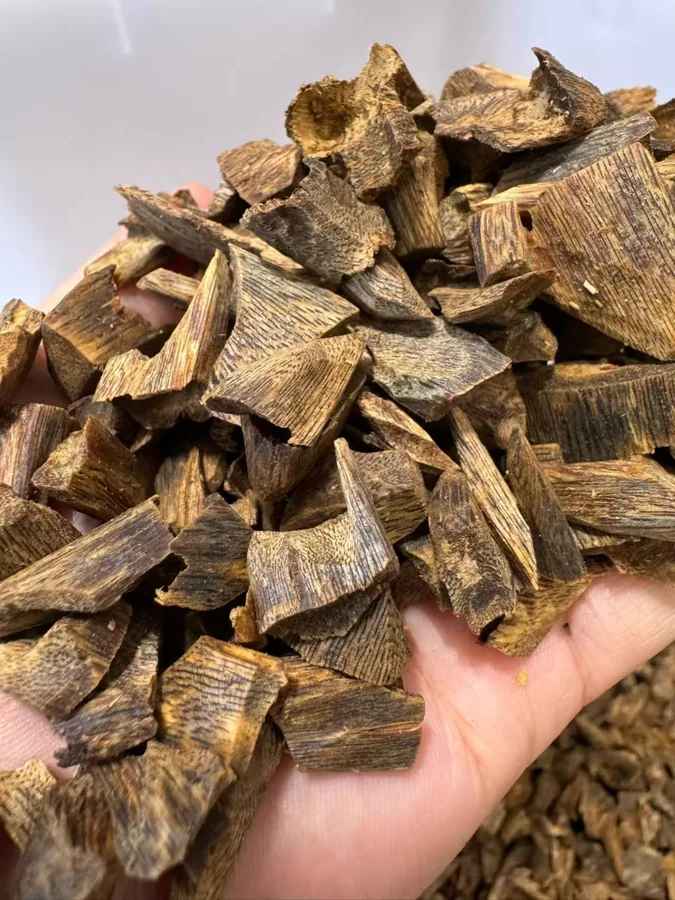
- Natural large agarwood chips — comparatively large, intact pieces with visible grain and resinous streaks, suited to presentation packs, incense use, further cutting or grinding.
- Natural small agarwood chips — smaller irregular pieces that are easier to portion, blend, repack and grind, which suits retail packs and sample units.
- Agarwood wood fragments — an irregular fragment format for sorting, blending, incense processing and powder production.
Custom processing, product specifications and packaging direction can be discussed for ODM cooperation. We do not publish a fixed MOQ, price or lead time, because those depend on the format, quantity, packing and destination; they are confirmed in the quotation after the specification and sample are reviewed. Our quality and supply framework describes material selection, format checks, weight and packaging confirmation and pre-shipment checks, and states plainly that it does not imply a certified quality system or laboratory testing of every batch.
FAQ
What does a wholesale oud chips supplier actually supply?
Depending on the business model: raw chips cut and screened from its own plantation, processed material bought from growers, aggregated lots from several factories, or finished products. Ask which steps happen in-house before comparing price.
What should I include in the first inquiry?
The intended use, format and size band, estimated quantity, pack format, target market, required documents and requested sample size. A written specification produces a comparable quote; an adjective produces a guess.
How is MOQ set for private-label oud chips?
Usually by the material run and, separately, by the minimum per pack or SKU. Ask for both numbers, plus whether a small-order surcharge or stock lot is available. Do not assume the material MOQ is the only minimum.
Should a sample be free?
Either model is normal. What matters is whether the sample comes from the offered lot, who pays courier and import charges, whether the charge is credited against the first order, and how long the price is valid.
How do I compare two quotes per kilogram fairly?
Put both on the same moisture basis, size band, fines allowance and Incoterm, then add repack, packaging, documentation and freight. A quote that excludes documentation is not cheaper; it is incomplete.
Which permits apply to oud chips?
Aquilaria and Gyrinops species are listed in CITES Appendix II, so an export permit from the exporting country is normally required, and your destination may require an import permit. Confirm the exact list for your country before booking freight.
Can you print our brand on the retail pack?
Label and artwork review, packaging direction and pre-production confirmation can be discussed as part of private-label coordination. Final pack options, minimums and costs are confirmed against your specification and destination requirements.
How long does a first order take?
It depends on the production slot, repack work, permit issuance and transit, so a single number is misleading. Ask for a stage-by-stage timeline and confirm which stage each date covers.
Conclusion
A first private-label order succeeds or fails on documents you control before production starts: a written chip specification, a pack and SKU plan, a lot-linked sample record, a landed-cost quotation and an inspection standard with a remedy clause. Choose a wholesale oud chips supplier that will put those five things in writing, and the price conversation becomes a comparison rather than a gamble.
If you are sourcing oud chips for a retail or distribution program, send your specification, pack plan, estimated quantity and target market through our contact page, and we will confirm what applies to your order.


