
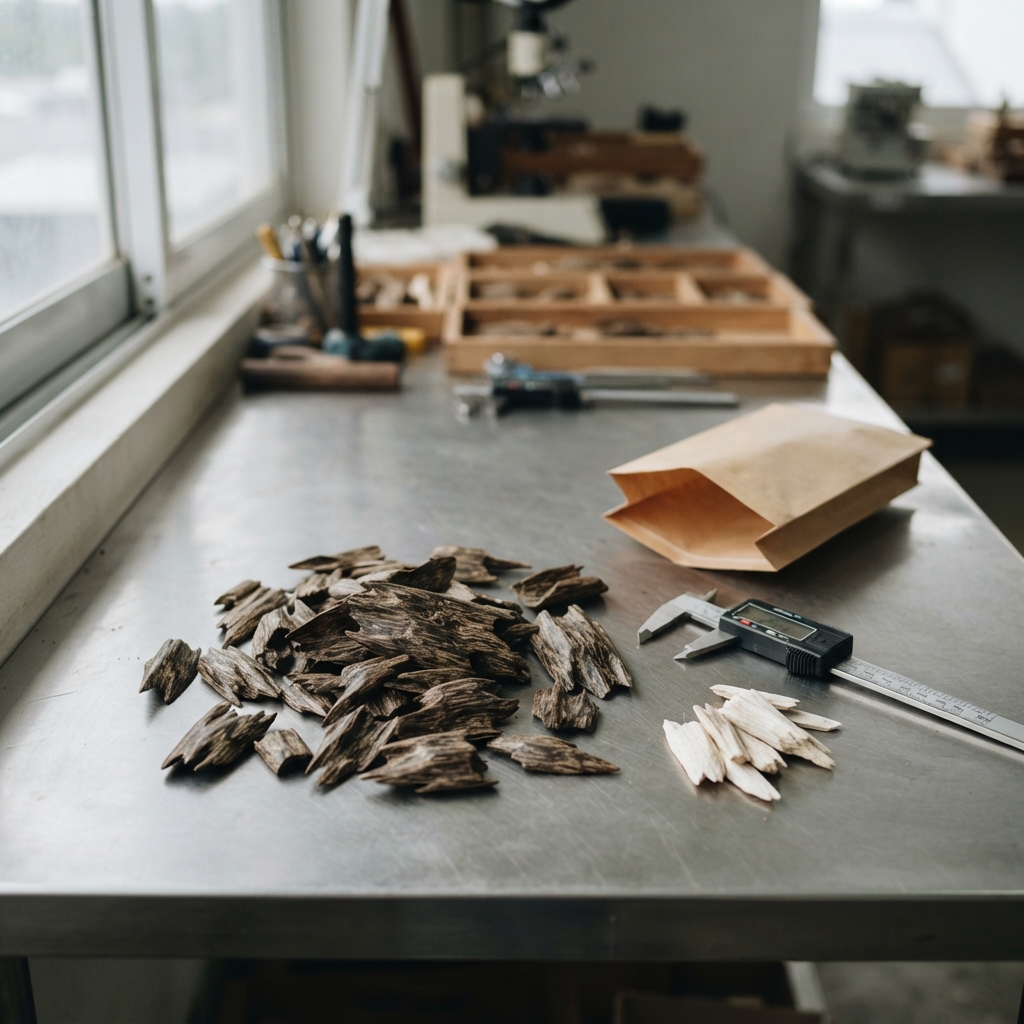
An oud chips manufacturer factory audit is a structured check of three things: whether the wood entering the building matches what you were quoted, whether the process between intake and packing is controlled, and whether the lot you will receive can be traced back to both. Price negotiation tells you what a supplier wants; an audit tells you what the factory can actually repeat.
Most importers audit too late. They approve a sample, order wholesale oud chips by the container, and only then discover that the "grade A" they bought is whatever the packing bench had on the day. This guide gives B2B buyers a walkable audit sequence, an evidence sheet you can fill in on site, a remote protocol for when travel is not practical, and a scoring method that turns notes into a go or no-go decision.
What an oud chips manufacturer audit proves, and what it cannot
A well-run audit answers operational questions with physical evidence:
- Does the factory hold raw material that can support your order size, or does it buy to order from traders?
- Is grading done against a written definition, or by feel and by price bracket?
- Is moisture and cut thickness controlled and measured, or left to the operator's judgement?
- Can a sealed bag on the packing bench be traced to a lot, a date and a supplier?
It does not answer everything. An audit will not measure resin chemistry, will not prove the legality of a specific consignment on its own, and will not tell you whether the company will still be solvent in two years. Those questions belong to laboratory testing, permit checks and commercial due diligence respectively.
Two framing points are worth carrying into the visit. First, agarwood has no binding international grading standard: CITES regulates whether the wood may cross a border, not how good it is, and every factory's A, AA or "super" label is a local convention. Second, all agarwood-producing Aquilaria and Gyrinops species are listed in CITES Appendix II, so export and re-export require permits (FAO, CITES, trade and sustainable forest management; CITES CoP20 working document on agarwood). A permit proves paperwork, not resin.
Step 1: Write the audit brief before you book anything
The single most common audit failure is scope drift: the buyer arrives with no defined question, the factory walks them through a showroom, and both sides leave with a good impression and no evidence. Fix the brief in writing and send it at least a week ahead.
- The format you are buying — large pieces, small chips, shavings or powder. Each has a different failure mode, and the audit should follow your format.
- The claim you want to verify — for example "no added fragrance or colour", "single-origin", "grade ratio 70:30 dark to white wood", or "moisture below our specification". One or two claims, stated plainly.
- The order size and cadence — a one-off trial lot and a repeating quarterly volume stress the factory differently.
- The destination market — it determines which documents and labelling points matter.
- The production day, not the tour day — ask explicitly to see the line running the material you intend to buy, and to open bags at random.
If a supplier will not accept a dated brief with random bag opening, that is already an answer.
Buyers comparing an oud chips manufacturer in China with suppliers in Vietnam, Thailand or India should keep the same audit walk but not the same document set: the issuing authority, the export port and the labelling requirements all change with origin, so ask for the papers for the specific consignment rather than a company-level file.
Step 2: Walk the five zones in this order
Walk the process backwards from packing to intake, or forwards from intake to packing, but always walk all five. A factory that looks orderly at the packing bench and chaotic at the grading bench will ship you inconsistent lots.
Zone 1 — Raw material intake and storage
This room tells you whether the factory owns its material position. Look for labelled inbound consignments, separation between origins and between cultivated and other sources, and a dry, ventilated store. Ask what happens to material that fails visual inspection on arrival. If every bag is unlabelled and stock is stacked by "whoever brought it", traceability downstream is impossible regardless of how good the office paperwork looks.
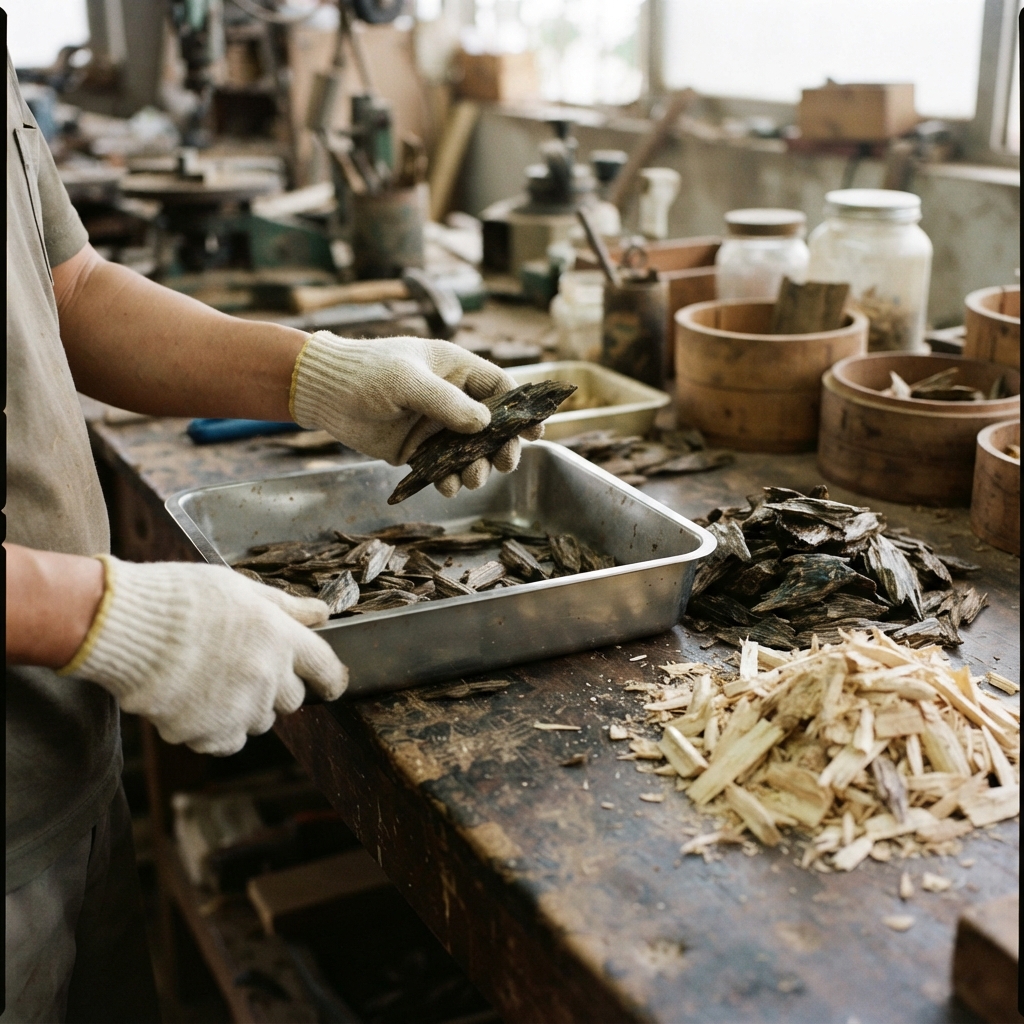
Zone 2 — Grading and cleaning bench
This is the room that decides your price. Grading is where white, unresinated wood is separated from resin-bearing wood, and where the real grade ratio of a lot is set. Because oud chips grading has no binding international standard, the factory's own written definitions are the only ones you can enforce, so read them here rather than in a contract. Ask three questions and watch where the answers come from:
- Can I see the grade definitions in writing, and the retained samples that anchor each grade?
- Where does the reject material go — a separate bin, or back into the lot?
- Who decides a borderline piece, and is that decision recorded?
Look at the floor around the bench. A clean bench with a visible reject pile of pale wood and dust is a good sign. A bench where sweepings are returned to the sack is the mechanism behind "the same grade burns differently every time".
Zone 3 — Cutting and shaping
How the wood is reduced matters as much as what is reduced. High-speed cutting generates heat, and heat drives off some of the volatile material you are paying for. Ask what method is used, then test the output rather than the description: take 20 random pieces from the lot you would buy and measure thickness with your own calipers. Record the range, not the average. A tight range means the packing bench can portion repeatably; a wide one means your customers will get different burn behaviour from the same tin.
Zone 4 — Drying and moisture control
Moisture is the quietest cost in an oud chips order: it is bought at the price of resinous wood and it changes in transit. Ask what basis the factory quotes on (wet or dry), what instrument or method is used, and what the reading was on the lot in front of you. Take a sealed subsample away with you and re-test it on arrival — a gap between the factory reading and your own is a fact you can put in a purchase order. For the full set of clauses, see our guide to oud chips moisture content.
Zone 5 — Packing and lot marking
The last room is where traceability either survives or dies. Check the liner, the seal, whether a desiccant is used and how, the carton grade, and — most importantly — whether the pack carries a lot code and a net weight. A bulk sack with no lot code cannot be linked to the audit you just performed, which means your evidence evaporates at the warehouse door. Packing specification details are covered in oud chips packaging and storage.
The audit record sheet
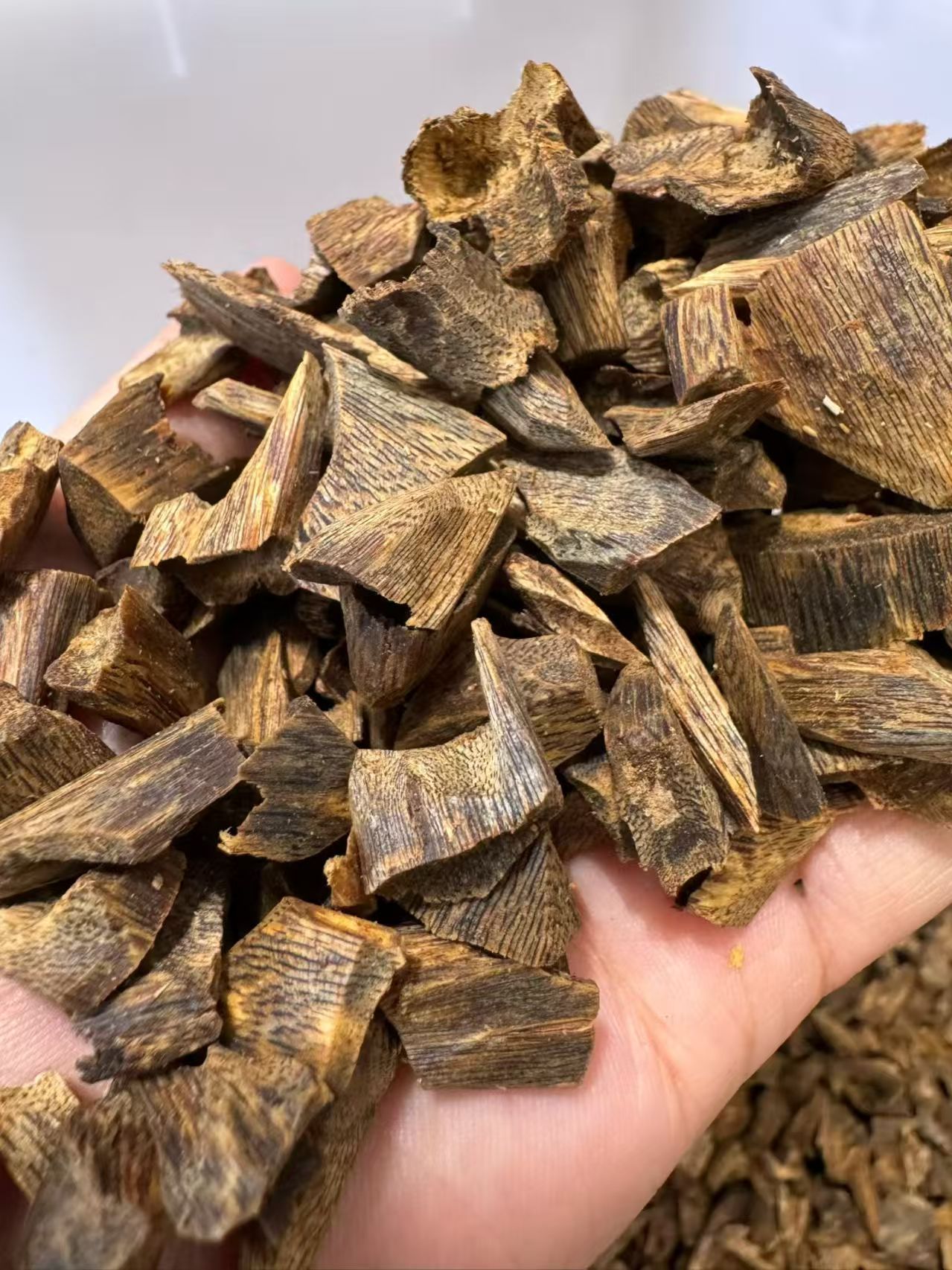
Every oud chips manufacturer should be able to answer these five rows. Fill the sheet in on site, and photograph everything you record; a photo with a lot label in frame is worth more than a paragraph of impression.
| Zone | What to observe | What to record | Stop signal |
|---|---|---|---|
| Intake and storage | Labelled consignments, origin separation, dry store | Lot code, supplier, arrival date, species as labelled | Unlabelled bags, mixed consignments |
| Grading bench | Written definitions, retained grade samples, reject bin | Grade definitions, photos of accepted and rejected material | Grades described only as "A+", "super" or "royal" |
| Cutting | Method used, thickness variation | 20-piece thickness range measured with your calipers | No measuring tool on site, or refusal to measure |
| Drying | Instrument, method, reading on your lot | Basis, method, reading, date, operator | Refusal to state method or basis |
| Packing | Liner, seal, desiccant, carton, label | Pack specification, label photo, net weight per pack | No lot code on bulk or retail packs |
Five red flags that should end the visit early
Any one of these is enough to stop and re-scope the order. None of them is a reason to keep negotiating on price.
- No grade definition exists in writing. If the only answer an oud chips manufacturer gives to "what is grade A" is a price band, your specification has no anchor and no claim can be enforced.
- The showroom lot and the production lot are different. Ask to see the actual bags allocated to your order, with the allocation recorded. If that request is deflected, the sample you approved is decorative.
- Reject material is not separated. White wood and fines returning to the lot is how grade ratios drift between shipments without anyone lying.
- Nothing links a bag to a date. Without lot marking, an arrival dispute becomes one party's memory against another's. Document the claim process before you need it — see oud chips claims and arrival inspection.
- A strong cold smell that collapses on heat. Genuine resin-rich chips are usually restrained at room temperature and open up when heated. An intense, sweet, uniform smell straight from the bag is more consistent with oil or fragrance treatment than with wood.
How to audit remotely when you cannot travel
A remote audit is weaker than a visit, but it is far better than none if it is unscripted and live. Book 60 to 90 minutes on a production day and insist on a walking video call, not a slide deck.
- Ask for a live walk from intake to packing, with the camera pointed at floors, bins and labels rather than at faces.
- Ask them to weigh 1 kg from a random bag on camera, then open a second bag of the same lot and compare.
- Ask for a caliper measurement on ten pieces, read aloud on camera.
- Ask for close-ups of a lot label, then a second call on packing day to see that same lot being sealed.
- Keep the recording and the date, and attach both to the sample approval record.
Pair the call with a physical sample from the identified lot, sent before the call so you can burn it while watching. A remote audit without a lot-linked sample verifies a building, not a product. For the sampling side of that pairing, see oud chip sample approval protocol and resin content verification.
Scoring the audit into a decision
Score each criterion from 1 to 5 and weight it. The weights below reflect what actually causes repeat-order failures for an oud chips manufacturer, where material variability is the norm.
| Criterion | Weight | What a 5 looks like |
|---|---|---|
| Material traceability | 25% | Every bag links to a lot, a date and a labelled source |
| Grading control | 20% | Written definitions, retained grade samples, separated rejects |
| Process control (cut and drying) | 20% | Measured thickness tolerance and recorded moisture readings |
| Packing and marking | 15% | Sealed liner, lot code and net weight on every pack |
| Document readiness | 10% | Permit, invoice and packing list describe the same goods |
| Capacity headroom | 10% | Stock and schedule visible beyond your order |
Read the total as a gate, not a grade. Above 80: proceed to commercial terms. Between 60 and 79: proceed only with conditions written into the order, such as pre-shipment inspection at your cost and a retained reference sample. Below 60, or a score of 1 on traceability at any total: stop, and treat the supplier as a spot trader until proven otherwise.
Two cautions on scoring. Do not compare scores between audits with different scopes — a 90-minute video call and a two-day visit are not the same measurement. And do not let a strong aroma sample lift a weak process score; the sample is one lot, the process is every lot.
Common mistakes buyers make
- Auditing the showroom instead of the line. Reception rooms are curated; floors are not.
- Auditing a sample instead of a lot. Ask which lot the sample came from and whether that lot is still available.
- Skipping the reject pile. The reject pile is the honest description of the grade you are buying.
- Never re-auditing. Material access, staff and grading habits change. An annual re-audit plus a pre-season check is a reasonable rhythm for a repeating buyer.
- Auditing before you know your own specification. If you cannot state your cut size, moisture limit and grade ratio, you are auditing an oud chips manufacturer against nothing. Start from our comparison framework for oud chips manufacturers and how MOQ is set.
What this looks like at NanjaOud
We are Jiangmen Nangjiaxiang Agarwood Development Co., Ltd., based in Jiangmen, Guangdong, with more than ten years of agarwood cultivation experience and a managed plantation base of over 160 acres (more than 1,000 mu). Processing is in-house: our facility runs stainless steel tanks, distillation equipment and production line equipment, and the processing route is set by the material and the product format rather than by a single fixed line.
Three points buyers should know before they audit us, because they set honest expectations:
- Our cultivation approach does not use chemical agents to induce resin formation. That is a statement about our cultivation standard, not a laboratory result on any specific lot.
- Our A, B and C grades are internal reference labels. They are not a universal or international grading standard, and we do not present them as one. Your specification and approved sample define the order.
- Our quality checks are order-level: visual and format checks, weight and packaging confirmation, batch and order records where applicable, and a pre-shipment confirmation. We do not claim a certified quality system or laboratory testing of every batch.
If your programme needs the physical material defined first, our natural large agarwood chips and natural small agarwood chips are the two formats most buyers start from, with custom processing, specifications, packaging and ODM coordination discussed against the brief. Working from our own plantation base and processing line, we quote an agarwood chips manufacturer programme per format and specification rather than per grade letter, and MOQ, lead time, freight and terms are confirmed in the quotation rather than published as fixed numbers. Our quality and supply framework sets out the same working sequence we would show you on site: select, process, check, pack.
FAQ
How long does an oud chips factory audit take?
Two to four hours on site is enough for a single-format buyer if the brief is agreed in advance and the line is running. Add half a day if you are auditing several formats or want to watch a grading session end to end.
Can I audit a manufacturer without visiting China?
Yes, with limits. A live, unscripted video walk plus a lot-linked sample and a packing-day follow-up call gives usable evidence on traceability, handling and marking. It is weaker on moisture control and on judgement calls at the grading bench, which are easier to assess in person.
Which documents should I ask to see during the audit?
The business licence of the entity that will invoice you, the CITES documentation for the consignment (not a generic certificate for the company), phytosanitary documentation where your market requires it, the grade definition, the retained sample approval record, and a packing list that describes the same goods as the invoice. For what each document does and does not prove, read oud chips manufacturer certifications.
Does a CITES permit prove the wood is high grade?
No. CITES governs trade in listed species; it does not grade quality. A permit tells you the consignment is documented for export and import, not that the resin content, aroma or cut match your specification.
Should I audit before or after sampling?
Sample first, then audit the lot the sample came from. An audit of a factory whose sample you have not burned tells you about a building. An audit tied to an identified lot, with the sample approved in writing, tells you about your order.
What if the factory refuses random bag opening?
Treat it as a failed criterion, not a negotiation point. A factory that cannot open a random bag for a serious buyer either does not control its lots or does not want you to see the ratio inside them.
How often should a repeating buyer re-audit?
Annually, plus a short pre-season check before your peak demand window. Re-audits can be lighter: confirm the grade definitions, re-measure thickness, re-check lot marking and compare the current reject pile with your retained reference sample.
Conclusion
Auditing an oud chips manufacturer is not about finding fault; it is about replacing impressions with records. Walk five zones, measure rather than listen, tie every observation to a lot code, and score the result before you discuss price. Whether the oud chips supplier you are visiting is a factory in Guangdong or a trading office with a warehouse, the evidence is the same: labelled material, a written grade definition, measured thickness and moisture, and a pack that carries its own lot number. A supplier who can show all four is telling you something no quotation can — that the next shipment can be made the same way.
If you are preparing a first or repeat order and want to align the audit with a specific format and market, send us the product family, intended format, estimated quantity, target market and packaging direction through our contact page, and we will help define the sample, specification and next commercial step.


