
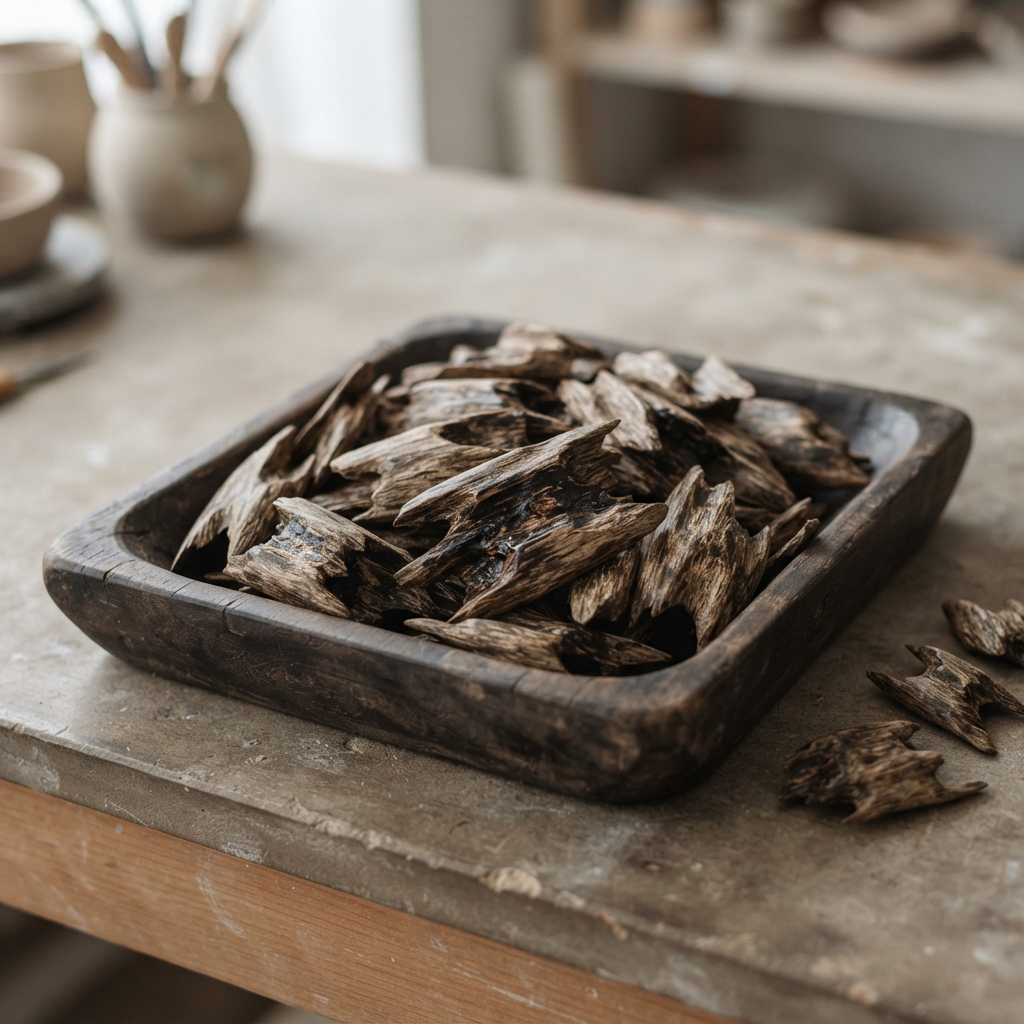
Oud wood chips are made by harvesting resin-bearing Aquilaria or Gyrinops wood, then cleaning, drying, cutting and grading it into pieces a buyer can burn, mill or resell. The quality you receive is decided long before the bag is sealed: in how the tree was wounded, how much pale sapwood stayed in the lot, how the wood was dried, and how the pieces were sorted. A buyer who understands those stages can audit an oud chips manufacturer in one visit instead of three shipments.
This guide walks through the seven production stages that shape wholesale oud wood chips, with the check to make at each one, the evidence to request, and the failure signal that predicts a claim later. It is written for importers, incense and bakhoor producers, attar houses and private-label brands comparing manufacturers — not for retail buyers looking for a single piece to burn at home.
Why the production stage matters more than the grade letter
Most sourcing conversations start with a grade name. That is the weakest possible starting point, because grade letters are supplier-internal labels. Two factories can both quote "super" and deliver material that differs in resin density, piece size, moisture and pale-wood share by margins wide enough to change your cost per usable kilogram by a third or more.
Production stages, by contrast, are observable. A factory either controls drying or it does not. Pieces are either sorted to a measurable size class or they are not. The trimming bench either separates resinous heartwood from pale sapwood, or it sweeps both into the same carton. When you know what each stage should look like, you can ask for a specific observation instead of a promise, and you can compare two manufacturers on the same evidence.
There is a commercial reason too. Every defect a buyer discovers on arrival — excess fines, uneven thickness, off-smell pieces, weight that does not match the invoice — was created or permitted at a named stage upstream. Tracing the defect back to its stage is how you turn a complaint into a corrective request the supplier can actually act on.
Stage 1 — Raw material: species, plantation age and resin formation
Agarwood is not a tree species that is simply cut and sold. The dark, aromatic wood forms as a defence response when the tree is wounded and colonised by microorganisms, which is why resin is distributed unevenly through a trunk rather than through all of it. Wild supply has been under heavy pressure for decades; all Aquilaria and Gyrinops species have been listed in CITES Appendix II since 2005, which is why legal export of chips involves a permit rather than only an invoice. The FAO's review of CITES and sustainable forest management notes that agarwood-producing species are now all listed in Appendix II (FAO).
That listing pushed the trade toward plantations, where resin formation is induced deliberately. The CITES Tree Species Programme's 2022 review of the agarwood-producing genera records that plantation agarwood is now regularly harvested only a few years after inoculation, and that some inoculants produce substantial resin. Two consequences follow for buyers.
First, "plantation" is not a grade. Inoculation method, tree age at induction, incubation period and genetics all move resin yield, and a plantation that harvests early will produce paler, lighter chips than one that waits. Second, documentation now matters as much as wood quality: the permit, the species name and the shipment description have to agree with what is in the carton.
The check at this stage
- Ask what was inoculated, when, and with what. A manufacturer who can answer at the compartment level is managing the material; one who answers "our trees are all natural" is reciting marketing.
- Ask for the species name in writing and match it against the CITES permit description later. A vague "agarwood" is not a species.
- Ask whether chemical accelerants are used. Some buyers accept induced resin; many do not accept acceleration by chemical means. Get the answer in writing either way, because the claim will end up on your own retail packaging.
Stage 2 — Harvest and log selection
Not every log is worth cutting into chips. At harvest, the resinous portions have to be identified and separated from wood that carries little or no resin. This is the first point where a factory decides what its chip output will be, and it is the point most often skipped in a buyer's due diligence.
Selection is usually guided by external indicators, by tapping or drilling, and in better-run operations by harvesting records that show which compartment and which induction date a log came from. The output of this stage is a set of logs sorted by expected resin level — a decision that will be reflected in your quotation weeks later.
The check at this stage
- Ask for lot traceability at compartment level for the lot you are being quoted, not for the factory in general.
- Ask how much of a harvested log becomes chip-grade material and what happens to the rest. If the answer is "all of it", the pale wood has to go somewhere, and the likely destination is your carton.
- Watch for a single blended stockpile. If every log in the yard feeds one pile, no grade claim downstream can be true.
Stage 3 — Cleaning, trimming and separation of pale wood
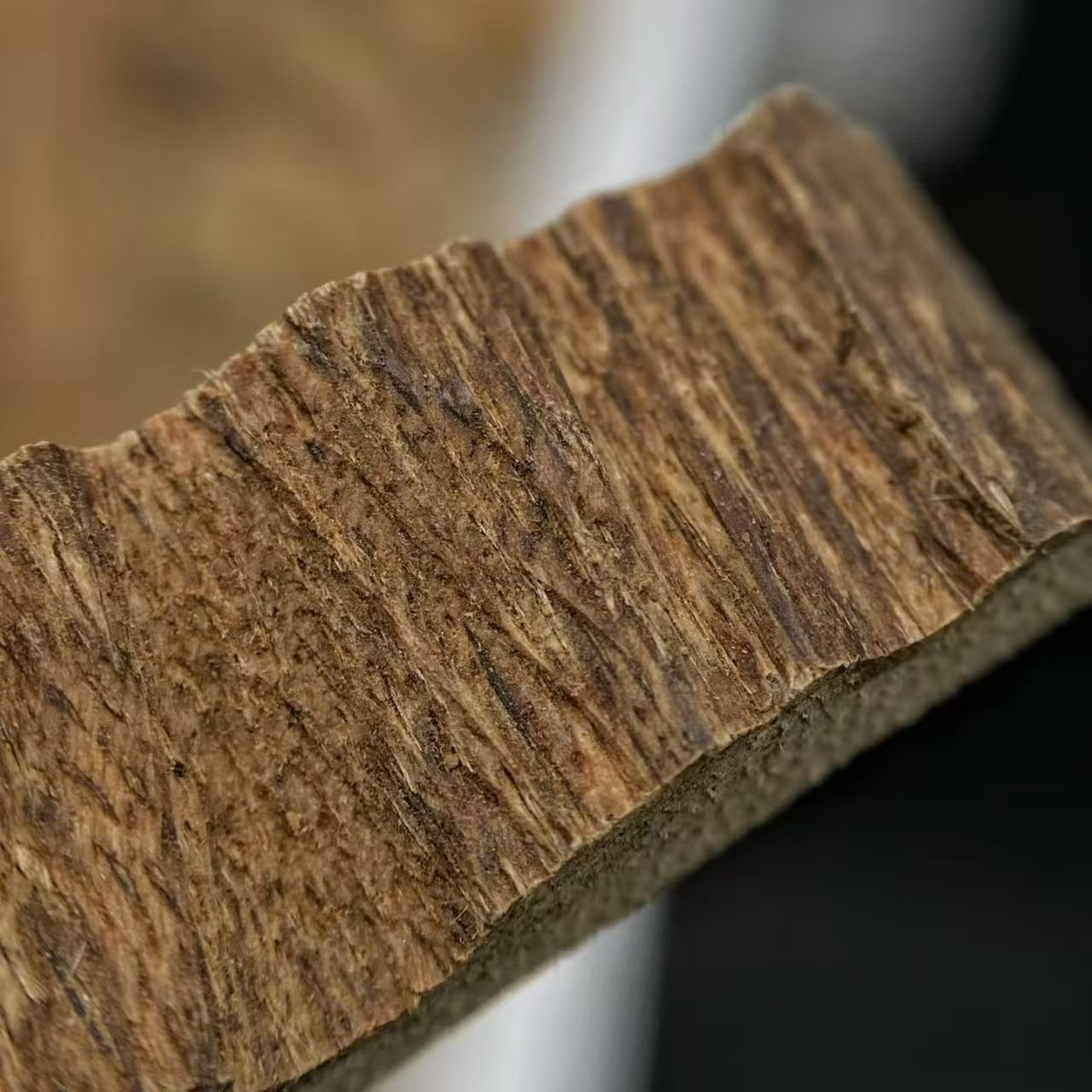
After harvest, wood is cleaned of bark, soil and decay, then trimmed. Trimming is where the economics of oud wood chips are decided. Resinous heartwood and pale sapwood look obviously different on a bench, but once both are cut to similar size and mixed, the difference is much harder to see in a photograph and easy to miss in a sealed bag.
This matters because pale wood is priced as if it were resinous. Illustrate it on your own lot: if 15% of a 100 kg shipment is non-resinous sapwood, you paid resin-grade money for 15 kg of material that will not perform on the burner. Across a container, that is not a rounding error.
The check at this stage
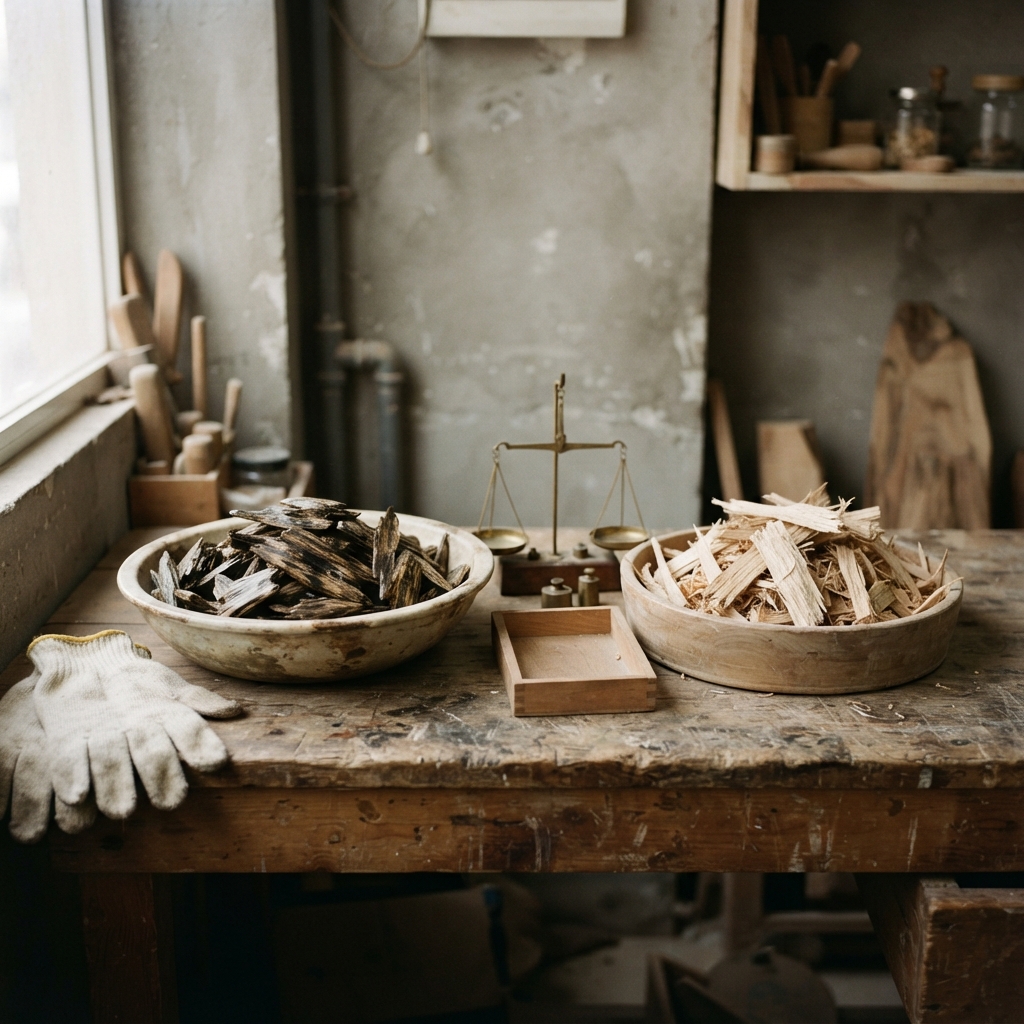
- Request a split sample: ask the supplier to send the dark fraction and the pale fraction separately from the same lot, with the share of each stated.
- Ask whether trimming is done before or after drying. Order matters, because wet wood hides colour differences that appear after drying.
- Confirm what happens to trimmings and dust. A credible answer connects them to powder or oil feedstock; an evasive answer usually means they return to the chip pile.
Stage 4 — Drying and moisture control
Drying is the least visible stage and one of the most expensive to get wrong, because water is sold at the price of resinous wood. A lot dried to a higher moisture content weighs more, photographs darker and smells stronger in the bag — and then loses weight, and often aroma, in your warehouse.
Moisture has to be agreed on a stated basis: wet basis or dry basis, measured how, on which sample. Without that, "12% moisture" in a quotation is a number with no meaning. Resin-rich agarwood also behaves awkwardly in a drying oven, because volatile compounds leave alongside water, so a single oven test can misstate the true figure if it is run without a method.
For the full method, the moisture clause to write into a purchase order and the claim route when an arrival is wetter than agreed, see our guide to oud chips moisture content.
The check at this stage
- Ask what the target moisture is and on which basis it is measured.
- Ask how drying is controlled — sun, shade, forced air, dehumidified room — and whether lots are dried separately or together.
- Weigh a sample on arrival, dry it under agreed conditions and reweigh. Two numbers and a calculator settle a dispute that otherwise runs for weeks.
Stage 5 — Cutting and sizing
Cutting converts trimmed wood into a saleable form: large pieces, small chips, granules or powder. Two variables dominate here, and buyers usually specify neither.
The first is cut method. Machine cutting is fast and consistent in dimension, but the blade generates heat, and heat drives aromatic compounds out of the wood at the moment of cutting. Hand shaping is slower and produces less uniform pieces, but it keeps more of the aromatic content in the chip. Neither is automatically better for every application — a bakhoor producer blending chips into a paste may care less about cut-induced loss than a retailer selling the piece itself — but the buyer should know which method produced the goods.
The second is size definition. "Small chips" is a name, not a measurement. A usable specification states a screen opening or a piece dimension with an allowed oversize and fines share, so that two deliveries can be compared with a sieve rather than an opinion. Our separate guide to agarwood chip and granule particle size sets out how to write that specification.
The check at this stage
- Ask which cut method was used for the lot you are buying, and whether it is consistent across repeat orders.
- Specify size with a number and request the retained sample that defines it.
- Ask what share of fines is normal for the size class and how fines are handled — screened out, or packed in.
Stage 6 — Grading and sorting
Grading is where supplier labels diverge most. In some factories a grade is a measured band: minimum piece size, minimum resin share, maximum pale-wood share, moisture ceiling. In others it is a visual impression formed by an experienced sorter at the end of a shift. Both exist in the trade; only the first one can be enforced.
The practical answer for a buyer is not to argue about letters but to convert the label into criteria you can test, then ask the manufacturer to confirm those criteria for the specific lot. A grade that cannot be described in numbers is a price bracket, not a specification.
| What the grade label usually implies | What to convert it into | How to verify it |
|---|---|---|
| "Premium" / "super" | Minimum dark-wood share, minimum piece size | Split a 200 g sample, sort by eye under consistent light, weigh each fraction |
| Single-origin claim | Species, region and harvest compartment | Match the permit description and the lot record |
| "High resin" | A stated test method and sample reference | Run a density or burn comparison against the retained sample |
| "Hand-selected" | Who sorted it and against which criteria | Ask for the sorting sheet signed for that lot |
| "Natural" | No chemical acceleration, stated in writing | Ask for the written statement and test the burn behaviour |
Resin claims deserve their own treatment because they drive price more than any other attribute; the methods buyers can actually run are set out in our guide to verifying oud chips resin content.
The check at this stage
- Ask for the sorting criteria in writing, per grade, before you request a quotation.
- Ask who sorts and how often the criteria are re-checked. One sorter with no written standard is a single point of failure.
- Keep your own retained sample per grade, sealed and dated, as the reference for every later arrival.
Stage 7 — Packing, documentation and dispatch
Packing is part of manufacturing, not a logistics afterthought. Chips that leave the factory at an agreed moisture can arrive wetter, mustier or lighter depending on the liner, the seal, the desiccant and the carton grade. Freight conditions — a container that heats and cools daily — will find every weakness in the pack.
Documentation is the other half of this stage. Legal export of CITES Appendix II material requires permits that describe the goods accurately: species, form, quantity. If the permit says chips and the carton holds powder, or the species on the permit does not match the invoice, the shipment stops at the border and the cost lands on the importer. The specification to put in your purchase order is covered in our guide to oud chips packaging and storage.
The check at this stage
- Approve the pack specification, not just the product: liner, seal, desiccant, carton grade, unit weight, label content.
- Check that permit description, invoice, packing list and HS code tell the same story.
- Ask for pre-shipment photographs of the actual packed lot, with the label visible.
The stage-by-stage audit table
Use this as a single page in a factory visit or a video call. The right-hand column is what tells you the stage is not under control; one weak stage is a question, three are a decision.
| Stage | Question to ask | Evidence to see | Failure signal |
|---|---|---|---|
| Raw material | Species, inoculation date, compartment? | Plantation records, species statement, permit draft | "All natural", no species name |
| Harvest | How is chip-grade wood separated from the rest? | Harvest and culling records | One blended stockpile for everything |
| Trimming | What share of the lot is pale sapwood? | Separated dark and pale fractions, weighed | Refusal to split a sample |
| Drying | Target moisture, on which basis? | Drying records, moisture meter log | No measured figure, "it is dry" |
| Cutting | Machine or hand, and to what size class? | Cutting area, screens, retained sample | Only one "size" exists |
| Grading | Written criteria per grade? | Sorting sheet signed per lot | Grades defined verbally only |
| Packing | Liner, desiccant, carton grade, unit weight? | Pack spec, packed-lot photos | Pack "as usual" |
| Documents | Do permit, invoice and HS code agree? | Full document set for a past shipment | Documents shown only after payment |
What to look at during a factory audit
A factory audit is not a tour. Four observations carry most of the information:
- The trimming bench. Is there a separate container for pale wood, and is it being used? This single detail predicts your pale-wood share better than any promise.
- The drying area. Are lots physically separated and labelled, or is everything in one heap? Separation is the visible form of batch control.
- The grading station. Is there a written sheet, a screen set, a scale and a retained-sample shelf? A grading area without a scale is a sorting opinion.
- The packing line. Does the carton being filled match the specification you were sent? Open one finished carton and weigh it.
If travel is not practical, ask for a short unedited video walk-through of the same four points, filmed in one continuous take, with the lot labels legible. Edited footage of a clean bench proves nothing; a continuous take at least shows what the floor looks like between edits. Pair it with the document set and a paid sample from the production lot, then judge the sample against the retained reference — the protocol for that is in our guide to oud chip sample approval.
Where the process shows up in your landed cost
Three stage outputs move cost more than the quoted price per kilogram: pale-wood share, moisture and fines. Converting a quotation into cost per usable kilogram — the weight that actually reaches your production or your shelf in saleable form — is the only comparison that holds across suppliers.
Worked example, using round numbers for illustration only: supplier A quotes a lot at 100 kg with 15% pale wood, 12% moisture and 5% fines. Supplier B quotes the same nominal weight with 5% pale wood, 9% moisture and 3% fines at a higher unit price. Once the unusable share is removed, B's cost per usable kilogram can easily be the lower of the two. The arithmetic is set out in our guide to oud chips manufacturer yield, and the same logic applied to quotations in our comparison of how to compare oud chips manufacturers.
How our own production is set up
NanjaOud is supplied by Jiangmen Nangjiaxiang Agarwood Development Co., Ltd., which works from a managed plantation base in Jiangmen, Guangdong, with more than a decade of cultivation experience and a planting base of over 1,000 mu. The company operates its own processing factory, so material moves from plantation to processing and finished agarwood products within one operation rather than through a chain of traders.
For chips, that operation supplies two standing forms — large agarwood chips, which keep visible grain and a more complete piece for incense use, further cutting, display and wholesale distribution, and small agarwood chips, which suit blending, milling and packed retail formats. Both are offered for bulk B2B supply, and custom processing, specification and packaging work can be discussed as an ODM project. The company states that no chemical agents are used to artificially accelerate resin formation in its cultivation, and that its products are supplied to buyers in the Middle East, Southeast Asia, Europe and the Americas.
Our quality approach is a working framework rather than a certified system: material and format review, product-appropriate handling, order and packaging confirmation, then pre-shipment checks on weight and packing. We do not present that as laboratory testing of every batch, and buyers who need third-party testing should specify it in the order so it can be arranged and paid for explicitly. The standing forms are listed under agarwood raw materials and chips, and the working method is described on our quality and supply page.
Common mistakes when evaluating a manufacturer
- Starting from the grade name. Convert every label into measured criteria before you compare prices.
- Approving a sample that is not linked to a lot. A sample with no lot reference cannot be enforced against production.
- Ignoring pale-wood share. It is the largest hidden discount in the trade and the easiest to measure.
- Treating "plantation" as a specification. Age at induction and incubation period change the material far more than the word does.
- Leaving moisture on a wet or dry basis undefined. A number without a method is not a clause.
- Assuming documents will be fine. Permit, invoice and HS code are checked by customs, not by goodwill.
- Auditing a showroom instead of a bench. Ask to see trimming, drying, grading and packing, in that order.
FAQ
What are oud wood chips made from?
They are cut from resin-bearing wood of Aquilaria or Gyrinops trees. The resin forms as the tree responds to wounding and microbial infection, so only part of a trunk carries it; the rest is pale wood that must be separated during trimming.
How long does production take from tree to chip?
It depends on the induction method and the incubation period the grower chooses. CITES' own review of the agarwood-producing genera notes that plantation material is now regularly harvested only a few years after inoculation, but the interval is a management decision, not a fixed industry standard — ask for the specific date for your lot.
Is plantation oud chips different from wild oud chips?
Yes, in origin, consistency and paperwork. Plantation material is induced and harvested on a schedule, which usually gives more repeatable lots; wild material varies more and is far harder to document legally. Both are subject to CITES Appendix II controls when traded internationally.
Why do two batches of the same grade smell different?
Because grade labels usually describe appearance and size, not chemistry. Inoculation method, tree age, incubation time, drying and storage all affect aroma. If aroma consistency is critical, define a retained reference sample and a comparison method in the purchase order.
Does machine cutting reduce the aroma of oud wood chips?
Blade heat can drive off aromatic compounds during cutting, which is why some producers shape by hand or cut at low speed. The effect differs by application: a piece sold to burn whole is more sensitive to it than chips milled into a blend. Ask which method was used and test the sample in your own process.
How do I check whether chips were soaked or artificially darkened?
Compare surface colour with a freshly broken edge, check for uniform darkening across pieces that should differ, and burn a small piece: added fragrance usually reads sharp and fades quickly, while resinous wood develops in stages. A split sample from the same lot gives you a fair comparison.
How much pale sapwood is acceptable in wholesale oud chips?
There is no universal figure; what matters is that the share is stated in the specification and verified on a sample. Ask the manufacturer to state the dark-to-pale ratio for the lot, then weigh the fractions yourself and hold the number against the price.
What documents should an oud chips manufacturer provide?
At minimum: a species statement, the CITES export permit that matches the goods, a commercial invoice, a packing list, and whatever phytosanitary or import paperwork your destination requires. The permit description must agree with the invoice and the HS code.
Can I qualify a manufacturer without visiting the factory?
Partly. A continuous video walk-through of the trimming, drying, grading and packing areas, a full document set from a past shipment, and a paid sample drawn from the production lot will answer most questions. What remote checks cannot confirm is capacity under load and how the floor behaves on a normal working day.
What should I fix in writing before the first order?
Form and size class, dark-to-pale ratio, moisture target and test basis, fines allowance, pack specification, document set, and the retained sample that defines acceptance. Everything else is negotiable later; these define whether the delivery can be accepted at all.
Conclusion
Oud wood chips are not made in a single step, and the differences between two manufacturers rarely sit in the wood itself — they sit in whether trimming, drying, sizing, grading and packing are controlled and recorded. A buyer who converts grade names into measurable criteria, audits the four benches that matter, and holds a retained sample against every arrival can compare manufacturers on evidence instead of adjectives.
If you are qualifying a supplier for wholesale oud chips, start with the specification rather than the price. Send your intended form, size class, dark-to-pale expectation, moisture basis and destination market through our contact page, and we will tell you what our plantation and processing setup can and cannot match for your order.


