
A kilogram of oud chips quoted by an oud chips manufacturer is a weight of wood, not a weight of product you can sell. Between the graded lot and your retail pack, weight leaves the chain as non-resinous white wood, trimming offcuts, dust and fines, moisture above the agreed basis, and pieces that fall outside your declared size range. If those losses are never defined, you pay resin-grade prices for material you cannot put on a shelf — and the gap only becomes visible after the container is open.
This guide shows how to separate factory recovery from buyer-side usable yield, how to measure both on a trial lot in a single day, how to convert the result into pack counts and monthly kilograms, and which clauses to put in writing before the first bulk order.
Why the kilogram you buy is not the kilogram you sell
Factories quote graded material by weight because weight is the only unit both sides can agree on at the loading dock. Your customer, by contrast, buys a burn, a look and a pack size. Everything that happens between those two definitions is yield, and yield is a specification item — not an accounting detail that can be settled after the fact.
Two suppliers can quote the same price per kilogram and deliver very different economics. One ships material trimmed to a declared thickness with fines sieved out; the other ships the same nominal grade with white wood intact and a few hundred grams of dust in the bottom of the carton. The second is cheaper per kilogram and more expensive per saleable unit.
The two yields buyers constantly confuse
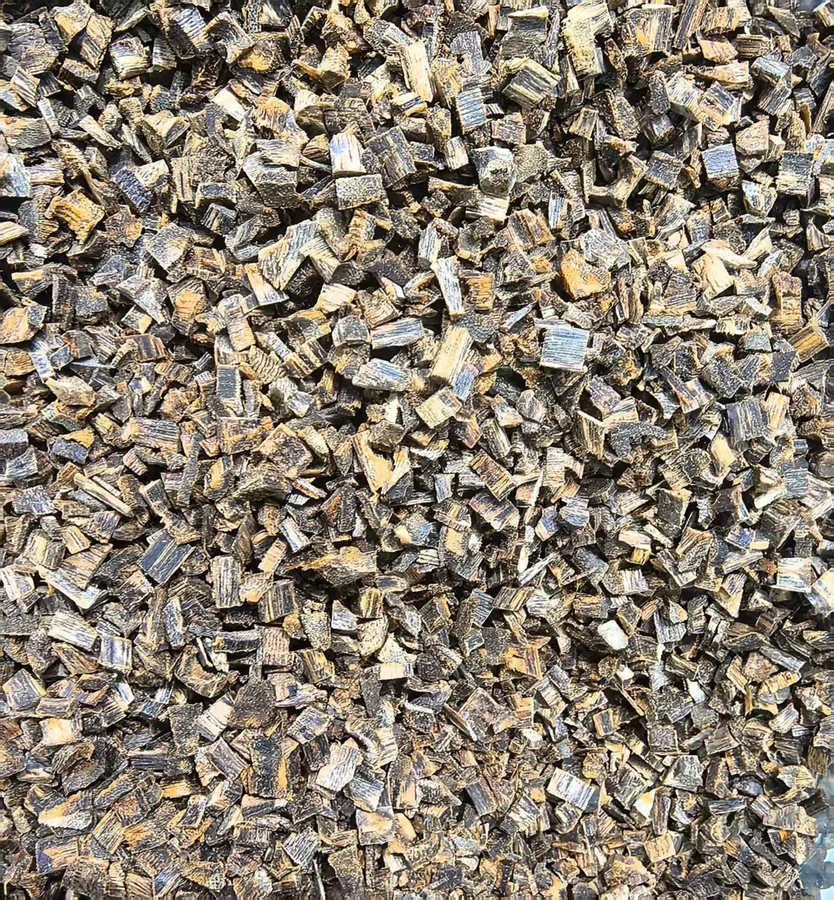
Factory recovery: raw wood to graded chips
A chip factory starts with blocks or sections of agarwood that are neither uniform nor fully resinous. The material is cleaned, the pale non-resinous wood is removed, pieces are cut or split to a target form, dried to a working moisture level, and sorted into selections. What survives that sequence is the factory's recovery for that grade.
Recovery is not a fixed property of a species. It moves with the resin distribution in the incoming wood, the thickness you specify, how strictly defects are cut away, and how much of the smaller material the factory is willing to sell as chips rather than downgrade to fragments or powder. That is why a supplier cannot give you one number for all grades, and why a recovery figure without a grade and a thickness range attached is not information.
Buyer usable yield: delivered kilogram to saleable unit
Your own yield starts when the carton is opened. You sieve out fines, re-sort for pieces that do not match the approved sample, trim broken edges if you are packing premium retail, and lose a further percentage if you dry the material to a lower moisture level before sealing it. Add the material consumed by inspection and burn tests and the usable figure is lower again.
Both numbers matter, but only the second one belongs in your margin calculation. Ask the factory for recovery as context; measure usable yield yourself.
Where the weight actually goes
The table below is the checklist to work through on any new lot. Each line is a place where a quoted kilogram quietly becomes less than a kilogram of product.
| Loss stream | What it is | Why it matters to a buyer | How to control it |
|---|---|---|---|
| Non-resinous white wood | Pale wood with little or no resin, often left on the outside of a piece | Adds weight at resin-grade prices and burns weak or scorches | Define how much white wood is acceptable per piece and check it on a cut face, not only on the outside |
| Trimming and offcuts | Material removed to square a piece, remove a defect or reach a thickness | Lowers the saleable weight of a premium pack; offcuts may be resaleable only as fragments | Agree who owns and pays for offcuts, and whether they are returned, credited or excluded |
| Dust and fines | Particles generated by cutting, drying, tumbling and transport | Higher in small chips and fragments; unsaleable in a premium pack | Specify a screen size, a maximum fines percentage and whether fines count toward the invoiced weight |
| Moisture above the agreed basis | Water weight inside the wood | Paid for at chip prices; also a mould and claim risk in transit | State a moisture basis and test method in the purchase order; see our guide to oud chips moisture content |
| Size mismatch | Oversize, undersize or mixed thickness against the approved sample | Turns a retail SKU into seconds, or forces re-cutting and new fines | Write a numeric size range with tolerances, not words like “small” or “medium” |
| Inspection and sample retention | Material consumed by burn tests, laboratory checks and retained samples | Small in absolute terms but permanent, and usually unplanned | Budget it explicitly and ask whether sample weight is credited |
How grade and format move the number
Yield is not independent of the grade definition — it is a consequence of it. Two grading styles dominate the market, and they behave differently when you try to measure them.
Thickness-led grading defines a grade by how thin a chip is cut, on the logic that thinner material carries less white wood. This is measurable with a caliper, which makes it the more useful basis for a purchase order. Its weakness is that thickness alone says nothing about resin distribution: a thin chip cut from pale wood is still pale.
Density-led grading uses the familiar sinking test, where a piece that sinks is treated as richer than one that floats. It is a fast field proxy, not a yield measurement — it tells you about relative density in a cup of water, not how many grams of a delivered lot will survive your sieve and your packing line.
Format changes the loss profile more than most buyers expect. Large chips carry fewer fines and present better in a display pack, but they need more trimming to look consistent and they leave offcuts when a customer wants a smaller piece. Small chips portion easily and pack neatly, yet generate a higher dust share and need a tighter screen specification. Fragments and powder follow different economics altogether, which is why a per-kilogram price is only comparable within the same format.
A trial-lot yield test you can run in one day
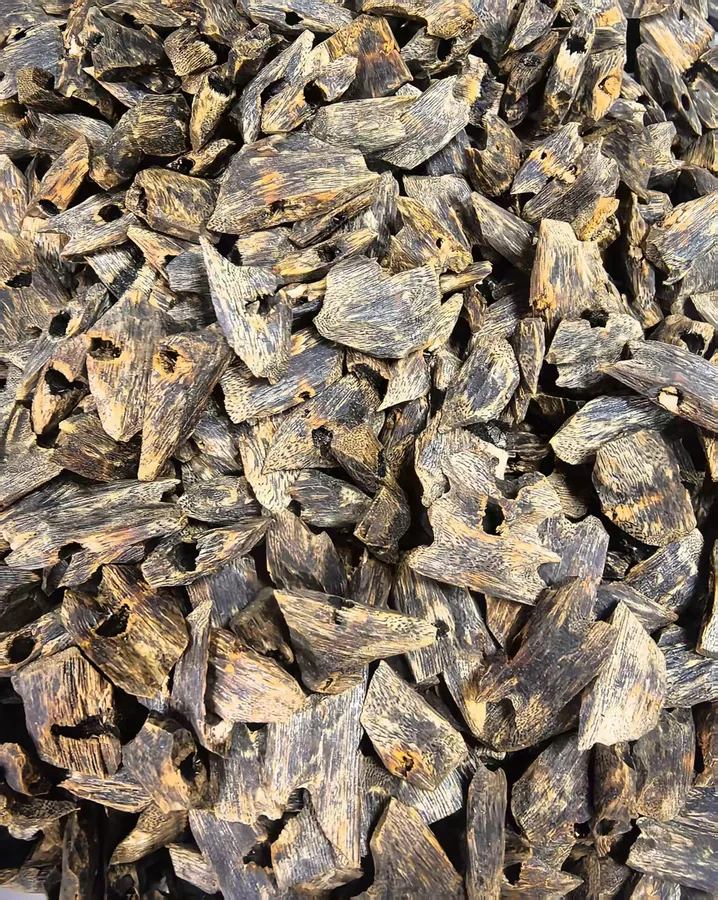
You do not need a laboratory to establish whether a lot behaves the way the quotation implies. You need a calibrated scale, two screens, calipers, a heater and a record sheet.
- Record the lot reference and the invoice weight before opening anything, and photograph the sealed carton. If the quotation does not carry a lot reference, that is the first finding of the test.
- Weigh the packaging separately so you know whether the quoted figure is net or gross.
- Sieve the full lot through a declared screen — for example a coarse screen for dust and a size screen at the lower limit of your specification — and weigh each fraction.
- Hand-sort a representative sub-sample into resinous and pale material. A hot-piece check on a small heater confirms what the eye suspects on ambiguous pieces.
- Measure thickness on at least thirty randomly picked pieces with calipers and record the minimum, maximum and median. A median that sits outside your declared range is a specification failure regardless of how the lot looks.
- Record moisture using the method you agreed in the purchase order, and note the basis. Pin meters read resinous wood inconsistently, so treat them as indicative unless the contract says otherwise.
- Weigh every fraction and calculate usable percentage on the same basis as the invoice. This is the single figure to compare across suppliers.
- Run a controlled burn test: a fixed weight on the same heater, in the same room, recording time to first aroma, time to peak and time to fade. Repeat three times. This is the beginning of your burn-yield data, not a verdict on the lot.
What to put on the record sheet
| Field | Why it belongs on the sheet |
|---|---|
| Lot reference and invoice weight | Without a lot link, the result cannot be enforced against a future delivery |
| Net weight after tare | Prevents a packaging-weight dispute later |
| Fines weight and screen used | Makes the dust allowance measurable and repeatable |
| White-wood weight or percentage | Converts a visual impression into a claimable number |
| Thickness min / median / max | The fastest check against a declared size range |
| Moisture reading and method | Separates water weight from wood weight |
| Usable kilograms and usable % | The number that feeds your costing |
| Burn observations | Links the physical lot to the experience your customer will judge |
Worked example: from a trial lot to pack counts
The arithmetic below is illustrative and uses round figures; it is a method, not a measured result or a quotation.
| Line | Illustrative figure |
|---|---|
| Invoice weight | 10.0 kg |
| Less fines below the declared screen | 0.3 kg |
| Less pale wood sorted out | 0.6 kg |
| Less trimming and offcuts | 0.3 kg |
| Less moisture above the agreed basis | 0.2 kg |
| Usable weight | 8.6 kg (86%) |
| Theoretical 25 g packs at 8,600 g ÷ 25 g | 344 packs |
| After a 3% packing and check-weigh allowance | About 333 packs |
The useful comparison is not 10 kg against 10 kg. It is 8.6 usable kilograms against the usable kilograms of the next quotation, after each one has been sieved and sorted on the same day with the same screens.
From usable kilograms to pack counts and forecasts
Once you have a usable percentage, two formulas carry most of the planning work.
- Packs from a shipment: usable kilograms × 1,000 ÷ fill weight in grams, then subtract your packing and check-weigh allowance.
- Kilograms to buy per month: packs sold per month × fill weight in grams ÷ 1,000, divided by usable yield.
Two practical caveats. First, declared net weight on a retail pack is a legal statement in most markets, so confirm the prepackaged-goods rules for your destination before you fix a fill weight; a generous fill is a cost, an underweight pack is a compliance problem. Second, fill weight and piece size interact: a 25 g pack of large chips contains fewer, more visible pieces than a 25 g pack of small chips, which changes perceived value even though the weight is identical.
For the purchasing side of the same calculation — how price per kilogram is built and how to convert a quotation into landed cost — see our guide to wholesale oud chips price per kilogram. For the timing side, the lead-time planning guide shows how to build a reorder calendar around the same forecast.
Burn yield: measure it instead of assuming it
Burn yield is the number your customer experiences: how long a given weight of chips keeps producing aroma on their heater. It is influenced by thickness, density, the load weight placed on the heater, the heater's surface temperature, ventilation and how the pieces are arranged. Because those variables are rarely documented, published claims about how many sessions a kilogram delivers are not comparable between sources.
What you can do is build your own reference. Fix the heater, the room, the load weight and the observation interval, then test the lots you are considering against each other. Record the time to first aroma, the time to peak and the time the aroma fades. After three or four lots you will have a defensible basis for choosing which format goes into a daily-use pack and which goes into a premium gift pack — and a reference your own customers can repeat.
What to ask before you accept a yield figure
- Is the quoted weight net or gross, and is packaging included?
- What moisture basis applies, and which test method defines it?
- What screen size separates saleable chips from fines, and what fines percentage is allowed in the invoiced weight?
- How is white wood defined for this grade, and how much is permitted per piece?
- What is the declared size or thickness range, with tolerances, and how is it checked before shipment?
- What recovery band does the factory work to for this grade and thickness, and from what kind of incoming material?
- Are offcuts and downgraded material returned, credited or excluded from the shipment?
- Does sample weight count against the order, and is it credited later?
- How will a yield shortfall be measured and remedied, and against which retained sample?
Questions six to nine are where most yield disputes originate. They belong in the RFQ, not in a conversation after arrival. Our checklist for comparing oud chips manufacturers sets these alongside the commercial criteria, and the arrival inspection and claims guide covers what to do when the delivered lot does not match.
Red flags in a yield conversation
- A usable percentage quoted with no basis. “Ninety-nine percent usable” means nothing without a screen size, a moisture basis and a definition of white wood.
- Weight stated in pieces. Piece counts hide both size variation and fines.
- Fines excluded from the invoice but present in the carton. If the allowance is not written down, you are absorbing it.
- A different grade definition in the sample and the order. Confirm that the thickness or size range on the sample sheet matches the production specification.
- No lot reference. Without one, a yield result cannot be tied to a future delivery or to an export document.
- Permit quantities that do not match the shipment. Agarwood-producing species are listed in CITES Appendix II, and permits are issued for a specific shipment with declared quantities — see the CITES CoP20 working document on agarwood-producing species. A late change in shipped weight can mean amended paperwork, so agree who is responsible before packing.
How we describe our chip formats
NanjaOud is the B2B brand of Jiangmen Nangjiaxiang Agarwood Development Co., Ltd., based in Jiangmen, Guangdong. Our supply position rests on more than 1,000 mu of standardized agarwood plantation resources and an in-house processing factory, which allows us to control the steps that generate yield loss — cleaning, trimming, cutting and sorting — rather than buying finished chips on the open market. According to company information, cultivation follows natural standards and no chemical agents are used to accelerate resin formation.
Our natural large agarwood chips keep a comparatively large, intact wood form with visible grain and resinous streaks, and are supplied for incense use, further processing, distribution and product development. Our natural small agarwood chips are processed into smaller, irregular pieces that are easier to portion, blend, repack and grind. Both are offered for bulk wholesale, with custom processing, specification and packaging discussions available under our ODM cooperation for overseas B2B customers.
We do not publish a single yield percentage for all grades, because the figure depends on format, grade direction, thickness and destination — the same reason a single MOQ figure would be misleading, as explained in our guide to oud chips manufacturer MOQ. What we can do is quote against your declared size range, moisture basis and fines allowance, and confirm what the factory can allocate for that specification. The broader range is on our agarwood raw materials and chips page, and how we describe quality control is set out on our quality and supply page.
Send your size range, moisture basis, fines allowance, intended pack format and destination through our contact page, and we will confirm what can be allocated and how the specification will be checked before shipment.
Frequently asked questions
What is a normal yield for oud chips?
There is no industry-wide figure. Yield depends on the resin distribution of the incoming wood, the thickness or size you specify, how strictly defects are cut away and whether fines are counted. Compare usable percentage between suppliers using the same screens, the same moisture basis and the same day, rather than comparing a supplier's claim with a market average that does not exist.
Is weight loss the same as moisture loss?
No. Moisture is only one stream. White wood removal, trimming, dust and size rejection usually account for more of the gap, and they behave differently: moisture can be controlled by drying, while white wood can only be controlled by grading discipline.
Should I pay for dust and fines?
Only if you have decided to. Define a screen size and a maximum fines percentage in the purchase order, and state whether fines count toward the invoiced weight. Many disputes are simply the absence of that sentence.
Does the sinking test tell me the yield?
No. A sinking test indicates relative density in water, which is a rough proxy for resin loading. It says nothing about how many grams of a delivered lot will pass your sieve or your packing check.
How do I compare a 5 kg quotation with a 20 kg quotation fairly?
Buy a trial quantity from each, run the same sieve-and-sort protocol, and convert both to usable kilograms and then to pack counts. Fixed costs such as freight, documents and inspection do not scale with quantity, so the smaller order will carry a higher cost per usable kilogram even when the wood price is identical.
Can chip size change how long a pack lasts?
Yes — thickness, density and the weight you place on the heater all affect burn duration. Because published session counts are rarely tied to a stated test method, build your own reference test and use it to compare lots and to brief your own customers.
Why does CITES paperwork care about weight?
Permits are issued per shipment with declared quantities. If the packed weight changes after the documents are issued, the paperwork may need amending, which costs time. Agree the weighing point and who handles amendments before the lot is packed.
Conclusion
Yield is the difference between a price per kilogram and a price per saleable pack, and it is decided by specification, not by negotiation. Define the size range, the moisture basis and the fines allowance; measure usable percentage on a trial lot with your own screens; and convert the result into pack counts and monthly kilograms before you commit to a bulk order. Do that once and every later quotation becomes comparable.
If you are specifying a chip format for retail packing or further processing, send your size range, moisture basis and target pack weight through our contact page and we will tell you what our factory can allocate against it.


