

A workable oud chips supplier contract ties money to evidence: a written specification, a lot-linked approved sample, an itemised quotation and an inspection record. When those four documents exist, payment terms stop being a leap of faith and become a schedule of releases. When they do not, every clause in the contract is arguing about something nobody defined.
This guide is written for buyers who are about to send a deposit to an oud chips supplier and want the payment, inspection and remedy mechanics of the oud chips contract to survive contact with reality. It does not repeat how to shortlist suppliers; it assumes you have a shortlist and are now negotiating the part that decides who carries the loss when something goes wrong.
Why payment structure matters more than the price per kilogram
Two quotations at the same price per kilogram can carry very different risk. One asks for the full amount before production and offers no inspection right. The other releases money in stages against documents and a pre-shipment check. The second is not necessarily more expensive; it is simply priced with the risk left where it belongs.
Oud chips are a natural, variable material with a regulated trade status, so the buyer's exposure is concentrated in three places: what the material actually is, whether it can legally arrive, and what happens if it does not match. Payment terms are the only lever that touches all three at once. A deposit paid against a specification is a different commercial act from a deposit paid against a photograph.
If you have not yet broken a quotation into its cost lines, the companion guide on what drives the wholesale oud chips price per kilogram shows which lines should appear before you negotiate payment at all.
The four documents a payment clause should reference
A payment clause that references nothing is a promise. A payment clause that references four documents is an instruction to a bank, an inspector and eventually an arbitrator. Before discussing percentages with any oud chips supplier, confirm that all four exist and are numbered:
- A specification with version number. Format, size band, screening, moisture basis, appearance tolerance, packaging and labelling. The version number is what stops a later "clarification" from becoming a different product.
- An approved sample record. Sample reference, lot reference, date, quantity, photographs with a scale, and who approved it. A sample without a lot reference approves a smell, not a product.
- An itemised quotation. Material, processing, packing, documentation, inland haulage, freight basis and the named Incoterm. Exclusions stated explicitly.
- An inspection standard. The checks, the sampling basis, the acceptance limits, the record produced and who may attend.
These four documents are also the cheapest form of due diligence. A supplier that cannot produce them in a consistent format is unlikely to produce them consistently at shipment, when you have far less leverage.
Oud chips payment terms compared
Oud chips payment terms are not a single market standard. What matters is that the structure matches your order type, your inspection capability and the supplier's track record with you. The table below compares the options buyers actually negotiate when they approach an oud chips supplier.
| Structure | How it works | Main risk to the buyer | Where it fits |
|---|---|---|---|
| Full advance by T/T | 100% before production | No leverage if the lot differs or documents are late | Very small trial orders, or an established supplier with a retained sample history |
| Deposit and balance before shipment | Part at order, remainder after inspection and before dispatch | Balance released against a report you did not commission | The default for most first orders if the inspection right is written in |
| Deposit and balance against documents | Remainder released when the document set is presented | Documents can be complete while the goods are wrong | Repeat orders with an agreed pre-shipment record |
| Documentary letter of credit | Bank pays against complying documents | Discrepancies cause delay; cost and paperwork are significant | Larger orders, new counterparties, or where the buyer's bank requires it |
| Retention or quality holdback | A small percentage held for a stated period after arrival | Collection effort if a claim arises | Private-label programmes where packaging or grading consistency is critical |
Two practical points sit behind that table. First, a letter of credit protects you against documentary non-performance, not against a product that meets the paperwork and not the specification, so it does not replace inspection. Second, a retention clause is only as good as the remedy ladder that defines what the retention is released against.
Incoterms: cost, risk and control are three different things
Buyers routinely say "CIF" when they mean "you arrange freight" and "FOB" when they mean "you pay until the port". The Incoterm decides three separate things: who pays which cost, where risk transfers, and who controls the transport document. Those three do not always move together, and the gap is where claims get lost.
| Term | Cost to | Risk transfers | What the buyer should confirm |
|---|---|---|---|
| EXW | Buyer, from the factory | At the factory | Loading, export clearance and permit application are effectively yours |
| FOB | Buyer, from the named port | On board the vessel | Who books, who pays origin charges, and when the container is stuffed |
| CIF | Seller, to the destination port | On board the vessel | Insurance cover level, and that risk still transfers at origin |
| DAP | Seller, to the named place | At the named place | Import duty, clearance and any destination permit remain yours |
For a regulated material the practical question is not only who pays freight. It is who holds the export permit, whose name appears on it, and who is responsible if the permit is issued after the vessel sails. Keep the oud chips supplier's permit obligation in a separate clause from its freight obligation, and put both in the contract rather than in a shipping instruction sent a week before dispatch.
A milestone payment schedule for a first order
The most useful thing a buyer can bring to a first negotiation is a schedule, not a demand. A schedule shows the oud chips supplier exactly which evidence releases which payment, which reduces the argument later. The example below is a structure to adapt, not a market standard.
| Stage | Payment | Released against |
|---|---|---|
| Order confirmation | Deposit (for example 30%) | Signed specification version, approved sample record, signed PO with Incoterm |
| Production complete | Second instalment | Pre-shipment inspection report with weights, size distribution and moisture result |
| Documents ready | Balance | Permit and shipping documents checked against the invoice description |
| Arrival and inspection window | Retention released | No claim raised within the agreed window, or claim closed |
The percentages are negotiable. The sequence should not be: each release is tied to a named document, produced by a named party, in a named format. A supplier who accepts that sequence is telling you its records exist.
Inspection: what has to be true before the balance moves
An inspection clause is only useful if it produces a decision. "Quality to be checked before shipment" produces a conversation. A usable clause tells the oud chips supplier exactly what will be checked and what happens at each outcome.
- Lot identity: carton and bag labels match the approved lot reference, not just the product name.
- Net weight: weighed per unit with tare deducted, on a stated number of units.
- Size distribution: a scoop sample screened against the agreed band, with oversize and fines percentages recorded.
- Moisture: measured by the method in the specification, on a stated number of units, with the basis named.
- Appearance: compared with the retained approved sample under consistent lighting, by a named person.
- Foreign matter: visual check for stone, soil, excess bark and non-agarwood material.
- Packaging: seal integrity, inner liner, carton strength and label accuracy.
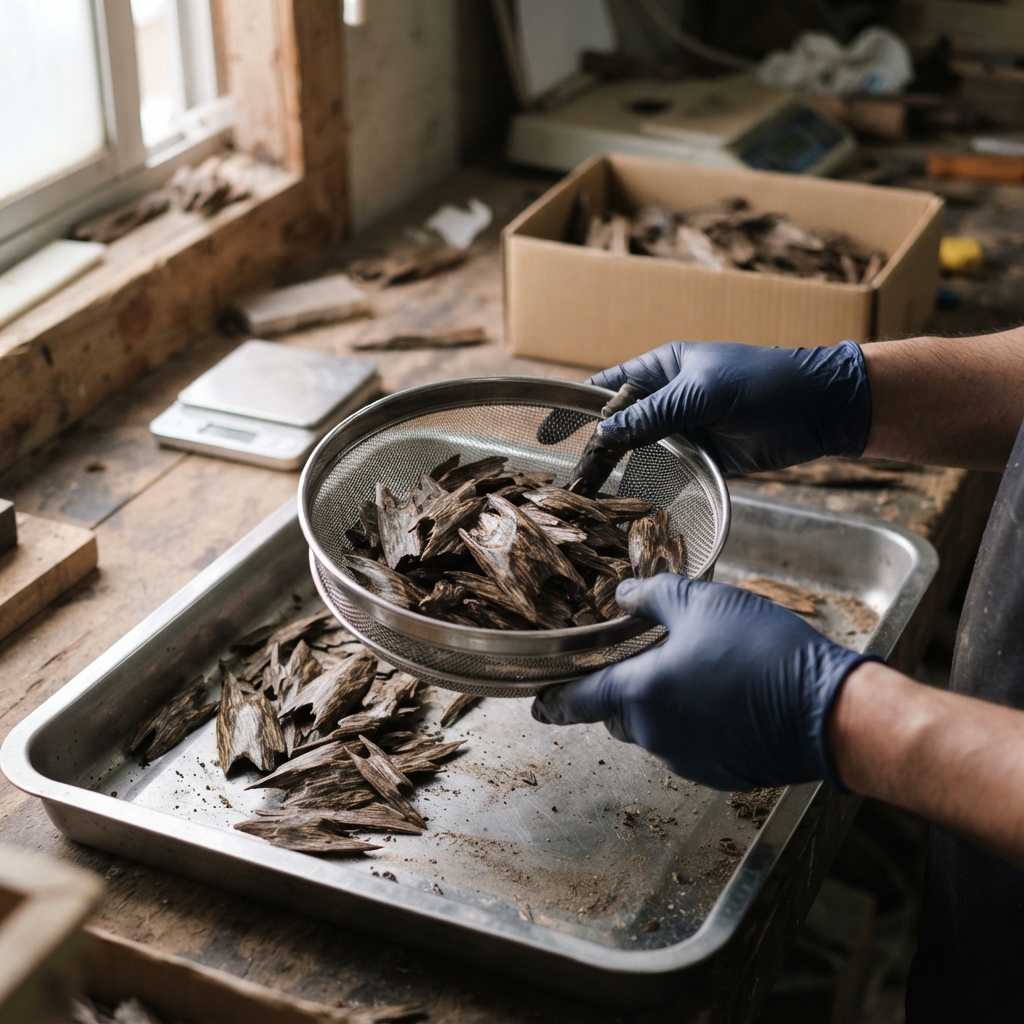
Two design choices decide whether this works. First, whether you or the supplier commission the inspection, and whether you may attend or send a representative. Second, whether the report is a document that releases payment or a courtesy copy sent afterwards. If the balance is already paid, the report is a record of an argument you have not yet had.
Where moisture is the point of contention, the dedicated guide on oud chips moisture content explains why wet and dry basis figures must be named in the specification before any payment milestone is set.
Claims and remedies: a clause you can actually execute
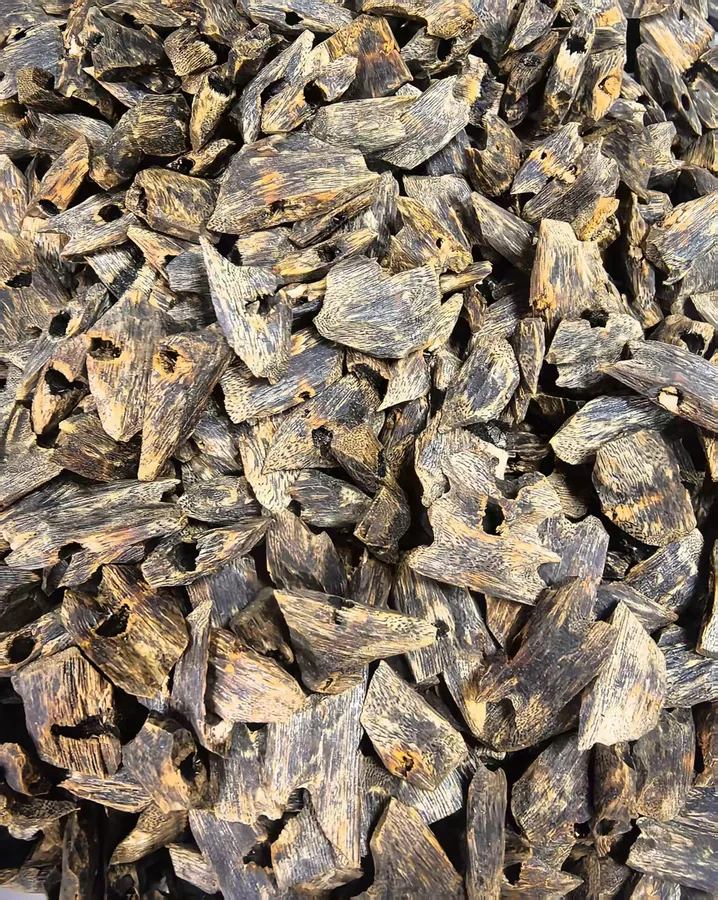
Most claim disputes are not about whether the wood changed; they are about what was agreed, and when the defect could reasonably have been found. A remedy clause belongs in every oud chips contract, not only in the first order, and it should answer five questions in writing.
- What is the reference? One sealed retained sample held by each party, referenced in the purchase order, plus the specification version.
- How long do I have? A stated inspection window after arrival, counted from a defined event such as container release, not from an email.
- What evidence is required? Photographs, weighing records, moisture records and, where disputed, a third-party report. Say who pays for the third party and how the cost is allocated if the claim succeeds.
- What is the remedy order? Replacement of the affected quantity, credit note, price adjustment, or return. Naming the order prevents a supplier offering the remedy that suits it.
- What is excluded? Natural variation between lots, damage after risk transfer under the Incoterm, and defects a normal inspection should have found. Written exclusions are better than silent assumptions.
If an oud chips supplier refuses a retained-sample clause entirely, treat that as a data point about its record keeping. Natural material varies; undisclosed variation is a commercial choice. The arrival-side procedure, including how to document a dispute so it can be answered, is set out in the guide to oud chips manufacturer claims and arrival inspection.
Documents as payment conditions: CITES and destination permits
Agarwood is a regulated material, and a payment schedule that ignores documents will eventually pay for goods that cannot clear. All agarwood-producing species in the genera Aquilaria and Gyrinops are listed in CITES Appendix II, which means a commercial shipment needs a CITES export permit issued by the exporting country's management authority, and many destinations require an import permit before the goods are released.
Governments enforce this at the border rather than at the invoice. Canada's CITES guidance, for example, states that the necessary permits must be obtained before import or export and must be validated by a border services officer (Government of Canada, CITES permits). The CITES CoP20 working document on agarwood also illustrates how thresholds are drawn, noting an exemption for personal-effects quantities of up to 1 kg of wood chips, which is a different category from a commercial shipment (CITES CoP20 working document).
Three contract consequences follow. First, the species and product description on the permit must match the commercial invoice exactly; a mismatch is a customs problem, not a clerical one. Second, permit lead time is often longer than production lead time, so the schedule should name who applies, by when, and what happens if the permit is not issued. Third, the balance release should be conditional on the document set being checked against the invoice, not merely received.
Price validity, currency and the clauses buyers forget
Natural material contracts fail on details that never appear in a price discussion. Ask the oud chips supplier to put these in the draft before signature:
- Price validity window. A price without an expiry cannot be budgeted, and a price that expires during production invites a renegotiation at your weakest moment.
- Currency and settlement. Name the currency, who bears conversion and bank charges, and whether the rate is fixed at order or at payment.
- Quantity tolerance. Natural material rarely fills a round number; agree whether the shipment may be plus or minus a stated percentage and how the invoice adjusts.
- Substitution ban. A clause stating that material must come from the approved lot reference or a lot disclosed and approved in advance. This is the single most useful line in the contract.
- Force majeure, defined. Name what counts, what notice is required, and what happens to the deposit if performance stops for a stated period.
- Governing law and forum. Choose a forum you could realistically use. A clause naming an inconvenient jurisdiction is a clause you will never enforce.
- Confidentiality and artwork ownership where private label is involved, including who owns the dieline and what happens to unused packaging.
How to negotiate by order type
The same supplier will offer different terms for a trial, a repeat run and a private-label programme, and the negotiation should reflect that.
| Order type | Priority in negotiation | What to concede first |
|---|---|---|
| Trial order | Inspection right and lot-linked sample | Order size, as long as the lot reference is fixed |
| Repeat order | Lot matching to the approved reference and disclosure of change | A slightly longer lead time for a documented lot match |
| Private label | Artwork ownership, per-SKU minimums, retention on packaging quality | Payment timing, if the retention clause is real |
Lead time belongs in the same negotiation. A schedule that promises a shipment date without naming the permit and inspection milestones is not a commitment; the staged breakdown is set out in the guide to oud chips manufacturer lead time planning.
Common mistakes in oud chips supply contracts
Each of these appears in real negotiations with an oud chips supplier, and each is cheaper to fix in the draft than after the deposit has cleared.
- Negotiating percentages before the specification exists. You are allocating risk on an undefined product.
- Paying a deposit against a photograph. A photograph is not a lot reference and cannot be inspected against.
- Assuming a letter of credit replaces inspection. Banks check documents, not resin appearance or moisture.
- Leaving the Incoterm to the freight forwarder. The term decides risk transfer, which decides who owns a loss in transit.
- Accepting "certificates available" without naming them. Ask for the permit list for your own destination, in writing, before the deposit.
- No retained sample. Without one, a claim becomes a comparison of memories.
- No substitution clause. The most common quiet failure is a different lot delivered against an approved sample.
- Signing a forum you cannot use. Enforceability is part of the price.
Supplier verification is a separate exercise from contracting, and the two are often confused. The document-matching method for confirming a legal entity, bank account and permit holder is covered in verifying an oud chips manufacturer in China, and the broader eight-criteria comparison sits in how to compare oud chips manufacturers.
What we can state about our own supply
We are Jiangmen Nangjiaxiang Agarwood Development Co., Ltd., based in Jiangmen, Guangdong. The facts relevant to a supply contract are these: we cultivate agarwood on more than 1,000 mu of standardized plantation resources, we operate our own processing factory, and our product documentation states that no chemical agents are used to accelerate resin formation. We supply overseas B2B buyers in the Middle East, Southeast Asia, Europe and the Americas, and we offer ODM cooperation covering custom processing, product specifications and packaging for overseas customers.
Our grade letters are internal references. A, B and C labels describe our own sorting shorthand; they are not a universal or internationally administered standard, so the physical criteria — size band, screening, appearance and moisture basis — are what we confirm in writing against your specification.
On commercial terms, our position is that MOQ, lead time, freight, ports, Incoterms and available stock are confirmed in the quotation rather than fixed on a web page, because they depend on format, quantity and destination. That is also why we ask for the specification before quoting a payment schedule, and why we prefer to answer contract questions in writing rather than verbally.
For buyers contracting chip volumes, the relevant formats are natural large agarwood chips, where intact pieces with visible grain and resinous streaks suit incense use, further cutting, grinding and distribution, and natural small agarwood chips, where smaller irregular pieces suit portioning, blending, repacking and further grinding. Both are supplied from our own plantation and processing factory, and both can be discussed as ODM projects where packaging and specification are part of the brief.
FAQ
What payment terms should I expect from an oud chips supplier?
Structures range from full advance on small trials to deposit-and-balance, documentary letters of credit and retention arrangements on larger or repeat orders. What matters is not the label but whether each release is tied to a named document and an inspection right.
What should an oud chips contract include?
At minimum: a versioned specification, a lot-linked approved sample, an itemised quotation with the named Incoterm, an inspection standard with acceptance limits, a remedy ladder, and a substitution clause. Payment terms should reference those documents rather than stand alone.
Is a deposit always required?
Usually, because production is scheduled against the order. The negotiable points are the percentage, what the deposit is released against, and whether part of it is refundable if documents cannot be issued.
Can I inspect the goods before paying the balance?
Only if the contract says so. Write the inspection right in, name the checks and limits, and make the report a payment condition rather than a courtesy copy sent after dispatch.
Does a letter of credit protect me against poor quality?
No. A letter of credit pays against complying documents. It reduces payment risk, not product risk, so it should sit alongside inspection rather than replace it.
Which Incoterm is best for a first oud chips order?
There is no universal answer. FOB gives you control of freight and a clear risk-transfer point at the port; DAP shifts more logistics to the supplier but leaves import clearance and destination permits with you either way. Choose the term that matches who can actually manage the permit and the port.
How long should the claim window be?
Long enough to inspect a representative sample properly after arrival, and short enough that the supplier can trace the lot. The important part is that both parties agree the number, the starting event and the evidence required before the first shipment.
What if the supplier substitutes a different lot?
Without a substitution clause, your remedy depends on general contract law and whatever sample record you kept. A clause requiring the approved lot reference, or advance disclosure and approval of a substitute, converts that into a clear breach.
Do samples need CITES documents?
It depends on the quantity, the destination and the product form. CITES rules distinguish small personal-effects quantities from commercial shipments, and national import requirements vary, so confirm the position for your country before a sample is couriered.
Conclusion
A good oud chips supplier contract is short, specific and built on four documents: specification, approved sample record, itemised quotation and inspection standard. Payment terms then become what they should be — a schedule that releases money as evidence arrives, with a remedy ladder behind it and a document set that lets the goods clear. Negotiate the sequence with your oud chips supplier before you negotiate the percentage, and put the substitution ban and the retained sample in the first draft rather than the last.
If you are preparing a first or repeat order for oud chips, send your specification, estimated quantity, destination and packaging direction through our contact page, and we will confirm the commercial terms and documentation that apply to your order.


