
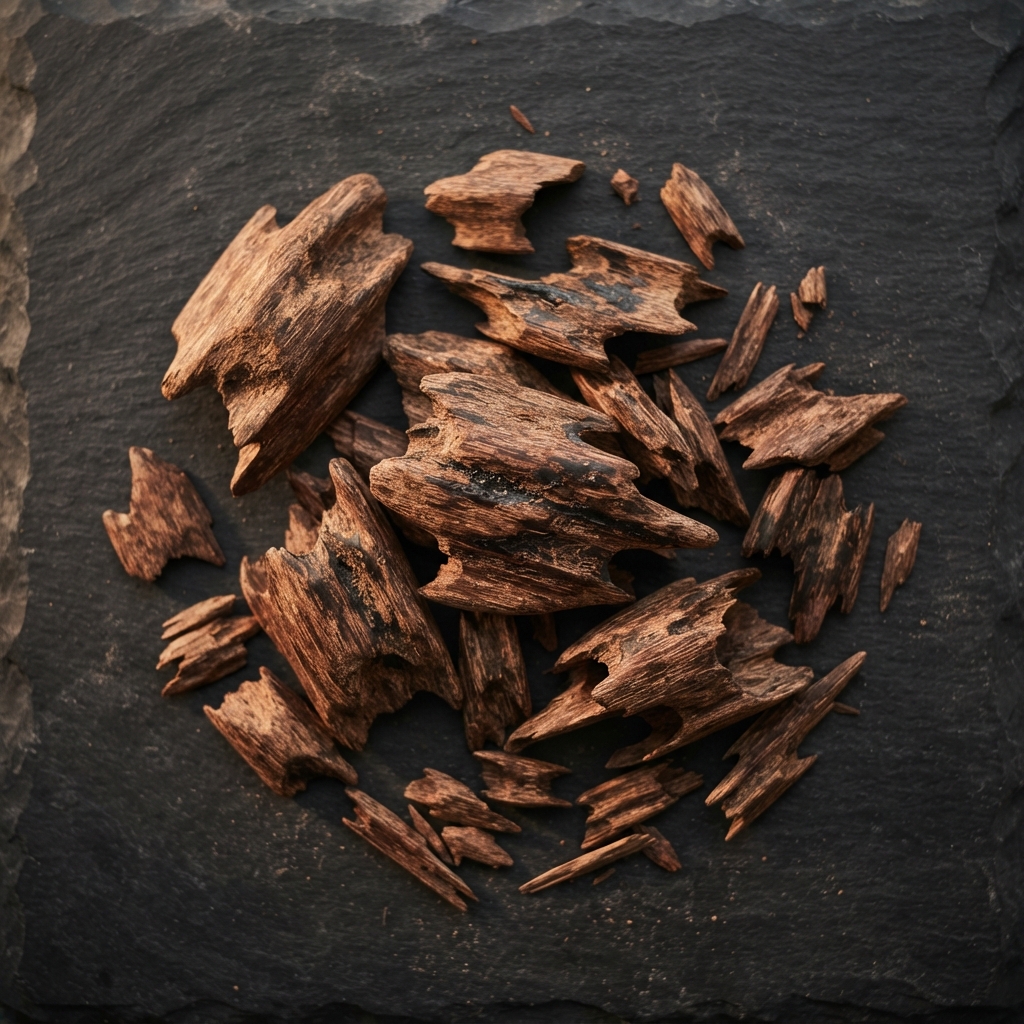
An oud chips manufacturer China buyers can rely on will pass four document checks before a single sample ships: a matching business licence, a consistent bank account, a lot-linked sample record and a named CITES exporter. In practice those four names often belong to three different companies, and the gap between them is where deposits, documentation and quality claims go wrong. This guide sets out a China-specific verification sequence you can run before you pay anything.
What “oud chips manufacturer China” hides in the paperwork
Most sourcing advice frames the choice as plantation versus trader. In China the useful distinction is narrower, because the company you negotiate with is rarely the only company involved in the shipment.
- Plantation operator with a deep-processing plant. Grows or manages Aquilaria, harvests, cuts and sorts in its own facility. Usually able to show inbound wood, cutting lines and packing in one continuous walkthrough.
- Processing workshop. Buys raw wood from growers or collectors and sells sized chips. Quality depends on inbound discipline, not on land ownership.
- Trading or export company. Holds the customer relationship, the English-language storefront and sometimes the export licence, while production happens elsewhere. Legitimate and common, but every quality commitment passes through a third party.
- Incense or finished-goods factory. Produces chips as a sorted by-product or side line. Convenient when you also buy sticks or powder, less predictable when chips are the main purchase.
None of these is automatically wrong. The mistake is assuming that the name on the storefront, the name on the invoice and the name on the export permit are the same. Before a sample is dispatched, ask for all four names in one email.
| Name that appears | Where you see it | Why it matters |
|---|---|---|
| Contract seller | Quotation, proforma invoice, sales contract | The entity legally responsible for the goods and for any claim |
| Invoice issuer and payee | Commercial invoice, bank details | Must match the contract seller; a different payee is a stop signal |
| CITES permit applicant and exporter | Export permit | A permit is issued to a named exporter and is not transferable to whoever happens to sell the goods |
| Factory | Walkthrough, business licence address | Capacity claims belong to this entity, not to the sales channel |
If a supplier cannot reconcile these four, you are not yet talking to a manufacturer. You are talking to a sales channel that has not told you so.
Step 1: Verify the legal entity behind the quotation
The first thing to verify in any oud chips manufacturer China enquiry is the legal entity itself. Chinese companies are registered, and registration is checkable. Request a scan of the business licence and read four fields.
- Chinese company name. It should appear on the quotation, the invoice and the bank account, not only as an English translation. Translations drift; registration names do not.
- Unified Social Credit Code. An 18-character identifier that ties the licence to the entity. A supplier unwilling to share it is not protecting a trade secret.
- Registered address and establishment date. A registered address that is a residential unit, a virtual office, or in a different city from the claimed factory deserves a direct question.
- Business scope. Look for wood processing, agricultural products or agarwood-related activity. A scope limited to trading or consulting tells you what the entity was set up to do.
Two cautions. Registered capital is a filing figure, not a measure of production capacity. And a business licence proves a company exists, not that it owns a factory, a plantation or an export permit.
Step 2: Separate a factory from a trading company
Ask for a live video walkthrough, not a video file. A recorded factory tour can be licensed footage or a partner’s plant; a live call in which you choose which door to open cannot be staged as easily. A China oud chips factory that owns its cutting and screening line should be able to show both without rearranging the room first.
Request that the camera moves through four areas in sequence: raw wood storage with visible lot labels, the cutting and screening line, the drying or conditioning area, and the packing bench where your cartons would be sealed. Then ask the person holding the phone to weigh a scoop of chips on camera. It is a small test that filters a surprising number of listings.
| Claim | Evidence worth asking for | What it still does not prove |
|---|---|---|
| We own the factory | Live walkthrough of the four areas, plus the factory address on the licence or a lease | That your specific order will run on that line |
| We have large capacity | Monthly output in kilograms, number of sorting staff, current order backlog | That capacity is free in your delivery window |
| We grow our own wood | Plantation location and area in mu or hectares, tree age at harvest, who harvests | Resin content of the lot actually offered |
| We process in-house | Named steps: cutting, screening, drying, sorting, packing | That every step is performed for every grade |
| We are a direct manufacturer | Consistency between licence name, invoice name and permit exporter | Anything at all about quality |
A credible oud chips manufacturer China buyers can audit will walk the camera into the raw-material store rather than stopping at the showroom, and will state plantation area, location and harvest practice without hesitation. Hesitation is information.
Step 3: Test the material claim, not the photograph
Photographs of dark, glossy chips are the most reliably misleading artefact in this trade. They are selected, lit and often show the best two percent of a lot. Replace the photograph with a written specification and a lot-linked sample, and every agarwood chips supplier on your list starts answering the same questions.
Questions that produce a checkable answer
Any oud chips manufacturer China buyers compare should answer these six in writing, not on a call.
- What is the size band, and which screen openings define it? How are oversize pieces and fines treated?
- Is the quoted weight as-received, or on a stated moisture basis? Moisture is sold as weight and lost in transit.
- What share of pale, hollow or bark-heavy pieces is acceptable?
- Which species, and where was it grown? In southern China the commonly planted species is Aquilaria sinensis, but the species name should be written down, not implied by a region.
- Is the material from plantation trees or from wild stock, and what evidence supports the claim?
- Does the sample come from the offered lot, and can a sealed portion be retained by both sides?
On resin, buyers often use a water float test as a quick indicative screen, since denser resin-rich pieces tend to sink. Treat it as a sorting aid, not a measurement: it does not quantify resin and says nothing about how a chip burns.
For sizing language and screening tolerances, the guide to specifying agarwood chip and granule particle size shows how to write a testable band. If the chips will be milled or blended rather than burned whole, agarwood chips for incense manufacturing covers how the same material behaves downstream.
Step 4: Map the export paperwork before you pay a deposit
All agarwood-producing species in the genera Aquilaria and Gyrinops are listed in CITES Appendix II, so a commercial shipment requires a CITES export permit issued by the exporting country’s management authority. TRAFFIC’s review of the agarwood-producing genera, published through the CITES Tree Species Programme, sets out the permit requirement and the trade volumes behind it (CITES Tree Species Programme, review of the agarwood-producing genera). Earlier TRAFFIC work on Aquilaria malaccensis documents the same permit logic for the species that started the listing (TRAFFIC, agarwood use and trade and CITES implementation).
This is where China sourcing differs most from buying domestically. For an oud chips manufacturer China export order, the permit is the binding document, not the invoice: CITES agarwood export paperwork names an exporter, a species and a description of the goods. If your seller is a trading company and the permit is held by a separate exporting entity, confirm in writing who applies, in whose name, and who bears the cost of a refused application.
| Document | Issued by | Must match | Confirm before deposit |
|---|---|---|---|
| CITES export permit | China’s CITES management authority | Exporter name, species, goods description, quantity | Who applies, expected lead time, cost, remedy if refused |
| Import permit, where required | Your national authority | Species and quantity on the export permit | Whether your destination needs one before shipment |
| Certificate of origin | Chamber of commerce or designated body | Invoice and consignee details | Whether tariff treatment depends on it |
| Phytosanitary certificate | Chinese plant quarantine authority | Goods description and packing | Destination requirement and who pays |
| Invoice and packing list | Seller | Permit description, HS code, net weights | Consistency, before the container is booked |
Two failure modes dominate. First, the species or product description on the permit does not match the invoice, and the shipment stops at destination. Second, the permit is applied for after production, and permit lead time becomes the real delivery date. Ask for the application to begin when the order is confirmed, not when the goods are ready.
Also agree the HS code with your import broker. Chips, powder and wood waste can be classified differently, and classification affects both duty and how the goods are described on the permit. Do not leave the code to the supplier alone.
Step 5: Build a landed cost from the Chinese port, not from the unit price
A per-kilogram quote for wholesale oud chips is a starting number. Chips are bulky and light for their volume, so freight is frequently charged on volumetric weight, and much of the difference between two quotes at the same Incoterm is packaging. Oud chips MOQ, custom size bands and pack format all move the unit cost, so ask for the price at your actual order size rather than the price at a nominal tonnage.
| Cost line | What to fix in writing | Why it decides the comparison |
|---|---|---|
| Material | Price per kg, weight basis, validity period | A quote without a validity window cannot be budgeted |
| Specification | The size band, screening and moisture basis the price refers to | Prevents a post-sample adjustment |
| Processing | Custom cutting, screening, sorting included or extra | Custom bands are a separate operation |
| Packing | Liner, carton or sack, compression, palletisation, labelling | Drives both damage risk and chargeable volume |
| Documentation | CITES, certificate of origin, phytosanitary, inspection fees | Usually excluded, then invoiced at shipment |
| Inland and port | EXW, FOB or CIF, with the named port | Defines who pays and who carries risk |
| Freight and insurance | Mode, transit time, chargeable weight rule | Bulky cargo is priced on volume, not only mass |
| Payment | Account name, deposit share, balance trigger | Deposit size is a real cost of capital |
Comparing one oud chips supplier with another on a single per-kilogram number hides all of this. Convert both to landed cost on the same Incoterm first. On payment, keep one rule: the account name should match the business licence name. A request to pay a personal account, or an account in a third company’s name, is the clearest single reason to stop a first order. For an initial shipment, stage payments against documented milestones and tie the balance to the pre-shipment inspection result.
Step 6: Inspect in China before the container is sealed
Inspecting at the factory, before loading, is cheaper than arguing after arrival. A third-party inspector is worth considering for a first order; give them your own checklist rather than accepting a generic report.
- Lot identity: carton labels reference the approved lot and the purchase order.
- Net weight per unit, with tare deducted, on a calibrated scale.
- Size distribution: a scoop sample screened against the agreed band; record oversize and fines percentages.
- Moisture by the method stated in the specification, on an agreed number of units.
- Appearance against the retained approved sample, under consistent lighting.
- Foreign matter: stone, soil, excess bark, non-agarwood material.
- Packaging: liner, seal, carton strength, label accuracy.
- Photographs of sealed cartons and labels, sent before the container leaves.
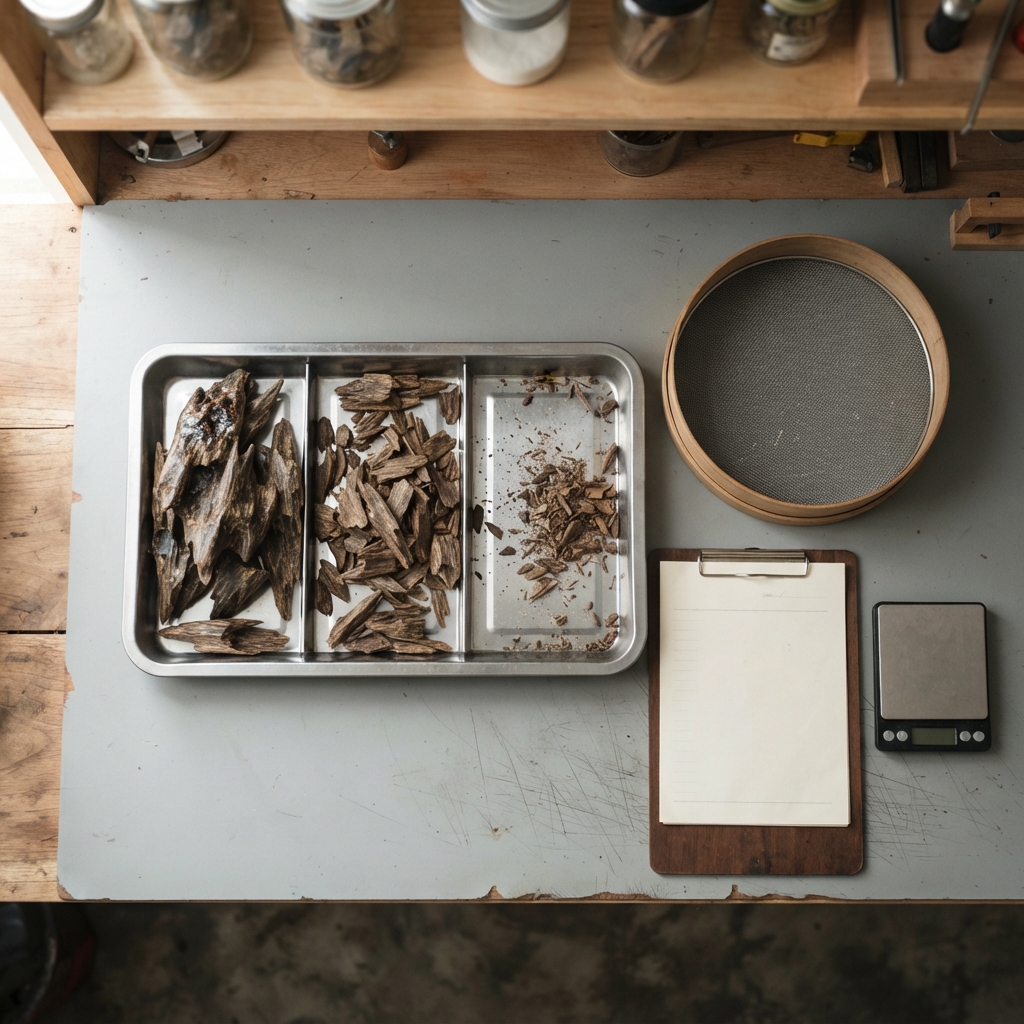
Agree the remedy at each outcome in the purchase order. If fines exceed the limit, is it a re-screen, a price adjustment or a rejection? A supplier who will not put that in writing has already answered.
Red flags specific to China sourcing
Test every oud chips manufacturer China buyers shortlist against this list before a deposit moves.
- Company name, bank account name and invoice name that do not match.
- A refused live walkthrough, or a walkthrough that never leaves the showroom.
- Grade letters presented as an international standard. They are internal labels, not a published scale.
- “Wild Hainan” or “Kynam” offered in bulk at a price below plantation material. Treat every origin claim as an evidence request.
- A quotation that omits documentation and adds it at shipment.
- Lead time quoted without naming the event it starts from.
- No retained sample clause, or a claims window measured in days.
- Pressure to pay a deposit before the licence and permit holder are identified.
OEM and private label: scope it before you brief artwork
Three different requests get called OEM in private label oud chips projects, and conflating them is where quotes stall. Separate them early: custom processing (a size band, screening or blend made to your specification), private label (your brand on an existing format and pack), and ODM (the supplier proposes format or presentation). Each carries its own minimum run, artwork ownership and tooling question.
- Who owns the artwork and the dieline, and can you move them to another supplier?
- What is the minimum run per SKU, and does it differ from the bulk-chip minimum?
- Are plates, dies or print setup charged once, or per run?
- What happens to unused packaging if you reorder in a different size?
Customs adds a further question. Retail-ready private-label packs may be classified and described differently from bulk chips, which affects both duty and the permit description. Confirm the retail pack with your broker before print approval.
A one-page verification checklist
Use the same twelve lines with every oud chips manufacturer China candidate, and score only after the specification is fixed.
| Check | Pass condition |
|---|---|
| Business licence | Chinese name, credit code and address match the quotation |
| Bank account | Account name identical to the licence name |
| Factory walkthrough | Live, four areas, your choice of route |
| Plantation claim | Location and area stated, harvest practice described |
| Specification | Size band, screening, moisture basis and appearance in writing |
| Sample | Drawn from the offered lot, sealed portion retained by both parties |
| Quotation | Itemised, with exclusions and validity stated |
| Permit holder | Named, and the same entity named as exporter on the documents |
| Inspection | Checklist, sampling basis and acceptance limits agreed in advance |
| Claims | Remedy ladder and inspection window written into the purchase order |
| Lead time | Stage by stage, with the starting event named |
| Payment | Company account, balance linked to inspection |
Twelve lines. A supplier that can close all twelve is a workable partner. One that closes eight is a project risk you have chosen to carry.
How NanjaOud fits this verification process
We publish this sequence because it is the one we expect to be measured against, and because the facts we can state are specific.
- Entity: Jiangmen Nangjiaxiang Agarwood Development Co., Ltd., based in Jiangmen, Guangdong, with a listed address at Building 9, No. 120 Liantang Road, Tangxia Town, Pengjiang District, Jiangmen.
- Source: more than ten years of agarwood cultivation experience and a managed plantation base of more than 160 acres in Jiangmen, Guangdong. Product documentation for our chip lines refers to more than 1,000 mu of standardized plantation resources.
- Cultivation: a stated practice of no chemical resin-induction agents.
- Processing: an in-house processing factory covering wood, powder, oil and incense formats.
- Quality framework: material selection, visual and format checks, weight and packaging confirmation, batch and order records where applicable, and pre-shipment confirmation. Our published framework states plainly that it does not imply a certified quality system or laboratory testing of every batch.
- Grading: A, B and C labels are internal references, not a universal or international standard.
- Commercial terms: MOQ, lead time, freight, ports, Incoterms and stock are confirmed in the quotation, after the sample, specification and packaging direction are reviewed.
On chips specifically, the current range includes natural large agarwood chips with intact pieces and visible grain, suited to incense use, further cutting, grinding and distribution; natural small agarwood chips for portioning, blending, repacking and further grinding; and agarwood wood fragments in an irregular format for sorting, blending and incense processing. Our quality and supply framework describes the checks behind those lines in more detail.
If you are comparing several candidates rather than verifying one Chinese supplier, the eight-criteria comparison framework for oud chips manufacturers covers supplier scoring, quotation structure and claims terms in greater depth. The two guides are designed to be used together: that one tells you what to compare, this one tells you what to verify in China.
We do not claim certificates or laboratory reports that our published documentation does not show. If your programme requires a specific permit list, certificate or test report, state it in the inquiry and we will confirm what applies to your order.
FAQ
How do I verify an oud chips manufacturer in China?
Start with four documents: the business licence, the bank account details, a lot-linked sample record and the export permit holder’s name. Then run a live video walkthrough and confirm that the contract seller, invoice issuer and permit exporter are the same entity or explicitly linked.
Is a Chinese trading company a bad choice for oud chips?
No. Trading companies can be useful for mixed orders and small volumes. The risk is paying a manufacturer’s price through a channel that cannot control production. Ask who physically cuts and sorts your lot, and whether you can inspect at that site.
Do oud chips from China need CITES documents?
Yes. Agarwood-producing species in Aquilaria and Gyrinops are listed in CITES Appendix II, so export requires a permit issued by China’s CITES management authority, and your destination may require an import permit before the goods leave.
What MOQ should I expect from a Chinese oud chips factory?
It depends on whether you are buying from existing production stock or scheduling a new run, and on whether custom size bands or packaging are involved. Ask for the MOQ per specification and per SKU, and ask whether a small-order surcharge is available instead.
Should I pay a deposit to a Chinese supplier?
A deposit is normal in this trade. What matters is that the account name matches the business licence name, that the deposit is documented against a specification, and that the balance is released against an inspection result you have seen.
How can I tell whether chips are genuinely resin-rich?
Use a written specification, a sample drawn from the offered lot, a retained sealed portion and a burn comparison under the same conditions. A water float test is indicative of density only and should not be treated as a resin measurement.
Which documents should arrive with the shipment?
Typically the CITES export permit, an import permit where your country requires one, a certificate of origin, a phytosanitary certificate where required, and an invoice and packing list consistent with the permit description. Agree the exact list per destination before booking freight.
How long does export documentation take from China?
Permit lead time is often longer than production lead time, and it varies with the authority’s workload and the completeness of the application. Ask for the current estimate in writing and confirm who applies, rather than assuming it runs in parallel with production.
Can a Chinese factory make private-label oud chips?
Yes, but separate custom processing, private label and full ODM before briefing artwork. Each has different minimum runs, tooling charges and questions about who owns the design files.
Conclusion
Verifying an oud chips manufacturer China buyers can trust is a document trail, not a conversation. Four names must line up, one specification must be written, one sample must be traceable to the lot, and one permit must name the exporter before a container moves. Get those in place and price becomes a genuine comparison rather than a guess; skip them and the cheapest quote is simply the one with the most unpriced risk.
If you are sourcing chips for incense production, fragrance processing, distribution or private label, send your specification, estimated quantity, target market and packaging direction through our contact page, and we will confirm what applies to your order.


