
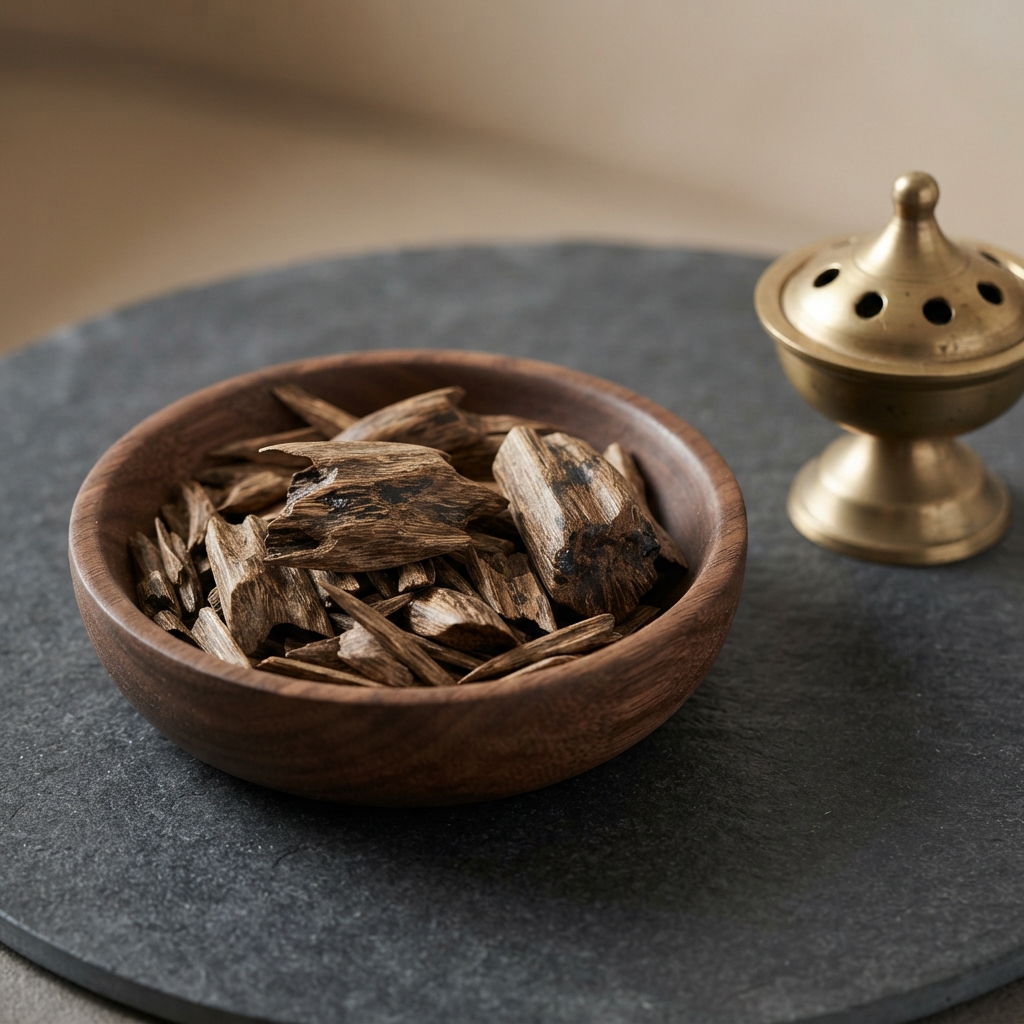
Oud chips for bakhoor are bought to a different brief than chips for incense sticks: the wood is usually seen, handled and often blended, soaked or layered with oils and powders, so size, visible resin, moisture and fines matter as much as scent. This guide shows B2B buyers how to write a bakhoor chip specification, test an arrival properly and evaluate an oud chips manufacturer without relying on grade names that mean different things to different suppliers.
Why bakhoor is a different buying problem from incense
Incense manufacturing tends to hide the wood. The chip or powder goes into a mill, a blend or a stick, and what the consumer sees is the finished product. Bakhoor manufacturing is closer to a display material: pieces sit in a mabkhara or a retail pack, they are poured, weighed and often handled by staff, and they are frequently combined with oils, powders and other aromatic materials before they ever reach a customer.
That changes the specification. A bakhoor program has to control four things at once: what the piece looks like, how it behaves when warmed, how it behaves when soaked or blended, and how much of the delivered weight is actually usable wood. A quotation that only states a grade letter answers none of those questions.
It also changes what "loss" means. Fines that are irrelevant in a milling operation are visible dust in a retail pack of bakhoor oud chips. Oversize pieces that are fine for a burner may not fit the packaging. Moisture that is inside the acceptable range for a raw material buyer becomes paid water weight when the same material is sold by the gram in a boutique.
The three material routes into a bakhoor line
Before comparing suppliers, decide which route your product actually takes. Mixed briefs are the most common reason two quotations cannot be compared.
1. Chips as the visible wood layer
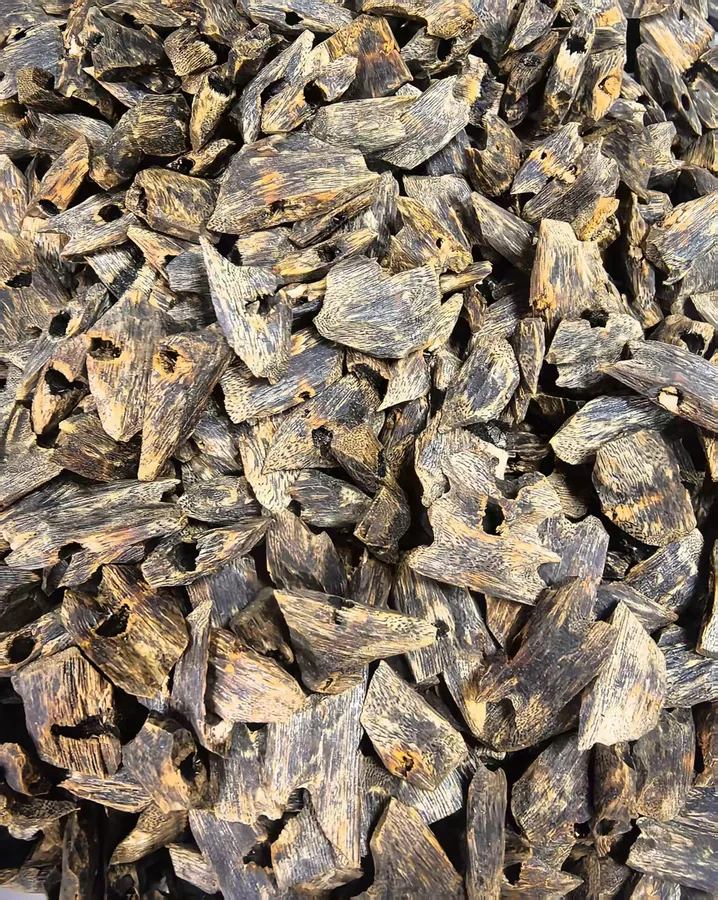
Whole or broken chips are packed as the aromatic wood component, sometimes plain, sometimes with a light oil or powder addition. Here the visual grade is part of the product: grain, colour contrast, resin streaks and piece size all read as quality to the end customer. Narrow, repeatable size bands matter more than a resin content claim printed on a supplier page.
2. Chips blended into a powder-based bakhoor
Agarwood chips for bakhoor blends are combined with agarwood powder and other aromatic materials, then pressed, rolled or packed loose. In this route the chips contribute texture and slow release rather than appearance alone, so a small chip with consistent behaviour can outperform a large decorative piece. Blend behaviour, not piece beauty, is the selection criterion.
3. Chips as a base for soaked or coated formats
Many producers treat chips before packing, adding oils or aromatic materials so the piece carries a house scent. Once treatment is added, the chip becomes an input to your process rather than a finished material, and the specification has to state the starting condition: natural, untreated chips at an agreed moisture and size, not a pre-scented piece with an unknown load. If your line is a private label bakhoor program, this is the step where your formula, not the supplier's, has to stay in control.
If your line covers more than one route, buy to the strictest one or split the purchase. Buying a single "bakhoor grade" for three products is how batches end up being re-sorted in your own warehouse.
A specification table for oud chips for bakhoor you can paste into an RFQ
The table below is deliberately written as buyer-controlled fields rather than supplier marketing. Every line should be answered in writing before a sample is sent, and every answer should be checkable on arrival.
| Field | What to state in the RFQ | How you check it |
|---|---|---|
| Form | Chip, broken piece, granule or powder fraction; state whether natural wood only | Visual inspection against the retained sample |
| Size band | Nominal piece size plus an accepted range and a screen opening for undersize | Sieve or hand-sort a 200–500 g draw from the lot |
| Fines limit | Maximum share passing the agreed screen, and what happens to excess | Weigh the undersize fraction from the same draw |
| Visible resin | Descriptive terms: grain contrast, streak density, dark-wood share — not a letter grade alone | Compare against the approved reference sample under the same light |
| Moisture basis | Whether the quoted weight is as-shipped or on a stated dry basis, and the test method | Record incoming weight, then re-weigh a sealed sample after drying |
| Treatment status | Natural and untreated, or treated — and if treated, what was added and at what stage | Ask for the process step in writing; smell and appearance checks |
| Foreign matter | No bark, soil, string, metal or non-agarwood species; state the check performed | Full inspection of the draw, not a spot check of the top layer |
| Packing | Inner bag, outer carton, net weight per unit, label content | Weigh three units at random and compare to the label |
| Documents | Permit, invoice description, packing list, any test report the supplier actually holds | Match the description to the goods, line by line, before clearance |
| Reference sample | Lot-linked sample, retained by both parties, signed and dated | Keep one sealed copy unopened for the life of the order |
Two fields do most of the work. The size band with its screen opening converts "small chips" into something a warehouse can measure, and the moisture basis converts a price per kilogram into a price per usable kilogram. Our guide to agarwood chip and granule particle size explains how to phrase the size terms so a supplier cannot interpret them two ways.
Five variables that move both price and performance
Oud chip size and screen opening
Oud chip size drives yield in ways buyers underestimate. Larger pieces look better in a retail pack but leave more air space per kilogram and can sit unevenly on a burner. Smaller pieces fill packaging more densely and warm faster, but generate more dust and can scorch sooner. The practical answer is a narrow band with a defined undersize limit, tested on your own burner rather than a supplier video.
Visible resin and how it is described
Terms such as grade A, super or double super are commercial shorthand with no shared definition across origins; they cannot be compared between two quotations without a reference sample and a written description of what the supplier means. Ask for descriptive criteria — grain contrast, proportion of dark resinous wood, piece integrity — and tie them to a sample you have approved. Our quality framework treats letter grades as internal supplier references, not an international standard, and any honest supplier should be able to say the same about their own labels.
Moisture basis
In a product sold by weight to consumers, water is expensive. A chip delivered at a higher moisture content can lose weight in your warehouse, in transit or on the shelf, and the loss lands on your margin, not the supplier's. Fix the basis in the purchase order and state how a dispute is measured. The mechanics are covered in our guide to oud chips moisture content.
Fines and oversize
Every lot produces a fraction outside the band. Decide in advance whether fines are accepted at a stated maximum, credited, or replaced, and whether oversize pieces can be returned or must be re-cut at your cost. Without that clause, the first arrival sets the precedent.
Treatment status
Natural, untreated material and pre-treated material are different products with different prices and different risk. If you treat in-house, buy untreated chips and keep control of the load. If you buy treated, you inherit the supplier's formula and its variability, and you need the addition declared in writing.
What to test on arrival, before you commit a season
A bakhoor lot is approved on evidence, not on the first impression from the top of the carton. A workable arrival routine for a B2B buyer looks like this:
- Photograph the sealed units before opening. Unit count, label, net weight, carton condition. This is the baseline if a claim is needed.
- Draw a sample across the lot, not from the surface. Take portions from several inner bags and combine them into one inspection sample.
- Weigh and sieve. Record net weight against the label, then separate the sample into in-band, undersize and oversize fractions and record each as a percentage.
- Check moisture. Seal a subsample immediately, weigh it, dry it under the agreed method and compare the result to the specification.
- Burn a fixed quantity on your own equipment. Same piece count, same burner, same ventilation, same observer scoring sheet. Compare against the approved sample, not against memory.
- Test the treatment behaviour if you soak or blend. Run a small trial batch through your actual process and record how the chips absorb, clump or bleed colour.
- Record the decision and the batch code. Approval means little if the retained sample cannot be matched to the shipment later.
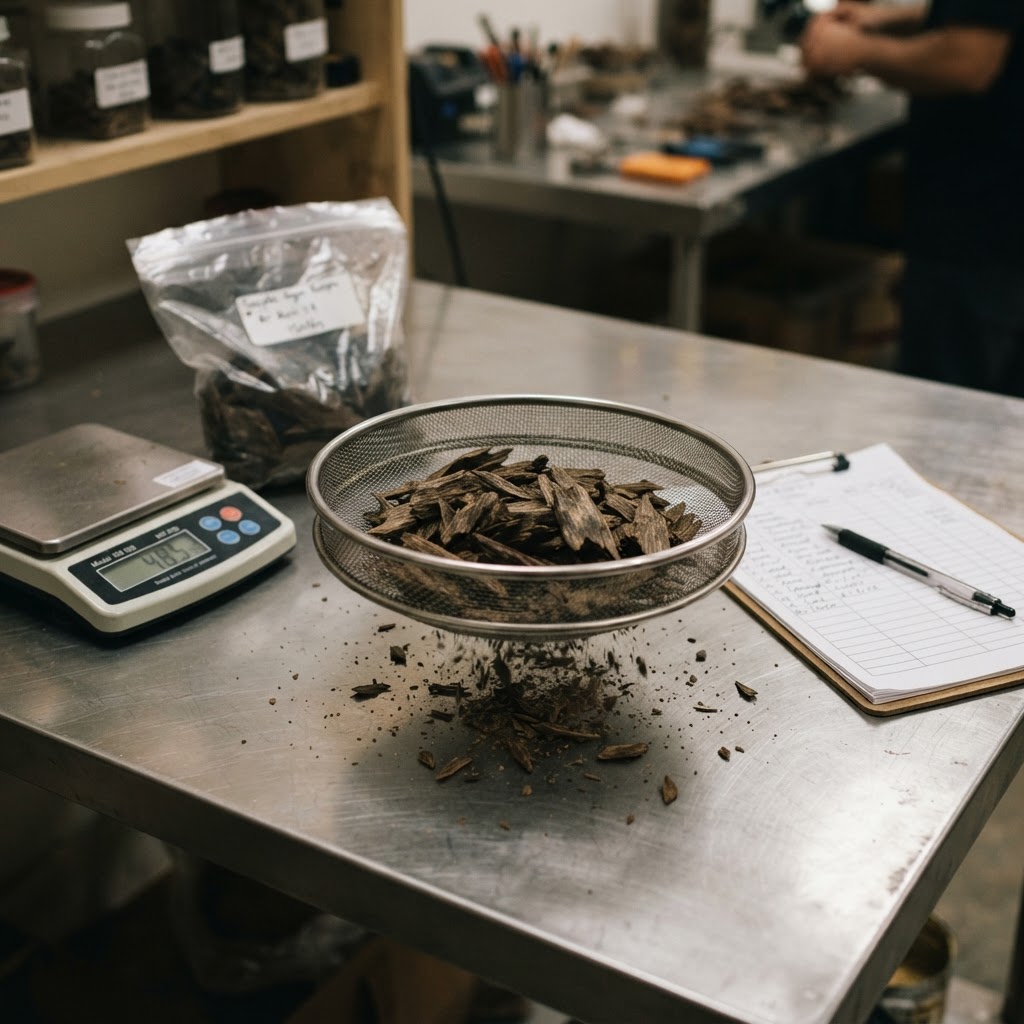
This is the same logic as a formal sample approval protocol, adapted to a material that is often seen and handled rather than milled. If your team is new to the category, run the arrival test on the sample itself first, so the bench method is settled before the bulk lot arrives.
Documents and compliance questions to settle early
Agarwood-producing species are listed in CITES Appendix II, which regulates rather than prohibits trade: export requires a permit, and the goods, the permit description and the commercial invoice have to agree. The CITES working document on agarwood-producing taxa (Aquilaria spp.) sets out those trade controls, and the FAO material on CITES and sustainable forest management explains how the permit system applies to wild, captive-bred and artificially propagated specimens.
For a bakhoor program, three practical checks matter:
- Description matching. The permit, invoice and packing list should describe the same form, species and quantity. A permit for one product form does not cover a shipment described as another.
- Named consignee and destination. Buyer name, port and country must be consistent across documents; re-consignment after issue is where clearance stalls.
- What the supplier can actually provide. Ask which documents are issued per shipment and which are issued once per year, and do not assume a certificate exists because the product page mentions quality control. A supplier that describes its own system as a working framework rather than a certified scheme is giving you usable information.
Our quality and supply framework sets out what we check and, just as importantly, what those checks do not claim. If your market requires a specific certificate, ask before the quotation, not after the deposit.
Common mistakes in bakhoor chip sourcing
- Buying on a grade letter alone. "Grade A" from two origins can describe two different materials. Without a written description and a reference sample, the letter is decoration.
- Specifying size in words. "Small" and "medium" are not measurements. Use a nominal size plus a range and a screen opening.
- Ignoring the moisture basis. A quoted kilogram is not a delivered usable kilogram unless the basis is stated.
- Approving a sample that was never linked to a lot. A beautiful sample with no batch reference cannot support a claim, and cannot be reordered.
- Letting the sample and the bulk run use different processes. If the supplier treats, dries or packs the bulk lot differently from the sample, your approval does not apply to what arrives.
- Assuming the cheapest quote is the cheapest material. Compare landed cost per usable kilogram after fines, moisture and freight, not the headline price.
- Leaving packaging until the end. Retail pack size constrains chip size. Deciding the pack after the wood is cut usually means re-cutting it.
How to evaluate an oud chips manufacturer for a bakhoor program
Send these questions in one message and read the answers for specificity. Vague answers are information too.
- Which product forms do you process in-house, and which are bought in?
- How do you define the size band, and what screen opening do you use for undersize?
- What moisture basis do you quote on, and how is it measured?
- Can you supply untreated chips, and can you describe every treatment step if not?
- What is your internal grade system, and what does each label actually describe?
- Which documents do you issue per shipment, and who is the permit holder?
- What is your sampling process, and will you retain a sealed sample of my lot?
- What changes between a trial order and a repeat order at the same specification?
- How do you handle a lot that fails the arrival check?
- Which markets do you already ship to, in which forms?
On capacity, lead time and MOQ, ask for the terms that apply to your specification rather than a general figure: the honest answer is usually that the minimum depends on grade, lot size and packing run. Our guides to oud chips manufacturer MOQ and manufacturer capacity show how to test those answers.
Our bakhoor-relevant materials
NanjaOud supplies natural agarwood chips from a managed plantation base of more than 160 acres in Jiangmen, Guangdong, with in-house processing. Our cultivation approach does not use chemical resin-induction agents, and the material is supplied as natural wood with visible grain and resinous characteristics.
Natural large agarwood chips keep a comparatively complete wood form with clearly visible grain and resin streaks. They suit buyers who need visually recognisable pieces for bakhoor display, incense use, further cutting or grinding, and distribution. Natural small agarwood chips are cut into smaller irregular pieces that are easier to portion, blend, pack and process, which fits blended bakhoor, repacking and private-label work. Both are offered for agarwood chips wholesale and ODM cooperation, and powder and oil formats for bakhoor blending are available through our agarwood powder range.
Internal A, B and C labels are our own supplier references for the material and format supplied; they are not presented as a universal grading standard. The final requirements are confirmed through the specification, visual review, quotation and approved sample. If you are deciding between chips, granules and powder for the same line, our form comparison and the bakhoor application overview are the fastest starting points.
FAQ
What oud chips for bakhoor should I choose by size?
There is no universal size. Retail packs and small burners favour a narrower band of smaller pieces that fill the pack evenly and warm quickly; display formats and traditional burners can take larger, more intact pieces. Fix the pack and the burner first, then set the band with a screen opening and an undersize limit.
Should bakhoor chips be natural or pre-treated?
Natural, untreated chips give you control of the final scent and the treatment load. Pre-treated chips save process time but transfer the formula and its variability to the supplier. Whichever you choose, state it in the purchase order and ask for the treatment to be described in writing.
Can I use the same chips for incense sticks and bakhoor?
Sometimes, but the specifications differ. Incense production is usually more tolerant of fines and uneven piece size because the material is milled or blended, while bakhoor is often judged on visible pieces. If you buy one lot for both, specify to the stricter end use.
How do I compare two quotations that use different grade names?
Ignore the letter and compare the written description, the size band, the moisture basis, the fines limit, the treatment status and the delivered form. Then compare landed cost per usable kilogram. Two suppliers using the same letter for different materials is normal in this category.
What moisture content should I ask for?
Ask for the basis and the measurement method rather than a number pulled from another supplier's page: whether the quoted weight is as-shipped or on a stated dry basis, how the test is run, and what happens if the arrival exceeds it. Resin-rich agarwood behaves differently from plain wood in a drying oven, so the method has to be agreed by both sides.
Which documents should arrive with a bakhoor chip shipment?
At minimum a commercial invoice, packing list and the CITES documentation required for the species and destination, with the goods described consistently across all of them. Additional testing or phytosanitary documents depend on your market; confirm which ones the supplier issues per shipment before you order.
How much sample should I request before a bulk order?
Enough to run your real process, not just to smell. That usually means a quantity that lets you sieve, weigh, dry and burn several times, plus a sealed portion retained for comparison. Sample cost and shipping are normally quoted per product and destination.
How do I keep the second order the same as the first?
Tie everything to a retained, signed sample and a written specification, and record the batch code on each shipment. Then repeat the same arrival checks. Repeatability is a documentation outcome, not a promise.
Conclusion
Oud chips for bakhoor are bought on four things: a size band you can measure, a resin description tied to an approved sample, a stated moisture basis, and documents that match the goods. Get those into the RFQ and the quotation comparison becomes straightforward; leave them out and every arrival is a negotiation.
If you are specifying a bakhoor line now, send us your pack size, target market, intended treatment route and estimated quantity through our contact page, and we will help define the material, sample and next commercial step.


