
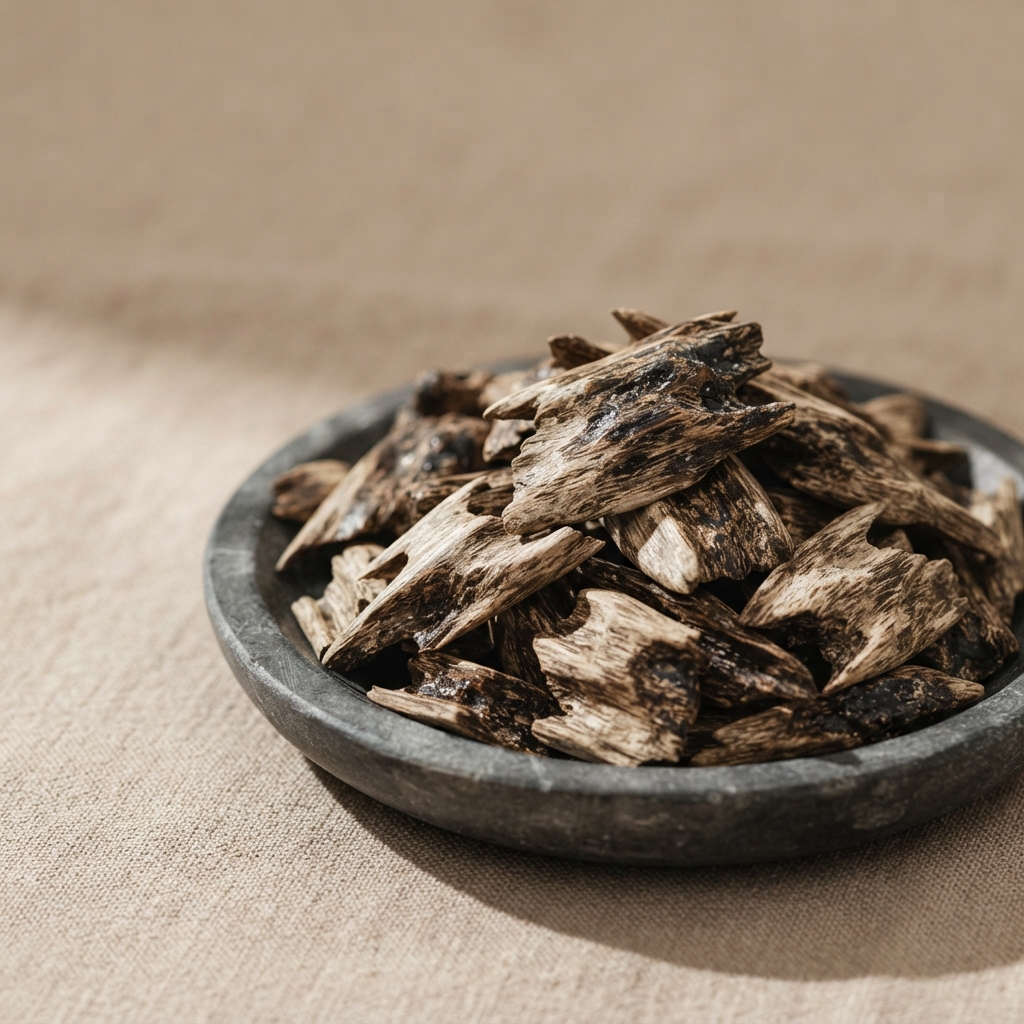
An oud chips manufacturer's capacity is not the tonnage printed in a brochure. It is the volume of sorted, dried and packed chips the factory can ship at your approved specification, month after month, after existing customers have taken their allocation. Buyers who test that definition before committing annual volume avoid the most expensive sourcing surprise in agarwood: a good first lot that cannot be repeated.
This guide is written for importers, distributors, incense and bakhoor producers, and fragrance brands moving from a trial order to a supply programme. It sets out what to measure, which evidence to request, how allocation actually works in oud chips wholesale, and the clauses that protect your second and third order.
Why a trial order proves less than buyers assume
A first shipment is usually assembled from material the supplier already holds, often from a lot reserved for sampling and small orders. That is a reasonable way to start, but it tells you very little about what happens when your monthly draw rises and the supplier has to cut into a new harvest, a different tree-age class or a different drying batch. A well-run oud chips supplier will tell you which lot your sample came from, and whether that lot still exists.
Two separate gaps appear at that point. The material gap is whether the next harvest can deliver the same resin distribution, piece size and aroma behaviour you approved. The scheduling gap is whether your order can get a slot in processing and drying when you need it, next to the supplier's larger or older accounts.
What to test instead of the sample
Instead of asking "can you supply this?", ask "how do you prove you can supply this again in March?". The answer should involve records, not adjectives: a harvest plan, a processing schedule, a lot-coding system and a named person who owns the allocation. If the answer is a photograph of a warehouse, you have learned about stock, not capacity.
The four capacities behind one quotation
Every quotation from an oud chips manufacturer rests on four capability layers. A weakness in any one of them becomes your delay or your quality claim later, so score them separately rather than treating "capacity" as a single number.
| Capacity layer | What it actually means | Evidence to request | Warning sign |
|---|---|---|---|
| Raw-material access | Standing plantation, committed supply or open-market buying; tree-age classes available for the next 12 months | Plantation location and area, species handled, annual harvest plan, planting-year records | "We buy from farmers when orders come in", with no named source or season plan |
| Processing throughput | Cutting, cleaning and sizing volume per shift at your piece size | Equipment list with rated throughput, shift pattern, current utilisation | Only finished-product photos, no statement of monthly output |
| Drying and finishing | How moisture is brought to the agreed range before packing | Drying method, measurement instrument and method, target range per order, record per lot | "Sun dried" with no measurement and no lot record |
| Sorting, packing and documents | Labour and space to grade, code, pack and prepare export paperwork at your volume | Sample lot code, packing specification, export document workflow and responsible staff | Grade names with no lot coding and no document owner |
Ask for each layer in writing and keep the answers with the quotation. When a shipment slips, the layer that failed is usually the one that was never documented.
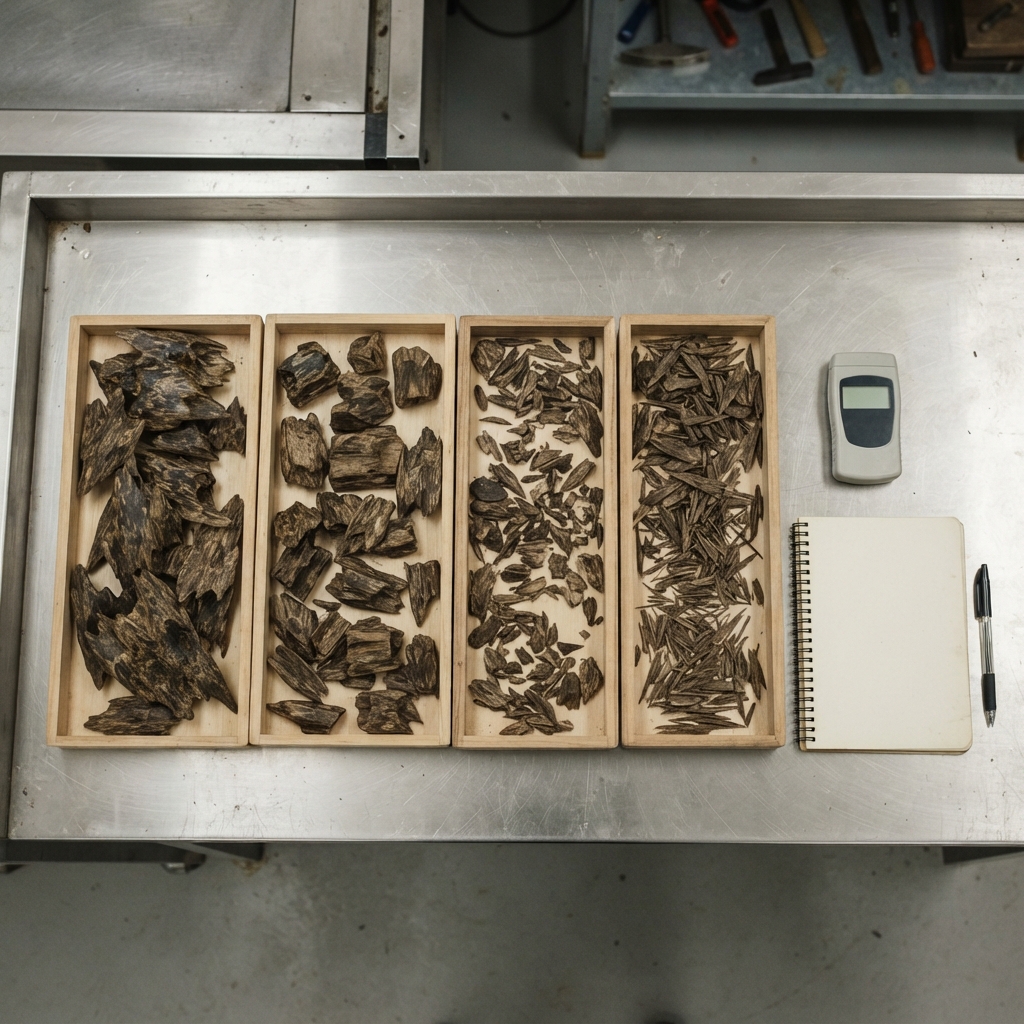
Measure capacity in shipment-ready kilograms
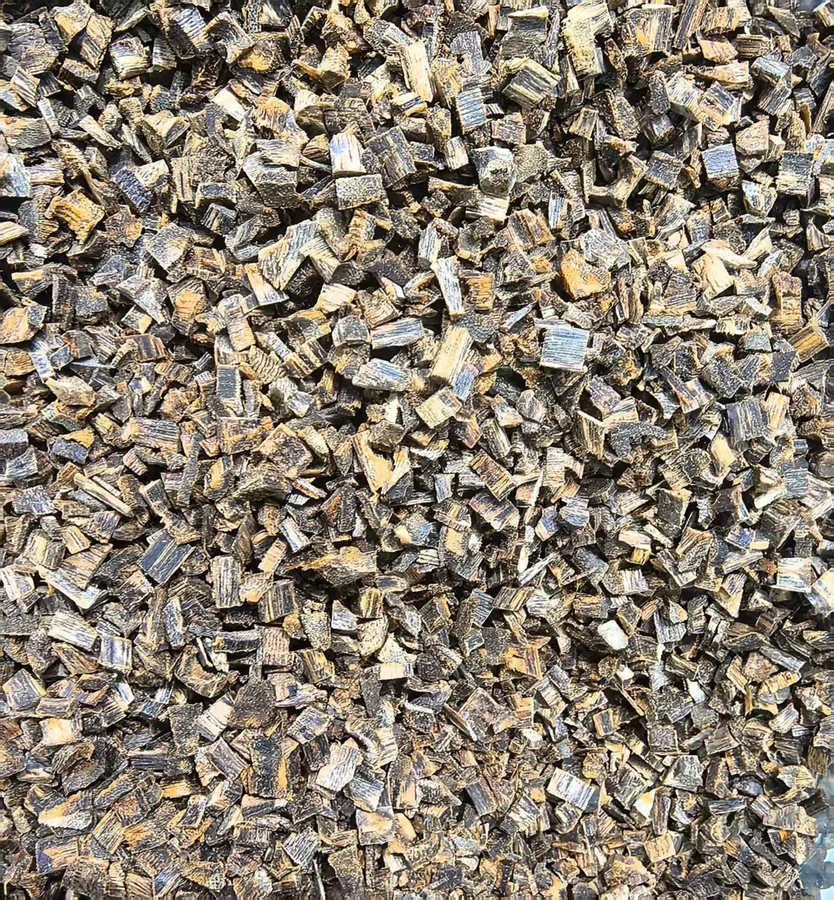
"We process several tonnes a month" is not a figure you can plan against. Convert every claim to the same unit: kilograms of finished, sorted, packed chips per month, at your piece size, your grade and your moisture basis. This matters most in agarwood chips wholesale, where two quotations can use the same words and mean different things.
- State the basis. A kilogram at 12% moisture and a kilogram at 20% moisture are not the same purchase. Capacity quoted on a wet basis flatters the numbers.
- Ask for the yield ratio. Raw harvested wood becomes trimmed, sorted, shipment-ready chips at a lower weight. Ask what ratio they plan on for your grade, then compare it with what you actually receive.
- Separate SKUs. A factory strong in small chips may be thin in large pieces, because the two come from different cuts. Get a monthly figure per SKU you intend to buy.
- Calculate your own draw. Annual demand, plus expected growth, plus a safety buffer, divided by twelve gives your baseline monthly requirement. Add your peak-season multiplier before you ask for allocation.
If the stated monthly output at your specification is less than twice your baseline draw, you are depending on a single customer relationship rather than a supply programme. That can still work, but it should be a conscious decision, not a discovery.
Plantation age and resin formation set the ceiling
Agarwood is not a crop you can accelerate on demand. Resin accumulates as a response to wounding and infection in Aquilaria and Gyrinops trees, and usable resin-bearing wood develops over years rather than months. FAO's review of CITES and sustainable forest management records that Aquilaria malaccensis was listed in CITES Appendix II in 1995, and that the 2004 Conference of the Parties listed the remaining agarwood-producing species in both genera. Legal export therefore depends on permits matched to species, origin and destination, and on a supply chain that can show where the wood came from.
That biology has a commercial consequence: an oud chips factory cannot double resin-rich output in a quarter. Sudden availability usually means one of three things — material held in stock, material bought in from other sources, or a change in the grade being shipped. None of these is automatically wrong, but each must be declared before it reaches your container.
Questions that reveal harvest planning
- Which planting years will be harvested for my orders over the next twelve months?
- How is resin formation managed, and are any chemical induction agents used? If so, where and on which lots?
- What happens to my specification if the next harvest runs lighter or heavier in resin?
- Who decides that a lot meets the approved grade, and what is recorded when it does not?
How allocation works when you are not the only buyer
Capacity is shared in every oud chips factory. A manufacturer with steady orders from two or three established buyers will protect those relationships first when a new harvest is short, when drying is delayed by weather, or when seasonal demand spikes. In Gulf markets, demand for bakhoor and incense rises ahead of Ramadan and Eid; in other markets it clusters around the fourth quarter and gifting seasons. Your order competes with those calendars.
Ask for an allocation in writing: kilograms per month, per SKU, with a review date and a named contact. A short allocation letter is more useful than a large capacity claim, because it converts a promise into a schedule you can plan production and cash flow around.
Dual sourcing without doubling your workload
Most experienced buyers keep one approved alternate rather than a single source. A common rule of thumb is to place roughly 70% of volume with the primary manufacturer and 30% with a qualified second, so the alternate stays active and current. The percentage matters less than the discipline: the second oud chips supplier should hold an approved sample and a valid quotation, not just a business card.
Keep at least one approved reference lot per SKU, stored correctly, with its lot code and the date it was approved. When a new shipment arrives, you are comparing it to a physical reference, not to a memory of last year's aroma.
A repeat-order scorecard for two or three suppliers
Score each oud chips manufacturer from 1 to 5 against the same evidence set, then weight the criteria. The point is not a perfect total; it is to make the trade-offs visible before you sign.
| Criterion | Weight | What you are scoring |
|---|---|---|
| Raw-material evidence | 20% | Named plantation or committed source, harvest plan, species clarity |
| Specification repeatability | 20% | Documented piece size, grade definition, moisture control and yield history |
| Allocation transparency | 15% | Written monthly allocation per SKU and a review mechanism |
| Lot traceability and documents | 15% | Lot codes, records per batch, permit workflow matched to destination |
| Sampling and approval discipline | 10% | Samples tied to a specific lot, written approval before production |
| Change notification | 10% | Notice before grade, harvest year or packing changes |
| Commercial terms | 10% | Price validity, tolerances, remedy route, payment structure |
A supplier scoring below about 70 out of 100 is usually not ready for an annual volume contract, however good the sample was. Between 70 and 85, start with a quarterly allocation and a formal review. Above 85, the remaining risk is commercial rather than operational.
Clauses that protect the second and third order
Most supply disputes are not about the first container. They are about what happens when the second one differs. These are the terms worth agreeing in writing before volume starts; your legal and finance teams should review the final wording.
- Capacity reservation. A monthly minimum and maximum in kilograms per SKU, with the review date.
- No substitution without approval. Any change of harvest year, source, grade or cut requires written notice and, where the change is material, a new sample approval.
- Tolerances with a remedy. State acceptable ranges for piece size, moisture and fines, and what happens when a lot falls outside them.
- A defined lead-time clock. Lead time should state its starting event — deposit received, sample approved, or permit issued — because each one moves the delivery date.
- Price validity. A fixed window, plus the trigger that allows a re-quote.
- Inspection and pre-shipment evidence. The right to see photographs or video of the actual lot, with its code, before it is packed.
- Document responsibility. Who applies for permits, who pays, and what happens if they are delayed.
What we confirm at NanjaOud
Our starting point is source access. We have more than ten years of agarwood cultivation experience and manage a plantation base of over 1,000 mu — roughly 160 acres — in Jiangmen, Guangdong, with cultivation practices that do not use chemical agents to induce resin formation. In-house processing covers cutting, drying, sorting and packing for wood, powder, oil and incense formats, which means the material and the finished format are handled inside one operation rather than passed between traders.
For chip buyers, that translates into two straightforward product lines: natural large agarwood chips for buyers who need visually recognisable pieces, and natural small agarwood chips for blending, grinding and repacking. Both are supplied with visible grain and resin-bearing characteristics, and both can be discussed against your intended application rather than a generic grade label — which is usually more useful than a grade name when you are comparing bulk oud chips offers side by side.
We do not publish fixed capacity, MOQ or lead-time figures, because they depend on the format, quantity and season. What we do instead is confirm them in the quotation, after the specification and sample direction are clear, and agree the packing and inspection points before production. For wholesale oud chips programmes that need custom cuts, sizes, packing or private-label presentation, the details are handled as an ODM project through our OEM and private label service; the quality framework we work to is described on our quality and supply page.
Common mistakes buyers make
- Treating the sample as a capacity test. A sample tests suitability, not repeatability.
- Comparing oud chips price per kilogram without a moisture basis. The cheaper quote may simply contain more water.
- Approving a grade name instead of a specification. "A grade" means nothing without size, moisture, resin visibility and a reference lot.
- Letting one supplier hold 100% of volume because the first order went well.
- Ignoring the permit clock. Export documents are part of lead time, not paperwork after it.
- Never re-testing the approved reference. Natural material shifts between harvests; your reference should be checked, not assumed.
Frequently asked questions
How much capacity should an oud chips manufacturer have?
Enough to cover your monthly draw at your specification with headroom for growth and seasonality. Ask for shipment-ready kilograms per month per SKU, not total raw wood processed.
Is a large plantation enough proof of supply?
No. Plantation area shows potential raw material, not processed output. You still need harvest planning, processing throughput, drying control and an allocation for your order.
How do I check moisture before a repeat order?
Agree a moisture basis and range in the specification, ask for the measurement method, and record your own result on arrival. Compare it with the approved reference lot rather than a single number.
Can one supplier cover all of my demand?
Sometimes, but it concentrates risk in one harvest, one drying cycle and one document workflow. A qualified alternate keeps your programme resilient without changing your primary relationship.
Which documents should accompany a repeat shipment?
Commercial invoice and packing list, lot identification, the moisture and grade record for the lot, and CITES permits where the species and destination require them. Requirements vary by country, so confirm them for your market.
How far ahead should I reserve capacity?
Before your peak season, and before the supplier's harvest and drying schedule is fixed. Buyers who reserve after the calendar is set are usually offered whatever remains.
What if the second lot differs from the approved sample?
Hold the lot, document the difference against the reference, and follow the inspection and claim route in your contract. Our guide to arrival inspection and quality claims sets out the evidence pack to prepare.
Does a low price mean the factory has spare capacity?
Not necessarily. It can also mean a trader without allocation, a different harvest year, or a wetter lot. Test the oud chips price against the specification before reading it as capacity.
Conclusion
Repeat-order reliability comes from four things you can check: raw-material access, processing and drying control, sorting and documentation discipline, and a written allocation. Ask for evidence at each layer, score two or three manufacturers on the same criteria, and put the second-order terms in the contract before the first container ships.
If you are planning a programme rather than a single purchase, share your product format, estimated monthly volume, target market and packing direction with our team through the contact page. We will confirm what the specification, sample and schedule look like for your case, and where the real constraints sit.
Related reading: lead-time planning, comparing manufacturers, what drives price per kilogram, and verifying a factory before you order.


