

Bulk agarwood shavings are bought by weight and qualified on evidence, yet most buyers commit to a container before they have seen a single bag of the production lot. The practical answer is a trial ladder: a lot-linked sample, a process trial, a pilot order, and only then a container, with a written pass condition at each gate. This guide sets out what to measure at every stage, how the same measurements behave at ten and a hundred times the quantity, and which questions an agarwood shavings supplier can only answer with a real order.
Why One Sample Cannot Qualify a Supplier
A sample proves that a good bag exists. It does not prove that your order will contain good bags, because a sample and a bulk lot are produced under different conditions. Samples are usually drawn from the top of a freshly filled bag, selected by hand, and shipped in a small carton where nothing settles. A container is filled from a production run, stacked under its own weight for weeks, and opened at the destination after a sea voyage.
Three things change with scale, and all three are commercial rather than aesthetic:
- Fines migrate. Small particles and dust move downward through a bag and a pallet during transport. The bag you open first is rarely the bag your production line will finish with, and the last bags of a lot can carry a materially different fine share from the sample.
- Moisture equilibrates. A 200 g sample dries or absorbs water faster than a 25 kg sack. A moisture figure measured on a small sample tells you about the sample, not about the packed lot in a humid container.
- Bulk density decides freight. Light, high-surface-area material fills a container before it reaches the weight allowance. The same net weight in a denser form can cost less to ship, which is why an apparently cheaper per-kilogram offer can lose on landed cost.
None of this makes small samples useless. It makes them a first gate rather than an approval. If you want the full inspection routine for a single arriving lot, the goods-in inspection plan for wholesale lots covers it in detail; this article is about the sequence of commitments that leads up to that lot.
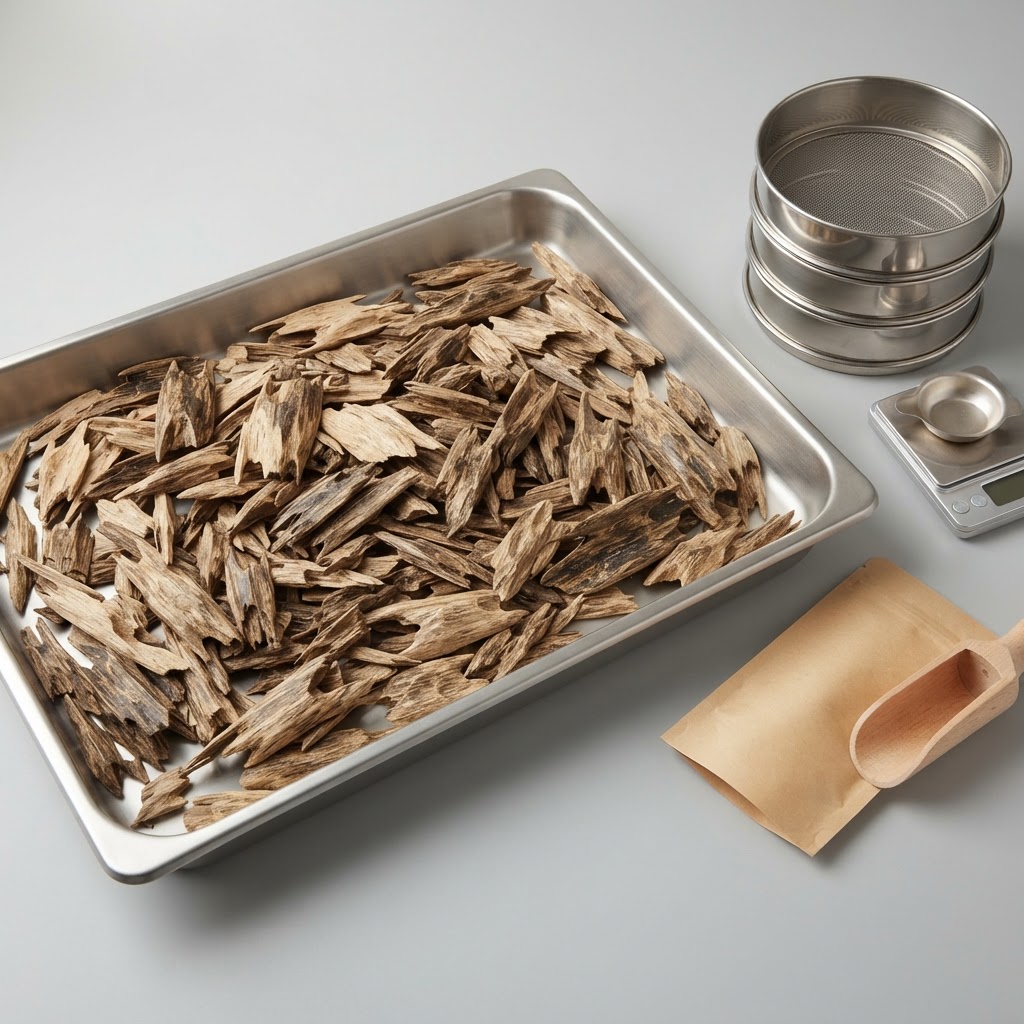
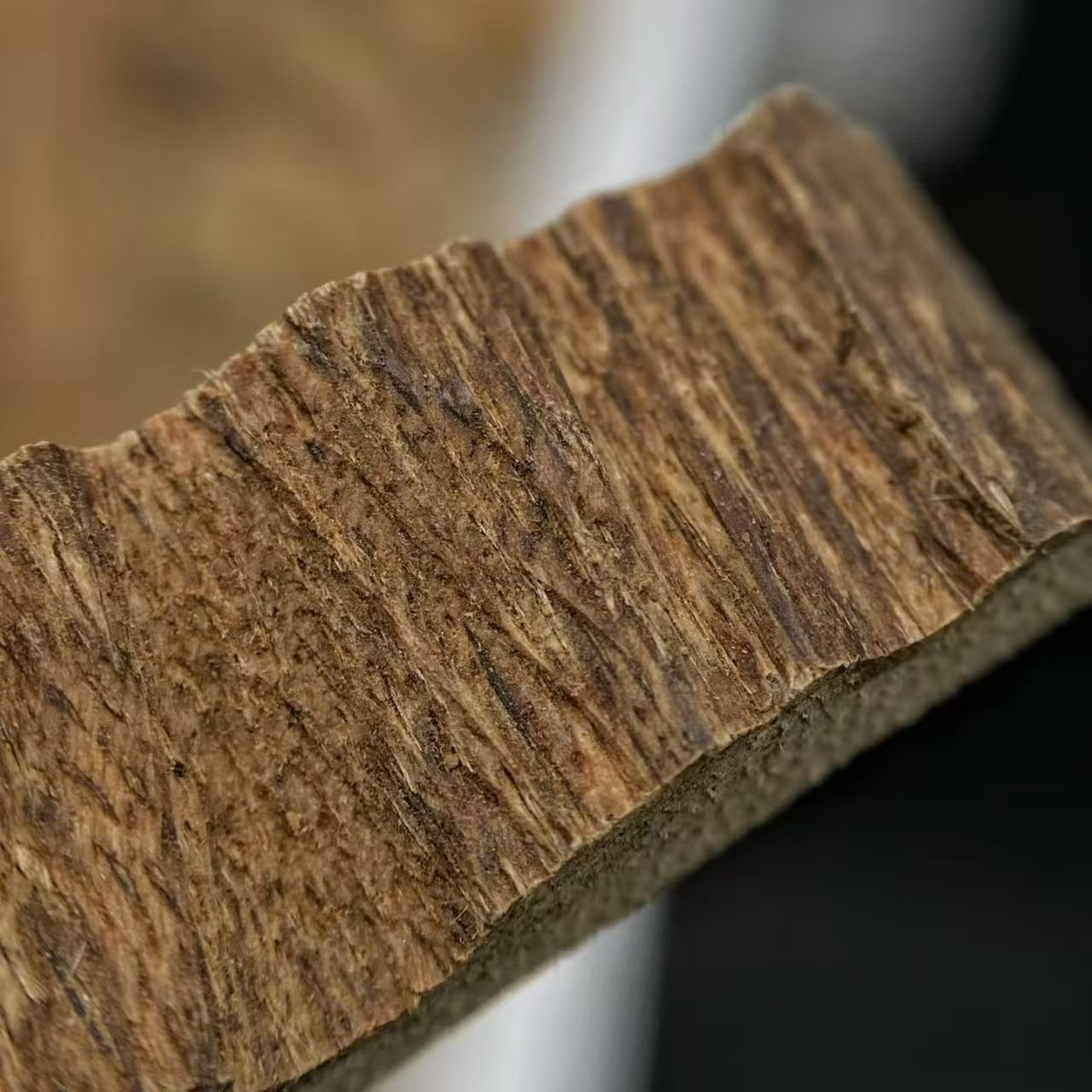
The Four Gates of a Trial Ladder
A trial ladder is a purchasing plan, not a supplier's sales process. You define the gates, the quantities, the pass conditions and the exit terms, then ask the supplier to price each stage. The quantities below are buyer-side planning defaults sized to a small manufacturer's batch; they are not market MOQs and should be adjusted to your own line.
| Gate | Planning quantity | What it can prove | What it cannot prove | Exit condition |
|---|---|---|---|---|
| 1. Lot-linked sample | 1–2 kg composite, plus a sealed retained portion | Form, screen band, fines share on arrival, smell and handling, document set | Packed density, moisture after freight, batch-to-batch repeatability | Sample matches a named lot; screen and moisture figures recorded |
| 2. Process trial | 20–50 kg | How the material behaves in your own mill, burner, blender or still; real usable share | Container-scale packing, freight damage, allocation across a season | Trial run yields an acceptable usable share and no process defect |
| 3. Pilot or repeat order | Several hundred kilograms, from a second production run | Repeatability: does a new run match the approved trial on the same measurements? | Peak-season capacity, multi-container logistics | Second run inside agreed tolerance bands; claim route tested once |
| 4. Container order | Full container or seasonal allocation | Packing survival, weight reconciliation, permit and document consistency, lead time | Nothing further — this is the operating stage | Goods-in release against a signed record |
Gate 1: the lot-linked sample
Ask for increments rather than a curated handful, and ask which production lot they came from. A sample without a lot code cannot be enforced later, because there is nothing to compare an arrival against. Request the screen band, the fines share and the moisture basis in writing with the sample, and keep a sealed portion under your own label. The sample approval method in this sample approval protocol applies to shavings, fragments and granules alike.
Gate 2: the process trial
This is the gate most buyers skip, and it is the one that changes the economics. Run the material through the equipment you will actually use. A burner trial tells you how a piece size behaves on heat; a mill trial tells you the grinding loss and the dust generated; a blending trial tells you whether the material disperses evenly or separates. Record the input weight, the output weight and what you discarded. That ratio is your usable share, and it is worth more than any adjective in a quotation.
Gate 3: the pilot order
A pilot order exists to answer one question: can the supplier repeat the approved material from a new production run? Order from a different run, not from the stock the sample came from, and measure the same items with the same method. This is also the stage to test the commercial machinery — invoice, packing list, permit details, and one small claim or correction handled end to end — while the exposure is still small. Buyers who compare suppliers only on the first sample are comparing sales samples, not supply capability; the supplier comparison on equal terms covers the scoring side of that decision.
Gate 4: the container order
At container scale the risks shift from material to execution: whether the packed weight matches the packing list, whether the bags survive stacking, whether the documents describe the same form and quantity as the goods, and whether the lead time quoted in stages was real. Gate 4 is also where a per-kilogram comparison finally becomes meaningful, because freight, packing and clearance are now real numbers rather than estimates.
Form Names Are Not Grades: Chips, Shavings, Granules and Powder
In the agarwood trade, chips, shavings, granules and powder describe how wood left a machine. They are not quality levels, and no international standard fixes the boundary between one name and the next. Shavings typically come from planing or dimensioning — thin curls and slivers with a high surface-to-volume ratio and low bulk density. Chips are cut or split pieces with visible faces. Granules are milled and then screened to a defined band. Powder is milled to a flour. The same wood, put through a different machine, becomes a different product with different handling behaviour and a different usable share per paid kilogram.
That is why the form name in a quotation should always be treated as a question. Two suppliers quoting "shavings" may be describing a planer by-product and a screened mill fraction. Before price, establish what produced the material, which screen openings it passed and was retained on, what share passes the finest screen, and whether the lot is a single production run. For a fuller treatment of the geometry differences, see chips vs shavings: matching the form to your process.
Agarwood Raw Material Specification Comparison Table
| Form | How it is usually produced | Spec items to re-confirm at trial scale | Likely process fit to test | What only the trial reveals | Common purchasing risk |
|---|---|---|---|---|---|
| Chips | Cut or split wood pieces with visible faces | Piece size range, oversized share, bark and pale-wood share, moisture basis | Direct burning, bakhoor, distillation feed, repacking | How much of the lot is oversized for your format; breakage in transit | Grade letters read as an international standard; oversized pieces counted as usable |
| Shavings | Planing, jointing or dimensioning; thin curls and slivers | Screen band, fines share, packed density, moisture, bag compaction | Burning, loose blends, milling feed, sachets | Real packed density and how much dust reaches the bottom of the sack | Paid by weight, shipped by volume; fines settle and change the delivered mix |
| Granules | Milled, then screened to a stated band | Band definition in millimetres, undersize and oversize share, dust share, run-to-run uniformity | Stick and cone formulation, metered feeding, sachets | Whether two runs hold the same band, and how the material flows in your feeder | "Granule" without a band is a word, not a specification |
| Powder | Milled to a flour-like consistency | Mesh or particle size, dusting behaviour, moisture pick-up, agglomeration | Incense formulation, bakhoor paste, aromatic blends | Caking in your climate and weight variation at the packing head | Dust losses at filling; moisture pickup in an unlined sack |
The table is about what to verify, not about which form is better. A form that suits a bakhoor producer can be the wrong purchase for a stick manufacturer, and no form name implies anything about resin content or aroma before the lot has been tested.
The Measurements That Must Repeat at Every Gate
A trial ladder only works if the same items are measured the same way at each stage. Fix five, and write the method next to each one so both parties can repeat it:
- Screen band. A composite sample mass, a stated sieve stack, an agitation method and time, and a result as percentage retained by mass per screen. ISO 3310-1:2016 sets technical requirements and test methods for test sieves of metal wire cloth (ISO, 2016), which gives both parties a common reference for the hardware. Hand sieving and machine sieving give different results, so state which one applies.
- Fines share. The percentage passing your finest screen. This is the fraction most likely to be unusable for your process, and it is the number that changes most between a sample and a delivered sack.
- Moisture state. As received, and on an agreed dry basis, with the drying temperature and time written down. Resin-rich material can behave awkwardly in a simple oven test, so the method has to be agreed rather than assumed and then applied identically to the approval sample and to every arrival. The moisture clause explains how water weight turns into price.
- Foreign matter. Define defect classes before you find one — bark, pale non-resinous wood, grit and sand, fibres or string, insect damage, out-of-band pieces — and set an allowed percentage by mass for each.
- Usable share. The proportion of the paid kilogram that survives your process and reaches the product. Measure it at Gate 2 and re-measure it at Gate 3; a shift there is the earliest warning that a supplier has changed run or screen setting.
Where no standardised indicator exists, the buyer and seller should agree the measurement method, the sample it refers to, and the allowed deviation. That is what makes a tolerance enforceable instead of rhetorical. The clause-by-clause version is set out in this shavings specification for an RFQ.
Quotations and the Hidden Costs That Appear at Scale
Each gate should be priced separately, because the cost structure changes between them. A sample may carry a courier charge; a 30 kg trial lot may be priced at a small-run premium; a container is priced against a full production run. Asking for all three in one quote exposes which of those premiums is real and which is a negotiating position.
The comparison only becomes honest when each bid is restated the same way:
Cost per usable kg = (goods + freight + duty and clearance + screening or reprocessing + disposal of rejects) ÷ (net kg × usable share)
Five cost lines are routinely left out of a headline price, and all five grow with volume:
- Screening and reprocessing. If you must re-screen or pre-grind, that is your labour and your loss, not the supplier's.
- Off-specification material. Out-of-band pieces and excess fines are still paid for at the price of aromatic wood unless a tolerance clause says otherwise.
- Packing. Sack type, liner, desiccant and net weight per unit affect both protection and freight. Packed density and freight cost explains why light material fills a container early.
- Documents and compliance. Export and import permits, inspection and clearance are costs with their own lead times, and they are frequently quoted separately at the last moment.
- Currency and payment. Terms, deposit structure and exchange exposure change the true cost of two otherwise identical offers.
This guide deliberately gives no loss percentages or market price bands. Real figures depend on species, grade, form, screen band, moisture basis, route and season, and a number published without those conditions invites the wrong comparison.
What Only an Order Can Prove About a Supplier
Questionnaires and catalogues screen for seriousness. An order tests for capability. The items below cannot be verified from a sample, a brochure or a video call:
- Allocation and capacity. Whether the volume you need next quarter competes with a larger customer for the same production run.
- Repeatability. Whether a second run holds the approved screen band, fines share and moisture, or drifts toward whatever the mill was set to that week.
- Change control. What happens when you need a different screen band, a tighter fines limit or a new pack: is that a new run, a re-screen, or simply not offered?
- MOQ composition. Whether the minimum is set by a production run, a packing unit, or a permit minimum — three very different constraints with three different negotiation paths.
- Document consistency. Whether the invoice, packing list and permit describe the same species, form and quantity. Aquilaria and Gyrinops are listed in CITES Appendix II, as reviewed in the CITES report on the two genera (CITES, 2022), so the permit description and the commercial description have to agree.
- Claim handling. How a small correction is actually resolved, which is the best predictor of how a large one will be handled.
Agarwood Shavings Supplier Evaluation Checklist
Use the gate column to decide when each check is possible. A check that cannot be done yet is not a pass.
| Check | Gate | Evidence to request | Pass condition |
|---|---|---|---|
| Sample | 1 | Lot-coded composite plus sealed retained portion; screen and moisture figures | Sample traces to a named lot and can be re-tested by both parties |
| Specification | 1 | Written form definition, screen band, fines limit, moisture basis and method, defect limits | Every item is measurable with an agreed pass or fail band |
| Process behaviour | 2 | Your own trial record: input weight, output weight, rejects, observations | Usable share and handling are acceptable on your equipment |
| Batch repeatability | 3 | Second-run material measured with the same method as the approved trial | Every measured item sits inside the agreed tolerance band |
| Packing and unit weight | 3–4 | Sack and liner specification, net weight per unit, closure, desiccant, pallet pattern, label content | Packed weight matches the packing list; condition survives stacking |
| Logistics and documents | 4 | Incoterm, port pair, document list, lead time in stages, permit holder | Documents describe the same species, form and quantity; lead time holds |
| After-sales terms | 3–4 | Claim window, tolerance remedy, re-screen or return terms, quality contact | Remedy is written into the purchase order, not promised verbally |
Mistakes That Repeat at Every Gate
- Buying a form name instead of a specification. "Shavings" describes a machine's output, not a promise about your order.
- Skipping the process trial. A material that looks right can still cost more per usable kilogram than a dearer one that runs cleanly.
- Sampling the stock the sample came from. A pilot order from the same run proves nothing about the next one.
- Changing two variables at once. New supplier, new screen band and new pack in the same order leaves you unable to attribute a failure.
- Leaving the remedy for later. A tolerance band without a remedy is advice, not a contract.
Our Materials: What We Can Confirm
NanjaOud (Jiangmen Nangjiaxiang Agarwood Development Co., Ltd.) supplies agarwood materials and finished products to incense manufacturers, fragrance companies, importers, distributors and private-label buyers from Jiangmen, Guangdong. Our catalogue lists agarwood wood fragments — irregular pieces with visible natural grain, suitable for burning, blending, further grinding and incense-related processing — and natural small agarwood chips, processed into smaller irregular pieces while retaining the wood structure and visible resin-bearing grain, for incense applications, repacking, further grinding and wholesale distribution.
We do not currently list a product under the name "shavings". If your specification uses that word, tell us the physical definition you need — production route, screen band, fines limit, moisture basis, pack — and we will confirm what form the offered material actually is rather than relabel a product to match a search term.
Our public catalogue shows wood fragments and small agarwood chips, but does not establish that either item matches a buyer's shavings specification. Send the target form, screen band, fines limit, moisture basis, sample quantity and destination; ask for an order-specific written confirmation before using the term on a purchase order.
FAQ
Is agarwood shavings the same as agarwood chips?
No. Both are wood, but shavings are thin curls from planing or dimensioning while chips are cut or split pieces. They differ in bulk density, fines share and behaviour in a burner or a mill, so they should be specified, sampled and priced as different materials.
What particle size should I write into a shavings order?
A screen band, not an adjective: the share retained between two stated openings plus a maximum share passing the finest screen. Name the sieve reference and state whether sieving is by hand or machine, because the result differs.
How much sample and trial material should I ask for?
Typically 1–2 kg of composite material for testing plus a sealed retained portion, then a 20–50 kg trial lot before a bulk commitment. Scale both to your own batch size, and insist the sample carries its lot code.
What MOQ is normal for bulk agarwood shavings?
There is no standard figure. Minimums are built from production runs, packing units and permit requirements, and they vary widely between suppliers. Ask what the number is made of and whether a smaller trial lot is available first.
Can I check quality without a laboratory?
Sieving, weighing, moisture measurement with a calibrated instrument, visual defect counting and a process trial will catch most specification failures. What matters is that the same method is used on the approval sample and on every arrival.
Can oud wood shavings be shipped internationally?
Agarwood materials move under CITES documentation because Aquilaria and Gyrinops are listed in Appendix II. Confirm that the export permit, invoice and packing list describe the same species, form and quantity before the goods leave.
Why is one quotation so much cheaper per kilogram?
Usually because it describes a different form, a wider screen band, a higher fines share, a different moisture basis or an incomplete document set. Restate both offers as cost per usable kilogram before deciding.
Conclusion
Buying bulk agarwood shavings is a sequence of decisions, not a single purchase. Link the sample to a lot, run the material through your own process, order again from a second run to test repeatability, and only then commit to a container — measuring the same screen band, fines share, moisture and usable share at every gate. Do that, and an oud wood shavings wholesale programme stops depending on adjectives and starts depending on numbers, which is the only basis on which a second order can be placed with confidence.
Start with the end use: what your line will do with the material, the form and screen band you need, the sample and trial quantity you want, your expected volume and your target market. Send those details through our contact page and we will confirm which of our actual materials fits — including whether the form you are asking for is one we supply under that name.


