
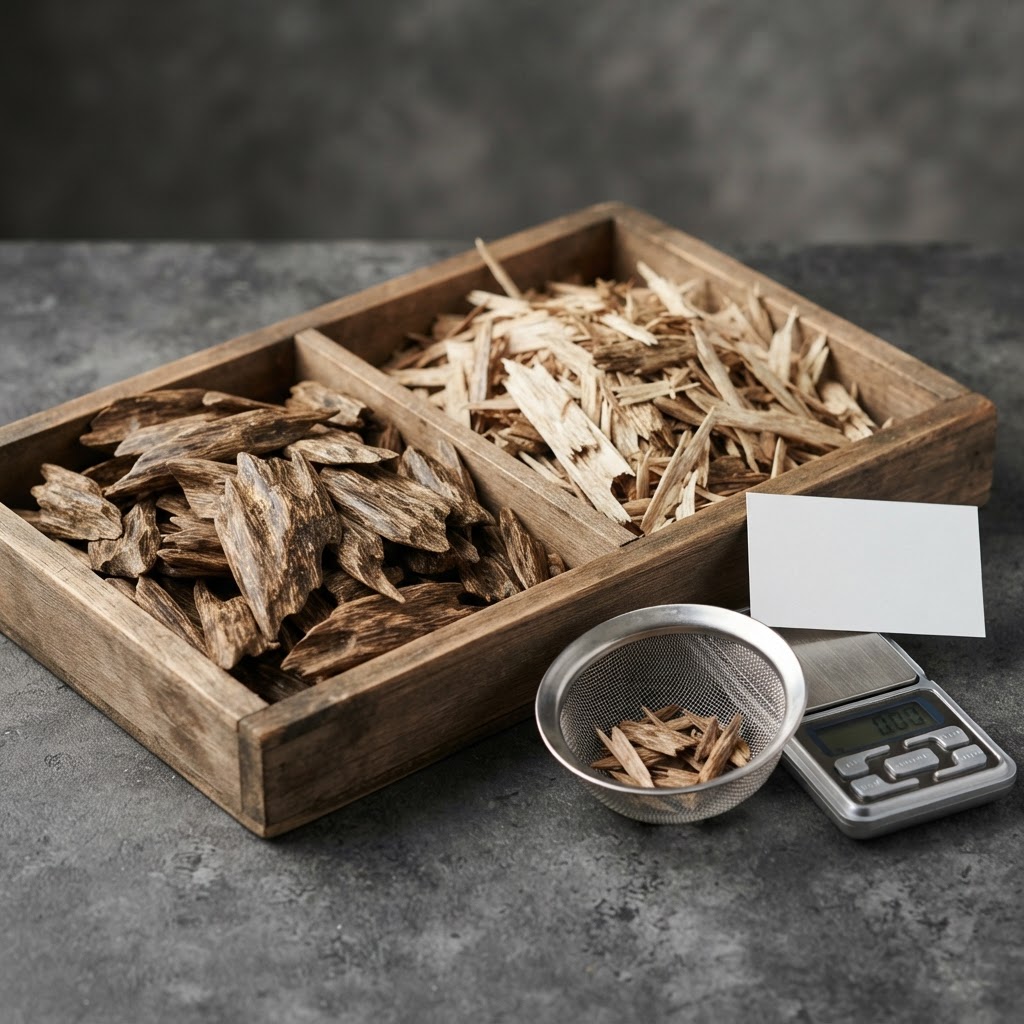
Short answer: the agarwood chips vs shavings question is decided by your process, not by which name sounds more premium. Chips are cut to a size on purpose and stay visible and separate in the bag; shavings are thin slivers, usually generated as a by-product of planing, slicing or shaping, and they settle, interleave and shed dust. Neither form carries a defined grade, so the buyer who wins is the one who measures the fractions, samples the offered lot and writes acceptance criteria before comparing price.
This guide is written for importers, incense and bakhoor manufacturers, fragrance processors and wood wholesalers who already know they need agarwood raw material but have not settled which physical form to buy. It does not repeat the general sourcing checklist published elsewhere on this site; it focuses on the decision that comes first — which form, for which process, at which packed density, with which fraction split — and on the arithmetic that shows what a kilogram actually delivers.
Agarwood chips vs shavings: why the two names describe different materials
Agarwood reaches the market as blocks, slices, chips, fragments, shavings, granules and powder. These words describe geometry. None of them is an international grade, and no standards body assigns them a resin content, a species or an aroma class. Two suppliers can both write “shavings” and ship material with different thickness, length, dust load and cleanliness, and both can be telling the truth about their own stock.
The structural difference that matters commercially is how each form is produced:
- Chips and fragments are cut to a target size, usually from trimmed wood or block offcuts. Someone decided the piece range, which means the size can be quoted, checked and repeated.
- Shavings are often the residue of another job — dimensioning blocks, shaping bead blanks, planing surfaces, slicing presentation pieces. A sidestream inherits whatever the upstream operation needed, so its sliver thickness and dust share can change when that job changes, without any change in the product name.
- Granules are cut or crushed to a more block-like profile, chosen when a buyer wants a small piece with predictable flow rather than a long sliver.
- Powder is milled material defined by what passes a screen, so fineness and dispersion become the usable characteristics instead of piece size.
That is why a straight price comparison across the two words is often meaningless. In the agarwood chips vs shavings decision you are comparing a purpose-cut material with a production residue, and the labour, screening and handling behind each one differ.
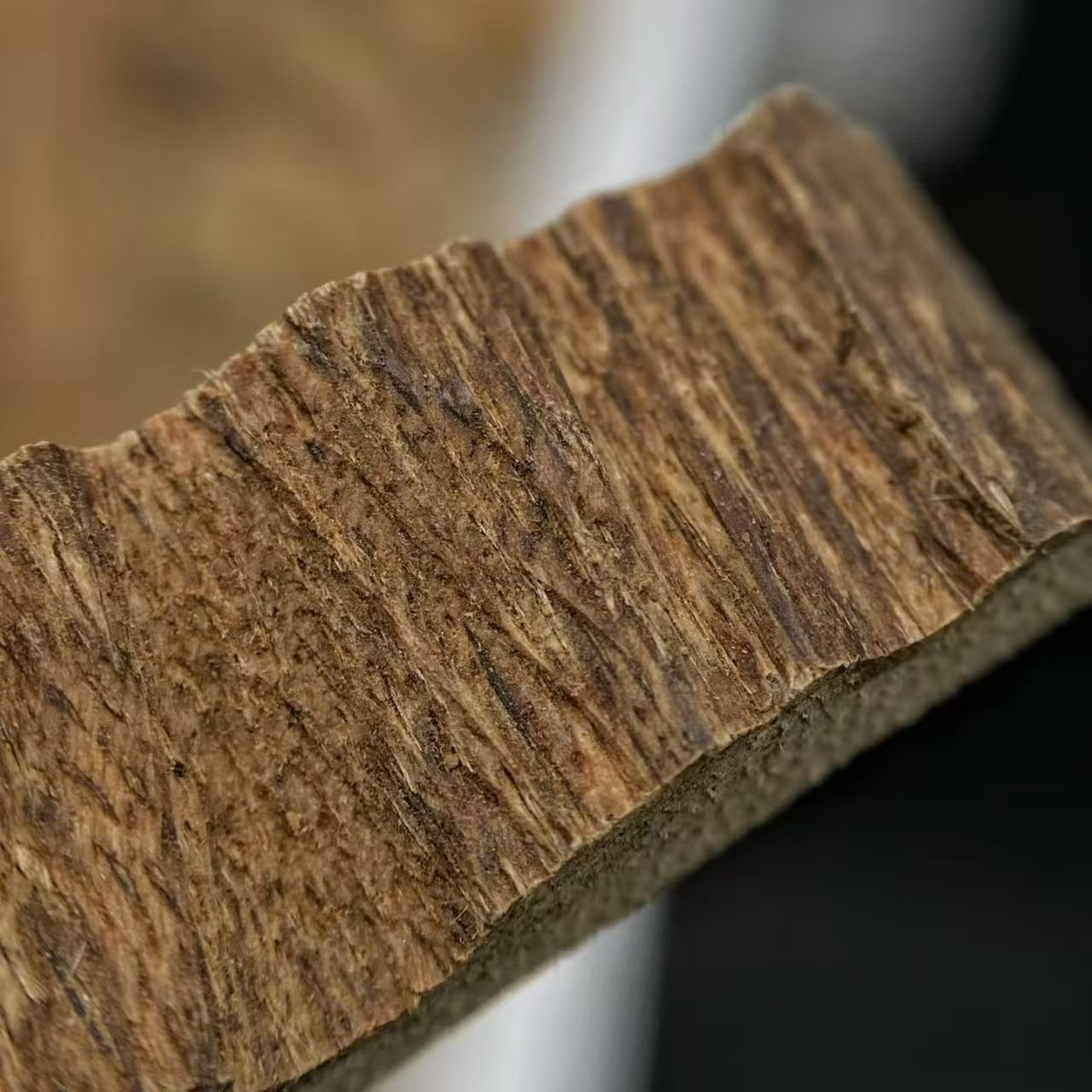
Agarwood Raw Material Specification Comparison Table
Use this table to decide which items must be written into a quotation for each form. It deliberately contains no universal size ranges, moisture figures or resin percentages: those depend on species, source, batch and supplier, and any number printed here would be invented. The right values are the ones you and your supplier measure on a real lot.
| Form | How it is typically produced | What it decides in your process | Items to fix in writing | Where sourcing risk sits |
|---|---|---|---|---|
| Chips / fragments | Cut to a target piece range from trimmed wood, block offcuts or sorted stock | Whether pieces stay visible and separate; how the material feeds a mill; how a retail pack reads | Piece size range and thickness, share below the target size, visible foreign matter, moisture basis, net weight per unit | Size quoted only as “small” or “large”; photographs taken from a better lot than the one offered |
| Shavings | Planing, slicing, sawing or shaping; frequently a by-product of another production job | Bulk density and bag fill; dust generation; how quickly thin material heats and dries; dosing in a blend | Sliver thickness and length limits, full fraction split by mass, fines definition and method, cleanliness, compression and packing | Form name treated as a grade; silent shift when the upstream job changes; dust bought at wood price |
| Granules | Cut or crushed to a smaller, blockier profile than slivers | Flow and dosing consistency; segregation in transit; behaviour in a mixer | Screen openings in millimetres, oversize and undersize limits, measurement method, fines share | “Mesh” quoted without an opening size; material separating so the top of the bag differs from the bottom |
| Powder | Milled and screened to a stated fineness | Dispersion in a binder, surface finish of the finished stick or cone, dust control on the line | Sieve convention and permitted oversize, flow and clumping behaviour, moisture condition, packaging barrier | Fineness given as one mesh number; a powder that disperses in one binder failing in another |
Read the table as a list of questions, not a ranking. No form is intrinsically more aromatic, and the same source wood can become chips or shavings depending on the cut. If your process decision is still open, the site’s chips vs granules vs powder comparison covers the three forms that already exclude slivers, and how to specify agarwood chip particle size covers the measurement language in more depth.
Agarwood granules vs powder: when slivers are not the answer
If your line needs a small, free-flowing piece rather than a long sliver, the relevant comparison is agarwood granules vs powder, not chips vs shavings. Granules are dosed by volume and tend to segregate in transit, so the oversize and undersize limits matter more than the average size. Powder is defined by what passes a screen, so dispersion in your binder becomes the deciding property. Both can be quoted against the same base material, and both need their own trial before a bulk order.
Start from your process, then choose the form
If pieces must stay visible and separate
Bakhoor blends, sampling sets and retail packs are judged partly by what the customer sees. Slivers interleave and compress, so a pack filled by weight with shavings can look sparse and settle into a flat layer, while chips hold volume and read as distinct pieces. In that case chips are the form to specify, and the sliver form is a cost decision you probably cannot take.
If the material disappears into a blend or a mill
Once the wood is going to be ground, blended or burned as bulk fuel for a process, the visible shape stops mattering and the fraction split takes over. This is where agarwood shavings for incense production and similar blended applications can be excellent value, provided you know how much of the bag will pass your working screen and what that passing fraction is worth to you. Two conditions apply. First, the dust and fines share must be measured, not described. Second, the material must be clean, because thin slivers are hard to inspect piece by piece and foreign matter hides easily among them.
If you mill in-house, compare routes rather than products
Buying coarse material and milling it yourself is a make-or-buy decision, and it has to be costed as one. On one side: the landed cost of chips or shavings plus your milling labour, power, dust extraction, floor losses and the value of the powder you cannot sell. On the other: the delivered price of ready-milled powder from the same source. Buyers regularly assume in-house milling is cheaper because the input price is lower, then discover that their losses, dust handling and slower throughput consume the difference. Run the arithmetic on a trial lot before committing a container — and note that this is a process question, not a claim about which supplier is better.
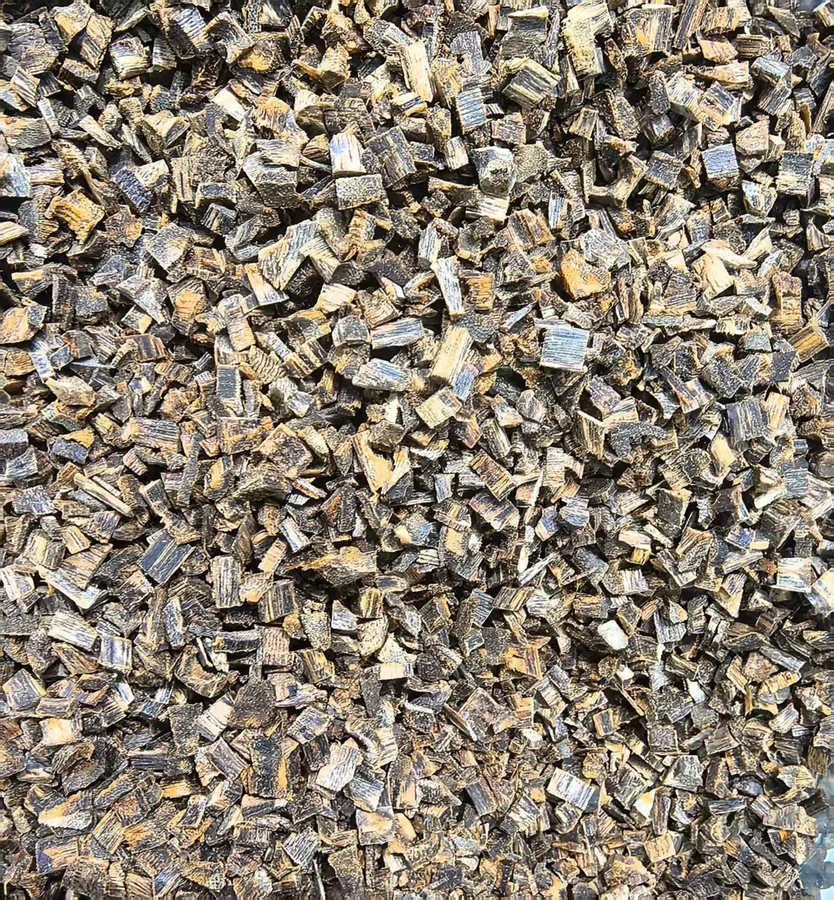
The mass-balance test: what a kilogram actually contains
Most form disputes come from a single number being quoted where a distribution is needed. A “fines percentage” tells you how much material sits below one opening; it says nothing about how the rest of the lot is spread. Run a mass balance instead.
Take a representative portion of the offered lot, weigh it, and pass it through a stack of two or three screens whose openings bracket your process limits. Weigh what is retained on each screen and what passes the finest one. Everything must add back to the starting mass, apart from a small handling loss you record separately. Then assign each fraction a use: premium pack, standard blend, mill feed, or reject.
| Fraction (illustrative only) | Share of mass | Possible use | Cost consequence |
|---|---|---|---|
| Retained on the coarse screen | Hypothetical figure | Visible-piece packs, bakhoor blending | Highest value per kilogram if the pieces are clean and presentable |
| Middle fraction | Hypothetical figure | Main production feed | The fraction your specification should be written around |
| Passing the finest screen | Hypothetical figure | Powder route, or loss | Paid for at wood price; value depends on whether you can sell or use it |
The numbers in that table are placeholders on purpose. Fill them from your own sieve test, because there is no defensible universal loss rate for bulk agarwood shavings and any published percentage should be treated as marketing. Once the split is measured, the comparable figure is:
Cost per usable kilogram = (material + screening or handling + packing + freight + duty and compliance + inspection) ÷ usable fraction
A single worked illustration, with invented numbers, shows why the cheapest bid can lose: a lot quoted at 100 per kilogram with 80 percent usable costs 125 per usable kilogram before freight; a lot at 110 with 92 percent usable costs about 120. The higher quotation is the better material. Your own measurements decide which case you are in.
Sampling: same conditions, different handling problems
A sample only means something if you know what it represents. Ask any prospective supplier how the sample was drawn, from which production run or container, and whether the order will come from that same material. If the answer is “a later run”, treat the sample as a reference for form rather than an approval of your shipment.
Draw or request increments from several positions rather than one scoop at the surface, combine them, then reduce the combined sample representatively for testing and retention. The handling problem differs by form: chips can be hand-sorted, which invites a biased sample of the best-looking pieces; shavings interleave and stratify, so a scoop from the top can understate the dust at the bottom of the bag. Record how many increments you took, their approximate mass and where they came from.
When you compare two candidates, code the samples and run the same sieve openings, the same sample mass and the same observation time. Then run a small trial in your own process, because images and product names are the weakest evidence available. For an agarwood chips vs shavings comparison, keep species and source logic constant and vary only the form; changing both at once tells you nothing about either. Retain a labelled portion of anything you approve, in the packaging you expect to receive.
Reading a quotation: the six lines that change the comparison
A price per kilogram is not a purchasing cost. Before you rank bids on an oud wood shavings wholesale programme, check that each one contains the same six elements:
- Material basis. Which form, which production route, which species or source description, and priced on net weight or gross.
- Moisture basis. Whether the figure is as-received or oven-dry, when it was measured, and how the material is packed to limit pick-up in transit. Water is paid for at wood price.
- Screening basis. Which openings were used, what share was removed, and whether that screening is included in the quoted weight or charged separately. Screening you pay for twice — once in the price of the lot and again in your own labour — is one of the most common hidden costs.
- Packing. Net weight per unit, liner and moisture barrier, compression, labelling and pallet condition. Shavings settle, so a bag filled by volume can arrive looking full and weigh less than expected.
- Delivery and duty. Incoterm, where risk transfers, freight basis, insurance, and who handles import clearance and any species-related documentation.
- Inspection. Who checks the lot, when, by which method, and what remedy applies if it does not match the approved sample.
If a bid omits any of these, do not adjust it with your own assumptions. Ask for the missing line in writing and compare only completed quotations.
Screening a supplier on evidence that survives a second order
Identity and control. Match the company name on the quotation to the bank account, the export documents and the holder of any species-related permit. Trading companies are legitimate, but you need to know which party controls the material and the processing, because that party determines whether the next shipment repeats.
A quote that restates your specification. A credible reply from an agarwood raw material supplier repeats your form, size or screen basis, fines treatment, cleanliness criteria, moisture basis and packing. A price plus a photograph means the specification was not read.
Change notification. Ask what happens when the upstream production job that generates by-product shavings changes. A supplier who can describe the trigger for telling you, and for re-sampling, is easier to work with than one who promises permanent uniformity from natural material.
Custom screening as a capability, not a phrase. “We can screen to your requirement” is only real if the supplier can state the equipment, the openings used, the resulting fines level and the effect on price and lead time.
Species and trade compliance. Agarwood-producing taxa are regulated internationally. CITES working documents record that agarwood-producing taxa listed in Appendix II refer to Aquilaria spp. and Gyrinops spp. (CITES CoP20 working document, 2022), and FAO guidance notes that trade is permitted subject to permit requirements (FAO, CITES and sustainable forest management). Requirements depend on species, source, product form and route, so confirm the exact documents with your supplier, your broker and your national authority. A plantation origin does not by itself settle the question, and a product name certainly does not.
MOQ and lead time by stage. Ask what the minimum consists of and where the lead time goes: material allocation, processing, documentation or freight. A minimum that prevents a genuine trial is a reason to look for a smaller first lot, not a reason to skip testing.
Agarwood Shavings Supplier Evaluation Checklist
Score two or three candidates on the same sheet before you commit. A blank answer is a finding, not a neutral result.
| Area | What to verify | Evidence to keep |
|---|---|---|
| Sample | How it was drawn, which lot or run it represents, whether the order comes from the same material, and a retained portion stored as approved | Sample ID and date, photographs with a scale, written lot linkage |
| Specification | Form and production route stated; size or screen openings in millimetres; fines definition and limit; cleanliness criteria; moisture basis; measurement method for each | Signed specification sheet, your own repeat measurements on the same openings |
| Batch | How lots are assembled, expected variation between runs, trigger and notice for changes upstream | Lot records, previous shipment data, written change-notification commitment |
| Packing | Net weight per unit, liner and moisture barrier, compression, odour isolation, lot labelling, pallet condition | Packing specification, photos of an actual shipping unit, arrival weights on a sample of bags |
| Logistics | Incoterm, lead time by stage, document set, species-related permits, routing and transhipment risk, insurance | Quotation terms, draft documents, freight quote, broker confirmation |
| After-sales | Inspection window, defect definitions, who pays for re-screening or return, replacement availability, named contact | Written claim clause, remedy ladder, how a past dispute was resolved |
Common form-selection mistakes
- Choosing the form from a price list. The form must fit feeding, blending, packing and burning. A cheaper sliver that will not run on your line is the most expensive material in the comparison.
- Assuming shavings are simply “smaller chips”. They differ in origin, geometry and dust behaviour, and they need their own specification.
- Quoting one fines figure instead of a distribution. A single number cannot show where the usable mass sits.
- Forgetting that by-product supply follows someone else’s schedule. Consistency depends on the upstream job, not on your order.
- Comparing a milled price with a coarse price. In-house milling carries labour, power, dust control and losses that belong in the comparison.
- Leaving inspection to the port. Define the inspection point, sample size and remedy before the container is loaded.
What NanjaOud currently lists, and what that means for a shavings brief
Precision here protects both sides. Our published raw-material range covers agarwood raw materials and chips, including irregular wood fragments and small and large chip formats described as suitable for incense burning, blending, repacking and further grinding, plus incense-grade agarwood powder milled for stick, coil and cone production. We do not publish a separate product under the name “shavings”, so we will not present any current item as a shavings SKU before the cut and geometry have been matched to a buyer’s brief and confirmed on a physical sample.
What the product information does show: the company is Jiangmen Nangjiaxiang Agarwood Development Co., Ltd., based in Jiangmen, Guangdong, with more than ten years of cultivation experience, a managed plantation base stated as over 160 acres (over 1,000 mu), its own processing facility, and a cultivation approach that does not use chemical agents to accelerate resin formation. Internal A, B and C labels, where they appear, are supplier references rather than a universal grading standard. For a buyer, that means the purchase decision should rest on an approved sample and a written specification rather than on a label or a form name.
Frequently asked questions
Are agarwood shavings the same as agarwood chips?
No. Chips are pieces cut to a target size and can be sorted and quoted by size range. Shavings are thin slivers, often produced as a by-product of planing, slicing or shaping, and they differ in bulk density, dust behaviour and how they settle in a bag. They should be specified and sampled separately even when both come from the same wood.
Which form should an incense manufacturer buy?
It depends on the step you are buying for. If the material will be milled and blended, a coarse form priced on a measured fraction split is usually the practical choice; if it must stay visible in a bakhoor or retail pack, chips are the form to specify. Test both on a small trial lot rather than deciding from a description.
How do I specify particle size for shavings?
Combine sliver limits with screen data: maximum thickness, maximum length, the openings used to measure fractions, and the permitted share passing the finest opening. Screen numbers alone describe slivers poorly, because a long thin piece can pass an opening while remaining awkward to dose. The same logic applies to agarwood chip particle size, where piece thickness often decides behaviour more than length.
What sample should I ask for before a bulk order?
Ask for a sample drawn from the lot being offered, with the drawing method and lot reference stated in writing, and confirmation that your order will come from that same material. Keep a labelled retained portion of anything you approve and store it in the packaging you expect to receive.
Is there a standard moisture figure for agarwood shavings?
There is no universal figure that applies across species, sources and routes. Agree the basis (as-received or oven-dry), the method and the point of measurement, then apply the same method to the approved sample and to the arriving lot. Consistency between the two is more useful than an impressive single number.
What is a realistic MOQ?
It varies with how the supplier assembles a lot and with your trial needs, so no single figure is meaningful. Ask what quantity allows a representative sample and a real processing trial, and treat a minimum that blocks testing as a reason to start smaller.
Do agarwood shavings need CITES documents?
Agarwood-producing Aquilaria and Gyrinops species are listed in CITES Appendix II, and whether a specific shipment needs permits depends on species, source, product form and route. Confirm requirements with the exporting supplier, your customs broker and your national authority before ordering.
How do I compare a shavings supplier with a chips supplier fairly?
Normalise both to cost per usable kilogram using your own sieve test, then compare samples under identical conditions and check that each quotation states the same six elements: material basis, moisture basis, screening basis, packing, delivery and duty, and inspection terms. In any agarwood chips vs shavings comparison, price per kilogram alone cannot rank two different forms.
Conclusion
Choosing between agarwood chips and shavings is a geometry and process decision before it is a price decision. Cut-to-size pieces stay visible and repeatable; slivers offer value but bring dust, density and by-product variability that must be measured. Whichever form you choose, the winning method is the same: define the fraction split, sample the actual lot, run a small trial in your own process, and convert every bid into cost per usable kilogram before you negotiate.
Start from the end use — how the material will be fed, blended, packed or burned — then send NanjaOud your target form, sample requirement, the specification items you need confirmed, your expected purchase quantity and your destination market through the contact page. Our team can tell you which current cut options can be matched to that brief and which details still need to be verified on a sample before a quotation means anything.


