
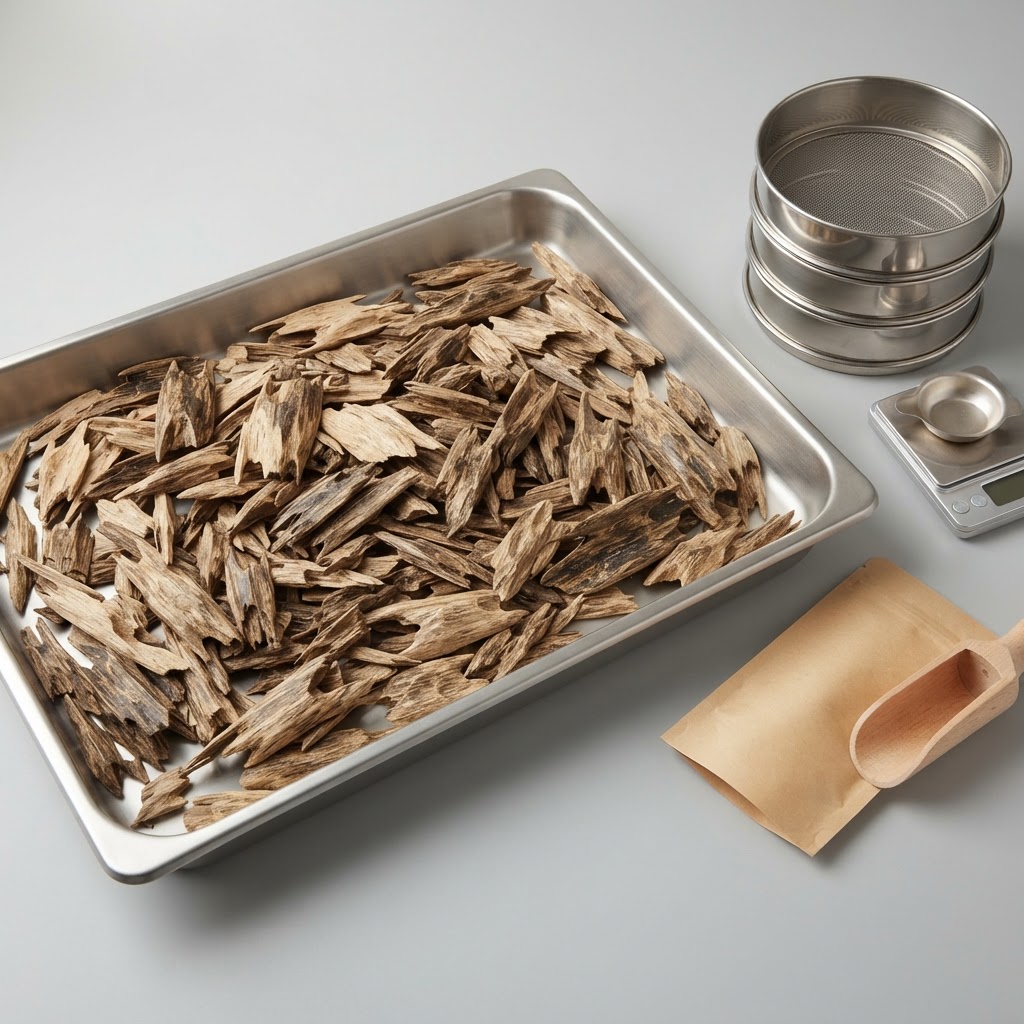
An agarwood shavings supplier is only as good as the specification your order is measured against. Because "shavings" is a form description rather than a grade, two suppliers can quote the same phrase and deliver different screen fractions, fines shares and moisture states. This guide gives importers, incense manufacturers and fragrance processors a goods-in inspection plan they can apply to any wholesale lot: define the form, fix the measured items, sample the lot properly, decide release on evidence, and compare every quotation as cost per usable kilogram.
What "Shavings" Actually Names — and What It Does Not
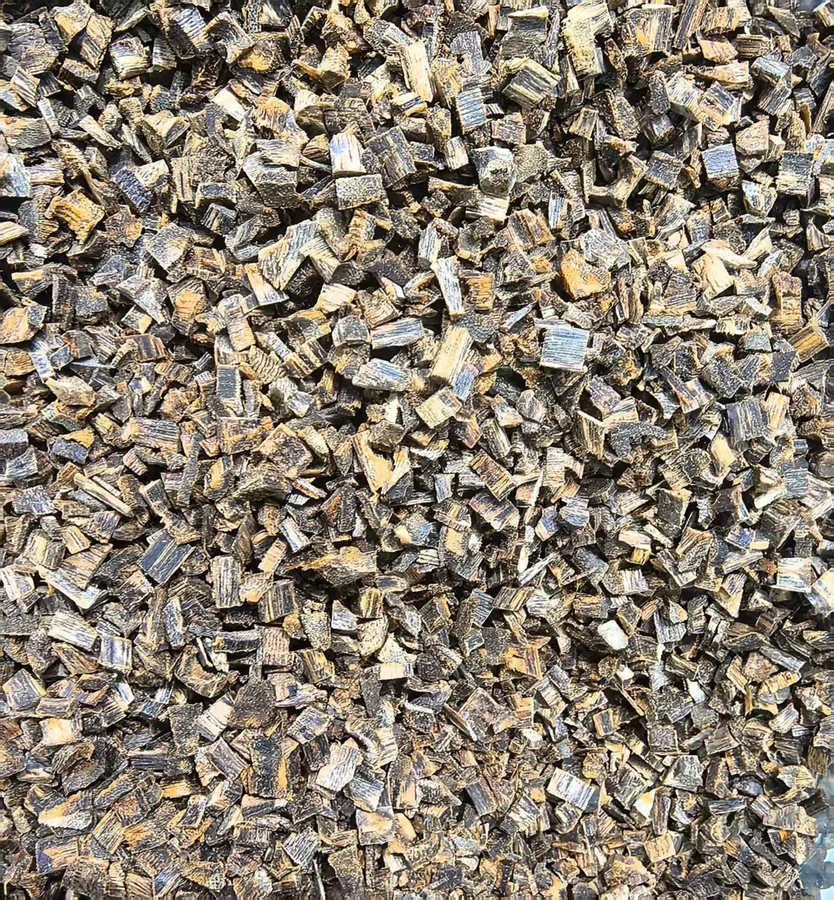
In the agarwood trade, chips, shavings, granules and powder describe how wood left a machine. They are not quality levels, and no international standard fixes the boundary between one form name and the next. A supplier's label therefore tells you something about their processing route, and very little about what will arrive in the bag.
Shavings usually come from planing, jointing or dimensioning: thin curls and slivers with a high surface-to-volume ratio and a low bulk density. Chips are cut or split pieces with visible faces. Granules are milled and then screened to a defined band. Powder is milled to a flour. The same wood, put through a different machine, produces a different product with different handling behaviour, different freight economics and a different usable share per paid kilogram.
This is why buyers searching for an agarwood shavings supplier, an agarwood granules supplier or bulk agarwood shavings are usually circling the same question from three directions: what physical form does my process need, and can this supplier describe it in numbers rather than adjectives?
Three words that sound like grades
Grade letters sit on top of form names, and that is where most confusion starts. A "Grade A shavings" lot from one supplier may match a "premium" lot from another, or match nothing at all. Internal grading is useful only when the buyer knows the criteria and the sample it refers to. At NanjaOud, A, B and C labels are internal supplier references and are not presented as a universal or international grading standard; final requirements are confirmed through the specification, the visual review, the quotation and an approved sample.
The difference between agarwood chips and shavings is mechanical rather than qualitative: a chip was cut or split, a shaving was planed or sliced. Neither word, on its own, says anything about resin content, aroma or price per usable kilogram.
Ask for the physical definition, not the trade name
Before price, ask four questions that turn a name into a specification:
- What produced it? Planer, chipper, hammer mill, pin mill or a combination — the tool decides the shape.
- Which openings did it pass and on which was it retained? Screen openings in millimetres, not "small" or "medium".
- How much passes the finest screen? That share is your fines, and it is usually the material you cannot use as intended.
- Is the lot one production run? A single run has one screen setting and one drying history; a blended lot does not.
Any agarwood shavings supplier who cannot answer those four points in writing is quoting a name, not a material. If you are still deciding between forms, the comparison of chips, granules and powder and the guide to writing a particle-size clause cover the selection logic in more detail. The point to carry into this article is narrower: whatever the form, it must be defined in measurements before it is priced.
Matching Form to Your Process
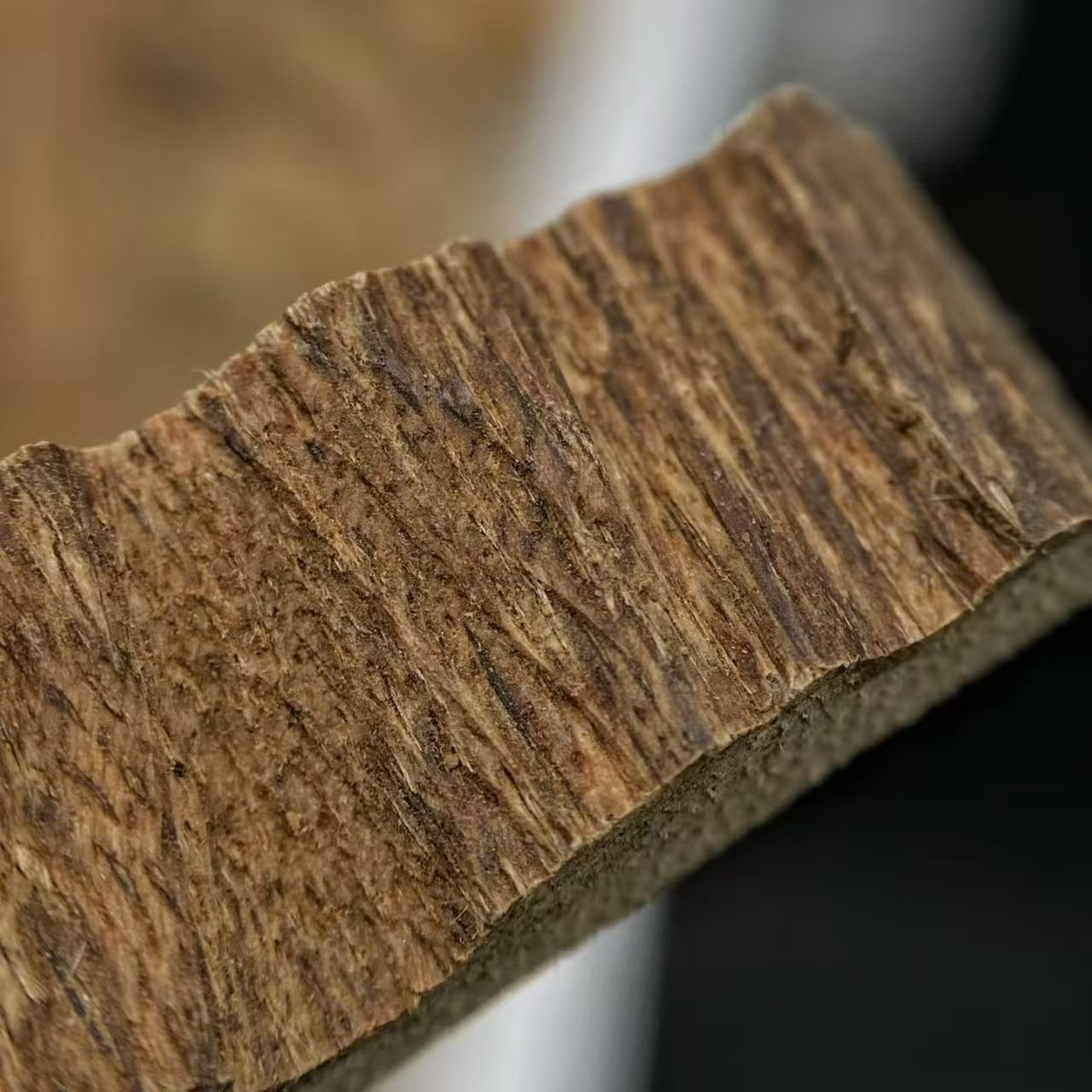
The costliest sourcing error is not an overpriced kilogram — it is a correctly priced kilogram your line cannot use at volume. Each process imposes its own constraints on piece size, dust and flow.
Direct burning and bakhoor
For burning, the buyer's real unit is a piece of a usable size: large enough to handle and to sit on a heat source, small enough to heat through. Very small fragments and dust tend to scorch quickly rather than release aroma gradually, so a lot with a high fines share can look generous on the scale and disappoint in the burner. Ask what share of the lot is retained on the coarse screen, not just what the average piece looks like in a photograph.
This is the most common way agarwood shavings for incense and bakhoor go wrong: the delivered lot passes a visual check but contains more dust than the sample that was approved, and the burner notices before the spreadsheet does.
Stick, cone and loose-blend manufacturing
Formulators care about how the material mills, blends and packs. Pieces that are too large may need pre-grinding, which adds a process step and losses; a high fines share may be acceptable or even welcome in a blend, but it changes the recipe and the fill weight. Powder handling brings its own problems: dust in the filling area, caking in humid conditions and weight variation at the packing head.
Distillation feed
Distillers generally prefer a consistent, free-flowing feed and often screen out fines before loading, because fines can compact inside the still and change how steam moves through the charge. Whether that matters for your operation is a question for your own trial, not for a supplier's brochure.
Agarwood Raw Material Specification Comparison Table
| Form (typical catalogue name) | What it usually is | Spec items to confirm before quoting | Process fit worth testing | Common purchasing risk |
|---|---|---|---|---|
| Chips / large pieces | Cut or split wood pieces with visible faces, irregular in shape | Piece size range, oversized share, bark and pale-wood share, moisture basis, grade criteria | Direct burning, distillation feed, carving, repacking | Grade letter quoted as if international; oversized pieces counted as usable but unsellable in small formats |
| Shavings | Thin curls and slivers from planing or dimensioning; low bulk density, high surface area | Curl thickness, screen band, fines share, packed density, moisture, bag compaction | Burning, blending, milling feed, sachets | Volume bought against weight paid — light material fills a container, so freight per kilogram rises; fines migrate to the bottom of the bag |
| Granules | Milled material screened to a defined band | Band definition (for example 2–5 mm), undersize and oversize share, dust share, batch-to-batch uniformity | Stick and cone formulation, sachets, metered feeding | "Granule" without a band is just a word; two suppliers, two products |
| Powder | Milled to a flour-like consistency | Mesh or particle size, dusting behaviour, moisture pick-up, agglomeration | Incense formulation, bakhoor paste, aromatic blends | Caking in transit, dust losses at filling, weight variation per unit |
The table is deliberately about what to verify, not about which form is "better". A form that suits a bakhoor producer can be the wrong purchase for a stick manufacturer, and neither form implies anything about resin content or aroma until the lot has been tested.
The Specification Items That Decide Acceptance
Screen fractions and fines share
Write the screen test into the specification in a way both parties can repeat: a composite sample mass (2 kg is a workable default), a stated sieve stack, the agitation method and time, and a report as percentage retained by mass on each screen. Name the sieve standard if you want a common reference — ISO 3310-1:2016 sets technical requirements and test methods for test sieves of metal wire cloth — and state whether sieving is by hand or machine, because the result will differ.
Then set a band, not a wish: for example, "minimum 85% retained between 5 mm and 20 mm, maximum 8% passing 2 mm". Agree what happens outside the band — price adjustment, re-screening at whose cost, or rejection.
Moisture state
Water is bought at the price of aromatic wood, so moisture needs a number and a method. Record two figures: as received, and on a dry basis after an agreed drying regime. Resin-rich material can behave awkwardly in a simple oven test, so the temperature and time have to be agreed rather than assumed, and the same method applied to the approval sample and to every arrival. Moisture also drives mould risk in a container and weight loss in storage, which is why the clause belongs in the purchase order rather than in a conversation. The moisture clause is covered in more depth in this guide to moisture content.
Foreign matter and uniformity
Define what counts as a defect before you find one: bark, pale non-resinous wood, grit and sand, fibres, plastic or string, insect damage, and pieces outside the agreed size band. State an allowed percentage by mass for each class and the inspection method used to measure it. Uniformity is a separate check: open bags from the top, middle and bottom of the pallet stack, because fines and small pieces settle downward during transport and the first bag you open is rarely representative.
Packing, unit weight and the retained sample
Packing decides whether the weight and condition you bought survive the container. Fix the sack type and liner, the net weight per unit, the closure, whether a desiccant is used, the pallet pattern and the label content — including the lot code that ties the bag to the sample you approved. Gross versus net weight should be stated explicitly, because the difference across a container load is not trivial. Packed density and freight cost explains how the same net weight becomes a different freight bill once bulk density changes.
Sampling: Making One Bag Tell the Truth About Five Hundred
A sample is only evidence if it represents the lot. Start by defining the lot in writing: one production run, one screen setting, one drying batch. If a supplier cannot name the lot a sample came from, the sample proves that a good bag exists — not that your order will contain good bags.
A workable default that a QC team can adopt and both parties can sign:
- Bag coverage: open at least the square root of the bag count, rounded up, with a minimum of five bags and a maximum of twenty per lot.
- Increments: take several small increments from different depths in each opened bag rather than one scoop from the surface.
- Composite and split: combine the increments, quarter them down to a composite sample, then split into a testing portion and a sealed retained portion.
- Retention: keep the sealed retained sample, labelled with lot code and date, until the claim window you agreed has closed.
- Trial lot: run 20–50 kg through your own process before committing to bulk. A burn test or a small production run on your equipment outranks any photograph or grade name.
When you ask a prospective agarwood shavings supplier to send material, ask for increments rather than a curated handful, and ask which lot they came from. The discipline of coding samples and recording what was approved is set out in this sample approval protocol; the same method applies whether the material is called shavings, fragments or granules.
Goods-In Release: A Decision With Four Possible Outcomes
Inspection without a decision is paperwork. Give the receiving team a gate sequence and four outcomes: release, release with a price concession, hold pending re-check, or reject.
- Documents: invoice, packing list, permit and certificate details agree with each other and with the goods.
- Weight: net weight per bag and per pallet against the packing list, plus total.
- Condition: bag integrity, moisture staining, odour of mould, contamination visible on opening.
- Screen test: composite sample through the agreed stack; percentage retained per screen.
- Moisture: as received and dry basis, same method as the approval sample.
- Visual and foreign matter: defect classes counted against the agreed limits.
- Process trial: a burn or small production run, observed and recorded.
Record the results on one sheet, sign it, and send a copy with any claim. A claim that arrives with screen percentages, moisture figures and photographs of labelled bags is a different conversation from one that arrives with an opinion.
Reading a Quote: Convert Every Offer to Cost per Usable Kilogram
Prices per kilogram are not comparable until they are expressed per usable kilogram. The conversion is simple and worth doing for every bid:
Cost per usable kg = (goods + freight + duty and clearance + screening or reprocessing + disposal of rejects) ÷ (net kg × usable share)
Usable share is 1 minus the fines you cannot use and the share you reject. A lot with a lower headline price and a high fines share can cost more per usable kilogram than a cleaner, dearer lot — and it also consumes more of your own labour.
In agarwood shavings wholesale, most quoted figures assume a particular screen band and moisture basis that the buyer never sees. Bulk agarwood shavings orders should be compared only after both bids have been restated on the same band, the same basis and the same delivery term. Beyond the formula, four items change the comparison: how bulk density affects container utilisation, whether export and import documentation is included or billed separately, which currency and payment terms apply, and whether lead time is counted from the purchase order or from permit issuance.
When a bid looks unusually low, ask what form and what screen band it refers to. A lower price often describes a coarser or dustier material, not a discount on the same product.
Screening an Agarwood Shavings Supplier
Identity, entity and form
Match the legal entity on the quotation, the bank account and the holder of the export permit. Then confirm the form: an agarwood raw material supplier whose catalogue lists "wood fragments" or "small chips" is not automatically offering shavings, and a buyer who assumes the words are interchangeable will receive whichever form the warehouse happens to hold.
Sample-to-order consistency
The most useful test of a supplier is not the first sample but the third order. Ask how the approved sample is linked to production: is the retained sample kept, is the lot code recorded, and what happens when a new production run cannot match it? An agarwood shavings supplier who can describe that process is usually one who can repeat a shipment.
Claims, tolerances and remedy
Put the tolerance bands, the inspection method, the claim window and the remedy into the purchase order. Agree in advance whether out-of-band material is re-screened, price-adjusted or returned, and who pays freight on a return. This is the clause that decides whether a dispute is a short email or a write-off. Contract mechanics are covered in this guide to payment, inspection and claims.
Species and CITES documents
The agarwood-producing genera Aquilaria and Gyrinops are listed in CITES Appendix II, as reviewed in the CITES review of the two genera (CITES, 2022). In practice that means an export permit issued for the consignment, and documents that describe the goods consistently: species, form, quantity in kilograms, and the importer. Ask who holds the permit before you pay a deposit, and check that the commercial invoice describes the same form as the permit — a mismatch between "chips" on one document and "powder" on another is a customs problem, not a clerical one.
MOQ, lead time and change control
Ask what the minimum order is built from — a full production run, a packing unit, or a permit minimum — and get lead time broken into stages. Then ask what happens if you need a different screen band next quarter: is that a new production run, a re-screen, or simply not possible? Suppliers who can answer that question precisely are the ones worth a second order.
Agarwood Shavings Supplier Evaluation Checklist
| Check | What to request | Pass condition |
|---|---|---|
| Sample | Lot-linked sample with lot code, screen data and moisture figure; sealed retained portion | Sample matches a named production lot and can be re-tested by both parties |
| Specification | Written form definition, screen band, fines limit, moisture basis and method, defect limits | Every item is measurable and has an agreed pass/fail band |
| Batch | Lot code on bags, production date, single-run confirmation, retained sample per lot | Third order can be traced back to the same material logic as the approved sample |
| Packing | Sack type, liner, net weight, closure, desiccant, pallet pattern, label content | Packed weight and condition survive the container; bag weight matches the packing list |
| Logistics | Incoterm, port pair, document list, lead-time stages, permit holder | Documents describe the goods consistently; lead time is quoted in stages |
| After-sales | Claim window, tolerance remedy, re-screen or return terms, contact for quality issues | Remedy is written into the purchase order, not promised verbally |
Five Mistakes That Cost the Most
- Buying a form name instead of a specification. "Shavings" is a description of a machine's output, not a promise about your order.
- Comparing price per kilogram without a fines share. The cheapest bid is often the dustiest one.
- Accepting a photographed handful as a sample. Photographs cannot be sieved, weighed or re-tested.
- Ignoring bulk density. Light material fills a container before it fills the weight allowance.
- Leaving the claim terms for later. A tolerance band without a remedy is advice, not a contract.
Our Material: What We Can Confirm
NanjaOud (Jiangmen Nangjiaxiang Agarwood Development Co., Ltd.) supplies wholesale agarwood materials to incense manufacturers, fragrance companies, wholesalers and importers. Our catalogue lists these materials as agarwood wood fragments and small agarwood chips — both irregular, natural wood pieces with visible grain, suitable for burning, blending, further grinding and incense-related processing — rather than under the name "shavings". If your specification uses the word shavings, tell us the physical definition you need and we will confirm what form the offered material actually is; we would rather correct the name than ship the wrong piece size.
What we can state plainly: more than ten years of agarwood cultivation experience and a managed plantation base of more than 160 acres in Jiangmen, Guangdong; in-house processing equipment; a cultivation approach that does not use chemical resin-induction agents; internal A, B and C grade references that are not presented as an international standard; and ODM and private-label coordination for international buyers. Our quality framework is built on material and format checks, weight and packing confirmation, and pre-shipment confirmation for the specific order — it is not a claim of a certified quality system or laboratory testing of every batch.
FAQ
Is agarwood shavings the same as agarwood chips?
No. Both are wood, but shavings are thin curls from planing or dimensioning while chips are cut or split pieces. They differ in bulk density, fines share and behaviour in a burner or a mill, so they should be quoted and inspected as different materials.
What particle size should I specify for shavings?
Specify a screen band rather than an adjective — for example the share retained between two stated openings plus a maximum share passing the finest screen. Name the sieve standard and the agitation method so both parties measure the same way.
How much sample should I ask a supplier for?
Enough to run your own test and keep a retained portion: typically 1–2 kg of composite material, plus a 20–50 kg trial lot before a bulk order if your process allows it. Insist that the sample carries the lot code it came from.
What MOQ is normal for wholesale agarwood materials?
Minimums are set by production runs, packing units and permit requirements, and they vary widely between suppliers. Ask what the figure is built from, and whether a smaller trial lot is available before a container-scale order.
How can I check quality without a laboratory?
Sieving, weighing, moisture measurement with a calibrated instrument, visual defect counting and a burn or production trial will catch most specification failures. Keep the records — a claim needs numbers, not impressions.
Can shavings be shipped internationally?
Agarwood materials move under CITES documentation because Aquilaria and Gyrinops are listed in Appendix II. Confirm that the export permit, invoice and packing list describe the same species, form and quantity before shipment.
Why is one quotation so much cheaper per kilogram?
Usually because it describes a different form, a wider screen band, a higher fines share, a different moisture basis or an incomplete document set. Convert both offers to cost per usable kilogram before deciding.
Do grade letters on shavings mean anything?
Only within the supplier's own system. Ask what criteria the letter refers to and which sample it describes; internal grades are not an international standard.
Conclusion
Choosing an agarwood shavings supplier is a measurement exercise. Define the form by how it was produced and which screens it passed, fix the fines, moisture, foreign-matter and packing clauses, sample the lot by a stated method, decide release on a signed record, and compare every bid as cost per usable kilogram. Do that, and an oud wood shavings wholesale programme stops depending on adjectives and starts depending on numbers — which is the only basis on which a repeat order can be built.
Start with the end use: what your line will do with the material, the form and screen band you need, the sample and trial quantity you want, your expected volume and your target market. Send those details through our contact page and we will confirm which of our actual materials fits — including whether the form you are asking for is one we supply under that name.


