
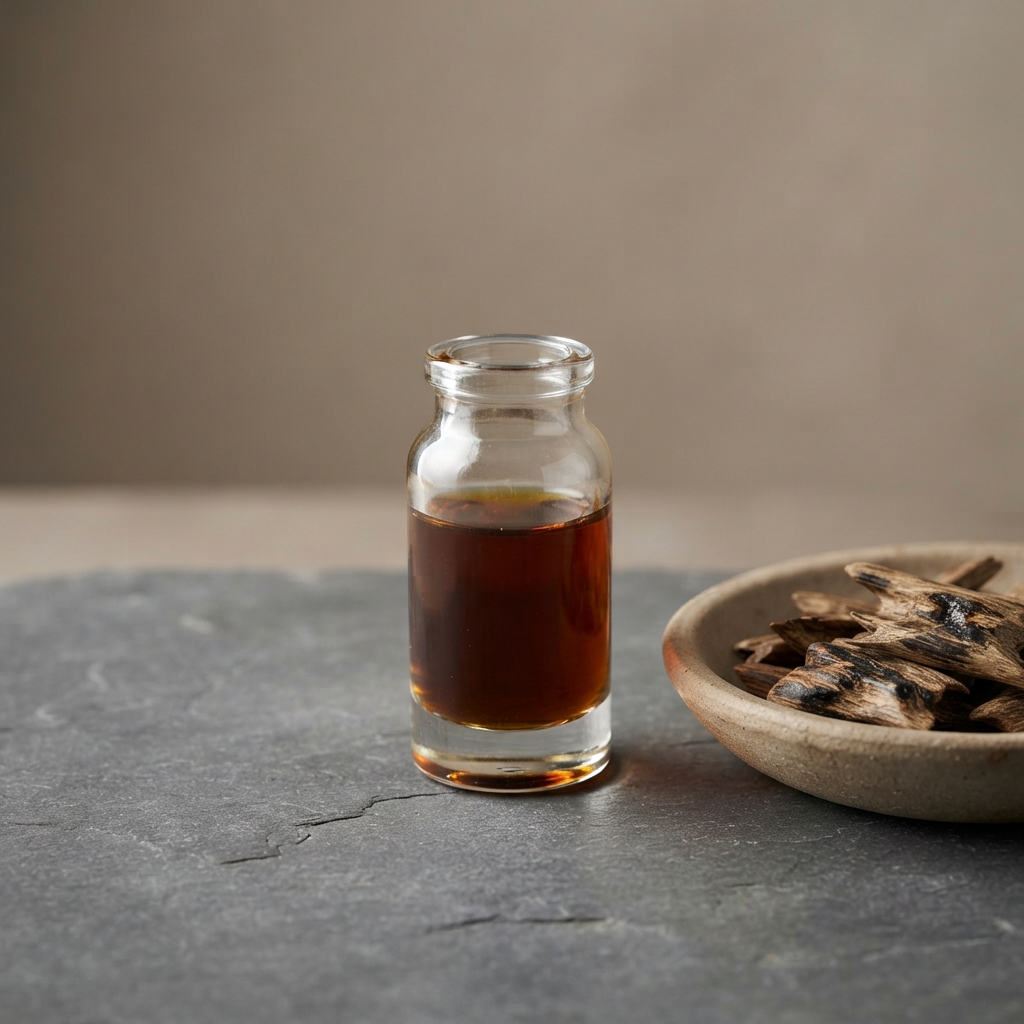
Pure oud oil wholesale is a commercial description, not a measured grade. In a workable contract it should mean one agarwood-derived oil, from a stated species and extraction route, with no added carrier, backed by a batch record that traces to your shipment. Turning that word into a specification the supplier must meet on every delivery is the buyer's job — and the checks below matter more than the adjective.
What Pure Oud Oil Wholesale Should Specify in Writing
"Oud oil" and "agarwood oil" are used interchangeably in trade. The name tells you which plant the material comes from, not how it was made or what else is in the bottle. Three different products travel under both names:
- Single-material oil — extracted from one agarwood species by one route and sold undiluted.
- Cut or extended oil — real oud oil blended with a carrier or another aromatic oil to reach a price point.
- Compounded fragrance — an oud accord built from aroma materials, containing little or no agarwood oil.
None of these is automatically dishonest, but they are not interchangeable in a formula and should not carry the same price. Ask every supplier to classify its offer in writing, then put the definition, species and extraction route into the purchase order. The naming question is covered in more depth in oud oil vs agarwood oil.
Why a Scent Description Cannot Prove Purity
Sensory evaluation is a screening tool, not evidence. A carrier can smell of very little and still carry a convincing top note; a small dose of genuine oil in a neutral base can read as "oud" to an experienced nose in a warm room; and the first ten minutes of a freshly opened sample rarely predict the dry-down. Nose fatigue sets in faster than most buyers admit.
Most oud oil adulteration is commercial rather than chemical: a legitimate oil extended with a carrier, or a modest quantity of real oil carrying a larger volume of blend. That is why price and paperwork sit at the centre of a purity check, and why a pure oud oil wholesale order should never be approved on the strength of a smell alone.
Use your nose for what it does well: comparing coded lots at the same dilution, on the same substrate, at the same time of day. Record what you smell and when. Then keep the paperwork that says what the sample actually was.
How Raw Material and Extraction Route Change the Purchase

Species, resin development and extraction decide yield, colour, viscosity and aroma profile, and therefore the price band you should expect. Several Aquilaria species and Gyrinops species are traded as oud; plantation-grown and wild-collected material differ in cost and documentation. Resin induction method also matters — ask whether resin formed naturally or was stimulated, and by what method.
| Extraction route | What it is | What to ask the supplier |
|---|---|---|
| Water or steam distillation | Steam passes through the wood; volatile oil is condensed and separated | Batch size, distillation duration, wood-to-oil yield, whether the oil is a first or later run |
| Supercritical CO2 | CO2 held above its critical point is used as the extracting fluid | Operating pressure and temperature, yields per batch, how residual CO2 is removed, equipment cleaning between lots |
A serious oud oil manufacturer can describe those variables for your specific lot without forwarding an email. Route names are marketing shorthand until you have a batch record behind them. For a fuller comparison, see steam-distilled vs supercritical agarwood oil.
Manufacturer, Wholesaler or Trader: What the Difference Costs You
A manufacturer owns or operates the extraction equipment and can explain a batch. A wholesaler holds stock and buys from producers. A trader intermediates and may never see the material. All three can serve you well, but only one of them can answer a technical question about your lot without forwarding an email.
Test the claim with three questions: who physically processed this batch, whose name appears on the export permit, and who owns the stock today. If the answers point to three different companies, you are buying through a chain — price it accordingly, and treat an agarwood essential oil supplier that cannot name its processor as a reseller until proven otherwise. Manufacturer vs trader sets out the document trail that distinguishes them.
Verifying Production Capacity Before You Commit
Capacity is not a number on a website; it is the volume a supplier can repeat without changing grade. Qualifying a bulk agarwood oil supplier means asking for monthly output in kilograms, the number of extraction units, the largest single batch produced in the last twelve months, and what changes about price and lead time if your order is five times the sample quantity. Then ask for a live video walkthrough of the extraction area while a batch is running, or a site visit.
Cross-check the answers against the supplier's own published process. A company that describes selection, processing, checking and delivery as separate steps, as NanjaOud does on its quality and supply page, should be able to map your order onto those steps.
The Sample and Document Pack to Request First
Ask for enough oil to run two evaluations plus a sealed reference, drawn from a named batch. Require the batch code, production date, species, extraction route and intended application on the label and in the covering email. Without a batch code, the sample cannot be tied to anything you buy later.
Oud oil for perfume manufacturing also has to be judged in your own formula: the same oil can behave differently in an alcohol-based fragrance, an oil-based attar and an incense blend. Say which application you are buying for, and ask the supplier to confirm the batch has been handled with that use in mind.
Alongside the sample, request: a safety data sheet, the batch record, any test report the supplier holds — and a clear statement of what that report covers and which laboratory issued it — plus the permits relevant to the shipment and a packing list that matches the invoice. Where a supplier holds no test report, that is information too; plan your own verification for high-value lots.
Designing a Sample Evaluation You Can Repeat
Code the samples so the evaluator does not know the supplier. Evaluate at the dilution and in the substrate you will actually use, side by side, in the same session. Score each sample on colour and clarity, viscosity, top note, heart, dry-down, intensity, off-notes and residue, and record the time of each observation. Keep a sealed retained sample of every coded lot, labelled with its batch code, in a cool dark place.
Half the value of this exercise is the record itself: when the second shipment arrives, you compare it to a sheet and a retained sample rather than to a memory, which is the only reliable way to test a pure oud oil wholesale promise twice. A practical log format is set out in wholesale agarwood oil sample evaluation.
Batch Consistency, Packaging and Storage
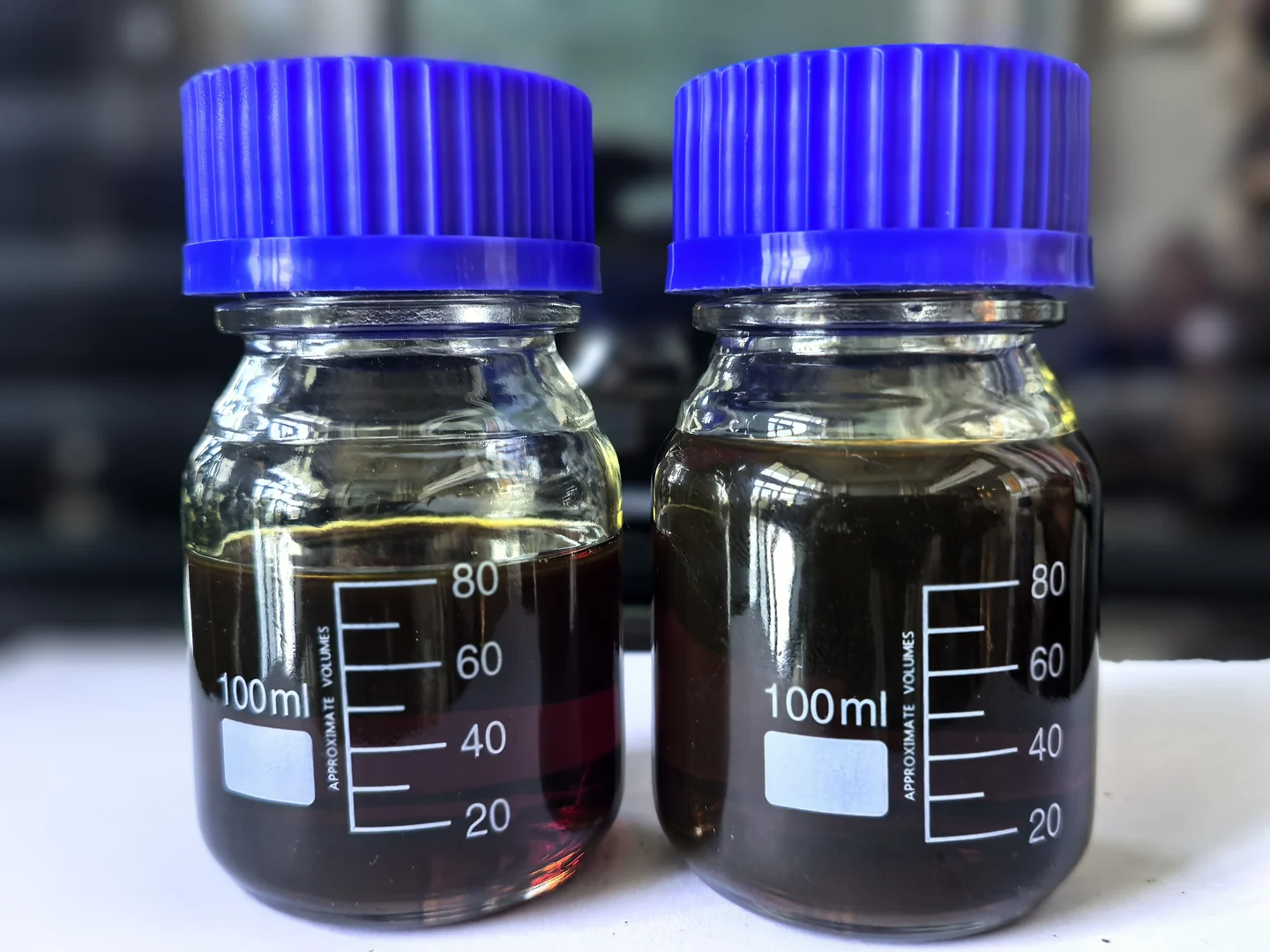
Write a batch specification with tolerance bands for colour, viscosity and sensory profile, and require a retained sample per batch. Consistency is proved across deliveries, not within one — which is why the repeat-order terms deserve the same attention as the first order. See the batch consistency checklist.
Oud oil is affected by oxygen, light and heat. Specify the container material, fill volume, headspace, seal and label, and for drums ask whether the headspace is flushed with inert gas. ISO 210:2023 sets out general requirements and guidance for essential oil packaging, conditioning and storage (ISO, 2023) — a useful reference when you write that clause.
What Actually Drives a Bulk Oud Oil Quotation
Species and resin grade, extraction route, batch size, container format, documentation, delivery term, freight and payment conditions all move the number. A pure oud oil price quoted without an Incoterm, a packaging format and a document list is not comparable to anything.
Ask for the quotation split into material, processing, packaging, documentation and freight, and convert every offer to landed cost per kilogram of usable oil at your delivery point. The method is worked through in bulk oud oil price.
Comparing Three Suppliers Without Being Anchored by Unit Price
Shortlist at least three oud oil wholesale suppliers and run them through the same process:
- Send the same written brief — use, target market, volume, packaging, documents required.
- Request the same sample size from a named batch, and evaluate blind.
- Normalise each quote to the same Incoterm, packaging and document set.
- Score lead time, retention of batch records and willingness to accept a pre-shipment sample as contract conditions.
- Discount any offer whose specification cannot be written down.
Documents by Destination and Intended Use
Three document families are usually in play, and they answer different questions. A safety data sheet describes hazards and handling; under the UN Globally Harmonized System it follows a 16-section structure, and the version you receive should match the destination market's rules. Label and ingredient requirements depend on whether the oil is sold as a cosmetic ingredient, a fragrance material or an incense input. Import classification and duty follow the form and presentation of the goods.
The third family is species-related. Agarwood-producing species — Aquilaria spp. and Gyrinops spp. — are listed in CITES Appendix II, so cross-border trade in specimens is subject to permit controls. Whether a permit is required for your oil, and which permit, depends on species, form and destination; confirm the position with the importing country's CITES management authority before you release a deposit. Do not accept a blanket statement that "all oud oil exports need one certificate" — or that none do.
MOQ, Custom Packaging and OEM/ODM
Minimum order quantities are set by production batch size, container fill and label or carton runs, not by negotiation style. Ask what the smallest viable production batch is, and what changes if you accept a standard container format. For private label, agree who owns the artwork, who approves the dieline, and which sample is the reference for the first run. OEM means the supplier produces to your written specification; ODM means you adapt an existing development. Say which one you are buying — the OEM and private label page explains the difference in program terms.
Lead Time, Logistics, Inspection and Claims
Break lead time into four clocks: raw material allocation, production, documentation, and freight. Ask for a date against each. Before shipment, agree a sealed retained sample, photographs of the packed goods and, for larger orders, the option of third-party inspection. Write the claim window, the evidence you will supply and the remedy ladder — replacement, credit or partial refund — into the order before production starts.
Oud Oil Supplier Evaluation Checklist
| Check | Evidence to request | Warning sign |
|---|---|---|
| Raw material source | Species name, plantation or wild origin, resin-induction method, harvest period | "Agarwood" with no species, or origin claims that change between emails |
| Sample performance | Coded sample from a named batch, evaluated at your use dilution | Sample arrives without batch code or production date |
| Batch records | Batch number, production date, quantity, retained sample | Records offered only after payment |
| Quotation terms | Unit, Incoterm, packaging, document list, validity period | Price per kilogram with no delivery term |
| Packaging | Container material, fill, headspace, seal, label content | Bulk drums with no liner or seal specification |
| Lead time | Dates for allocation, production, documents and freight | A single delivery date with no milestones |
| Verifiable documents | SDS, permits under the correct holder name, test report scope | Permits or certificates issued to another company |
Frequently Asked Questions
Is "pure oud oil" a legal grade?
No. There is no international grading system that certifies an oil as pure oud. It is a contract term, and it only has force once you define species, extraction, carrier status and batch documentation.
How can I tell whether oud oil has been diluted?
Not from smell alone. Compare coded samples at your use dilution, ask what the batch record and test report actually cover, and commission independent laboratory analysis at your own cost for high-value lots. Treat a price far below the market band for the stated species as a question, not a bargain.
Do I need a CITES permit for oud oil?
Possibly. Agarwood-producing Aquilaria and Gyrinops species are listed in CITES Appendix II, but the permit position depends on species, form and destination. Confirm with the importing country's CITES authority before you commit.
What MOQ should I expect?
It follows the smallest production batch the supplier can run plus the container fill and packing run. Ask for that figure directly rather than negotiating a number that the plant cannot actually produce.
Distilled or supercritical CO2 oil?
It depends on the application and the profile you approved. Judge both in your own formula at your own dilution; the route name alone does not tell you which will perform better for you.
How many samples should I evaluate before a bulk order?
At least two, drawn from different batches, so that you are testing consistency as well as quality — and keep one sealed as the reference for the first delivery.
Conclusion
Pure oud oil wholesale becomes a real specification when you can name the species, the extraction route, the batch and the documents behind a shipment — and when two different batches perform the same in your own application. Build that evidence into the sample stage, and the bulk order becomes a confirmation rather than a gamble.
NanjaOud supplies supercritical agarwood oil from Jiangmen, Guangdong, described on its agarwood oil page as a dark amber to reddish-brown oil positioned for fine fragrance, incense blending and home fragrance work, alongside agarwood raw materials and chips. The company states more than a decade of cultivation experience, a managed plantation base, its own processing facility and ODM and private-label support. For a pure oud oil wholesale enquiry, send your intended use, target market, estimated volume, packaging requirement and sample request through the contact page.


