
Short answer: ask for an identified sample of each route that is actually available, then test both in the intended fragrance product at the same evaluation level. Record extraction method, material description, dilution status, sample code, sensory observations, analytical documents available and behavior in the final base. A method name is useful for screening, but it is not a guarantee of scent, composition, authenticity or suitability for a particular market.
NanjaOud's public agarwood oil category presents oil supply directions, while its supercritical agarwood oil listing gives buyers a current product enquiry path. A public category label is not a lot-specific specification. Ask NanjaOud which distilled or supercritical material can be sampled for the actual brief, and what evidence accompanies that material. This guide is a comparison method for buyers, not a statement that the company has two interchangeable oils in stock.
Site implementation image used as a container reference. The photograph does not identify the extraction route, species, lot, purity or test result of the liquid.
What the route tells you, and what it does not
Steam distillation uses water vapor and condensation to recover an aromatic fraction. In agarwood commerce, buyers may also encounter the term hydrodistillation; it is worth asking the supplier to describe the process rather than treating all water-based labels as identical. Supercritical CO₂ extraction uses carbon dioxide under controlled pressure and temperature as an extraction medium. The resulting material may contain a different set and proportion of compounds from a distilled fraction.
A primary study on supercritical extract from Aquilaria sinensis analyzed constituents in a defined research sample. It supports a narrow point: extraction method matters to chemical characterization. It does not give a universal formula for every commercial agarwood oil, and it does not establish NanjaOud's composition. Likewise, published work on environmental interactions in supercritical agarwood oils reinforces that source material and processing conditions matter. Buyers should not transfer a research result from another species, origin or batch to a quotation.
Do not choose a method from the photograph. Dark color, viscosity in a glass vessel and a label saying “CO₂” cannot establish how the material was made. Request a method statement tied to the sample code. Ask whether the supplied item is a neat oil, an extract, a blend or a dilution, and what carrier or solvent, if any, is present. If an answer is commercially sensitive, agree on the minimum disclosure required for your formulation and market review.
| Buyer question | Distilled sample: what to record | Supercritical sample: what to record | Approval consequence |
|---|---|---|---|
| What is being offered? | Process description and sample identity | CO₂ process description and sample identity | Prevents a generic method label replacing a lot record |
| What is in the bottle? | Neat, diluted or blended status; stated additives | Extract, diluted or blended status; stated additives | Determines fair trial concentration and label review |
| How does it smell? | Opening, middle and drydown in a defined base | Same observations in the same base | Tests product fit rather than an abstract grade |
| What evidence exists? | Available batch document and method of analysis | Available batch document and method of analysis | Lets the buyer decide what remains unverified |
| Can it be repeated? | Reference sample and proposed supply lot | Reference sample and proposed supply lot | Connects development approval to procurement |
The table is a buyer worksheet. It sets no NanjaOud yield, composition, grade or price. A supplier may offer only one route for a particular enquiry; the buyer can still use the same fields to assess that offer.
Design a comparison that answers the formulation question
Start with the finished product: alcohol perfume, oil perfume, home fragrance, incense blend or another intended use. Write down the base, intended concentration range, market, scent direction and the decision you need to make. An oil that is appealing on a smelling strip can become too dominant, too faint or unstable in a formula. The product brief tells the evaluator what “better” means.
Prepare coded, dated samples and record the supplier's dilution statement. Compare like with like where possible. If one sample is neat and the other is diluted, a drop-for-drop trial is misleading. State the mass or concentration used and the carrier, and let a qualified formulator decide the trial level. Keep the base formula and maturation time the same during the first comparison. Do not change the accord, bottle and dosage together and then attribute the result to extraction route.
Evaluate the materials first on a neutral strip and then in the intended base. Note the opening, development and residual impression at stated intervals. Use descriptive terms tied to the brief: smoky, woody, balsamic, sweet or another note the panel can actually identify. Avoid assigning a “pure agarwood” verdict by smell alone. Different reviewers may disagree; preserve their notes and the sample codes rather than averaging them into a single quality number.
Next, observe practical behavior. Does the ingredient disperse in the chosen base? Is there haze, sediment or a change after a realistic holding period? Does the scent remain coherent with other materials? These observations are formulation trial results, not a stability certification. If a target-market claim or safety assessment is needed, agree on the appropriate testing and documentation with the responsible specialist before sale.
Site implementation image used only to show a liquid presentation. It is not evidence that the pictured liquid has a verified extraction method, composition or approved batch.
Ask for the right documents without assuming they exist
Request the identity and commercial description of the sample, the extraction-route statement, batch or sample code, any dilution or carrier declaration, and the documents required by your product and destination. Ask whether a certificate of analysis or GC–MS report exists for the actual offered lot, and what method and date it uses. ISO 7609 describes a general gas chromatography method for essential oils; mentioning the standard does not mean a supplier's report follows it or that a chromatogram alone proves origin.
If you receive an analytical report, compare its sample identifier with the bottle and proposed supply lot. Note whether it reports methods, peaks, relative areas and any interpretation. A profile can support comparison, but the test method and reference matter. A neat-looking chromatogram without traceability may not answer the purchase question. Ask for clarification before translating the report into a purity or authenticity claim.
Extraction method also does not settle legal or labeling classification. “Essential oil,” “CO₂ extract,” “natural,” and ingredient declarations can carry different meanings in different markets and product categories. The importer or brand should check applicable requirements for its destination and use. NanjaOud should be asked for the records it actually holds; the buyer should not presume a certificate, export document or regulatory approval from a product-page name.
Turn the preferred sample into an RFQ
An approval note should say which sample won, for which application, at what trial concentration and under what evaluation conditions. Attach the reference sample code and any unresolved questions. A supplier can then confirm the current material, feasible packaging and quotation terms. If the proposed shipment is a different batch, agree which identity, sensory and analytical comparisons are needed before accepting it.
Send an RFQ with the intended product, target market, desired route or reason for comparing routes, sample quantity, destination, expected order scale and required documents. State whether the formulation accepts a dilution or needs the material as supplied. Ask what is currently available for sampling and what can be specified in writing. The contact page is the appropriate path to discuss a specific NanjaOud offer.
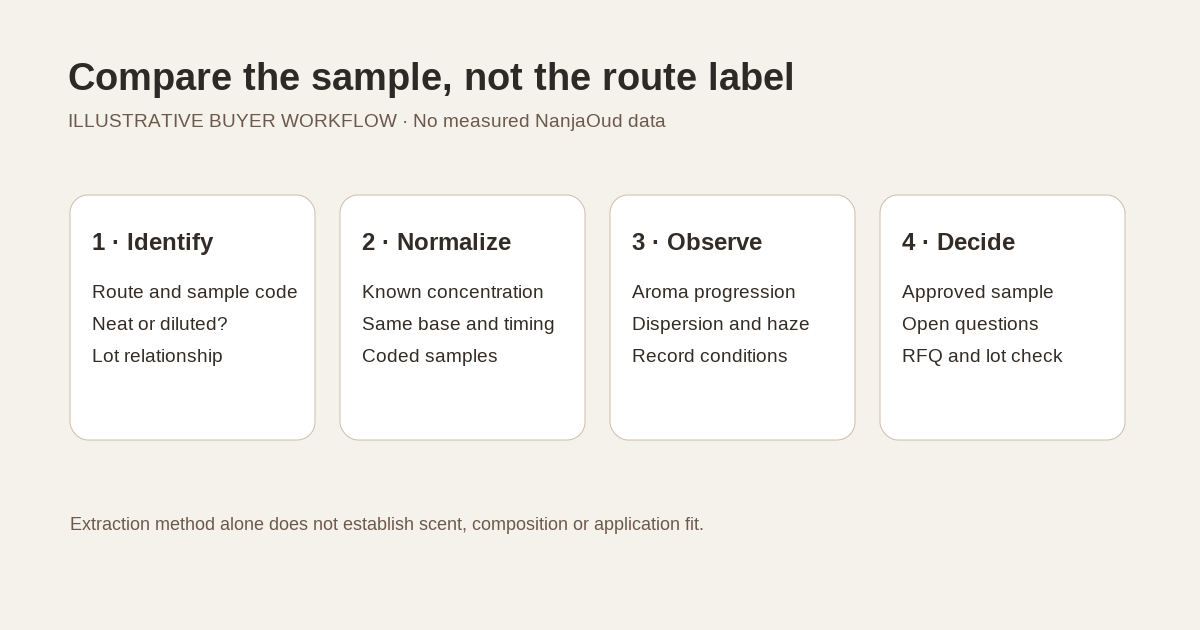
Illustrative workflow only; no measured NanjaOud extraction, chemical or performance data are shown.
Buyer FAQ
Is supercritical agarwood oil always stronger than distilled oil?
No universal ranking follows from the route name. The starting wood, process settings, dilution and evaluation base all matter. Test identified samples at a known concentration in the intended product.
Does a GC–MS report prove an agarwood oil is authentic?
It can provide useful analytical evidence if the sample and method are traceable. Interpretation needs an appropriate reference and competent reviewer; a report by itself does not prove species, origin or commercial purity.
Can I use the same approval for perfume and incense?
Only after separate application trials. Heat, solvent, base ingredients, dosage and the buyer's sensory goal differ. Keep the reference sample, but record a distinct decision for each use.
What if the supplier offers only one extraction route?
Ask for the available sample's exact identity, method description and documentation. You can still evaluate its formulation fit and request a written specification instead of demanding a comparison that the supplier cannot supply.
Which route should appear in my RFQ?
Name the route if it is a genuine requirement. Otherwise describe the application and acceptance trial, and ask the supplier to identify the offered route. Tie any award to an approved sample and documented supply item.


