
Species and origin are the two oud chips claims that decide price, legality and repeatability — and the two most buyers never verify. A working rule for B2B buyers: treat species as a botanical fact that belongs in the CITES permit and the specification, and treat origin — planted or wild, region, tree age — as a supply-chain claim that needs lot records rather than adjectives. This guide shows which claims an oud chips manufacturer can actually prove, which are conventional trade language, and how to write both into an RFQ you can enforce.
Why species is a document question, not a tasting note
Agarwood is not one material. It is the resinous heartwood of several species in two genera, Aquilaria and Gyrinops, and the trade names "oud" and "agarwood" apply to all of them. Botanically, Aquilaria is native from Assam across southern China to New Guinea, and Aquilaria malaccensis alone ranges from Bangladesh through western and central Malesia (Royal Botanic Gardens, Kew, Plants of the World Online).
That matters commercially because every species in both genera is listed in CITES Appendix II. The listing covering all Aquilaria and Gyrinops species was approved at CoP13 in 2005 (CITES CoP19 Inf. 12), so an export permit is required and that permit names the species. A quotation that says "Vietnamese oud" or "Cambodian agarwood" describes a country, not a species, and a country cannot fill the species field on a permit.
So the first question to an oud chips manufacturer is not "where is it from" but "which species is on the permit, and does my invoice use the same name".
The four groups of material you will actually be quoted
Most quotations you receive will fall into one of these four. The ranges below are botanical; the plantation supply column describes where commercial volume commonly comes from, not a quality ranking.
| Species group | Native range | Where plantation supply commonly comes from | Ask before you accept a quote |
|---|---|---|---|
| Aquilaria sinensis | Southern China, including Guangdong, Hainan and Guangxi | Chinese plantation material | Is the lot from the supplier's own plantation or bought in? Which province? |
| Aquilaria crassna | Indochina — Thailand, Cambodia, Vietnam | Vietnamese, Cambodian and Lao plantations | Is it plantation-grown, and is the species named on the export permit? |
| Aquilaria malaccensis | Bangladesh to western and central Malesia | Malaysian, Indonesian, Indian and Bangladeshi supply, with heavy restrictions on wild harvest | Is the material plantation-grown? What harvest basis applies to this lot? |
| Aquilaria filaria and Gyrinops spp. | Eastern Indonesia, Papua New Guinea | Papuan and eastern Indonesian supply, often wild or mixed lots | Which species exactly, and can the permit state it? |
Species names are botanical; the scent words sellers use — sweet, balsamic, animalic, medicinal — are trade convention, not species standards. Two lots of the same species from different plantations can smell quite different. Species narrows the field; the sample decides the purchase, which is why a lot-linked sample approval protocol belongs next to any species claim.
Planted versus wild: what actually changes for you
Wild agarwood is the material the trade romanticises and the material regulators worry about. The IUCN Red List assesses Aquilaria malaccensis as Critically Endangered in the wild, and the Appendix II listing exists precisely because harvest pressure on wild populations is high. The planted vs wild agarwood question is therefore settled by records, not by adjectives. Three practical consequences follow for a buyer:
- Legality is a paper chain, not a story. Wild-origin material needs a harvest basis the exporting country can defend; plantation material needs plantation records. Ask which basis applies to your lot, in writing.
- Consistency comes from plantations. A managed plantation can supply graded, repeatable lots. Wild supply is opportunistic and varies piece to piece, which is difficult to build a retail range on.
- The "wild" premium is a claim until it is documented. Wild material is often priced higher for character. Unless lot records support the claim, you are paying for an adjective.
None of this makes plantation material inferior. It makes it specifiable. What a buyer of wholesale oud chips gives up with plantation supply is unpredictability — and most B2B programmes are buying the opposite of unpredictability.
What a manufacturer can prove — and with what
The useful distinction is between provenance, which documents can support, and material quality, which only tests and samples can support. Manufacturers routinely blur the two.
| Claim on the quotation | What can support it | What it still does not prove |
|---|---|---|
| Species | Species field on the CITES export permit; nursery or plantation records; lot sheet | That the pieces in the carton match the lot sheet — only inspection does that |
| Country or region of harvest | Permit country, phytosanitary certificate, shipping documents | That the wood was grown there rather than imported and re-exported |
| Planted or wild | Plantation records and harvest plan; type of harvest permit | Quality, resin content or tree age |
| Tree age or "old tree" material | Plantation planting records | Anything about an individual piece without a lot link |
| Natural resin formation, no chemical induction | Process records and a written induction statement | That no resin or oil was added after processing |
| Grade or resin percentage | Density test, laboratory extractive test, sealed reference sample | That the next lot was graded by the same method unless you repeat the test |
Read the table down the middle column: the documents prove where the material came from, and only measurement proves what it is. Ask any oud chips manufacturer for the lot sheet, not the brochure. One that can produce a permit but no lot sheet can tell you what species left the country; it cannot tell you what is inside the carton. The document families themselves — permits, phytosanitary certificates, test reports, and what each one actually covers — are set out in our guide to oud chips manufacturer certifications.
Writing species and origin into the RFQ
Five clauses turn the discussion into something enforceable. They are short enough to paste into a purchase order and specific enough that two oud chips suppliers cannot answer them with a catalogue page.
- Species statement. "Material shall be [species], as stated on the CITES export permit and the commercial invoice. Any substitution requires written approval before shipment."
- Origin statement. "Country and region of harvest: [X]. Grown or wild-harvested: [ ]. The supply basis is to be stated on the lot sheet."
- Traceability. "Each lot carries a lot number linking delivered cartons to the harvest and processing record supplied with the quotation."
- Consistency across repeats. "The species and origin declared for the approved sample apply to all repeat orders. A change of plantation, region or species is a change of specification and requires re-approval."
- Document consistency. "CITES permit, phytosanitary certificate, packing list and invoice describe the goods identically, with the species name spelled the same way on each."
Clause 5 is where shipments actually fail. A permit that names one species and an invoice that describes a different product creates a question at the border that no relationship survives intact. If the supplier is a trading company rather than the producer, that gap widens, which is why verifying the manufacturer in China belongs in the same file as the species clauses.
Approving the sample that matches the claim
Species narrows the field; the sample decides the order. Run three checks on a sample tied to a lot number, not on a "representative" bag sent separately from production:
- Physical check. Piece size and form, colour variation, visible resin streaks, moisture feel, foreign matter, and how much pale non-resinous wood is present.
- Burn check. Same piece weight, same heat source, same distance. Record the first minute, the middle of the burn and the residue, and note whether the aroma holds or collapses.
- Record. Photograph, weigh and seal the approved sample with the lot number, so an arrival dispute has a reference both sides accepted.
If a quotation names a species and the sample performs noticeably differently from the last approved lot of that species, treat it as a sourcing question before you treat it as a grading question. Resin content is the usual explanation, and it is measurable — the methods are covered in how to verify oud chips resin content. An oud chips manufacturer that resists a lot-linked sample is telling you something about how the bulk lot will be assembled.
Common mistakes
- Using a country as a substitute for a species, then discovering the permit needs a botanical name.
- Treating "wild" as a grade and paying a premium for an undocumented adjective.
- Assuming CITES paperwork certifies quality. It regulates trade, not resin content, grade or aroma.
- Accepting a permit whose species field does not match the invoice and packing list.
- Approving a sample with no lot number, leaving nothing to compare an arrival against.
- Letting a supplier switch plantation, region or species mid-programme without re-approval.
- Buying on a single lot's appearance from an oud chips manufacturer you have not verified, and assuming the next lot will be graded the same way.
How NanjaOud handles material origin
NanjaOud supplies agarwood chips from our own plantation base and processing factory in Jiangmen, Guangdong, backed by more than a decade of cultivation experience and a managed plantation base of over 160 acres. We work to natural cultivation standards and do not use chemical agents to accelerate resin formation. Supply is integrated from plantation through processing, and we support bulk supply and ODM programmes for B2B buyers in the Middle East, Southeast Asia, Europe and the Americas.
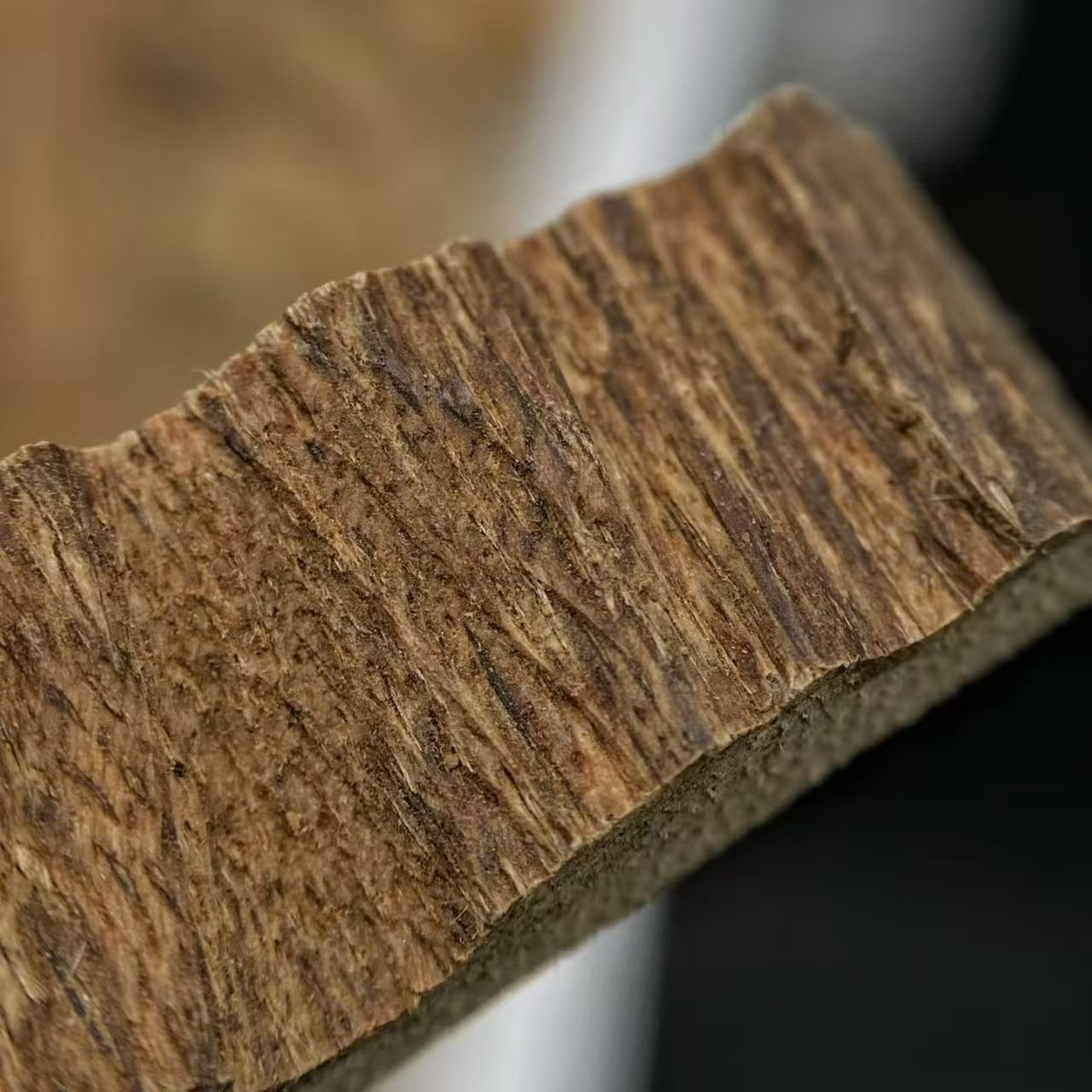
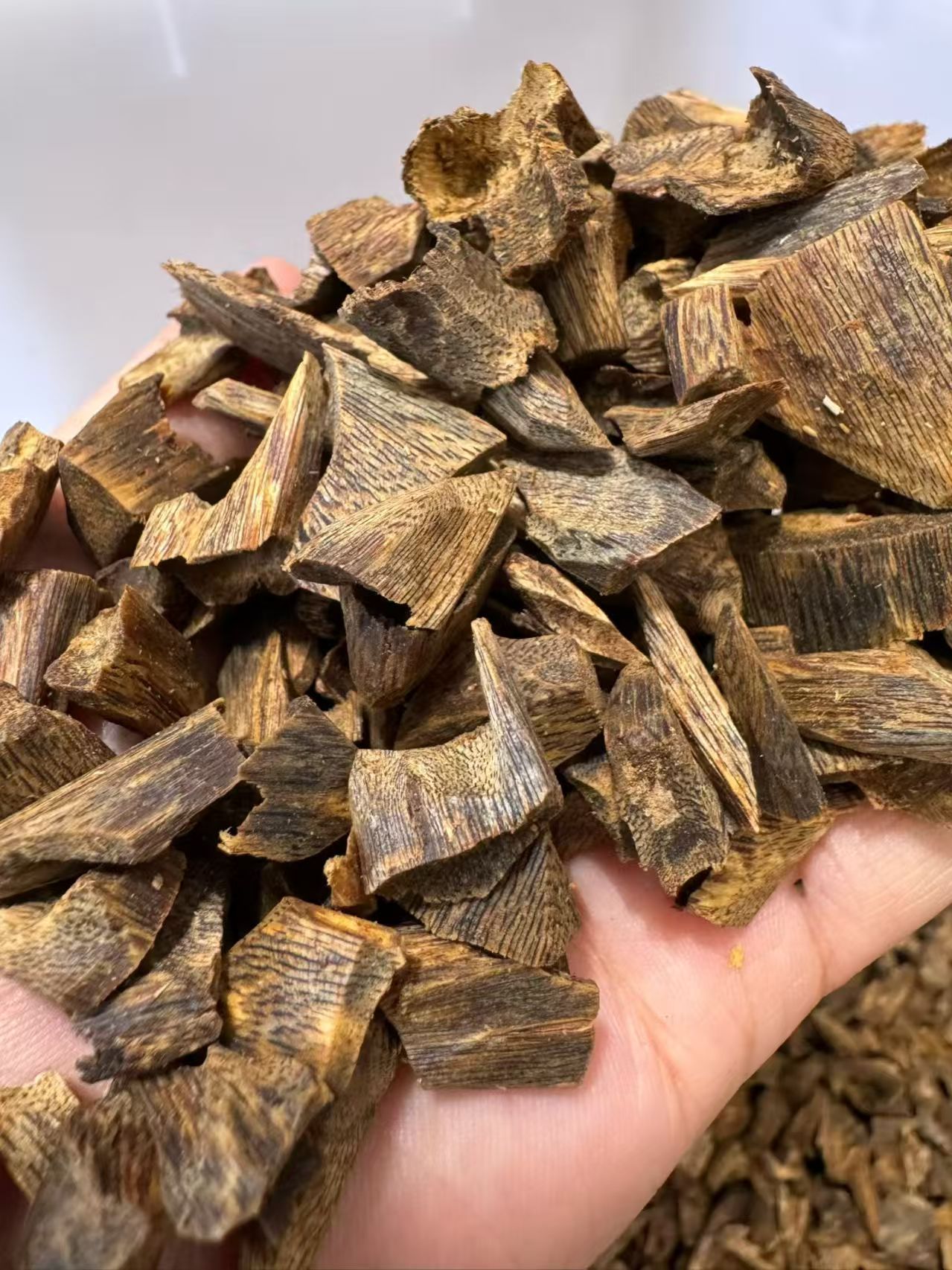
Two chip formats cover most buying briefs. Large agarwood chips keep a comparatively large, intact form with visible grain and resinous streaks, which suits buyers who need visually recognisable pieces for incense, display, further cutting or grinding and distribution. Small agarwood chips are processed into smaller irregular pieces that are easier to portion, blend, pack and repack, which suits incense manufacturing, blending, grinding, repacking and private-label work. Both formats are described on the agarwood raw materials and chips page, and the inspection and batch-check routine behind them sits under quality and supply. For brands building a repacked or private-label range from agarwood chips wholesale lots, the same chip specification and lot records carry into the finished pack.
If species and destination market matter to your programme — and for CITES-regulated material they usually do — put both in your enquiry, so the specification you receive and the documents that travel with the goods describe the same wood.
Frequently asked questions
Does an oud chips manufacturer in China only sell Aquilaria sinensis?
No. Chinese processors also handle imported species and material grown outside China. What matters is not the factory's address but the species named on the permit and the lot sheet for your specific order.
Can I legally import wild-harvested oud chips?
Only within the CITES framework: a valid export permit from the country of harvest is required, and your own country's import rules apply on top of it. National harvest restrictions can be stricter than the CITES listing, so confirm the position with your import authority before you commit to a wild-origin lot.
Is plantation agarwood lower quality than wild agarwood?
Not inherently. Plantation material can be graded, tested and repeated, which is what most programmes need. Judge a lot on visible resin, density, aroma on the burner and consistency with the approved sample rather than on the word "wild".
How do I verify the species named on a quotation?
Check three things: the species field on the CITES export permit, the lot sheet that links cartons to a harvest record, and whether the invoice and packing list use the same name. Botanical identification of processed chips is limited in practice, so the paperwork and lot records carry most of the weight.
Do all agarwood species need CITES documents?
All species in Aquilaria and Gyrinops are listed in Appendix II, so commercial export requires CITES documentation regardless of whether the material is plantation-grown or wild.
Is sinking grade a species?
No. Sinking is a density observation, not a botanical category, and density can be raised by moisture as well as resin. Treat it as one measurement on a lot-linked sample, not as an origin or species claim.
Does origin change the price per kilogram?
Species, resin content, grade, form and documentation all move the price; country alone is a weak price driver. Compare quotations as landed cost per usable kilogram rather than per quoted kilogram, as described in what drives the wholesale oud chips price.
What should I send with my first enquiry?
Destination market, end use (burning, incense production, blending, repacking), the species or origin you expect, quantity, pack format and whether you need a lot-linked sample. Those six points let any oud chips manufacturer or agarwood chips supplier quote like for like instead of guessing at your market.
Conclusion
Species and origin are checkable facts, not marketing language: the species belongs in the CITES permit and the specification, and planted-versus-wild plus region belong in lot records you can inspect. Get those five RFQ clauses into your purchase order, tie your approved sample to a lot number, and most of the arguments that follow a shipment never start. If you are sourcing agarwood chips for incense, fragrance, repacking or distribution and want to discuss format, quantity and destination market, you can send your requirements to our team.


