

Oud chips manufacturer traceability is the ability to connect a specific carton back to a specific lot, and that lot back to a specific harvest, through records that a third party can check. An oud chips manufacturer either holds those records or it does not; a printed code on a bag is not the same thing as a chain of custody. This guide sets out the lot file, the handover records and the arithmetic test that let B2B buyers verify traceability before a container ships.
What Traceability Actually Means in an Oud Chips Order
Buyers often use "traceable" and "certified" as if they were the same word. They are not. Certification describes a document that exists; traceability describes a link between two things that can be demonstrated. A shipment can carry a valid export permit and still be untraceable, because the permit proves the wood was legally exported, not that the wood in carton 14 came from the lot named on the paperwork.
In practice, traceability in agarwood has three layers, and each one fails in a different way:
- Identity. The material is described by species, form, grade definition and moisture basis. Identity fails when "Grade A chips" means one thing in the quotation and another in the container.
- Continuity. Every time the material changes hands inside the supply chain — harvest to drying, drying to cutting, cutting to grading, grading to packing — a record moves with it. Continuity fails at the handovers, not at the ends.
- Evidence. The records are retained, dated, signed and reproducible on request. Evidence fails when the supplier can describe the process from memory but cannot produce a document.
For a buyer, the practical question is narrow: if a defect appears in carton 14 six weeks after arrival, can the manufacturer name the lot, the harvest window and the processing dates, and can they show that the graded output reconciles with the raw material input? Everything else in this article is a way of answering that question.
Why a Trace Code Alone Proves Nothing
Several suppliers now advertise a "unique trace code" on every batch. That is a genuine improvement over no code at all, but it is a labelling practice, not a control system. A code becomes meaningful only when four conditions hold:
- The code is unique per lot, not per product or per year.
- The code is written on the commercial documents — invoice, packing list, permit description — not only on the retail bag.
- The code resolves to a record the supplier will show you, including weights and dates.
- The record reconciles arithmetically with the quantity shipped.
Condition four is where most claims collapse. A supplier that assigns one code to "2025 plantation material" and ships 4,000 kg against a lot that could not have produced 4,000 kg of graded chips is not traceable, however professional the label looks. This is why the mass-balance test later in this guide matters more than the code itself.
The Six-Field Lot File Every Oud Chips Manufacturer Should Produce
You do not need a bespoke software platform to run this. You need six fields, written down, per lot. Ask for them as a single document before you approve a sample, and again with the shipping documents.
| Field | What it should contain | What it proves | How to test it |
|---|---|---|---|
| Lot code | One alphanumeric code, unique to the lot, repeated on invoice, packing list and carton labels | That the shipment and the paperwork describe the same material | Pull three cartons at random and compare labels to the packing list |
| Species and origin | Genus and species name, country and region, and whether the material is plantation-grown or wild | That the commercial description matches the permit description | Compare the species name across quotation, permit and label |
| Harvest and processing dates | Harvest window (month and year), drying dates, cutting and grading dates | That the lot is a real production run with a timeline, not a reassigned stock label | Check that the sequence is physically possible and consistent with lead time |
| Mass balance | Raw material weight in, graded output weight out, and the loss | That the shipped quantity could plausibly come from the stated input | Re-run the arithmetic; ask what the loss consists of |
| Moisture basis | The moisture content and whether it is stated on a wet or dry basis, plus the test method | That the weight you pay for is comparable between lots | Request the figure on both bases; a supplier who cannot convert does not measure it |
| Document set | CITES permit or certificate, phytosanitary certificate, test reports, and the HS classification used | That the legal and customs side is consistent with the physical lot | Cross-check the permit description against the invoice description word by word |
Two fields deserve emphasis. Species and origin is where price and legality are decided, and it is the field most often left vague; our separate guide to what species and origin labels really prove walks through the wording to demand. Moisture basis is where weight quietly disappears, because a lot quoted at one moisture level and delivered at another can be several percent different in usable material for the same nominal kilogram.
Oud Chips Manufacturer Traceability: Five Handover Points
Traceability is not created by a document at the end; it is created at each point where material changes state or location. Ask for one record per handover, and expect the lot code to appear on all five.
1. Plantation plot to green material
The record should identify the plot or block, the harvest date and the weight of green material removed. This is the only point where origin can be established, so a supplier without plantation records can never fully trace a lot — it can only trace the purchase.
2. Green material to drying
Drying is where weight changes most, so the record should show the weight in, the weight out, the drying method and the duration. A drying record with no weights is a diary entry, not a control.
3. Drying to cutting and grading
This is where form is created: chip size, screen fraction and the separation of grades. The record should state the screen or cutting specification used and the weight retained in each grade. Without it, "large chips" and "small chips" are descriptions rather than outputs.
4. Grading to packing
Packing converts bulk material into shipping units. The record should link carton or bale numbers to the lot code and to the packed net weight. This is the handover that makes a claim possible, because it is the only one that connects a physical carton to a document.
5. Packing to shipment
The final record is the shipping set: invoice, packing list, permit and bill of lading, all carrying the same lot code and the same description. Where these four documents disagree, the discrepancy will usually surface at the destination port rather than at origin.
The Mass-Balance Test: The Fastest Way to Spot a Cosmetic Trace Code
Mass balance is the arithmetic that separates a real lot record from a decorative one. The logic is simple: agarwood loses weight at every processing step, so the graded output must be smaller than the raw input, by an amount the supplier can explain.
Ask for three numbers — raw material in, finished graded output, and loss — and then ask what the loss consists of. A credible answer names the categories: moisture driven off during drying, trimming and offcuts, dust and fines, and material diverted to other grades. An evasive answer is usually a sign that the numbers were reverse-engineered from the shipment.
As a general illustration of the method rather than a figure from any specific supplier: if a lot records 1,000 kg of green material in, and 620 kg of graded chips out, the 380 kg difference should be attributable to named categories. If the same lot then ships 900 kg, one of the three numbers is wrong, and the lot code on the carton is telling you less than you think. Run the test on a trial lot before you run it on a container — the arithmetic is the same and the cost of being wrong is much smaller.
Mass balance also connects to the commercial side. Our guide to why a kilogram is not a kilogram of product shows how the same loss appears in your cost per usable kilogram, which is the number that should drive a comparison between suppliers.
CITES and Origin Documents: Where Traceability Meets Compliance
For an international agarwood order, identify the species, product form, origin and destination before assuming which permits or other documents apply. Check the current listing and annotation in the CITES species checklist, then confirm the export and import requirements with the competent authorities and your customs broker. A supplier declaration is useful for matching records, but it is not a substitute for an official permit when one is required.
Compare the species and form description, lot reference, quantity, exporter, consignee and validity dates across the applicable permit, invoice and packing list. Investigate any difference before shipment. If the invoicing, exporting or payment entities differ, ask for an explanation and documents linking their roles; a mismatch is a due-diligence question, not automatic proof of misconduct.
Destination rules can differ. Confirm the final document list for the actual species, material and route before setting the shipment date. Our document comparison guide explains what each type of supplier document can establish, while the classification checklist helps align the commercial description.
How to Audit Traceability Without Visiting the Factory
You do not need to fly to the plant to test a chain of custody, though a site visit remains the strongest evidence. A remote audit works when it is document-led and asks for things that cannot be produced retrospectively.
- Request the lot file before the samples. A supplier who sends samples first and records later is managing the relationship, not the process.
- Ask for a live video walk of one lot. Pick a lot that is mid-process and ask to see the drying area, the cutting area and the packed cartons with their labels, in one continuous take.
- Cross-check three documents against one carton. Invoice, packing list and permit against a single labelled carton. This is the highest-yield five minutes in any remote audit.
- Ask for the previous lot's file too. Repeatability is the real test; a supplier who can produce two consecutive lot files is running a system, and one who can produce only the current lot is running a favour.
- Record what you were shown. Date, lot code, documents seen and open questions. Memory is not evidence if a claim arises later.
For the physical side of the same exercise, our factory audit walk-through sets out the five zones to inspect and the evidence sheet to complete on site.
Common Mistakes Buyers Make
- Accepting a code without a record. A trace code that resolves to nothing is a design element.
- Comparing quotations before normalising the specification. Price per kilogram means nothing until form, grade definition and moisture basis are fixed.
- Treating the permit as the whole compliance file. Permits travel with shipments; phytosanitary certificates and test reports are separate documents with separate failure modes.
- Auditing only the current lot. One lot proves a shipment; two consecutive lots prove a process.
- Leaving the lot code out of the purchase order. If the code is not a contractual field, it is a courtesy.
- Ignoring the invoicing entity. A perfect lot file attached to a mismatched bank account is a payment risk dressed as a quality document.
How to Request a Lot File From NanjaOud
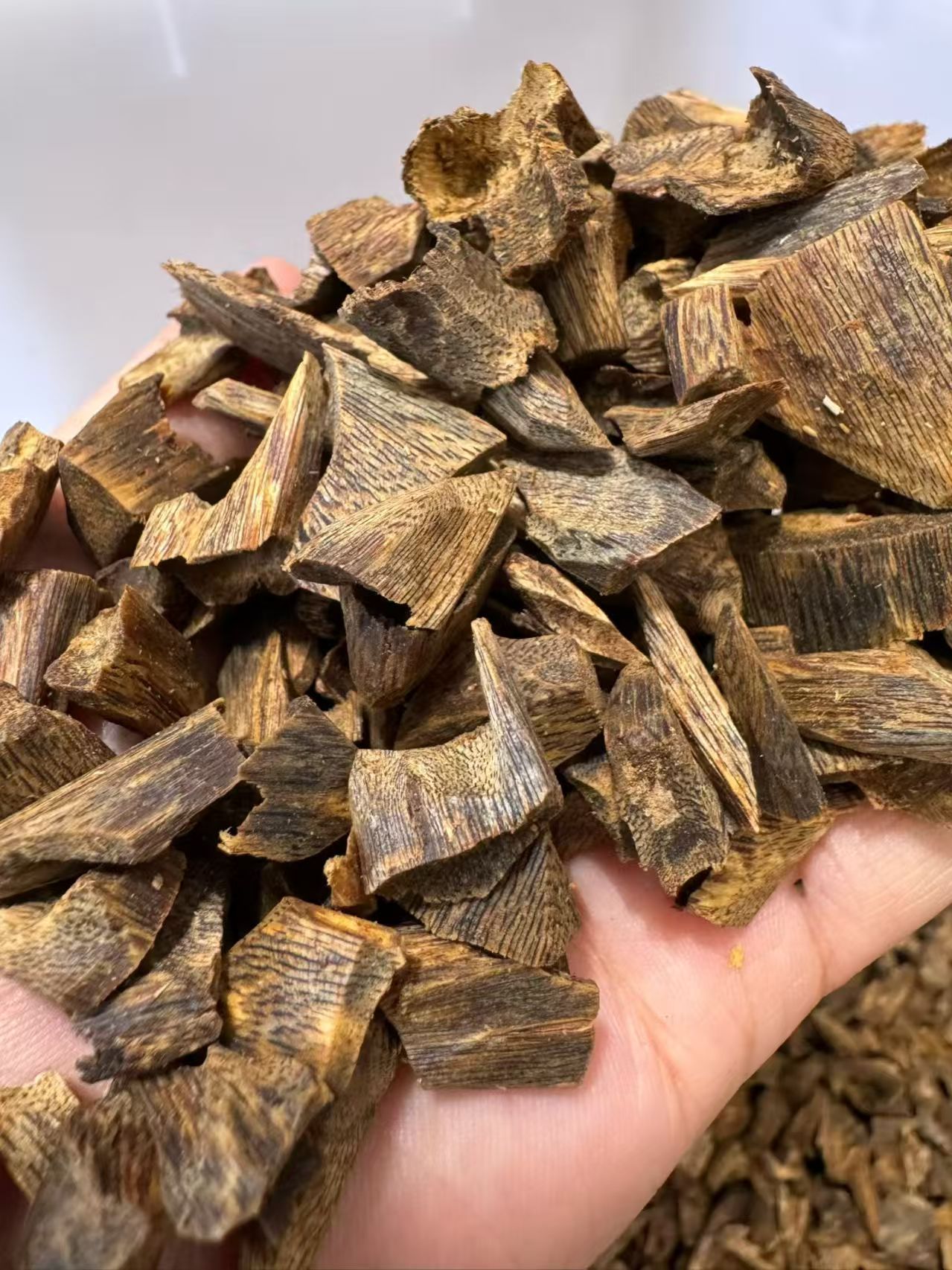
NanjaOud lists natural large agarwood chips and natural small agarwood chips. These product references identify forms; they do not prove a particular lot has a complete chain of custody. Before ordering, ask for the offered lot code, species and origin declaration, supplier or harvest record where available, processing handovers, packing record and the documents required for your destination. Specify which records you must see before sample approval and before shipment. If a field cannot be documented for the offered lot, record that gap and decide whether the lot meets your policy.

Frequently Asked Questions
What does "traceable" mean for oud chips?
It means a specific carton can be linked to a specific lot, and that lot to a specific harvest and processing record, through documents a third party can check. The link must be written, dated and arithmetically consistent.
Is a trace code the same as traceability?
No. A trace code is a label. Traceability is the record the label points to, plus the reconciliation between raw material input and shipped output. A code with no record behind it proves nothing.
Do I need CITES documents for a commercial oud chips order?
Check the current species listing, annotation, product form and shipment route with the relevant authorities. Ask the supplier and your broker to identify the exact export and import documents required for that order; keep the approved documents linked to the lot and shipping file.
What is a mass balance and why should I ask for it?
It is the record of raw material in, graded output out and the loss between them. It is the fastest way to test whether a lot could plausibly have produced the quantity shipped, and therefore whether a lot code describes production or just packaging.
How many lots should I audit before approving a supplier?
Two consecutive lot files is a workable minimum, because one lot proves a shipment and two prove a process. For a first container, audit the trial lot and the production lot that follows it.
Can traceability be verified without a factory visit?
Largely, yes. A document-led remote audit with a continuous video walk, a three-document cross-check against one labelled carton and a review of two consecutive lot files will surface most breaks. A site visit remains stronger evidence.
Why does moisture basis matter in a traceability file?
Because weight is the commercial unit. A lot quoted on one moisture basis and delivered on another can differ materially in usable material for the same nominal kilogram, and the difference is invisible unless the basis is written down.
What should the purchase order say about lot codes?
The lot code should be a contractual field, repeated on the invoice, packing list, permit description and carton labels, with a right to reject material whose documents do not match.
Does plantation-grown material change the traceability requirement?
It changes the evidence, not the requirement. Plantation material can be traced to a plot and a harvest window, which is generally stronger evidence than wild material, but only if the plantation records are actually produced.
How do I compare two suppliers who both claim full traceability?
Ask both for the same six-field lot file for the same two consecutive lots, then run the mass-balance arithmetic on each. The supplier whose numbers reconcile and whose documents match is the traceable one; the other is describing an intention.
Conclusion
Oud chips manufacturer traceability is not a certificate you receive; it is a set of records that survive an arithmetic test. Ask any oud chips manufacturer for the six-field lot file, one record per handover, and the mass balance behind the shipment — then check that the permit, invoice and carton label describe the same material. Suppliers who can do this consistently are the ones worth a repeat order, because a process that reconciles once can be made to reconcile again.
If you are building a sourcing programme and want to test this on a real lot, send your required form, grade definition, quantity and destination market through our contact page and we will respond against your specification rather than a catalogue.


