

Short answer: there is no single oud chips HS code. Customs classifies the goods by form and treatment — whole pieces, chips, powder, oil or finished retail bakhoor — and each destination adds its own national tariff line. Because all Aquilaria and Gyrinops species sit in CITES Appendix II, the oud chips HS code you declare must also agree with the species, quantity and description printed on the export permit. The practical work is not "find the code"; it is making five documents tell one story before the container is booked.
This guide is written for importers, distributors and private-label brands placing a first or repeat order of agarwood chips. It sets out how to approach the HS classification, which fields on the oud chips import documents customs officers actually compare, where shipments stall, and which clauses to put in the purchase order so that a paperwork problem does not become your loss alone.
Why the HS code and the permit description must agree
An HS code drives duty, tax, licensing and sometimes port-of-entry rules. A CITES permit drives legality. They are issued by different authorities for different reasons, and nothing forces them to match unless the buyer insists on it.
Two consequences follow. First, a classification error is not a rounding error: the wrong heading can change the duty rate, trigger a licensing requirement or invalidate a preferential tariff claim, and corrections after release are far more expensive than a ruling before shipment. Second, a description mismatch between the permit and the commercial invoice is one of the most common reasons a consignment is stopped, even when the wood itself is legal and correctly declared.
The listing itself is not in dispute. CITES records all Aquilaria and Gyrinops species in Appendix II under annotation #14, which defines the forms and products the listing covers, according to the CITES CoP20 working document on Appendix-II annotations. Annotation wording is reviewed at each Conference of the Parties, so the current text — not a blog summary, including this one — is the version to check with your broker and your national CITES authority. A CITES permit for agarwood therefore records the species and form; your own authority decides what it will accept at import.
Oud chips HS code: classify by form, not by trade name
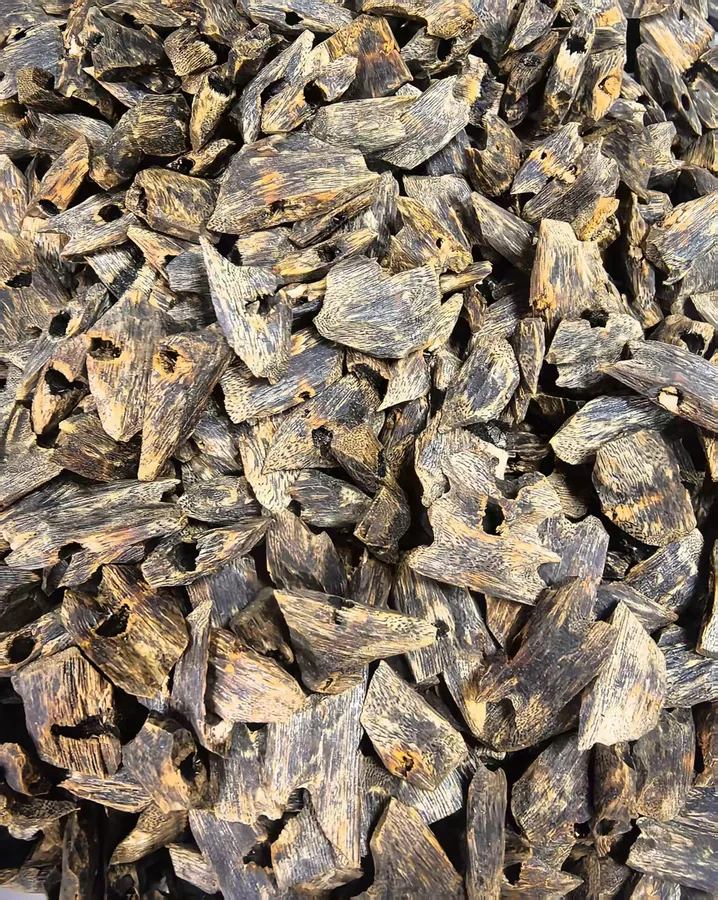
"Oud chips" is a commercial description, not a tariff category. The agarwood chips HS code you end up with is a function of the form and treatment, not of the grade label on the bag. The same plantation material can move through several headings as it is cut, milled, extracted or packed for retail. Chapter 44 (wood and articles of wood) is the usual home for wood in chip or fragment form; milled powder sold as a perfumery raw material and distilled oil are treated under different chapters. National tariff lines then split these headings further.
| Form offered | How customs usually reads it | What decides the heading | Document risk to watch |
|---|---|---|---|
| Whole pieces, blocks and logs | Wood, relatively unprocessed | Degree of processing, species, whether the piece is worked | Piece count versus declared weight; "sample" description on a commercial quantity |
| Chips and fragments | Wood in chip form | Size reduction only, or further treatment such as scenting or coating | Invoice says "chips", permit says "wood" or another species spelling |
| Milled powder | Perfumery or incense raw material, or wood product — depends on end use and presentation | Whether it is fresh-milled wood or an extracted residue | Exhausted and unexhausted powder described identically |
| Distilled or supercritical oil | Essential oil or extract | Extraction route and concentration | Quantity declared in litres on one document and kilograms on another |
| Scented bakhoor, retail-packed | Prepared aromatic product | Whether it is genuinely retail-ready and whether added oils change the character | Assuming a retail exemption that the current annotation or national rule does not give |
Treat every row as a question to put to a customs broker about the customs clearance of agarwood, not as a code. Only the destination authority can give a binding classification, and many issue advance rulings in writing. Request the ruling for the exact form, treatment and packaging you will import, and keep it with the order file.
The five documents that must tell one story
Most clearance problems are internal inconsistencies, not missing paper. Before booking freight, lay the documents side by side and compare the same fields across all of them. The matrix below is the check we recommend to buyers, and it is the check we expect a buyer to run on us.
| Document | Fields to compare | Typical mismatch |
|---|---|---|
| CITES export permit | Species and genus spelling, source code, description of goods, quantity and unit, exporter, importer, validity dates | "Agarwood chips" instead of the genus name; grams on the permit, kilograms on the invoice |
| Commercial invoice | Goods description, HS code, net quantity, unit price, Incoterms, currency, buyer legal name | Description written for marketing rather than for customs |
| Packing list | Carton count, net and gross weight per carton, marks and numbers | Net weight that does not reconcile with the permit quantity |
| Bill of lading or air waybill | Consignee, notify party, port of loading and discharge, gross weight, description | Consignee is a trading name that does not match the importer on the permit |
| Certificate of origin, phytosanitary certificate, test report (where applicable) | Issuer, date, consignment reference, species, treatment | Documents issued for a different lot or an earlier shipment |

Run the unit and naming check first
Three checks catch most avoidable holds. Convert every quantity to one unit in your own worksheet before you compare documents; permit quantities are frequently stated in a different unit from the invoice. Spell the species as the permit spells it, and ask the supplier to use the same spelling on the invoice. Finally, decide in writing whether the invoice describes the material by its commercial name, its botanical name, or both — and make that choice once, for every document in the set.
Where shipments actually get held
In our experience of buyer-side document reviews, holds cluster around a short list of causes rather than exotic ones:
- Description drift. The permit, invoice and packing list describe the goods three slightly different ways, so an officer cannot confirm they are the same consignment.
- Quantity tolerance. Actual packed weight differs from the permitted quantity by more than the tolerance the permit allows, usually because chips are packed after the permit was issued.
- Wrong source code. Plantation material declared with a source code that does not reflect how it was grown or collected.
- Entity mismatch. The importer named on the permit is not the entity on the trade licence, the letter of credit or the bill of lading.
- Retail-exemption assumptions. A seller assumes finished or gift-packed goods fall outside the permit requirement without checking the current annotation and the destination's national rules.
- Split and sample shipments. Part of a permitted quantity is couriered as a "sample" with no documents, and the remaining commercial shipment then cannot be reconciled.
Each of these is cheap to prevent at the quotation stage and expensive to fix at the port. Demurrage, storage and inspection costs usually start accruing before anyone agrees who caused the problem.
Give your broker these six questions before you book freight
- What is the binding classification for this exact form, treatment and packaging, and can you obtain it in writing?
- What duty, tax and any preferential rate applies at my port, and does the origin documentation support that rate?
- Does my destination require an import permit, a registration or a prior authorisation in addition to the export permit?
- Are there port-of-entry restrictions, designated inspection points or wood-packaging requirements?
- What invoice wording do you want, and in which unit should quantity be declared?
- What is the realistic clearance time, and what happens to storage cost if a document is queried?
Send the answers to the supplier before the order is confirmed, not after production — and confirm the oud chips HS code against them. A supplier who cannot work to a written document list is telling you something useful about the order ahead.
Put document responsibility in the purchase order
Commercial terms decide who absorbs a paperwork failure. Four clauses are worth more than any verbal assurance:
- Document set and deadline. Name each document, who issues it and the date the complete set must reach you — before the shipment leaves, not on arrival.
- Liability for holds. State who pays storage, demurrage and inspection if goods are held because a supplier-issued document is wrong or late.
- Payment linked to document check. Release the balance against a verified document set plus the agreed pre-shipment inspection, not against the bill of lading alone.
- Quantity reconciliation. Agree the tolerance between permitted quantity and packed quantity, and what happens if the lot exceeds it.
These clauses sit alongside price and lead time, and they change the real landed cost far more than a small movement in the per-kilogram quote. For how freight, processing and documentation sit inside an oud chips wholesale quotation, see our breakdown of what drives wholesale oud chips price per kilogram.
Check the supplier's document practice, not its certificate wall
Any oud chips supplier can claim certification. Ask instead for evidence of process, and accept a redacted copy where commercial details are sensitive:
- A redacted permit from a previous shipment of the same species and form, showing how the goods were described.
- The name of the permit holder, and confirmation that it is the same legal entity that will invoice you and receive payment.
- The HS code the supplier declares on export, and where it appears on the invoice.
- A written explanation of what happens when packed quantity differs from the permitted quantity.
- A document checklist specific to your destination, not a generic brochure.
This is the same entity-matching discipline that protects you against trading companies presenting as factories; our guide to verifying an oud chips manufacturer in China sets out the matching steps. Our own quality and supply page states the scope plainly: checks are aligned to the order and do not imply a certified quality system or laboratory testing of every batch.
Where our chips fit the documentation chain
NanjaOud supplies natural agarwood chips from a managed plantation base of more than 160 acres in Jiangmen, Guangdong, processed in our own facility. Buyers comparing agarwood chips for sale across several suppliers should put the same five document questions to each of them. Both listings below are natural wood with visible grain and resinous streaks, and neither is presented as carrying a certification we have not stated.
- Natural large agarwood chips — larger, more intact pieces, used for burning, further cutting, grinding and distribution.
- Natural small agarwood chips — smaller irregular pieces that are easier to portion, blend, repack and process.
We also support format and packaging discussion for buyers developing their own line, which is where the retail-versus-bulk distinction starts to matter for classification. Our applications overview shows how chips, powder and oil are used across bakhoor, incense and fragrance programs.
Common mistakes to avoid
- Asking "what is the HS code for oud" instead of describing the exact form and treatment.
- Accepting the supplier's code without a broker's written confirmation for your own destination.
- Letting the invoice carry a marketing description that no customs officer can match to the permit.
- Shipping a sample outside the permitted quantity and assuming it is exempt.
- Booking freight before the document set has been checked internally field by field.
- Leaving storage and demurrage liability unallocated in the purchase order.
Frequently asked questions
Is there one HS code for oud chips?
No. Classification follows the form and treatment — whole pieces, chips, powder, oil or a prepared retail product — and each country applies its own national tariff line. Obtain a written classification for your exact goods and destination.
Do I need an import permit as well as the export permit?
Under CITES, Appendix II trade generally requires an export permit, but many countries add stricter national requirements. Confirm with your own CITES authority before you order, not after the goods are ready.
Do small samples need CITES documents?
Size does not create a general exemption. Whether a couriered sample needs documents depends on the species, form and destination rules, so ask before sending. Treating a sample as paperwork-free can complicate the commercial shipment that follows.
Can retail-packed bakhoor avoid a permit?
Annotation #14 defines which forms are covered, and genuinely retail-ready finished products may fall outside it — subject to the current wording and any stricter national rule. Confirm the position for your product and market rather than assuming it.
What if the packed quantity differs from the permitted quantity?
This is a common cause of holds. Agree a tolerance in the purchase order, pack against the permitted figure, and decide in advance who bears the cost of an amendment or a split shipment.
Does a test report replace the permit?
No. A test report may describe the material, but it does not authorise trade in a listed species. The permit and the customs declaration are separate legal requirements.
Who pays if customs holds the container?
Whoever the contract says. If the purchase order is silent, the importer usually absorbs storage and demurrage first and argues later. Allocate the cost in writing.
Conclusion
The oud chips HS code question is really a document-control question: describe the goods once, in the same words and units, across the permit, invoice, packing list and transport document, and confirm the classification with your own broker before freight is booked. Buyers who do this spend their first order on wood, not on storage fees.
If you are planning a shipment and want to check what documentation can travel with the material we offer, send your destination, intended form and quantity through our contact page and ask for the document list before you request a quotation.


