
Oud chips grades are supplier-defined labels, not an industry standard. Two manufacturers can both sell "Grade A" agarwood chips that differ in resin content, moisture basis, piece size and aroma, and both labels can be honest, because no authority publishes a single grade ladder for oud chips. The way to buy graded oud chips repeatably is to convert the grade label into a written purchase-order specification with a test method, a tolerance and a retained sample attached to it.
This guide is written for importers, incense manufacturers, bakhoor producers and private-label brands who are comparing oud chips manufacturers and keep running into the same wall: the grade letters look the same on every quotation, but the material behind them does not. Because oud chips grades are relative to one supplier's sorting, the comparison has to move from the letter to the measurement. What follows are the four grading languages used in the trade, the five fields every grade claim has to be translated into, a clause set you can paste into an RFQ, and the checks that tell you whether a lot matches the sample you approved.
Why "Grade A" is not a specification
Grading agarwood chips is a sorting decision made inside one supplier's stock. A grader looks at resin colour and spread, tests density, warms a piece, and then assigns a letter that sets a price tier. The letter is meaningful within that supplier's range, because it tells you where a lot sits relative to the rest of that supplier's material. It carries much less meaning across suppliers, because the cut-off points are commercial decisions, not published thresholds.
Published trade tables illustrate the gap. One Gulf fragrance retailer's public guide places Grade A at 30% resin and above, with B at 20–30%, C at 9–20% and D below 9%. An Indonesian supplier's published table uses different cut-offs for the same letters. A Chinese plantation supplier publishes a D-to-AAA scale and states plainly that there is no universal standard. All three can be internally consistent and still produce three different "Grade A" lots. Sellers describe the same shorthand in their catalogues — "oud chips grade A", "oud chips grade AA", "sinking grade" — and none of those phrases carries a measurement.
That is not a reason to avoid grades. It is a reason to treat a grade as a starting point for a conversation and a purchase order as the place where the definition finally becomes binding. If you buy on the letter alone, the only thing you have agreed is a word, which is why most disputes over oud chips grades begin long before the container is loaded.
What our own labels mean — and do not mean
We publish A, B and C labels as internal supplier references. They describe where a lot sits inside our own sorting, and they are not presented as a universal or international grading standard. Our published quality framework also does not claim a certified quality system or laboratory testing of every batch. We state this because a buyer comparing three quotations deserves to know which part of a grade claim is a convention and which part is a measurement. The rest of this article is about turning the convention into the measurement.
The four grading languages buyers meet in the market
Almost every grade argument starts because two people are speaking different grading languages without noticing. There are four in common use, and each one is answering a different question about the same wood.
| Grading language | Typical wording | What it actually measures | What it does not prove |
|---|---|---|---|
| Letter grades | A, AA, AAA, B, C, D | Relative position inside one supplier's sorted stock | Resin percentage, species, aroma, or comparability with another supplier's letter |
| Density / sink terms | "sinking", "half-sinking", "semi-sinking", "floating" | Whether a piece is dense enough to sink or partly sink in water | That the density comes from resin rather than moisture or mineral content |
| Origin and trade names | Kynam or kyara, Cambodi, Hindi, Kalimantan, Hainan | A place, species tradition or market reference | Any measured grade inside that name |
| Percentage claims | "20% resin", "high oil content" | A number, if a method and a moisture basis are stated | Anything at all, if the method and basis are missing |
Where an agarwood grading system comes from
Every manufacturer runs its own agarwood grading system, and most of them are built the same way: a working sort rather than a published standard. Material is separated by visible resin, then by density, then by aroma on the heater, then by size and form. The bands are set by what the factory can sell in each price tier, which is why the same physical lot can be called a different grade by two honest sellers.
A grader's training matters here. Someone who has sorted thousands of lots reads colour, weight and resin distribution quickly and consistently inside their own system, and that skill is real. It simply does not transfer as a number to your purchase order. Treat an agarwood grading system as evidence that the supplier sorts deliberately, and then ask for the properties behind the sort.
Density deserves a specific warning because it is the most abused. Sinking is a density result: a piece that sinks is denser than water. Resin raises density, so a sinking piece is often resin-rich, which is why the term survives in the trade. But waterlogging and mineral content also raise density, and a piece can sink without smelling the way a buyer expects. Buyers who ask for sinking grade oud chips are asking for one property, not for a verified aroma, and a supplier who offers it as a complete description has told you exactly that much.
Percentage claims are the most useful language, and the most dangerous when incomplete. A resin or extractive figure means nothing until you know whether it was measured on a wet or dry basis, which test method was used, and whether the sample tested came from the lot you are buying. Our own article on verifying oud chips resin content walks through the density, laboratory and burn checks that make a percentage comparable; the point here is that the number needs those three attachments before it becomes a clause.
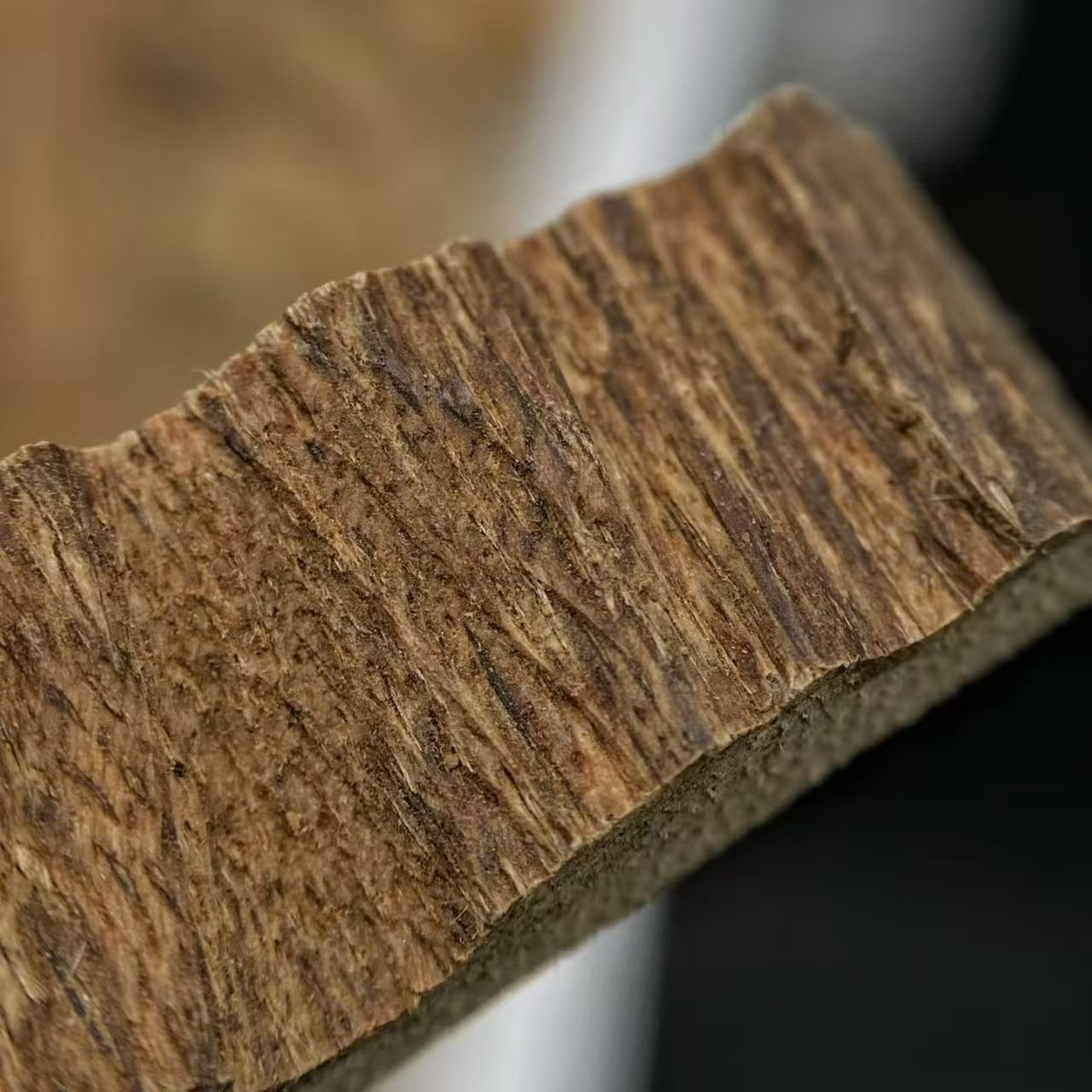
What a grade label has to be converted into: five fields
A grade becomes buyable when five fields are written down. Miss any one of them and the remaining four will not save the order. Every field exists to make oud chips grades testable rather than theatrical.
1. A resin or extractive basis
State the figure, the method and the basis. "Minimum 20% alcohol-soluble extractive, dry basis, tested on a sample drawn from the offered lot" is a clause. "Grade A, high resin" is a description. If the supplier cannot name the method, ask for a certificate of analysis that does, and treat the figure as indicative rather than contractual.
2. Form and piece size distribution
The same grade in a different cut is a different product. Large display-grade pieces, small uniform chips for retail packs, fragments for blending and powder for stick production behave differently in a process, and they are not interchangeable at the same price. Fix a size range with a screen opening and an allowed share of oversize and fines, exactly as you would for any other graded raw material. Our guide to specifying agarwood chip and granule particle size gives the wording for that clause.
3. A moisture basis
Water is bought at the price of resinous wood. A grade agreed at 14% moisture and delivered at 20% is a lighter lot than the one you priced, and the loss appears as soon as the material dries in your warehouse. Fix a moisture limit, a test method and the basis (wet or dry), and state what happens if an arrival tests above the limit. The mechanics are set out in our guide to oud chips moisture content.
4. An aroma and burn reference
Aroma is the property buyers actually care about and the hardest to write down. Do not try to describe it in adjectives alone. Tie it to a physical reference: "aroma and burn behaviour to match retained sample LOT-XX-01, approved on [date], sealed and held by both parties", then add the operating conditions used to judge it — heater type, temperature, piece size and observation time. Two people warming the same chip on different equipment will otherwise disagree honestly.
5. Evidence and sampling
State how the grade will be demonstrated: which sample is drawn, by whom, from where in the lot, how it is sealed, what photographs are taken, and which documents travel with the shipment. A grade claim without a sampling procedure cannot be tested, and an untestable claim cannot be enforced. This is the field that turns a written oud chips specification into something a third party could audit without you in the room.
A purchase-order clause set for graded oud chips
The table below converts each field into contract language and a verification method. Copy it into an RFQ, delete what does not apply, and send the same version to every supplier you are comparing. A clause set like this is what finally makes oud chips grades comparable, because every seller is answering the same question with the same unit of measure.
| Clause | Wording to write | How it is verified |
|---|---|---|
| Product and species | Product name, declared species (for example Aquilaria sinensis), origin, and the internal grade reference used by the supplier | Invoice and packing list match the quotation; species statement consistent across the offer, the order and the export documents |
| Grade definition | The measurable properties behind the letter: resin or extractive minimum, density behaviour, colour and resin distribution, aroma reference | Approved retained sample plus any certificate of analysis naming its method |
| Form and size | Cut form, screen opening, allowed oversize and fines share, piece count per unit weight for retail formats | Sieve or hand check on a drawn sample at arrival, recorded on a sheet both parties sign |
| Moisture | Maximum moisture, test method, basis, and the weight adjustment or remedy above the limit | Moisture reading taken on arrival before the material is repacked or stored |
| Aroma | Reference to the approved retained sample, plus the heater and temperature to be used in any comparison | Side-by-side warm test against the sealed sample, recorded with photographs |
| Packing | Unit weight, liner, seal, desiccant, carton grade, label content and pallet configuration | Pre-shipment photographs and a physical check on arrival |
| Documents | The document set agreed for the destination, with the exact product description to appear on each | Document review before shipment release, not after arrival |
| Acceptance and remedy | Defect classes, the acceptance limit per class, the notice period for a claim, and the sequence of remedies | Arrival inspection report, photographs, retained sample and the signed receipt |
Two clauses do most of the work. The first is the grade definition, because it stops the letter from floating free of any measurement. The second is acceptance and remedy, because it decides whether a mismatch becomes a conversation or a loss. Neither clause needs a lawyer to draft, and both need to be agreed before the deposit, not after the container arrives.
How to verify a grade claim before you commit volume
Verifying oud chips grades is a sequence, and skipping a step moves the risk forward rather than removing it. Run these six checks in order on any supplier you have not bought from before.
- Ask for the grade in numbers, not letters. Request the resin or extractive figure, its method, the moisture limit and the size range. A supplier who cannot answer in numbers has a sorting system, not a specification.
- Ask where the sample comes from. A sample drawn from the lot being quoted is evidence. A sample drawn from a display jar is marketing. Ask for the lot reference and the date the sample was drawn, and keep the answer with the sample.
- Run a density check and write down what you did. Use the same container, water temperature and piece size each time, and record which pieces sank, half-sank or floated. The result describes the sample; it does not certify the grade, and recording the method is what makes the number repeatable.
- Warm the sample under controlled conditions. Fix the heater, temperature, piece weight and observation time, and note first aroma, body, and what remains after the piece stops giving. Compare suppliers on the same protocol, never on memory.
- Measure moisture before you judge weight. A heavy sample may simply be wet. Record moisture alongside weight so the two numbers can be read together.
- Seal and hold the approved sample. Sign a short record that states what was approved, and hold one sealed unit yourself and ask the supplier to hold another. That sample is the only grade definition that survives into the shipment.
The full approval protocol, including the purchase-order clause that ties the bulk lot to the sample, is set out in our guide to approving oud chip samples before a bulk order. If you are qualifying a supplier for the first time, that protocol and this article are designed to be used together.
Common mistakes that turn a grade dispute into a loss
- Buying the letter and not the basis. "Grade A" without a resin figure, a moisture limit and a size range gives you nothing to test.
- Comparing a wet lot with a dry lot. Weight-based prices flatter high-moisture material. Convert both offers to a stated moisture basis before comparing cost per kilogram.
- Accepting photographs as grade evidence. Colour in a photograph depends on lighting, white balance and editing. Photographs document what was sent; only a physical sample defines what was approved.
- Letting the sample come from somewhere else. If the sample was not drawn from the quoted lot, you have approved a different product.
- Skipping the fines and oversize allowance. A grade can be correct on average and still be unusable if a third of the weight falls outside the size you can process.
- Treating a sink test as a verdict. Density is one property. Density plus resin figure plus aroma plus moisture is a grade.
- Testing without recording conditions. An unrecorded test cannot be repeated, which means it cannot support a claim.
- Agreeing a remedy after the dispute starts. The remedy ladder has to be in the order, not negotiated while a container sits in port.
Comparing agarwood chips grades across three suppliers is usually where these mistakes surface, because the quotations look alike until you ask each seller for the same five fields. The same discipline applies when you line up a second source: a second supplier is only a backup if it can reproduce the specification you already approved.
What the paperwork can and cannot prove about grade
Buyers often expect documents to settle a grade question. They usually cannot, and knowing which document answers which question prevents a lot of wasted argument. Documents cannot resolve oud chips grades; they resolve legality, health status and identity.
A CITES permit is the clearest example. Aquilaria species are listed in CITES Appendix II, which means international trade in the wood is controlled and the shipment needs the corresponding permit for the destination. That permit is evidence about species and legal export; it says nothing about resin content, aroma or which internal grade the lot was sorted into. A phytosanitary certificate is evidence about plant health. A certificate of analysis is evidence about the sample that was tested, for the method named on it. An invoice description is evidence of what the parties agreed to call the goods, which matters at customs and in a dispute.
So the document set protects the shipment, and the grade clause protects the material. Ask for both, and check that the product description is consistent across the offer, the order, the invoice and the permit. Where those descriptions drift apart, the goods and the paperwork stop describing the same thing. Our guide to oud chips manufacturer certifications sets out what each document family proves and what it leaves open.
Buying graded oud chips from a manufacturer: what to ask, and what we publish
The last step is comparing actual suppliers on the same request. Choosing an oud chips manufacturer on the strength of a grade letter is the weakest possible basis for a decision, because the letter is the one part of the offer that costs nothing to write. Send every candidate an identical RFQ with the clause set above, ask for the same evidence, and score the answers rather than the letters.
A short scorecard for comparing manufacturers
| Criterion | What a strong answer looks like | What a weak answer sounds like |
|---|---|---|
| Grade definition | Numbers, method, moisture basis and size range in writing | "Grade A, best quality, very high resin" |
| Sample provenance | Sample drawn from the quoted lot, with a lot reference | A sample from a showroom jar, no lot reference |
| Source | Named plantation or processing base, species stated | "Our factory in China", no location or species |
| Consistency | Retained samples from previous shipments can be compared | Grade changes between orders, no records offered |
| Documents | Clear list, with the description that will appear on each | "All certificates available" without a list |
| Acceptance terms | Defect classes, claim window and remedy ladder in the offer | Remedy discussed only after a complaint |
Our own material, described as it is
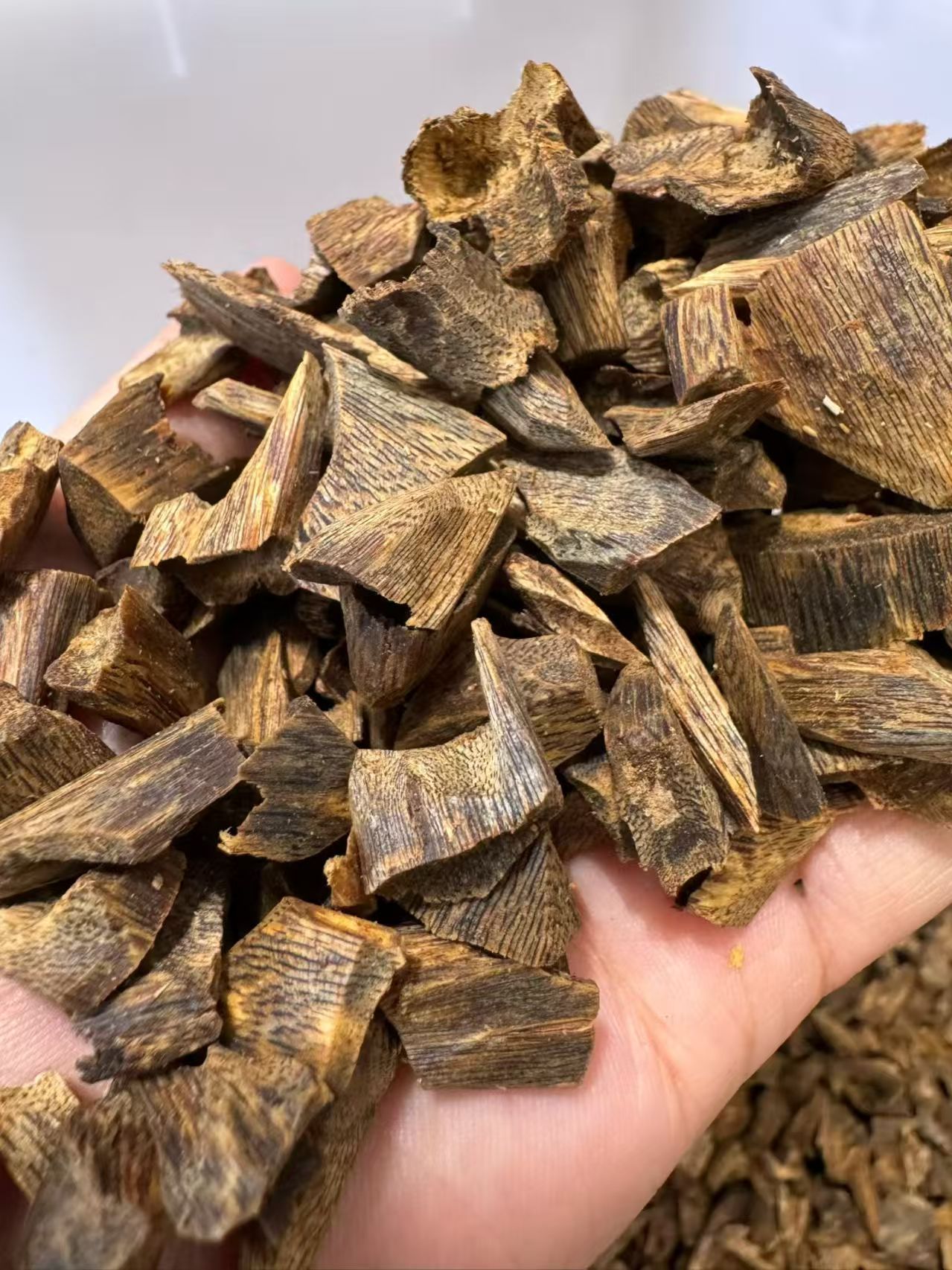
We supply natural agarwood chips from our plantation base in Jiangmen, Guangdong, with in-house processing rather than trading-only sourcing. The large-chip format keeps comparatively large, intact pieces with visible natural grain and resinous streaks, which suits buyers who need recognisable pieces for incense use, further cutting, or distribution. The small-chip format is cut into smaller irregular pieces with the same visible grain, and is easier to portion, blend, repack and grind — a practical format for incense production, private-label packs and blending. Both formats are offered for bulk wholesale with ODM cooperation on specification, packaging and product direction. You can see the range on our agarwood raw materials and chips page.
Two facts about our sourcing matter for grade conversations. Our cultivation follows natural standards and we do not use chemical resin-induction agents to accelerate resin formation, which means grading depends on what the wood actually developed rather than on an induced result. And our processing is done in-house, so a size or cut change is a production instruction rather than a request passed to a third party. What we will not do is quote a resin percentage we have not measured, or present an A, B or C label as if an international body had defined it.
Frequently asked questions
Are oud chips grades standardized?
No. There is no international standard that fixes what Grade A or AA means for oud chips. Letters are supplier-internal references, and published trade tables place the cut-offs in different places. Treat a grade as a supplier's sorting label and confirm it with measurable properties in the purchase order.
What is the difference between Grade A and Grade AA oud chips?
Inside one supplier's range, an oud chips grade AA lot normally sits above grade A and denotes heavier resin, darker colour or a higher density share. Across suppliers the letters are not comparable, so ask for the resin or extractive figure, the moisture basis and the size range behind each label before comparing price.
Is sinking grade better than Grade A?
They measure different things. Sinking describes density; Grade A describes a supplier's position in its own sorting. A dense piece usually carries more resin, but density can also come from moisture or minerals, so sinking is supporting evidence rather than a quality verdict.
How do I check a resin percentage claim?
Ask for the method, the moisture basis and the identity of the sample tested. Then verify with a density check, a controlled warm test and a moisture reading on the sample you were sent. A percentage without a method and a basis cannot be compared with another supplier's figure.
Should the grade be written into the purchase order?
Yes, and as measurable properties rather than a letter. Write the resin or extractive minimum, the size range with oversize and fines allowances, the moisture limit, the aroma reference to an approved retained sample, and the acceptance and remedy clauses.
How much does a grade difference change the price?
Pricing is quoted per lot and per grade, so there is no reliable general multiplier. Compare offers on the same form, size range, moisture basis and delivery term, then convert each to a landed cost per usable kilogram rather than comparing headline prices.
Can I mix grades in one shipment?
Yes, but specify each grade as a separate line with its own quantity, size range and packing, and require the cartons to be marked by grade. Mixed lots without line-level marking are one of the most common sources of arrival disputes.
What if the arrival does not match the approved sample?
Inspect on arrival, record what you measured against the sample you retained, photograph the material and the packing, and notify the supplier inside the claim window written in your order. The claim is only as strong as your records and the sample you both sealed.
Do documents prove the grade?
No. A CITES permit proves species and legal export, a phytosanitary certificate covers plant health, and a certificate of analysis covers the sample tested for the method named. Only the specification and the retained sample define the grade you bought.
Conclusion
Oud chips grades work as a sorting language and fail as a specification. The letters tell you where a lot sits inside one manufacturer's stock; they do not travel between suppliers, and they do not survive a moisture difference, a size drift or an aroma argument. Convert the label into five written fields — resin basis, form and size, moisture, aroma reference and sampling evidence — and the grade becomes something you can test, enforce and reorder.
If you are currently comparing quotations, the fastest way to make them comparable is to send every supplier the same clause set from this article and ask for the same evidence against it. If you would like our current formats, size options and the specification we can hold for a repeat order, describe your target market, intended application and estimated volume on our contact page, and we will respond with the details that apply to the material rather than a generic grade letter.


