
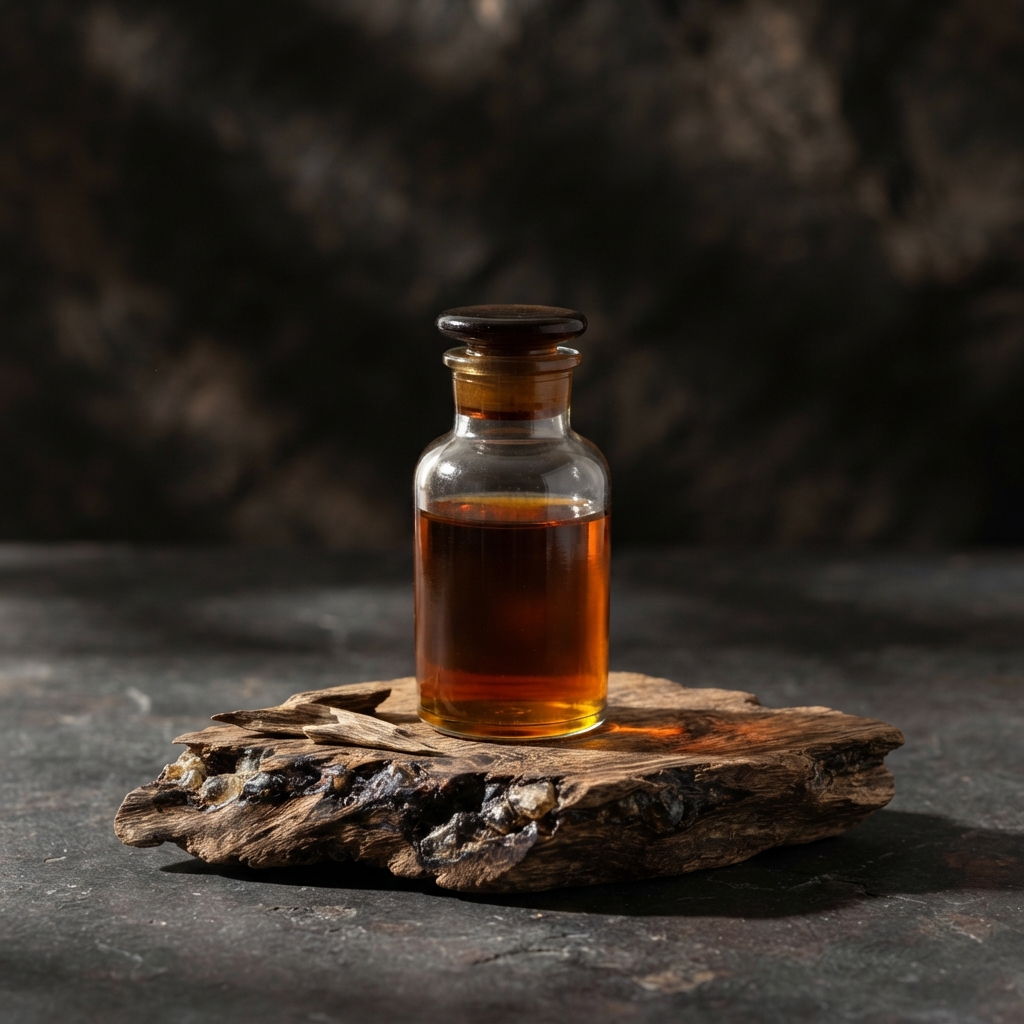
An oud oil manufacturer RFQ works when it fixes the material, the sample, the documents and the delivery term before anyone quotes a number. Buyers who send a one-line request for "best price on oud oil" receive answers they cannot compare; buyers who send a structured brief receive bids they can audit. This guide shows what to put in that brief, what evidence to demand back, and how to read the replies.
Start with the decision, not the price
An oud oil quotation is a set of assumptions. The unit price usually means "this material, in this packaging, under this delivery term, with these documents, at this quantity". Change any one of those and the number moves. The purpose of a request for quotation (RFQ) is not to collect prices — it is to make those assumptions explicit, identical across suppliers, and written down before sampling begins.
A useful RFQ answers five questions for the supplier: what material and form you want, how much you need now and later, where it is going, how it must be packed, and what evidence must travel with it. A manufacturer quoting from a standing catalogue is answering a different question from an oud oil manufacturer quoting your brief.
Oud oil and agarwood oil: one material, several names
"Oud" is the Arabic-derived trade name; "agarwood" is the English name for the resin-bearing wood of Aquilaria and related trees, and the oil pressed or extracted from it. Sellers also use gaharu, aloeswood, eaglewood and chenxiang. In most trade correspondence, "oud oil" and "agarwood oil" describe the same category, so the name tells you very little about what is in the drum.
What matters is the qualifier attached to the name. "Pure", "wild", "Cambodian", "aged" and "therapeutic grade" are marketing claims unless they are defined and documented. Meanwhile "oud fragrance oil", "oud oil solution" and "oud accord" often describe a compounded fragrance or a diluted aromatic preparation rather than a wood-derived oil. Anyone comparing agarwood essential oil wholesale offers meets the same problem: two listings can use identical wording and still describe very different materials. Naming the product precisely in the RFQ, with a specification and a reference sample, removes the ambiguity that survives every conversation.
| Term in a quotation | What it usually means | What to ask before accepting it |
|---|---|---|
| Oud oil / agarwood oil | Oil obtained from resin-bearing agarwood, by distillation or solvent/supercritical extraction | Species or source material, extraction route, batch code, and whether any carrier or diluent is present |
| Pure oud oil | An assertion, not a specification | How purity is defined in writing, and which test or record supports the claim |
| Oud fragrance oil / oud accord | Usually a compounded fragrance, sometimes with little or no agarwood oil | Full composition declaration and the agarwood-oil share, if any |
| Oud oil solution / extract | Aromatic material in a carrier or solvent base | Carrier identity, concentration, and whether the base is declared on the SDS |
How raw material and extraction route shape the purchase
Two oils can look identical in a bottle and behave differently in a formula. The variables that separate them are mostly upstream of the still.
Raw material source
Ask whether the wood comes from a managed plantation, from purchased lots of mixed origin, or from a declared region. Plantation material supports repeatability because the grower controls age, handling and resin development; purchased lots support variety but make batch-to-batch matching harder. Also ask how resin formation was induced, and whether the supplier will state that in writing. Practices differ across origins, and the answer belongs in your file next to the sample.
Extraction route
Distillation and solvent or supercritical extraction produce materially different oils: yield, colour, density and the balance of top notes versus heavy base notes all shift. Neither route is automatically better; each suits different applications and price points. Buyers sourcing oud oil for perfume manufacturing have a particular reason to insist on this point: the route must be declared, must remain constant between orders, and must appear on the specification rather than being inferred from a description. If your formula was built on a distilled oil, a switch to an extracted oil is a new material, not a cost saving.
Why an aroma description cannot prove purity
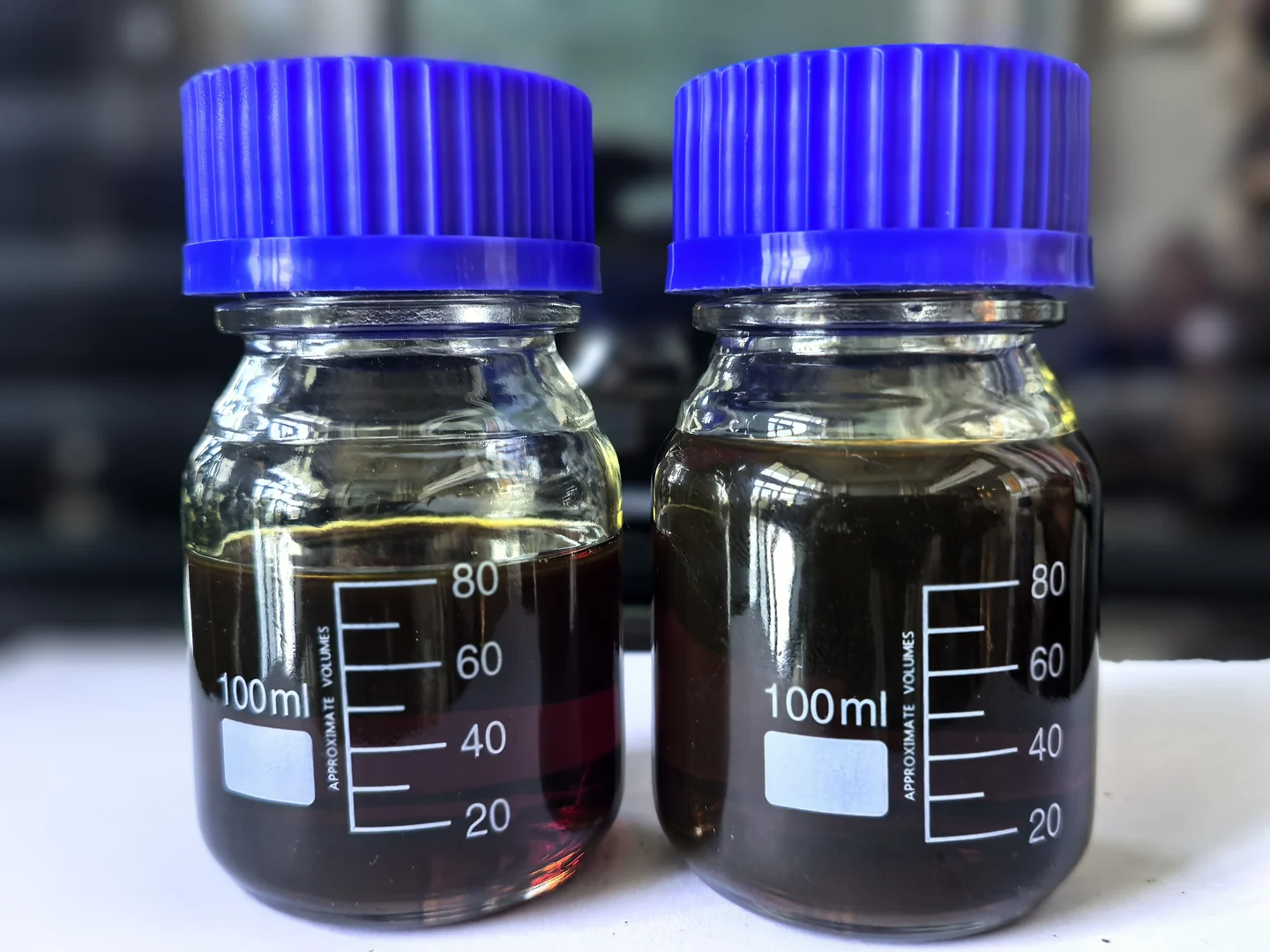
Sensory language is the weakest part of most oud oil files. Descriptions such as "sweet, woody, balsamic, long-lasting" are useful for internal evaluation, but they do not identify species, exclude added aroma chemicals, or prove that a drum contains only wood-derived oil. Perfumers can build a convincing oud profile from other materials, and a trained nose is not a chain of custody.
Technical evidence has limits too. Gas chromatography–mass spectrometry profiles the volatile compounds in a sample and is genuinely useful for spotting inconsistencies between batches, unusual peaks and some adulterants; published GC-MS profiling of different Aquilaria species (2018) shows measurable compositional differences between species. But a chromatogram is only as good as the sample it was run on, and a report proves what that sample contained on that day — not what is in the container you will receive. Treat aroma and lab data as supporting evidence, and make the link between sample, report and batch the thing you actually verify.
Manufacturer, wholesaler or trader: three different answers
The same RFQ produces different answers depending on who receives it. A manufacturer can speak to material access, extraction capacity, batch control and lead time. A wholesaler can speak to stock, grading and dispatch, but usually has to relay process questions. A trader can speak to price and availability, and often very little else.
None of these roles is disqualifying — a good trader with reliable mill relationships is a legitimate supply route. The problem is paying manufacturer-level claims for trader-level visibility. The practical test is whether the reply contains specifics that only an oud oil manufacturer could give: which material entered the batch, how it was processed, what the yield was, and who signed the batch record. If every answer routes through a third party, price your risk accordingly. For a full verification method, see how B2B buyers verify who really produces the oil.
Verifying production and supply capacity
Capacity questions should be about constraints, not floor space. Ask any oud oil manufacturer what limits throughput in a normal month, how many batches of your specification can run in a quarter, and what happens to your order when a larger buyer books the same material. A supplier who can describe their bottleneck is usually more reliable than one who promises unlimited volume.
- Ask for the last twelve months of delivery performance on a comparable specification, with on-time percentage rather than a list of happy customers.
- Ask how raw material is held between batches and what stock buffer exists for your grade.
- Ask who approves a batch for release, and what would cause a batch to be rejected internally.
- Ask for two references buying a similar volume and specification, and check whether their answers match the sales narrative.
What an oud oil manufacturer should prove with samples and batch records
An agarwood oil sample without a batch reference is a gift, not evidence. Good oud oil batch documentation begins at the sample stage: the sample should carry the batch or lot code it was drawn from, the production date, the declared extraction route, and the packaging it will ship in. Then request the records that accompany that same code — a batch record or certificate of analysis where the supplier issues one, a specification sheet, an SDS, and any origin or export documentation that applies to the material and destination.
Be specific about what you are asking for, because "all certificates" invites a folder of irrelevant paper. State the exact questions you need answered: what the material is, how it was produced, when, in what quantity, and which document connects the drum to the sample you approved. If a supplier cannot issue a particular document, ask what they can issue instead — a gap you have mapped is safer than a claim you cannot test.
A sample evaluation protocol you can repeat
Run the same protocol on every candidate so the comparison is honest. A workable sequence:
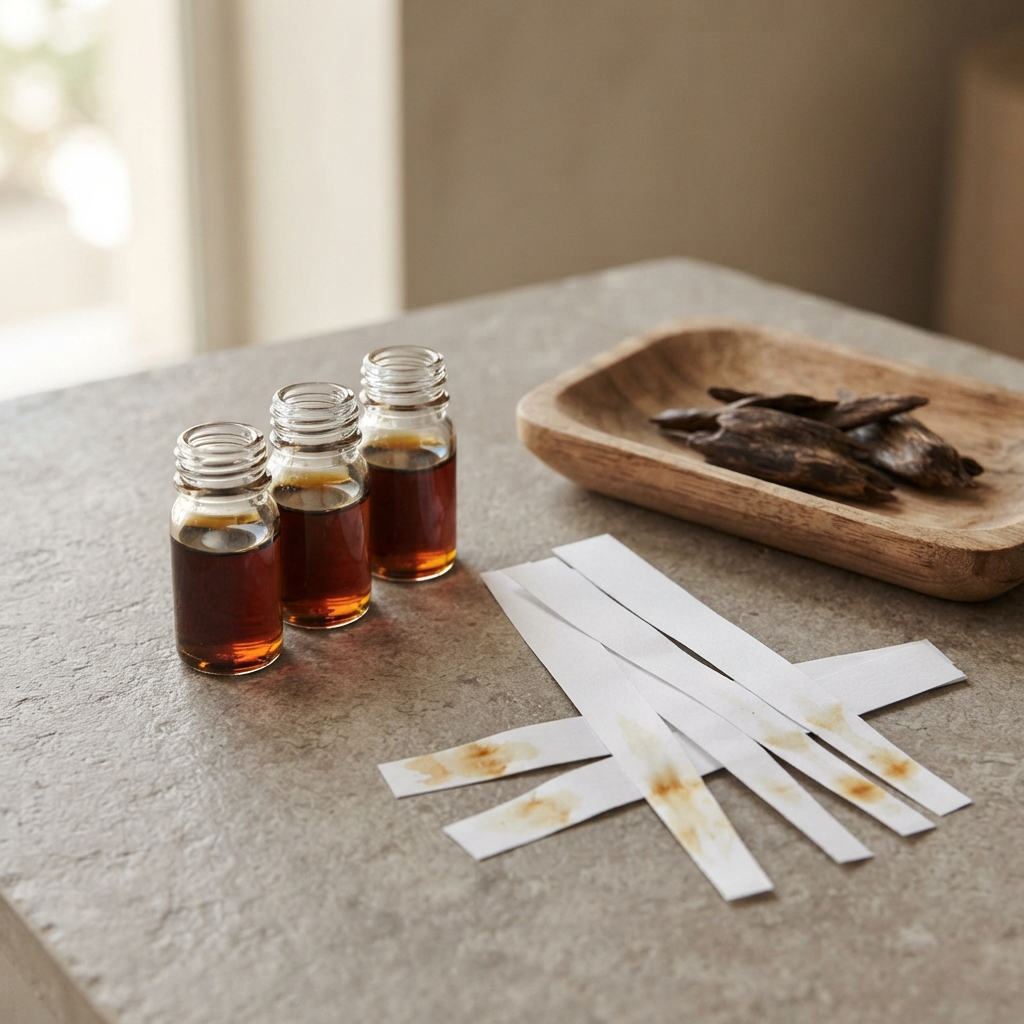
- Intake and log. Record arrival date, batch code, declared quantity, container type and seal condition before opening.
- Physical check. Observe colour and clarity against the declared description; note any sediment, cloudiness or separation; weigh the sample.
- Sensory trial. Evaluate on blotter at a fixed dilution and undiluted, at set intervals (for example 15 minutes, 2 hours, 8 hours, 24 hours). Score intensity, opening, heart, drydown and persistence on the same sheet each time.
- Application trial. Test in your actual base at your actual dosage. Oud oil behaves differently in alcohol, in oil-based products and in incense blends.
- Document reconciliation. Confirm that the batch code on the sample matches the batch code on every document supplied.
- Retain and record. Keep a sealed retention sample of each candidate, labelled with supplier, date and code, so a later bulk delivery can be compared against it.
Approve in writing, and attach the approved sample reference to the purchase order. Without that clause, "matches the sample" is an opinion rather than a term of the contract. The same discipline applied to a different material is set out in the batch consistency and verification checklist for perfume manufacturing.
Batch consistency, storage and packaging
Consistency is a production question, not a promise. Ask how the supplier holds a reference standard, how they compare a new batch against it, and what tolerance band they accept before a batch is blended or reworked. Ask what happens when a batch falls outside the band — the answer tells you whether the standard is real.
Storage and packaging then decide whether that consistency survives the journey. Oud oil is sensitive to light, heat and oxygen; the pack should be compatible with the oil, sealed, and specified down to container material, closure, headspace and outer carton. Agree in the RFQ whether you are buying bulk drums, small bulk containers, or retail-ready units, and whether the supplier or you specify the primary container. Packaging is also a cost line, not an afterthought: a decorative bottle and gift box can change landed cost more than a modest movement in oil price.
What actually drives the quoted price
Every oud oil manufacturer prices against the same list of variables; what differs is how transparently each one is shown.
| Cost driver | Why it moves the number | How to ask about it |
|---|---|---|
| Raw material grade and resin content | Higher resin yield per kilogram of wood raises input cost sharply | "What material grade entered this batch, and what yield did it give?" |
| Species, origin and sourcing model | Plantation, purchased lot and wild-sourced material carry different risk and cost | "Is the origin fixed for repeat orders, or does it vary by lot?" |
| Extraction route | Capital, energy and yield differ by method | "Which route, and will it stay the same on reorder?" |
| Batch size | Small runs spread fixed costs over fewer kilograms | "What is the smallest economic batch at this specification?" |
| Packaging | Container, closure, labelling and retail presentation add cost | "Quote bulk and retail-ready separately." |
| Documents and testing | Third-party analysis and permits carry direct cost and lead time | "Which documents are included, and which are charged separately?" |
| Delivery term | Incoterms decide who pays freight, insurance and clearance | "Quote FOB and CIF so the difference is visible." |
Notice what is absent: no single line is "the price". When a quotation is 30% below the others, one of these rows has usually been redefined. For a full method of normalising bids, see how to compare bulk oud oil quotations.
Comparing three or more quotations
Never compare headline unit prices across suppliers who quoted different things. Normalise first: same specification, same unit, same packaging, same Incoterm, same validity period, same documentation. Then compare cost per kilogram of usable oil and the total landed cost at your volume.
Three columns are enough to expose most differences: what is included, what is excluded, and what is assumed. A quote that excludes documents or freight is not cheaper; it is incomplete. A quote that is valid for seven days is telling you something about its cost base. And a quote that will not name the batch or the origin is quoting a category, not a product.
Destination-market documents: SDS, composition, labelling and CITES
Requirements follow the destination and the use, not the supplier's template. Before you approve a bulk order, confirm with your own importer, lab or regulatory adviser which documents your market expects: a safety data sheet in the required format and language, composition or allergen information for fragrance use, labelling that meets local consumer and cosmetic rules, and any cosmetic or aromatic-material notifications that apply to your product category. Ask the supplier what they can provide and what they cannot; a written list beats a reassuring sentence.
Agarwood is also a regulated material. Several agarwood-producing species, including Aquilaria malaccensis, are listed in the CITES Appendices, and trade in specimens of listed species is controlled. Whether a CITES agarwood permit applies to a specific oil shipment depends on the species, the material form, the source and the importing country's rules — so do not accept a blanket statement that "CITES is included" or, equally, a claim that no permit could ever apply. Ask which species the batch derives from, what source code applies, and which permit or exemption your import authority requires for that form. The FAO overview of CITES and sustainable forest management explains why agarwood trade is managed this way.
MOQ, trial runs and private-label questions
Minimum order quantity is a production figure. It reflects batch size, packaging runs, labelling setup and the effort of preparing documents per shipment. Ask what sets the minimum for your specification, whether a smaller trial run is possible at a premium, and what volume would move you to the next price band.
If you are planning oud oil private label projects, separate three questions that are often bundled: who supplies the oil, who fills and labels it, and who holds the artwork approval. Ask what the supplier will confirm in writing — container and closure options, label content, carton configuration, and the point at which packaging becomes non-cancellable. Our own private label and OEM coordination process works through labels, bottles, boxes and shipping packs in that order, and final specifications are confirmed per project rather than published as fixed stock.
Lead time, logistics, inspection and claims
Ask for lead time as a range with its assumptions: from what event it starts, what could extend it, and how it changes with quantity. Then agree the logistics chain: Incoterm, port, consolidation, and who arranges insurance. For high-value oil, build in a pre-shipment check — photographs of sealed containers, batch codes and carton labels before the container closes.
Finally, write the claim route before you need it: how many days you have to inspect on arrival, what evidence you must supply (photographs, retention sample, third-party report), what remedy applies (replacement, credit, price adjustment), and who pays for return freight. A supplier who resists documenting a claim process is telling you how a dispute will go.
Oud Oil Supplier Evaluation Checklist
Use this table when you shortlist an oud oil manufacturer or supplier, so that every candidate is judged on the same evidence.
| Area | Specify in your RFQ | Evidence to expect back |
|---|---|---|
| Raw material source | Species or trade name, origin, plantation or purchased lot, resin-induction practice, whether origin is fixed for reorders | Written origin statement, material description, and a sourcing answer that stays consistent between sales and production contacts |
| Sample performance | Sample size, dilution for evaluation, application and dosage you will test, batch code to be quoted on the sample | Sample drawn from a named batch, with colour and clarity consistent with the specification and a retained reference for later comparison |
| Batch records | Batch or lot coding, production date, quantity produced, reference standard and tolerance band | Batch record or certificate of analysis where issued, plus a clear statement of what is and is not tested |
| Quotation terms | Unit, quantity breaks, Incoterm, currency, validity, payment terms, what is included and excluded | Itemised quote separating material, packaging, documents and freight; willingness to quote two Incoterms |
| Packaging | Container material and size, closure, headspace, labelling, outer carton, retail-ready or bulk | Pack specification per line item, with minimum quantities for custom packaging stated plainly |
| Lead time | Start event, range in weeks, effect of quantity and packaging, pre-shipment checkpoints | Lead time stated against a specific approved specification, with the assumptions written down |
| Verifiable documents | SDS, specification sheet, composition declaration, origin and CITES position for the species and destination | Documents that match the batch code on the sample, plus a written list of what the supplier cannot provide |
Where NanjaOud fits
NanjaOud is an agarwood grower and processor based in Jiangmen, Guangdong, with more than ten years of cultivation experience and a managed plantation base of over 160 acres. Our agarwood oil range includes supercritical agarwood oil for fragrance and incense manufacturing, supplied in bulk to fragrance houses, incense producers, distributors and private-label brands, with ODM coordination available.
We describe our working framework honestly: material and format checks, weight and packaging confirmation, and order records where applicable. That framework is not a certified quality system, and we do not claim laboratory testing of every batch. Samples are available, with cost and shipping confirmed according to the product, format and destination; MOQ, lead time, freight and Incoterms are confirmed in the quotation. If your brief needs a capability we have not stated, ask us directly rather than assuming it — the quality and supply page sets out exactly what we do and do not claim.
FAQ
What should an oud oil RFQ include?
Material and form, intended application, quantity now and annually, target market, packaging direction, required documents, delivery term and sample requirements. Add your evaluation criteria so the supplier knows how the bid will be judged.
Is oud oil the same as agarwood oil?
In trade usage they usually describe the same category of oil from resin-bearing agarwood. "Oud" is the Arabic-derived name and "agarwood" the English one, so neither word confirms quality, species or purity on its own.
Can a GC-MS report prove an oil is pure?
It proves what was found in the sample tested. It can reveal inconsistencies and some adulterants, but it does not by itself certify botanical origin, exclude every possible addition, or guarantee the contents of the container you receive.
Does oud oil need a CITES permit to import?
It depends on the species, the material form, the source and the importing country's rules. Several agarwood-producing species are CITES-listed, so confirm the position for your specific shipment with your import authority rather than relying on a general statement.
How large a sample should I request?
Enough to evaluate undiluted and at your intended dilution, to run an application trial in your own base, and to retain a sealed reference. Ask for the sample to be drawn from a named batch and to carry that code on its label.
Why do oud oil quotations vary so much?
Because they rarely describe the same thing. Grade, origin, extraction route, batch size, packaging, documents and delivery term all move the price. Normalise those variables before comparing numbers.
Can I start with a small trial order?
Often, at a higher unit cost, because fixed costs are spread over less material. Ask what sets the minimum for your specification and what volume moves you into the next price band.
Conclusion
Choosing an oud oil manufacturer is mostly a documentation exercise. Fix the material and the spec, tie every sample and report to a batch code, normalise the quotations, and write the claim route before you order. Suppliers who answer those requests with specifics are telling you how they operate; suppliers who answer with adjectives are telling you something too.
To move from checklist to quotation, send us your application, target market, estimated annual volume, packaging direction and sample requirements through our contact page — we will confirm what we can supply and what we cannot.


