
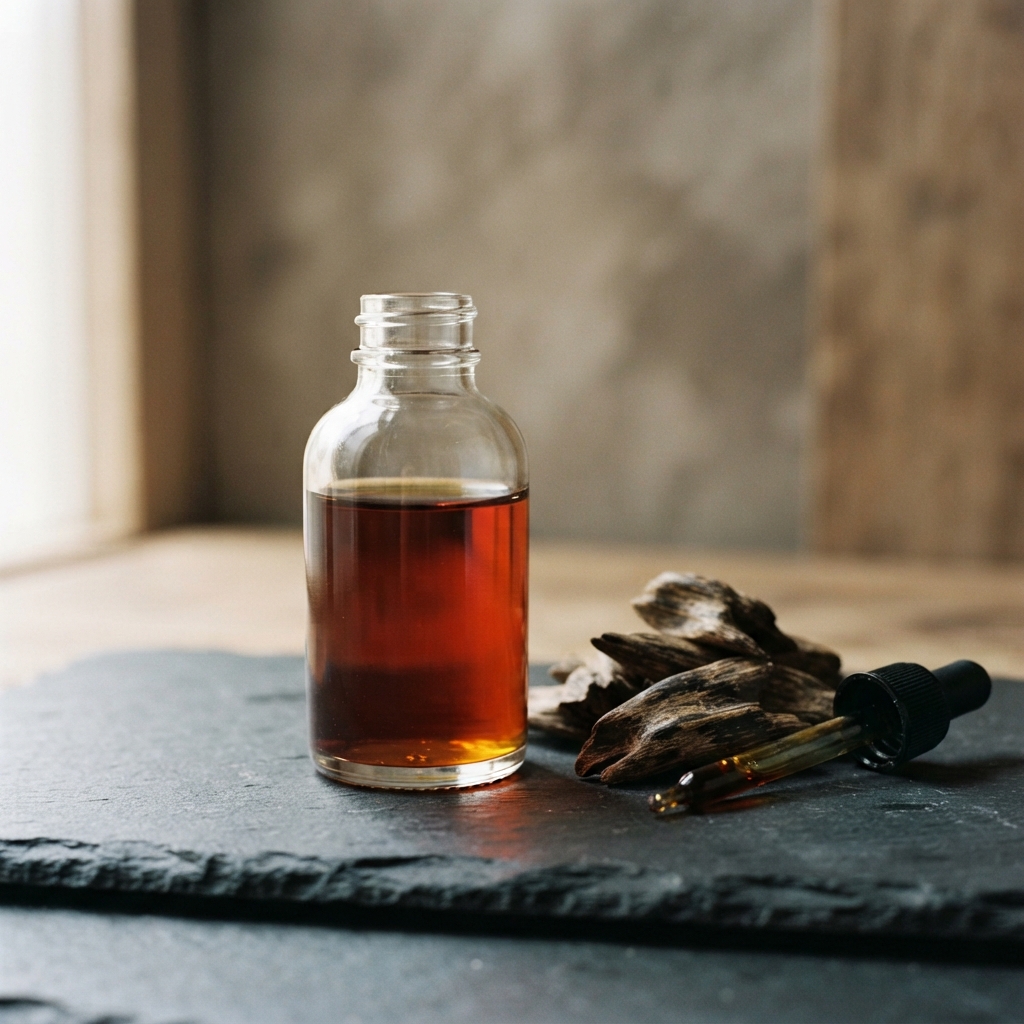
An oud oil certificate of analysis is a report of measured results for one production batch, and it becomes evidence only when the batch number, the laboratory, the method and the material description all match the lot you are buying. Most sourcing disputes over oud oil are not caused by a missing document; they are caused by a document that was never tied to the shipment. This guide shows importers, perfume brands and fragrance traders how to request that evidence, read it line by line, and write it into a purchase order before a bulk order is placed.
The Five Documents Buyers Confuse
A supplier folder often contains several papers that look authoritative and answer completely different questions. Separate them before you evaluate anything.
| Document | Question it answers | What it does not prove |
|---|---|---|
| Certificate of analysis (COA) | Which values were measured on a named batch, by which method | That the batch you receive is the batch described |
| GC-MS report | Which volatile compounds appear in the sample and in what relative amount | Species certainty, origin, sensory quality or legal status |
| Batch or production record | Who produced the oil, when, from what material and in what quantity | That the oil in the drum is the oil in the record |
| Safety data sheet (SDS) | Hazards, handling, storage and transport classification | Quality, purity or authenticity |
| Species and export papers (for example CITES permits) | Whether the shipment may cross a border, and under whose name | Quality — and only if the permit description matches the goods |
Buyers who treat these as one interchangeable "certificate" end up accepting an SDS as proof of purity or a permit as proof of quality. An agarwood oil COA is the only one of the five that reports measured values, which is why it is the document your purchase order should reference by number. Ask for each paper separately, and ask which lot each one refers to.
Start With the Name Printed on the Report
"Oud oil" and "agarwood oil" are two trade names for aromatic material from Aquilaria and closely related genera; neither name is a specification. The naming question is covered in our guide to oud oil versus agarwood oil, but for document purposes the rule is narrow: the product name on the COA, the invoice, the packing list and the permit should describe the same material in the same words.
Where the names diverge — a COA headed "agarwood oil", an invoice headed "oud oil", a permit describing chips — you have a traceability gap, not a translation preference. Ask the supplier to reconcile it in writing before the deposit, not after arrival.
Raw Material and Extraction Route Decide What the Report Can Show
Two oils sold under the same name can produce very different analytical profiles because the material and the route differ. Steam or water distillation, solvent extraction and supercritical CO2 extraction each recover a different fraction of the wood, so a report is only interpretable when the route is stated on the batch record beside it.
Ask four questions in writing: which species and growing region supplied the wood; whether the material was plantation-grown or wild-collected; how resin formation was managed; and which extraction route produced the batch. A supplier that describes its cultivation approach — for example stating that no chemical resin-induction agents are used — has given you a claim you can then test against the batch record, which is more useful than an adjective on a label.
Why Aroma Cannot Prove Purity
Sensory assessment is a screening tool, not evidence. Nose fatigue sets in within minutes, a small quantity of genuine oil in a neutral carrier can read convincingly as oud in a warm room, and the first ten minutes after opening rarely predict the dry-down. Aroma can tell you whether a sample sits in the right family and whether it suits your formula; it cannot tell you whether the oil is undiluted, which species it came from, or whether the drum matches the sample.
Most agarwood oil adulteration is commercial rather than chemical: a legitimate oil extended with a carrier, or a modest volume of real oil carrying a larger volume of blend. That is why the useful question is never "does it smell right?" but "which measured result, on which batch, supports the claim I am paying for?"
Whose Name Should Appear on the Report
A manufacturer operates the extraction equipment and can explain a batch. A wholesaler holds stock. A trader intermediates and may never see the material. All three can be legitimate, but only the party that processed the oil can produce a production record for it.
Match four names against each other: the legal entity on the quotation, the entity on the bank account, the entity on the export documents, and the producer named on the batch record. Oud oil supplier verification therefore starts with the producer's own paperwork, not with the seller's brochure, because where the names diverge you are buying through a chain and the technical answers you receive are second-hand. Our article on verifying who really produces the oil sets out the document trail that separates the two.
Using Documents to Test Capacity and Continuity
Capacity is not a number in a brochure; it is the volume a supplier can repeat without drifting grade. Batch records test that claim cheaply. Ask for the batch numbers issued over the last twelve months, the production dates, the quantity of each batch, and the largest single batch produced.
A producer with real throughput can show a sequence of dated, numbered batches. A reseller typically cannot, and will offer a generic report instead. When you place a second order, compare the new oud oil batch record against the first: if the numbering restarts, the dates cluster suspiciously, or the "batch" is always the same reference, you are looking at a stock description rather than a production record.
The Sample and Document Pack to Request
Request oud oil wholesale samples that are lot-linked, not a drop from an unlabelled stock bottle, and ask for enough material to run two evaluations plus keep a sealed reference. Alongside them, ask for:
- Batch or lot number, production date and quantity produced
- Species and origin declaration tied to that lot
- Extraction route and a statement of any carrier or diluent
- A certificate of analysis, where the supplier issues one, naming the laboratory and the method
- A safety data sheet for the material as supplied
- Any species or export document the shipment will travel under
If a supplier issues no COA, that is information rather than a disqualification: it tells you the verification cost sits with you, and you can price independent testing into the order. What you should not accept is a report that names no lot.
Reading a COA Line by Line
Identity and traceability fields
Check the product name, botanical name, lot or batch number, production date, quantity represented, laboratory name, report number and date of analysis. A report without a lot number describes a sample, not a shipment. A report dated after your order was packed should be explained.
Physical and chemical parameters
Typical lines include appearance, colour, odour, specific gravity, refractive index and optical rotation, each with a method reference and a result. These are useful identity and consistency checks: they help you confirm that two deliveries are the same material, and they flag obvious substitution. They are not a standalone oud oil purity test, because a blend can be formulated to land inside a wide physical range.
GC-MS composition
The chromatogram and peak table in an oud oil GC-MS report are the part buyers most often over-read. Two questions make the difference: is the table reported as area percentage or as a quantified amount against a calibration standard, and which compounds were used as markers? Area percentage is a relative figure that shifts with the sample and the method; it is not a purity measurement.
Also ask whether the laboratory looked specifically for diluents and carriers, and at what detection limit. A generic scan that reports thirty sesquiterpenes and no carrier may simply not have been set up to find one. Where the value of the lot justifies it, confirmatory techniques such as chiral analysis or stable isotope work can address questions that a standard scan cannot, and the laboratory you commission should be able to explain its limits. Laboratories accredited to ISO/IEC 17025 can show that their methods and competence have been independently assessed.
What a GC-MS report cannot tell you
It cannot grade an oil, confirm a country of origin, or prove that a product is legally exportable. Nor does it replace sensory evaluation for your application. Treat it as one line of evidence among several, and be sceptical of suppliers who present a chromatogram as a complete answer.
Batch Consistency, Storage and Packaging
Consistency is a specification problem before it is a supplier problem. Write tolerance bands for colour, viscosity and sensory profile, and require a retained sample from every batch so that a later delivery can be compared against a physical reference rather than a memory.
Oud oil is affected by oxygen, light and heat. Specify the container material, fill volume, headspace, closure and label, and for drums ask whether the headspace is flushed with inert gas. ISO 210:2023 sets out general requirements and guidance for essential oil packaging, conditioning and storage, and is a practical reference when you write that clause. Our guide to oud oil shelf life and retesting covers arrival inspection and retention practice.
What a Quotation Should Show When Testing Is Included
Testing changes the price, so it has to appear in the quotation. Ask for the offer to be broken into material, processing, packaging, testing, documentation and freight, with the Incoterm named. Then specify who commissions the test, which laboratory, which parameters, and whether the cost is per batch or per shipment — and say whether an oud oil certificate of analysis is part of the price or a buyer-side cost.
At small volumes, laboratory work can be a meaningful share of the cost per kilogram, which is why buyers sometimes pay for one full analysis on a trial batch and rely on physical parameters plus sensory comparison thereafter. Whatever you choose, write it down: an undefined testing arrangement is the most common reason a "certified" batch arrives with no usable report.
Comparing Three Suppliers Without Being Anchored by Price
Send the same written brief to at least three suppliers — application, target market, estimated volume, packaging and the documents you require. Request the same sample size from a named batch, evaluate the samples blind, then normalise every quotation to the same Incoterm, packaging unit and document set.
Then compare landed cost per kilogram of usable oil alongside the evidence offered: does the bid include a lot-linked COA, a batch record and an SDS, or only a price? A cheaper offer without lot data is not cheaper; it moves the verification cost onto you, and the difference usually shows up as an oud oil certificate of analysis you have to commission at your own expense. Our breakdown of bulk oud oil price comparison shows the normalisation step in detail.
Destination Market: SDS, Composition Data and Labelling
Three different requirements usually apply, and they depend on the destination and on what you do with the oil. A safety data sheet describes hazards and handling; under the UN Globally Harmonized System it follows a 16-section structure, and the version you receive should match the rules of the market you are importing into. Composition and allergen information matter when the oil becomes part of a cosmetic or fragrance product. Labelling requirements follow the classification of the finished article, not the drum it arrived in.
Confirm the applicable rules with your own regulatory adviser or the importing authority, and ask the supplier for the documents that support them. Do not accept "therapeutic grade", "food grade" or "certified organic" as a substitute for a certificate that names the standard and the certificate holder.
CITES and Species Documents for Regulated Agarwood
Agarwood-producing species are listed under CITES. Aquilaria malaccensis was the first agarwood species listed in Appendix II, in 1995, and the remaining agarwood-producing species were added at a later Conference of the Parties; the CITES Secretariat's own species documents record this history. Listing does not mean every consignment of oil needs the identical paperwork: the requirement depends on species, form, quantity and how the importing country implements the listing.
Your oud oil import documents should be checked as a set — invoice, packing list, permit and analysis describing the same goods — because a permit describing wood chips will not clear a drum of oil. What you can ask regardless of the outcome: which species the lot comes from, which permit the shipment will travel under, who the named permit holder is, and whether the permit description matches the goods. Confirm the position for your own shipment with the importing country's CITES management authority before you release a deposit.
MOQ, Sampling Runs, Custom Packaging and OEM/ODM
Minimum order quantity follows the smallest production batch a supplier can run, plus container fill and any label or carton run. Ask what the figure is based on and whether a smaller trial quantity is available before bulk.
For private-label and OEM work, confirm in writing who supplies the bottle, who owns the artwork, which approval steps precede production, and which sample the first run will be measured against. OEM means the supplier produces to your specification; ODM means you adapt an existing development. Say which one you are buying, and record it in the order.
Lead Time, Logistics, Inspection and Claims
Lead time is four clocks running at once: material allocation, production, documentation and freight. Ask for a date against each rather than one delivery estimate.
Before shipment, agree what will be inspected, by whom, against which specification, and whether a third-party inspection is available. Then write the claim route into the order: the notification window after arrival, the evidence you will supply, and the remedy ladder. For a document-led purchase, the strongest clause ties the claim to the approved sample and the batch report, so that a dispute is settled by comparison rather than by opinion.
Oud Oil Supplier Evaluation Checklist
| Area | What to confirm | Document that proves it |
|---|---|---|
| Raw material source | Species, region, plantation or wild origin, resin management | Written origin declaration tied to the lot, not to the product family |
| Sample performance | Colour, odour and behaviour in your own base, evaluated blind | Coded, lot-linked sample plus your signed evaluation record |
| Batch records | Batch number, date, quantity, extraction route, retained sample | Production record and, where issued, a lot-specific COA |
| Quotation terms | Unit, Incoterm, currency, validity, testing and packaging separated | Written quotation that names what the price includes |
| Packaging | Container, closure, fill weight, headspace, labelling | Pack specification and a photograph of a packed unit |
| Lead time | Dates for allocation, production, documents and freight | Dated schedule in the order confirmation |
| Verifiable documents | Entity, bank, export and species papers agree with each other | Copies issued in the same legal name as the quotation |
What to Request From NanjaOud for the Proposed Oil Lot
NanjaOud lists agarwood oil products. A product listing and photograph establish a product reference; they do not establish that a COA, GC-MS report, laboratory accreditation or a particular batch test is available. Send the intended use, target quantity, destination and proposed acceptance criteria. Ask NanjaOud which batch identifiers, samples and test documents can be supplied for that specific quotation. If an independent test is required, agree on the laboratory, method, sample custody and cost before ordering.
Conclusion
An oud oil certificate of analysis is worth the paper it is printed on only when it names the batch, the laboratory and the method, and when the batch it names is the one in your drum. Build the same evidence set for every candidate supplier — lot-linked sample, batch record, SDS, species papers and a quotation on stated terms — and compare them on identical footing.
To confirm what can actually be supplied for your programme, send your application, target market, estimated volume, packaging direction and the documents your market requires through the contact page.
FAQ
Is a GC-MS report proof that oud oil is pure?
No. It shows which volatile compounds a sample contains and in what relative amount. It can reveal obvious dilution or substitution, but it does not grade the oil, confirm its origin or prove that the batch you receive matches the sample tested.
What should an oud oil certificate of analysis include?
A lot number, production date, quantity, product and botanical name, the laboratory and report reference, the test methods, the measured values, and a statement of any carrier or diluent. Without the lot number, the rest is of limited use.
Do I need to test every batch myself?
Not necessarily. Many buyers run one full analysis on a trial batch, then rely on physical parameters, a retained sample and sensory comparison for repeat orders, escalating to laboratory work when a delivery looks or behaves differently.
Which laboratory should test oud oil?
One that can explain its methods and limits, and preferably one whose competence is independently assessed, such as a laboratory accredited to ISO/IEC 17025. Ask what the method detects and at what limit before you commission it.
What is the difference between a COA and an SDS?
A COA reports measured results for a batch. A safety data sheet reports hazards, handling and transport information for the material. Neither substitutes for the other, and an SDS proves nothing about quality.
Do I need CITES documents for oud oil?
Possibly. Agarwood-producing species are CITES-listed, but the requirement depends on species, form, quantity and destination. Confirm with the importing country's management authority, then ask the supplier which permit the shipment will travel under.
How many samples should I request before a bulk order?
At least two, from different batches, so you are testing consistency as well as quality — plus one sealed reference to compare against the first delivery.
Can I reject a delivery using a COA?
Yes, if the purchase order names the specification and the approved sample, and the arrival is tested against both within the notification window. A claim without a written benchmark becomes a negotiation.


