
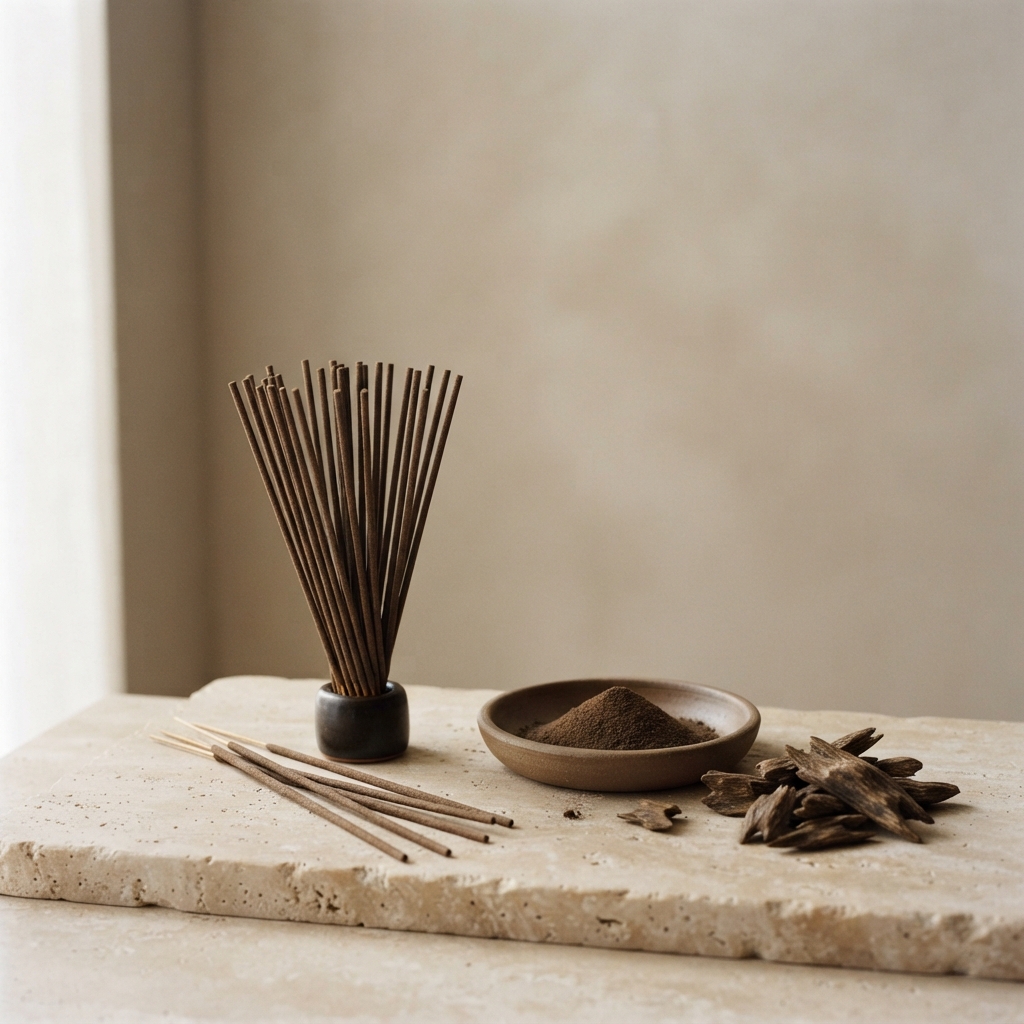
An agarwood incense stick is a construction before it is a fragrance. Wholesale buyers choosing between cored and coreless agarwood incense sticks are really choosing a diameter, a burn profile, a packing method and a claim route — and every one of those has to be written down before the first carton ships.
What Cored and Coreless Agarwood Incense Sticks Actually Are
Two production routes dominate wholesale incense supply. They behave differently in the box, in the burner and in a dispute.
Cored construction
A cored stick is made by coating an aromatic paste around a thin bamboo or wooden reed. The reed carries the stick and keeps it straight; the coating supplies the scent. Because the core is a separate material, the buyer is paying for two components and should ask for both to be named: the reed type and the coating composition. A cored stick is generally stiffer and more tolerant of rough handling, which is why it dominates high-volume retail and ritual formats.
Coreless construction
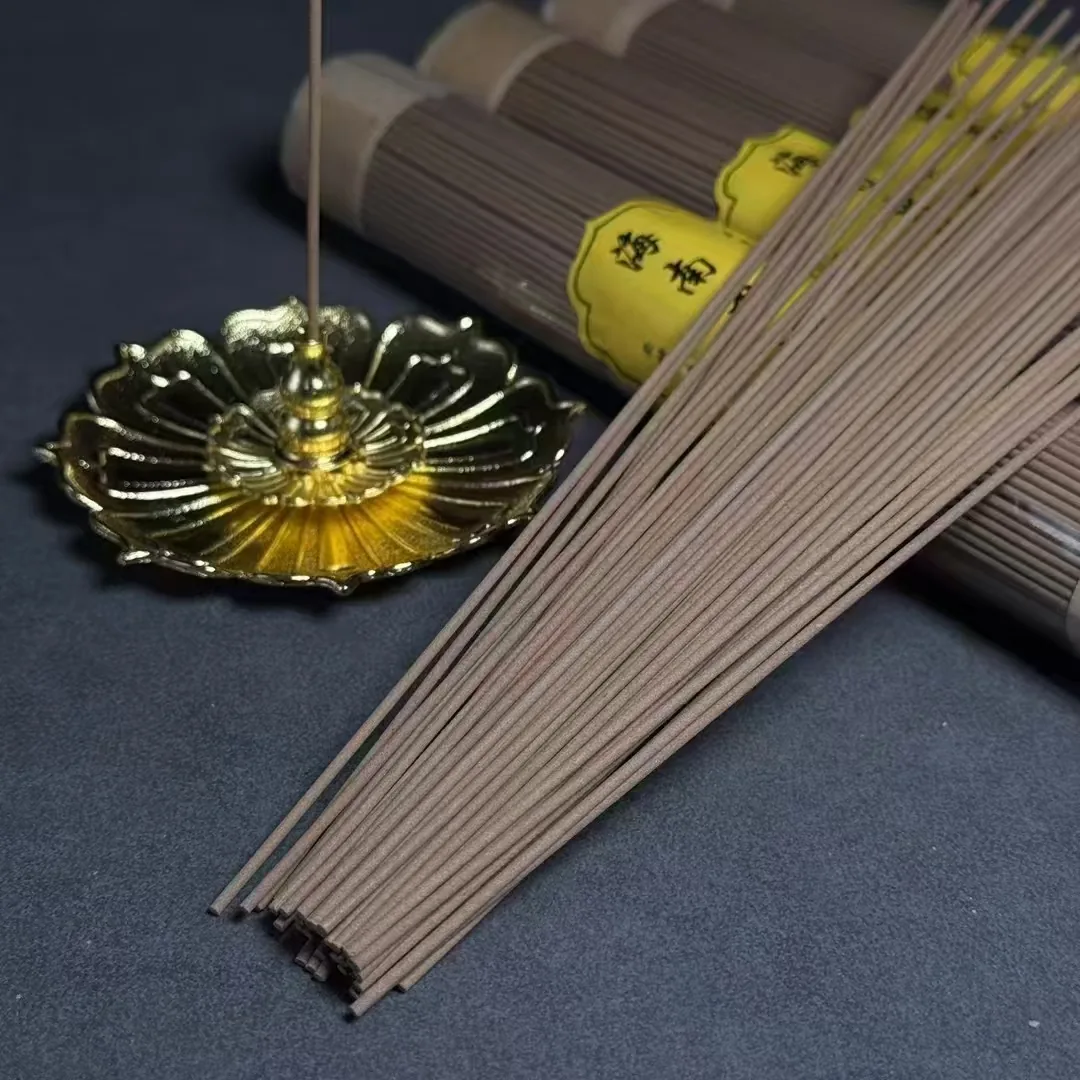
A coreless stick is extruded from a single aromatic mass — wood powder, binder and any added fragrance — with no internal support. It is usually slimmer and more uniform in appearance, and it burns as one material rather than as a coating over a reed. Coreless formats are common in premium and private-label ranges, including the slim coreless Hainan and Kynam sticks in our agarwood incense range. Coreless sticks are less forgiving: they are more sensitive to moisture, packing and handling, so bending and breakage become commercial issues rather than cosmetic ones.
| Buying criterion | Cored stick | Coreless stick |
|---|---|---|
| Construction | Aromatic coating over a bamboo or wooden reed | Single extruded aromatic mass, no reed |
| What you must specify | Reed type, coating weight, coating thickness | Diameter, extrusion density, binder |
| Typical failure mode | Coating cracks or separates from the reed | Bending, snapping, soft or crumbly body |
| Packing risk | Lower; sticks resist compression | Higher; needs rigid support and moisture control |
| Claim evidence | Reed and coating both sampled | Diameter and density measured at several points |

Why Construction Changes What You Are Buying
Diameter, length and burn behaviour
Burn time is a function of mass, diameter, density and airflow — not of the word "agarwood". A supplier who quotes a burn time without stating stick diameter, length, unit weight and test conditions has given you a number you cannot enforce. Require the figure to be recorded against a measured sample, and read our guide to testing incense stick samples for burn performance before you accept a claim.
Aroma, binder and smoke
The aromatic experience comes from the wood fraction and from anything added to it. Binders such as natural tree-bark or gum powders hold a coreless stick together; some producers also use fragrance compounds. "Natural" is a marketing word until the ingredient declaration names the wood species, the binder and any added fragrance. Smoke volume is a separate specification: it follows the same mass and airflow variables and should be described in your own words against a reference sample, never copied from a supplier's brochure.
Packing and breakage
Coreless sticks need a rigid inner support, a moisture barrier and a carton that survives compression. Cored sticks tolerate more. Either way, breakage allowance is a commercial term: state a maximum acceptable breakage percentage per carton and the remedy if it is exceeded.
How to Evaluate Samples Before a Wholesale Order
Ask for material and formulation disclosure
Request in writing: wood species or trade name, form of the wood fraction, binder type, any added fragrance or colourant, nominal diameter and length, unit weight and packing count. If a supplier cannot state the binder, the sample is not yet a product.
Run a repeatable burn trial
Burn at least three sticks from the same bundle, in the same room, at the same time of day, and record ignition time, total burn time, visible smoke, ash colour and structure, whether the stick stays upright, and any odour note that is not wood. Photograph the ash and the remaining stub. Then repeat on a second bundle from a different production run — that is where inconsistency shows.
Tie the approved sample to the bulk lot
Keep a sealed reference sample, label it with the date, the supplier's lot code and your own code, and write the sample reference into the purchase order. Without a lot-linked sample, "as approved" has no meaning in a dispute. Our wholesale specification guide sets out the clauses that make this enforceable, and the manufacturer shortlisting guide covers the earlier qualification stage.
Wholesale Terms: MOQ, Quotation and Packaging
What an MOQ figure should include
An MOQ is not one number. Ask whether it applies per scent, per format, per pack size or per mixed pallet, and whether a lower quantity is possible with a stock pack. Sample cost, courier cost and whether the sample charge is credited against the first order should be stated, not assumed.
Reading a quotation
Convert every offer to cost per sellable stick, including the pack, the inner support, the label, the export carton and the freight term. A lower unit price with a heavier pack or a higher breakage rate is not cheaper. Our quotation comparison guide shows the arithmetic.
Private label, OEM and ODM checks
For a private-label or ODM program, confirm who owns the formulation, who approves artwork, what the print and label approval route is, and whether the MOQ changes when the pack changes. The private label OEM guide covers briefing and qualification in detail.
Import Compliance: Documents to Confirm Per Market
Requirements differ by destination and by product, and no single certificate covers every market. Treat the following as a question list, not a guarantee.
Product safety and labelling
Ask which product-safety rules apply to incense in the destination market, what the label must state — ingredients, warnings, importer details, batch code — and whether the supplier can provide a safety data sheet or composition statement. Burning products are regulated differently from cosmetics and from food-contact goods; confirm the applicable rules with your own importer or compliance adviser rather than relying on a supplier's summary.
CITES and agarwood species
Agarwood-producing species of Aquilaria and Gyrinops are listed in CITES Appendix II, so international trade in the wood and its products is subject to permit requirements (CITES CoP20 working document on agarwood). Ask whether the material is plantation-grown, which species it is, and which permits the exporter will provide. The FAO review of CITES and forest trade explains why the paper trail matters for agarwood specifically.
Wholesale Agarwood Incense Supplier Comparison Checklist
| Dimension | What to record | Pass condition |
|---|---|---|
| Raw material | Species or trade name, wood fraction, plantation or wild | Named and consistent across lots |
| Formulation transparency | Binder, added fragrance, colourant | Full written declaration |
| Product specification | Diameter, length, unit weight, packing count | Measured, not described |
| Burn performance | Burn time, smoke, ash, upright behaviour | Recorded against a sealed sample |
| Sample stability | Second-run bundle versus first | Within your stated tolerance |
| MOQ | Per scent, format and pack | Written, with mixed-pallet rule |
| Packaging | Inner support, moisture barrier, carton grade, label | Survives compression test |
| Quotation | Cost per sellable stick, Incoterm | Comparable across suppliers |
| Lead time | Production, documents, freight | Backward-planned to your in-store date |
| After-sales | Breakage allowance, claim window, remedy | Written into the purchase order |
Common Mistakes
- Approving a sample without recording its diameter, weight and lot code.
- Comparing quotations at unit price instead of cost per sellable stick.
- Accepting "natural" as an ingredient statement.
- Ordering coreless sticks in a pack designed for cored ones.
- Leaving breakage allowance and the claim window out of the purchase order.
- Assuming one compliance document satisfies every destination market.
FAQ
Is coreless agarwood incense better than cored?
There is no universal answer. Coreless removes the reed from the burn and gives a slimmer, more uniform stick; cored is more robust in handling and freight. Choose by market, pack format and price position, then test both.
How long should an agarwood incense stick burn?
It depends on diameter, length, density and airflow. Require the burn time to be tied to a measured sample with stated test conditions, otherwise the figure cannot be enforced.
Does a bamboo core change the smell?
The reed is a separate burning material, so whether it is noticeable depends on the coating and the reed itself. Burn cored and coreless sticks side by side in the same room before you decide.
What is a normal MOQ for agarwood incense sticks?
It varies with format, pack and scent. Ask for the MOQ per scent, per format and per pack, and confirm whether a mixed pallet is accepted.
Do I need CITES documents?
If the product contains listed Aquilaria or Gyrinops material, international trade is subject to permit requirements. Confirm the species and the permits with the exporter and your own import authority.
How do I check sample-to-bulk consistency?
Use a sealed reference sample, quote its code on the purchase order, compare a second production run before ordering, and inspect the arrival against the same measurements.
Can I order private label?
Yes, for the formats a supplier actually lists. Confirm formulation ownership, artwork approval and how the MOQ changes with the pack.
Conclusion
Cored and coreless agarwood incense sticks are two different products with two different risk profiles. Define the construction, measure the sample, tie it to a lot code and put the breakage and claim terms in the purchase order — then price the offers on cost per sellable stick. If you are sourcing for a wholesale or private-label program, send your estimated quantity, target market, stick type, dimensions, packaging direction and sample standard through our contact page, and review the Hainan and Kynam incense products we currently list.


