
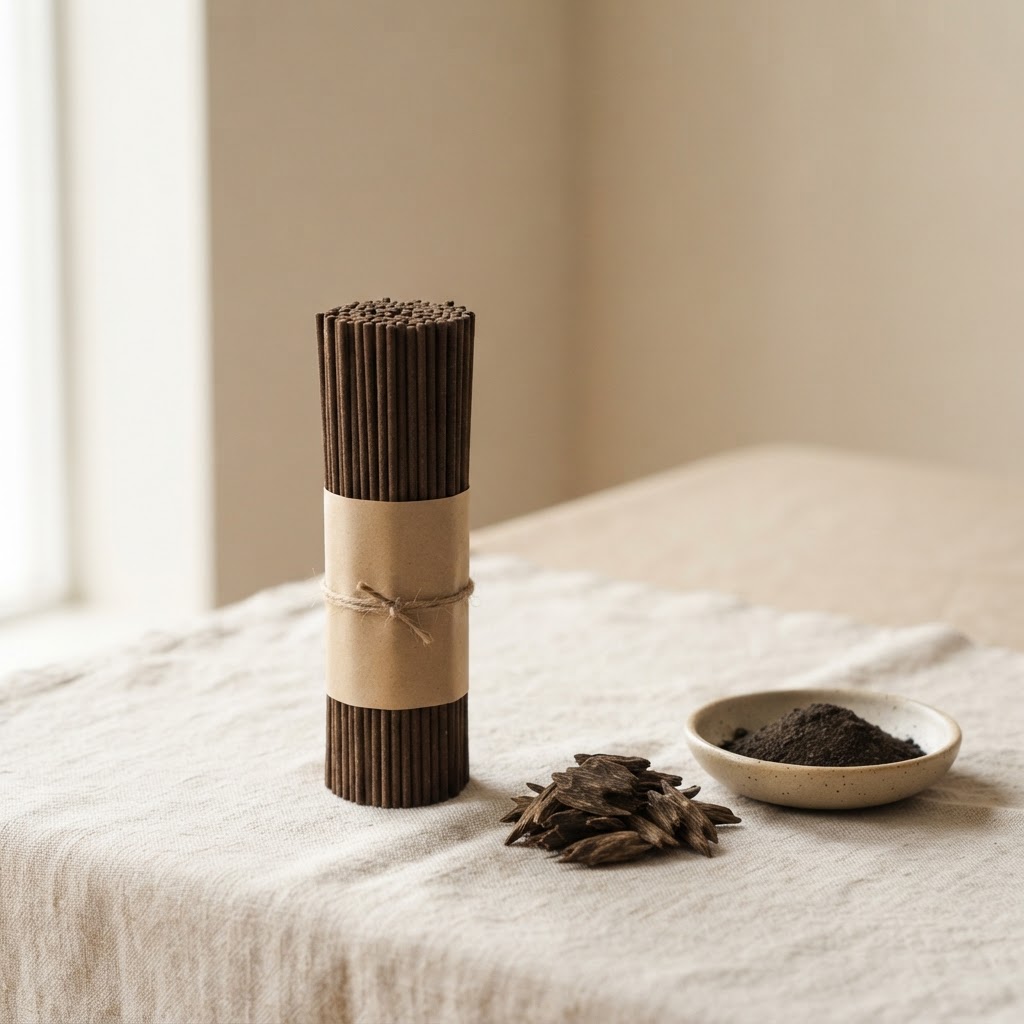
An agarwood incense sticks wholesale price is not one number: it is a quotation built from a material share, a stick format, a packing unit and a freight term, and two suppliers can quote the same carton count at a threefold difference without either being dishonest. Comparing those offers only works when you convert each one to the same basis — cost per sellable stick at your door — and when the specification behind the price is written down.
What an agarwood incense sticks wholesale price covers
A stick can be predominantly agarwood powder, a blend where agarwood is one component, or an agarwood-scented stick built on a carrier powder and a fragrance oil, and all three are sold under the same words. Ask each agarwood incense sticks supplier which of the three they are quoting, the species or trade name of the wood, and the approximate share of agarwood as a band rather than an exact recipe. That answer explains most of the gap between offers, and it is the line you can never audit later if it was not written down.
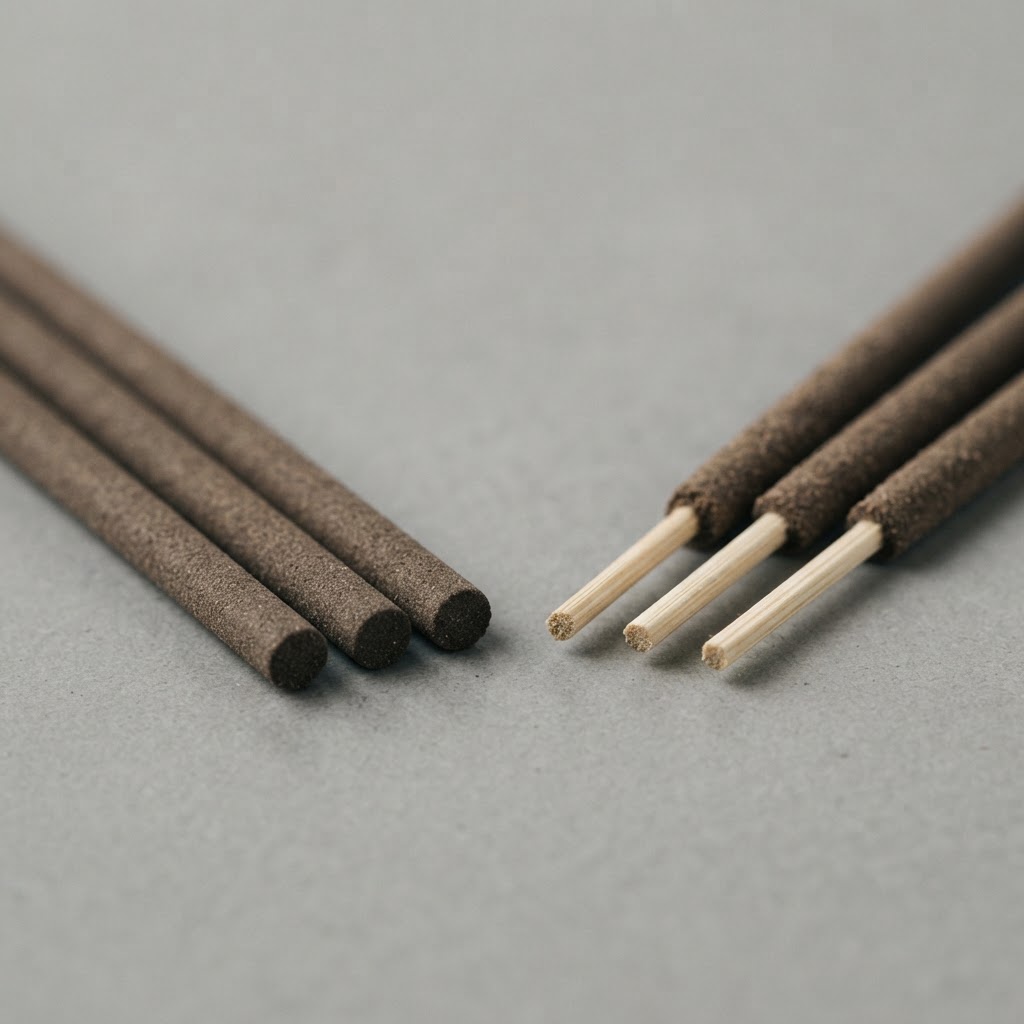
Construction and size come next. A bamboo-cored stick carries paste on a splint, so part of its cross-section is not aromatic material, while coreless incense sticks are extruded solid; diameter, length and paste density then decide the grams of blend in each stick. Coreless sticks are usually more brittle before they age, so inner packing has to be specified with them. A cheaper stick is often simply a thinner or shorter one, so ask for length, diameter, nominal grams per stick and pieces per bundle, and treat a missing size as a missing price.
Behind the unit price sit conversion loss, drying and breakage. Paste is lost in rolling or extrusion, sticks lose water weight before packing, and a proportion breaks between the drying rack and the carton. When you buy bulk agarwood incense sticks, ask what breakage rate the price assumes, and whether the carton count is the packed count or the calculated one.
Reading a quotation: four figures to normalise
Price basis
Per stick, per bundle, per box and per carton are four different prices. Ask for the basis on the quotation and convert everything to a cost per stick before ranking, because an agarwood incense sticks wholesale price is only comparable when both cartons hold the same number of sticks of the same size.
Packing, printing and freight
Confirm whether inner packing, retail box, print setup and export cartons are included, which Incoterm applies (EXW, FOB, CIF or DDP), and who books freight and insurance. A private label incense sticks program adds dielines, proofs and print setup, so separate those lines from the product price; an offer that excludes inner packing and freight usually loses its advantage once both are added.
MOQ tiers and mixed SKUs
The incense sticks MOQ is normally set per SKU and per packing format rather than per order, and the minimum for printed packs is often two to three times the stock-pack minimum. Request a written table and confirm whether several SKUs can share one container — the answer decides whether a small first order is possible at all.
Payment terms and price validity
Deposit and balance split, currency and how long the price holds all matter when material prices move. Record the validity date; a quotation without one is not a commitment.
Cost per sellable stick: the number to compare
Add the invoice value to freight, insurance, duty and clearance, then divide by the number of sticks that reach a shelf intact. In oud incense wholesale, a low unit price with heavier breakage and a high minimum per SKU can cost more per sellable stick than a higher quote with firmer inner packing; that is general guidance, not a rule for any one supplier. Run the calculation on your own figures and keep it beside the approved sample, so the price decision and the quality decision are recorded together.
Proving the bulk order matches the sample you priced
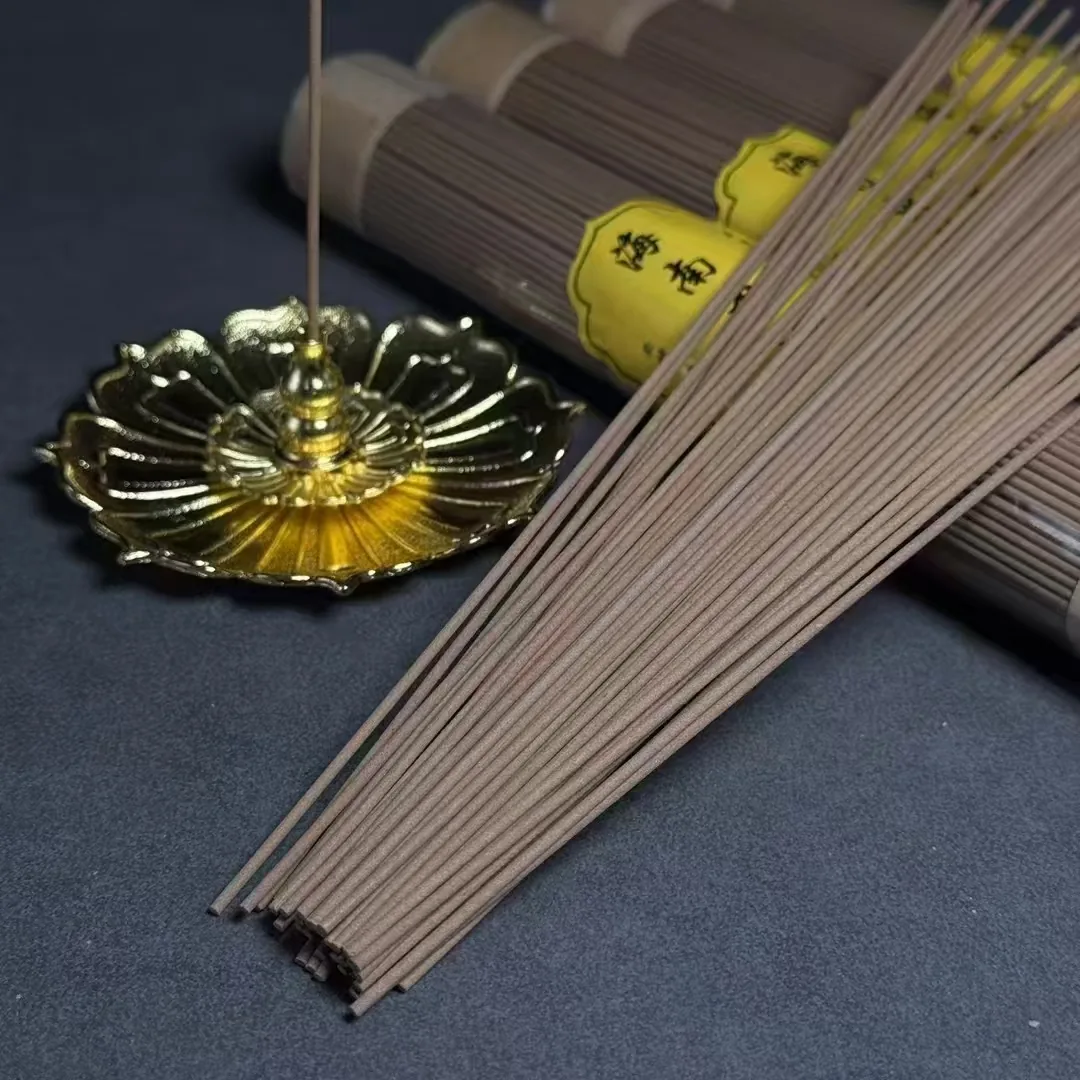
Price and sample are two halves of one offer. Attach the specification to the purchase order — construction, length, diameter, grams per stick, pieces per bundle, packing method, breakage allowance and lot code — and reference the sealed approval sample by date. Then require a pre-shipment sample drawn from finished bulk production rather than from the sample room, and compare it with the retained sample on ignition, total burn time, smoke density, ash behaviour, self-extinguishing and how the scent develops from the first third to the last. Take three sticks from different parts of the bundle, not three from the top.
Our guide to testing agarwood incense stick samples sets out what to record, and the supplier shortlisting guide covers material disclosure and qualification in more depth.
Agree the shortfall route before the container ships
Fix the notice window after arrival, the evidence you will send (photographs of the sealed carton, the opened bundle, a broken-stick count, a burn comparison against the retained sample) and the remedy: replacement, credit, price adjustment or return, with return freight assigned in advance. A claim is decided on the record you kept.
Compliance items that change the landed cost
Request a full component declaration, a safety data sheet where the product or its fragrance components require one, an allergen statement for the fragrance portion, and test reports showing the laboratory, method, date and the batch they refer to. Commercial agarwood comes mainly from Aquilaria and Gyrinops species, which are CITES-listed, so shipments of their parts and derivatives generally need export documentation from the origin country plus whatever the importing country asks for; the CITES review of the agarwood-producing genera is useful background on the trade.
Product-safety and labelling duties are set market by market and are not harmonised. In the European Union, Regulation (EU) 2023/988 on general product safety places traceability and labelling duties on manufacturers and importers; other markets set their own rules on language, warnings and importer identity. Confirm the position with your importer of record or customs broker before artwork is approved, and build documentation time into the schedule.
Wholesale Agarwood Incense Supplier Comparison Checklist
Score each supplier from one to five on all ten dimensions below, and fill the evidence column. A row with no evidence is not a score.
| Dimension | What to record | Warning sign |
|---|---|---|
| Raw material | Species or trade name, part used, plantation or wild, share band | "Agarwood" named with no species or share |
| Formula transparency | Binder type, added oils or resins, colourants, moisture at packing | No component category disclosed at all |
| Product specification | Coreless or cored, length, diameter, grams per stick, pieces per pack | Size given only as "standard" |
| Burn performance | Your own sheet: burn time, smoke, ash, self-extinguishing | A website burn time never tested on a sample |
| Sample stability | Two coded samples ordered weeks apart behave alike | The second sample is visibly different |
| MOQ | Written table per SKU and per packing format | One verbal number for every product |
| Packaging | Inner protection, carton grade, dieline and signed proof | Print approved without a proof |
| Quotation | Basis, Incoterm, what is included, validity date | Price with no basis and no validity |
| Lead time | Sample, production, documentation and freight windows | One date offered for all four |
| After-sales | Notice window, evidence list, remedy ladder, named contact | The contact goes quiet after payment |
Agarwood incense sticks from NanjaOud
NanjaOud supplies agarwood incense from Jiangmen, Guangdong, for wholesale, private-label and ODM programs. The agarwood incense range lists the current formats; the Hainan agarwood incense sticks product is described as a slim coreless stick with a uniform brown appearance, presented in compact bundles, and offered for bulk supply plus private-label and customization discussion covering packaging, labelling and gift-set presentation. The company states more than ten years of agarwood cultivation experience, a managed plantation base of more than 160 acres (about 1,000 mu), natural cultivation standards without chemical resin-induction agents, and in-house processing, with raw material available through the agarwood chips and raw materials range.
Fixed dimensions, burn times, smoke levels and recipe ratios are deliberately not published on those pages: they are confirmed against a buyer-approved sample during sampling and quotation. The quality and supply page describes the checks applied to an order, the OEM and private label page covers packaging and branding cooperation, and buyers briefing a custom incense sticks manufacturer can send their specification through the same route.
Frequently asked questions
How is an agarwood incense sticks wholesale price normally quoted?
Usually per box or per carton, sometimes per bundle. Ask for the basis in writing, then convert every offer to a cost per sellable stick before comparing.
Why do quotations for the same carton count differ so much?
Different agarwood share, grams per stick, cored or coreless construction, packing and freight terms. Once those are normalised, the remaining difference is usually material grade.
What should I ask for before approving a sample?
The written specification for that sample, whether it is a stock sample or a made-to-specification trial, and the production price for the same specification. A sample with no matching price proves capability, not cost.
Are CITES documents included in the quoted price?
Not by default. Whether a finished incense shipment needs permits depends on species, material form and destination, so ask which documents are included, who obtains them, and add the cost and lead time to your landed-cost sheet.
How do I calculate cost per sellable stick?
Take total landed cost, subtract the sticks that arrive broken based on your own arrival count, and divide. Recalculate on the repeat order, because breakage changes when packing or courier routes change.
Conclusion
An agarwood incense sticks wholesale price becomes trustworthy only after three things exist: a written specification behind the number, a tested sample tied to that specification, and a landed-cost calculation that includes packing, freight, breakage and documentation. Suppliers who can answer all three are worth a repeat order, whatever their first quote looks like. If you are preparing a bulk order, send your estimated quantity, target market, stick type and dimensions, packing requirements and sample standard through our contact page and we will confirm what is available for your project.


