

Agarwood shavings wholesale buyers face a decision that most quotations never put on the table: pay a premium for material already cut and screened to a band, or buy chips and fragments and produce that screened fraction inside your own plant. The answer is arithmetic, not preference. It depends on four numbers you can obtain before you order — the screening premium per tonne, your annual tonnage, the share of the feedstock that leaves as off-band material, and the real cost of running a screen in your building.
This guide is written for importers, incense and bakhoor manufacturers, and wood wholesalers who need to decide whether to buy oud wood shavings ready-screened or produce that band in their own plant. If the form question itself is still open — chips versus shavings versus granules versus powder — start with the comparison of agarwood chips vs shavings and how each form fits a process, then come back here to price the two routes.
What agarwood shavings wholesale buyers are really paying for
A supplier selling shavings is selling two things at once: wood, and a screening job already done. The wood component is priced by species, source and visible resin character. The screening component is priced by labour, equipment time and the material that was discarded to reach your band. When a buyer compares a shavings quote with a chip quote on price per kilogram alone, the second component disappears from the comparison, and so does the reason one number is higher than the other.
That is why the useful question is not "which form is better" but "at what annual volume does it become cheaper to screen this myself, and what risk do I take on if I do". Buyers who answer it in writing usually discover one of two things: that the premium is small relative to the labour they would add, or that they are already paying for screening twice — once in the material price and again in a reprocessing step on arrival.
The premium behind an agarwood shavings wholesale quote
Shavings and fine fragments are frequently a by-product of another operation: planing, slicing, dimensioning blocks or trimming pieces for retail. A plant that generates them can sell them as they fall, or screen them into a tighter band and sell that band at a higher price. The premium covers the screening run, the discarded oversize and undersize material, and the fact that a tight band means a smaller saleable share from the same tonne of input. None of this makes the premium fair or unfair. It makes it calculable, which is the only thing a buyer needs.
Agarwood Raw Material Specification Comparison Table
The table frames the four forms by what you must do to them before they enter your process, because that conversion work is the cost the purchase price usually hides. Incense factories buying agarwood shavings for incense sticks, coils or cones are usually more sensitive to the mill feed than to the label, while a buyer comparing a shavings quote with what an agarwood granules supplier offers is comparing two different cuts, not two quality levels.
| Form | How it is usually produced | Conversion you still own | What to confirm in writing | Where it typically fits |
|---|---|---|---|---|
| Chips and fragments | Cut, broken or trimmed to a rough size; visible grain and resinous colour | Size reduction and screening if your process needs a band | Size band and screen openings, oversize and undersize limits, foreign matter limit, moisture basis, pack weight | Burning, bakhoor blending, display, feedstock for in-house milling or screening |
| Shavings | Thin slivers from planing, slicing or a light cutting pass; often a by-product stream | Little or none if the band is right; possibly a fines trim | Thickness and length range, screen series, fines limit, dust, moisture basis, compression and pack format | Loose incense blends, burning, milling feedstock, repacking |
| Granules | Reduced and screened into a defined band; more uniform than shavings | Metering and blending only | Nominal band, share above and below the band, fines limit, moisture, uniformity across the lot | Metered blending, incense formulation, sachets, automated filling |
| Powder | Milled material specified by the share passing a stated screen | None, but dispersion and dust control move downstream | Screen or mesh size, passing percentage, moisture, agglomeration, liner and pack | Stick, coil and cone formulations, aromatic blends, extraction feedstock |
Two cautions on reading this table. First, the names are geometry words, not quality levels: no standards body assigns them a resin content, aroma class or species, and suppliers apply them inconsistently. Second, a supplier's A/B/C labels are internal sorting references; they do not translate between companies unless both sides define what each letter measures.
The four numbers that decide buy-screened versus screen-in-house
Agarwood shavings wholesale quotations rarely arrive in a comparable shape, so put these four numbers on one sheet before you negotiate anything.
- Screening premium. The price per tonne of the screened shavings band minus the price per tonne of the feedstock you would otherwise buy, expressed on the same moisture basis and the same delivery term. If the two quotes use different Incoterms or moisture bases, normalise them first or the premium is fictional.
- Yield from feedstock. The share of your feedstock that actually lands inside your band, measured on a real sample rather than assumed. Feedstock that yields 70 percent in-band is not comparable with feedstock that yields 90 percent, even at the same price.
- Annual tonnage through the band. Not your total purchase, only the material that passes through this step. At bulk agarwood shavings volumes a premium that looks trivial per tonne becomes the dominant cost, and a screen you buy for 20 tonnes a year is idle most of the year.
- Your true screening cost. Labour hours per tonne including setup and cleanup, power, space, dust extraction and filter media, screen replacement, supervision, and the disposal or discounting of the off-band fraction. Add the cost of the working capital tied up in feedstock that sits waiting for the screen.
The break-even test, written as a formula
Annual cost of buying screened, per tonne of in-band material, is the screened price divided by the delivered in-band share. Annual cost of screening in-house, per tonne of in-band material, is the feedstock cost divided by its in-band yield, plus your screening cost per tonne of feedstock divided by the same yield, plus the value you lose on off-band material that cannot be sold at full price.
Screen in-house only when that second figure is lower after every one of those terms is included. In practice the formula usually settles the argument in one direction very quickly, because in-house screening adds a fixed cost that does not shrink when volumes fall.
A worked example with assumed figures
The numbers below are illustrative only and are not a market reference; substitute your own quotations and test results.
| Line | Buy screened shavings | Buy chips, screen in-house |
|---|---|---|
| Quoted price per tonne of purchased material | 300 (assumed) | 230 (assumed) |
| In-band yield of what you receive | 95 percent | 72 percent, measured on a sample |
| Effective cost per in-band tonne before extra costs | 316 | 319 |
| Screening cost per feedstock tonne (labour, power, screens, dust) | 0 | 35 |
| Off-band fraction recovered at a discount | not applicable | 28 percent of feedstock sold at 40 percent of price = about 26 credit |
| Indicative cost per in-band tonne | about 316 | about 328 |
In this agarwood shavings wholesale example the screened purchase wins narrowly, and it wins because the in-house yield is poor and the screening cost is real. Change one assumption — a feedstock yielding 88 percent, or a screen already installed and paid for — and the answer flips. That is the point: the decision is sensitive to measured yield, which is why a feedstock sample you have screened yourself is worth more than any quotation.
The clause set a screened agarwood shavings wholesale order needs
If you buy screened, the specification has to describe a test, not an adjective. A workable clause names the screen series, the nominal band, the maximum share allowed above the top screen and below the bottom screen, the sample mass, whether the material is conditioned or dried before screening, and how long the stack is shaken. Fines deserve their own line, defined as the share passing your smallest useful screen, because fines are the fraction that most often turns a good-looking lot into an expensive one.
Foreign matter needs a limit and an inspection method: a stated sample mass, visual sorting, and a list of what counts — bark, fibre, sand, packaging debris. Moisture needs a basis and a method, since wet-basis and oven-dry figures describe different quantities, and resin-rich material behaves awkwardly in a standard oven test. None of these clauses demands laboratory precision. They demand that the method, the sample and the permitted deviation are agreed before the price is fixed. The full arrival routine is set out in this goods-in plan for wholesale shavings lots.
Verifying the premium is real: the side-by-side screen test
A premium for screening is only justified if the supplier's band is tighter than what you could produce. Test that directly, on your own bench, before you accept the price.
- Draw a lot-linked sample of the offered shavings and a lot-linked sample of the feedstock you would otherwise buy. Label both with batch reference, date and the specification version they were drawn against.
- Screen the same mass of each through the same stack, with the same shaking time, in the same condition.
- Weigh each fraction and record the shares above, inside and below your band. Photograph the fractions on a plain background with a scale reference.
- Run a small process trial on the inside-band material — a mill pass, a blend, a burn — and record dust, bridging and finished appearance.
- Retain a sealed portion of each sample under the same storage conditions as your approved reference, so a later dispute is settled by comparison rather than recollection.
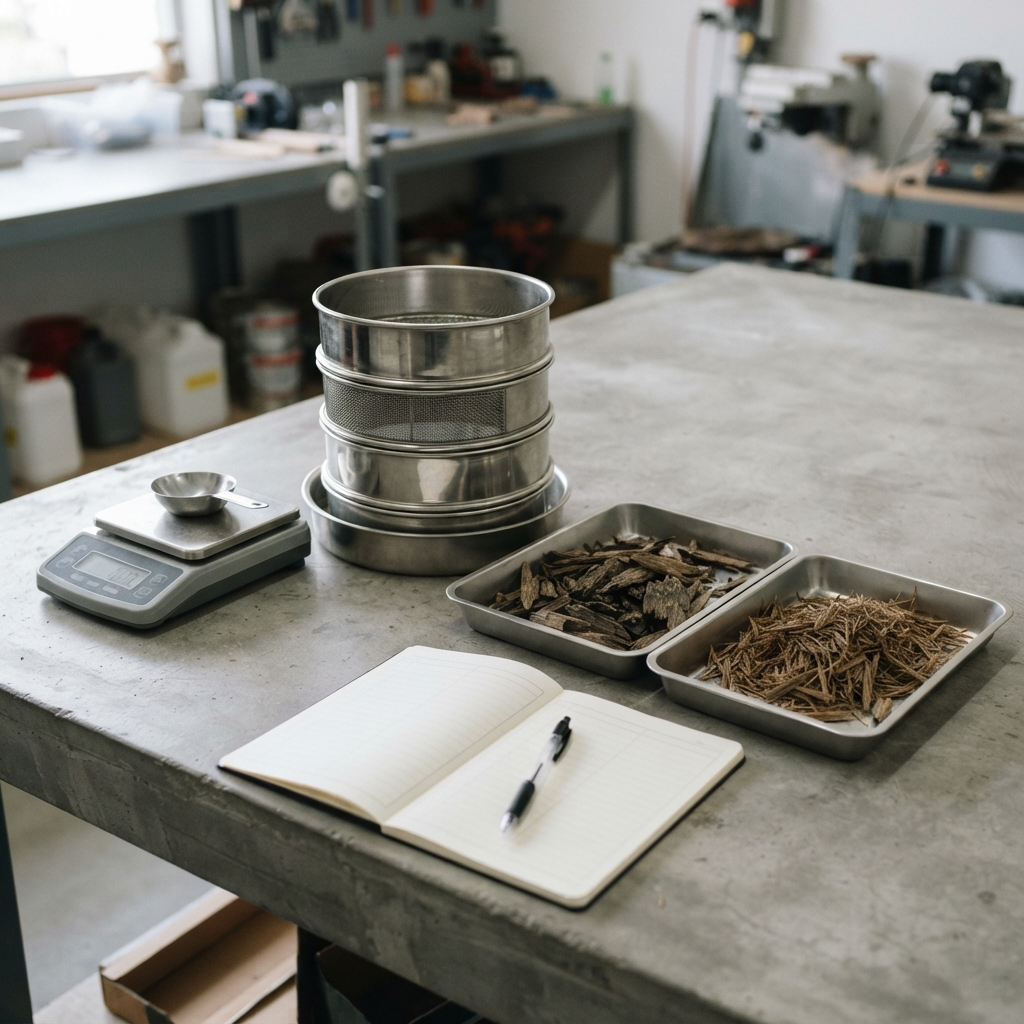
If the purchased shavings and your own screened fraction land within a few points of each other, you are paying a premium for convenience, and you should say so in the negotiation. If the supplier's band is materially tighter, the premium has a measurable basis. Either way you now have a number to discuss instead of an impression.
Screening in-house: what you actually take on
The equipment is the easy part. The recurring obligations are the ones that decide whether the route saves money.
- Feedstock consistency. A screen is only as repeatable as its input. If chip geometry shifts between lots, your in-band yield shifts with it and your costing becomes guesswork.
- Change-over discipline. Every product change means cleaning the stack and re-baselining the yield. Small runs carry a disproportionate setup cost.
- Dust and housekeeping. Fine wood dust is a handling, cleaning and air-quality issue, not a footnote. Extraction and filter costs belong in the model.
- Off-band disposal. You now own the oversize and the fines. If they cannot be sold, milled or blended, they are a cost, not a by-product.
- Records. Yield per lot, screen condition, hours and outcomes, or you cannot tell whether the route is still cheaper than the quote you rejected.
Hidden costs on both routes
In agarwood shavings wholesale the material is sold by weight but shipped by volume: shavings are bulky, so freight is charged on space, and the same container carries less usable material than a denser form would. That penalty applies to bought shavings and to bulky feedstock alike, and it interacts with packing: a compressed or well-filled pack moves more material per cubic metre than a loose one. The mechanics are worked through in this guide to shavings density, packing and freight cost.
Both routes also carry documentation exposure. Agarwood-producing species of Aquilaria and Gyrinops are listed in CITES Appendix II, so cross-border movement generally requires the corresponding permits, and the permit description must match the material actually shipped — a consignment described as chips cannot arrive as screened shavings without a paperwork problem. The FAO review of CITES, trade and sustainable forest management and one national authority's CITES import and export guidance both show how the requirement is framed in practice. Confirm species, form and listing status with your broker and the importing authority before the order is fixed.
Then add the costs that never appear on a price list: duty and import charges, inspection or re-screening on arrival, the working capital tied up in a slow-moving lot, and the cost of a claim you cannot support because the specification was never written down.
Screening an agarwood shavings wholesale supplier on capability
Once you know which route you want, the questions you put to any agarwood raw material supplier change. Ask whether the company generates the form it sells or buys it in, because a generator can usually describe the upstream operation that produced it and a trader often cannot. Ask whether the agarwood wood shavings they offer come off their own line or arrive from a third factory. Ask what the standard output of that line is, and whether your band is that output or a special run.
Ask for the screen series they use, not just the band name, and ask how they hold the profile between lots and what they will commit to in writing when it drifts. On the commercial side, establish the minimum quantity for your exact profile rather than for the catalogue item, and break lead time into allocation, screening, drying, permits and freight. A single lead-time number hides which of those is the constraint. If custom screening is offered, ask to see the screens and a retained sample from a previous custom run; if it cannot be shown, treat the offer as aspiration.
Agarwood Shavings Supplier Evaluation Checklist
Score each candidate on evidence before you commit agarwood shavings wholesale volume. A line with no evidence scores zero, however good the conversation was.
| Area | Question to ask | Evidence that passes |
|---|---|---|
| Sample | Is the sample drawn from the lot that will ship? | Batch reference, date and specification version on the label; sealed and retained |
| Form definition | Which operation produced this shavings stream? | A named upstream step, described consistently by sales and production |
| Specification | Which screen series and limits apply? | Written band, oversize and fines limits, moisture basis and test method |
| Batch consistency | What did the last two lots measure? | Recorded screen and moisture results, or a repeatable sample from each |
| Packing | Unit weight, liner, seal, compression? | A pack specification that protects the band and the moisture through freight |
| Logistics | Packed density and loading plan? | Landed cost per in-band tonne, not per kilogram |
| Compliance | Whose name is on the permit, and what form does it describe? | Permit description matching the shipped form; entity, invoice and bank aligned |
| Claims | What happens if the band is missed? | Inspection method, claim window and remedy ladder agreed in the order |
What to Ask NanjaOud About Feedstock
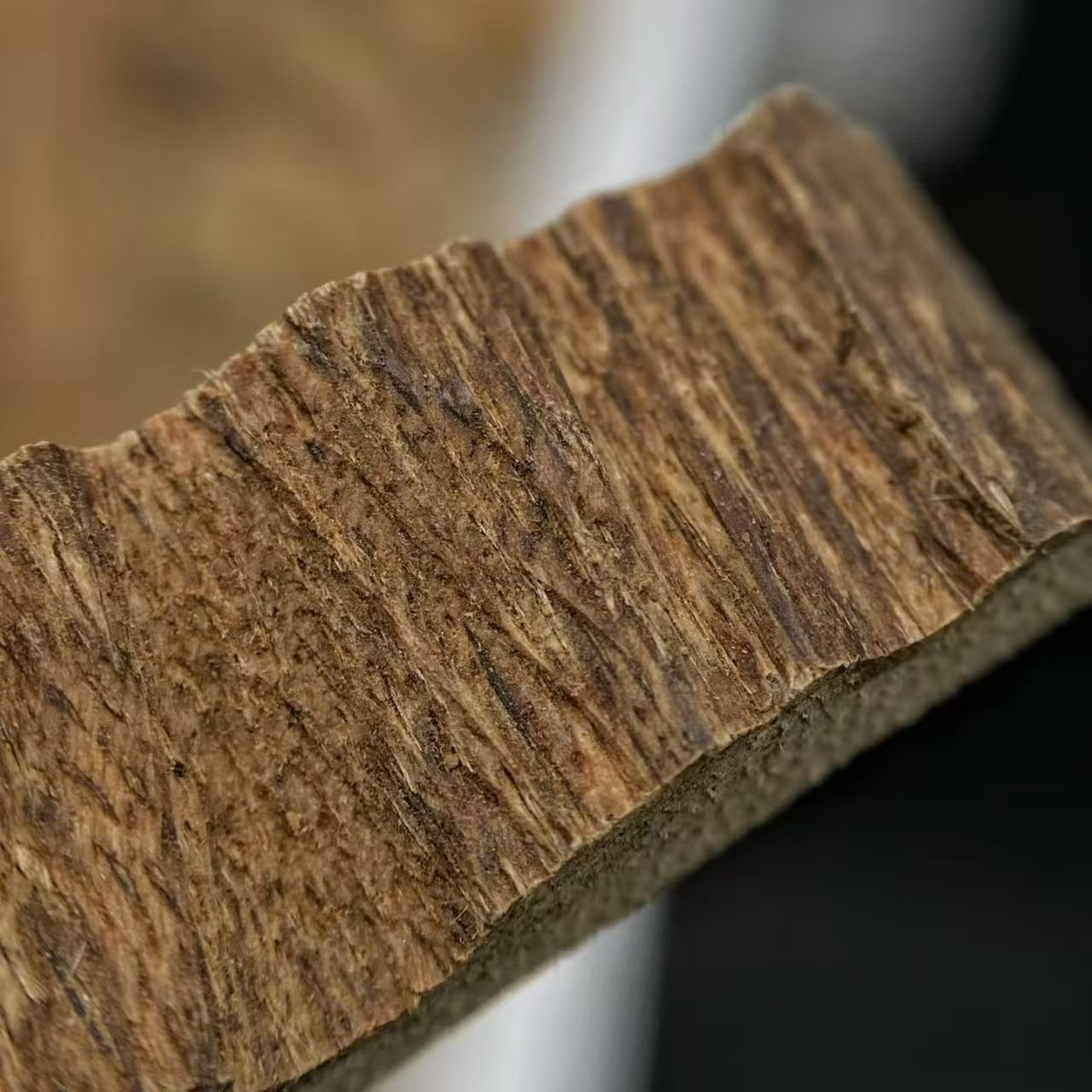
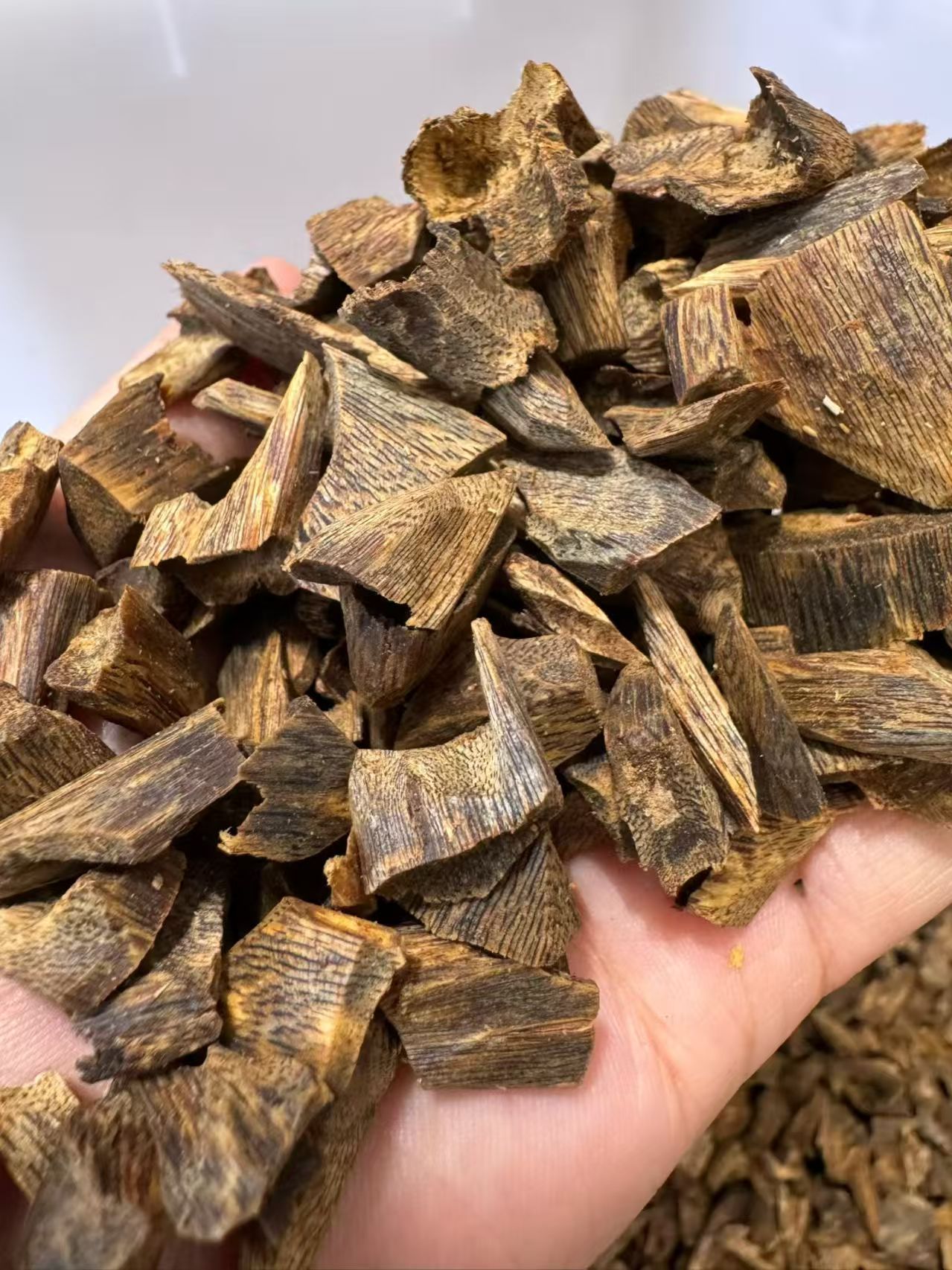
NanjaOud lists natural large agarwood chips and natural small agarwood chips. These are chip-form product references, not a published guarantee that a particular screened shavings band is available. Send your target screen openings, oversize and fines limits, sample amount, annual volume and destination. Ask the team to confirm which current product or processing route can meet the written specification, and obtain an approved sample before costing an in-house screening alternative.
Frequently Asked Questions
Is it cheaper to buy agarwood shavings or to screen chips myself?
For agarwood shavings wholesale buyers the answer depends on the screening premium, the in-band yield of the feedstock you would buy, your annual tonnage through the step, and your fully loaded screening cost. Below a modest volume the premium is usually cheaper than the fixed cost of screening; at volume, in-house screening can win if the feedstock yields well. Run the break-even formula on your own figures before deciding.
Are agarwood shavings the same material as agarwood chips?
No. Chips are pieces with visible wood structure cut or broken to a rough size; shavings are thin slivers produced by planing, slicing or a light cutting pass, usually with a lower bulk density and a higher dust load. They may come from the same source wood, but they are different physical forms with different handling behaviour.
What screen sizes should I specify for a shavings band?
Specify a stack and a nominal band rather than a single number, plus the maximum share allowed above the top screen and below the bottom screen. Add the sample mass, the condition of the material during the test and the shaking time, because two operators using different procedures will report different results on the same lot.
How do I measure the in-band yield of a feedstock before ordering?
Screen a lot-linked sample of the feedstock through your own stack, weigh each fraction, and record the shares. Do it twice on different samples from the same lot to see the variation, and repeat on the second shipment. A yield figure from one hand-picked sample is a sales estimate, not a planning number.
What minimum order should I expect for a screened form?
Minimums in agarwood raw material usually follow lot allocation and screening batch size rather than a fixed policy, so the figure moves with the form, the band width and the grade. Ask for the minimum on your exact profile, and ask what widening the band would do to it.
Do I need CITES documents for shavings as well as chips?
Agarwood-producing species are listed in CITES Appendix II, so cross-border shipments generally require the corresponding permits whatever the physical form, and the description must match what is shipped. Confirm the listing status for your species and the documentation your importing authority expects before the order is fixed.
How do I check quality without a laboratory?
Screen a stated sample mass, weigh the fractions, sort visible foreign matter, measure moisture by the method named in your specification, and run a small process trial. Record all four on a sheet both parties sign. Those records, kept per lot, will settle more disputes than a single laboratory report on a sample nobody can trace.
What should a first order look like?
Small enough to test properly and large enough to run a real production trial: one lot, lot-linked samples retained, the arrival test performed in full, and the results compared with the quotation's claims. Approve the second order against those records, not against the first impression.
Conclusion
Agarwood shavings wholesale is a yield question before it is a form question. Whether you buy screened material or screen chips in-house, the decision comes down to measurable yield and fixed cost, not to which form sounds more professional. Get the premium, the feedstock yield, your tonnage and your true screening cost onto one sheet, test the same mass on your own screens, and let the arithmetic pick the route. Buyers who do that stop paying twice for the same screening job.
Start from the end use: tell us the process, the form and band you need, the sample you want to test, the tonnage you expect and the market you ship to. Our team can then confirm which current agarwood raw material form is closest to your requirement and what would have to change to reach your profile — send those details through the contact page.


