
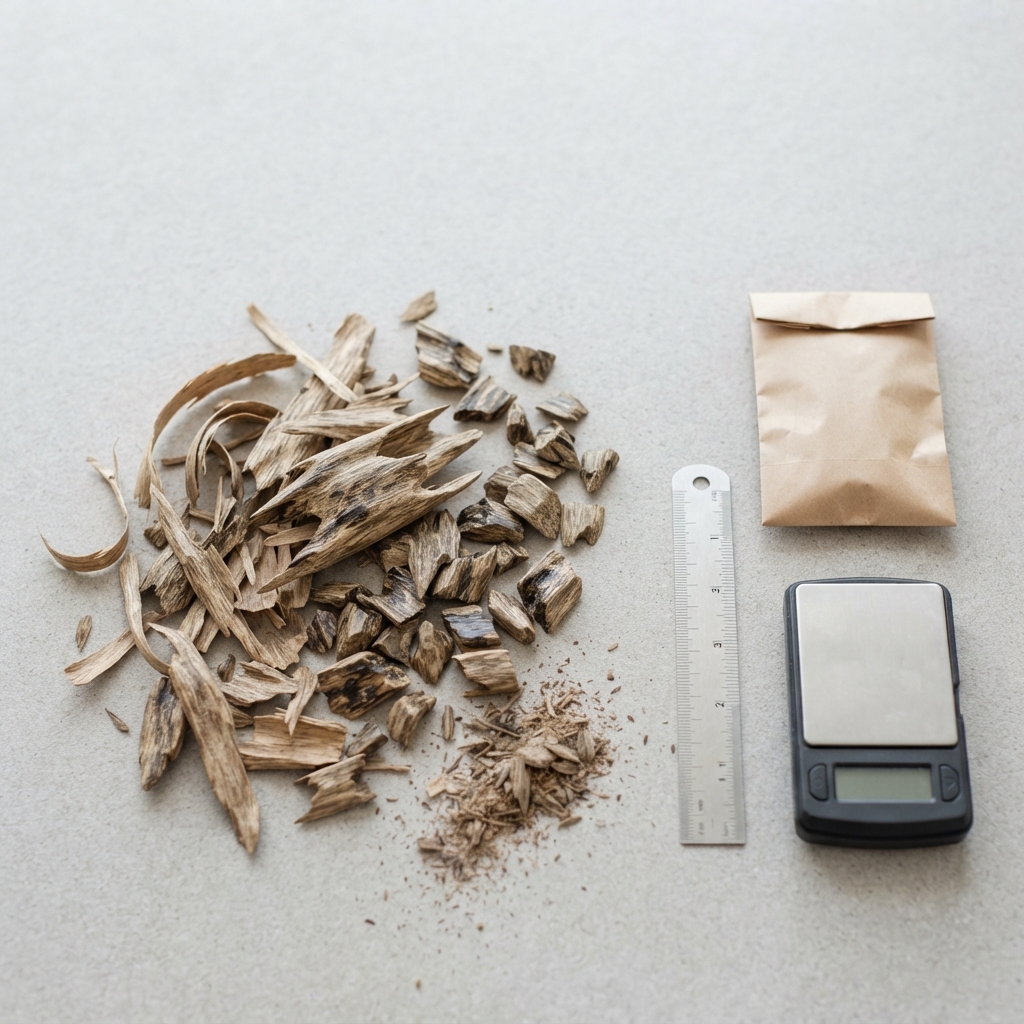
Short answer: a quoted shavings lot may contain several particle forms. Cut pieces, thin slivers, small fragments and fines can have different uses, so confirm the actual mix rather than relying on a headline form name. The buyer who controls the purchase writes the expected mix into the order, measures it with a simple sort test, and prices each fraction before comparing quotations.
This guide is for importers, incense and bakhoor manufacturers, fragrance processors and wood wholesalers who already buy agarwood incense raw materials in bulk and keep receiving lots that do not quite match the form they thought they ordered. It deals with one specific problem: what to do when shavings arrive as part of a mixture. If the earlier question — which single form fits your process — is still open, the site’s chips vs shavings process comparison answers that first. This article assumes the form brief exists and moves on to composition, valuation and acceptance.
Why an agarwood shavings supplier rarely ships one form
Shavings are a by-product geometry. Slivers come off a planing, slicing or shaping operation, and a factory that also cuts chips and blocks produces several geometries on the same floor. Separating them costs labour, so a lot is often sold as one line item. Public listings for agarwood shavings wholesale show the convention plainly: one retail box described as “chips, shavings and broken oud pieces”, one bulk lot advertised as graded chips with “superfine dust” included. The listings are honest about being mixed. The quotation usually is not.
Two consequences follow. First, the form word in a product name tells you the dominant class, not a guaranteed composition. Second, the classes are not worth the same to you: pieces you can pack and show, slivers you can blend or mill, and dust that may be a straight loss. A price per kilogram averaged across all three hides that difference, and it hides it in the supplier’s favour whenever the fine share drifts upward.
None of this implies misdescription; a mixed lot is ordinary trade practice. The commercial risk is that the mix is undefined, so neither side can say what “as agreed” meant when the second container looks different from the first. That is exactly the gap a composition clause closes.
Agarwood Raw Material Specification Comparison Table
The table treats the four common form names plus fines as separate classes inside a bulk lot, because that is how they actually arrive. It deliberately gives no size ranges, moisture figures or resin percentages: those depend on species, source, batch and supplier, and any number printed here would be invented. Fix the values with your supplier and record them against a sample you keep.
| Form class | What it looks like in the bag | What to fix in writing | Where it lands in your process | Common sourcing risk |
|---|---|---|---|---|
| Cut chips and fragments | Discrete pieces with recognisable grain, sized on purpose, staying separate when poured | Piece size and thickness range, share below target size, visible foreign matter, moisture basis, net weight per unit | Visible-piece packs, bakhoor blends, mill feed, repacking | Size quoted only as “small” or “large”; photographs taken from a better lot than the one offered |
| Shavings (slivers) | Thin, long, interleaved material that settles and compacts; dust migrates to the bottom of the bag | Sliver thickness and length limits, class share by mass, definition of fines with the screen opening, cleanliness, packing compression | Blending, milling, bulk burn applications where visible shape does not matter | Form name treated as a grade; silent drift when the upstream job changes; dust bought at wood price |
| Granules | Small, blockier pieces with a more even flow than slivers | Screen openings in millimetres, oversize and undersize limits, measurement method, fines share | Dosing into a mixer; small-piece packs where flow matters | “Mesh” quoted with no opening size; segregation so the top of the bag differs from the bottom |
| Powder | Milled material, uniform at a glance, prone to clumping and to coating the bag walls | Sieve convention and permitted oversize, flow and clumping behaviour, moisture condition, barrier packaging | Stick, coil and cone production; binder-based blends | Fineness stated as one mesh number; a powder that disperses in one binder failing in another |
| Fines and dust | The fraction that passes your working screen; easy to under-sample and easy to over-pay for | The opening that defines it, permitted share, whether it is counted in net weight, how it is priced | Powder route if your process can use it; otherwise handling loss | Counted as saleable weight, invisible in a photograph, and the first thing to grow between lots |
Read the table as a list of questions rather than a ranking. No class is intrinsically more aromatic, and the same source wood can end up as chips, slivers or powder depending on the cut. The distinction matters most for agarwood shavings for incense production, where the sliver and fines share decides how the material feeds a mill or a blend. Nothing here should be used to claim an oil content, a grade or a superior aroma for one form.
Write the composition into the order
A composition clause is short, and it converts a form name into something an agarwood shavings supplier can be held to. Five elements are enough:
- Class definitions. What counts as a chip, a sliver, a granule and fines in your order. Define fines by the screen opening they pass, never by the word “dust”.
- Share by mass. The expected percentage of each class in the delivered lot, with a permitted deviation you state. A range is more honest than a single figure on natural material.
- Measurement method. How the share is determined: test portion mass, hand sorting or screening, and who performs it. Without a stated method, two parties will measure two different things and both will be right.
- Sampling unit. Whether the composition applies to each bag, each pallet or the lot, and how many increments make up the test portion.
- What happens on drift. Re-screening at whose cost, price adjustment, replacement or rejection, plus the notice period for an upstream change that alters the mix.
A sort test you can run in an hour
Screening alone under-describes slivers, because a long thin piece can pass an opening and still behave like a sliver in a blender. Combine a screen with a hand sort on a modest portion.
Draw increments from several positions in several bags instead of one scoop from the top, combine them, and reduce representatively to a test portion of one to two kilograms. Weigh it, separate it by hand into your defined classes, and weigh each class back. The classes must add up to the starting mass, apart from a small handling loss you record separately. Convert the result to percentages of the test portion and photograph the sorted classes on a plain background with a scale in frame.
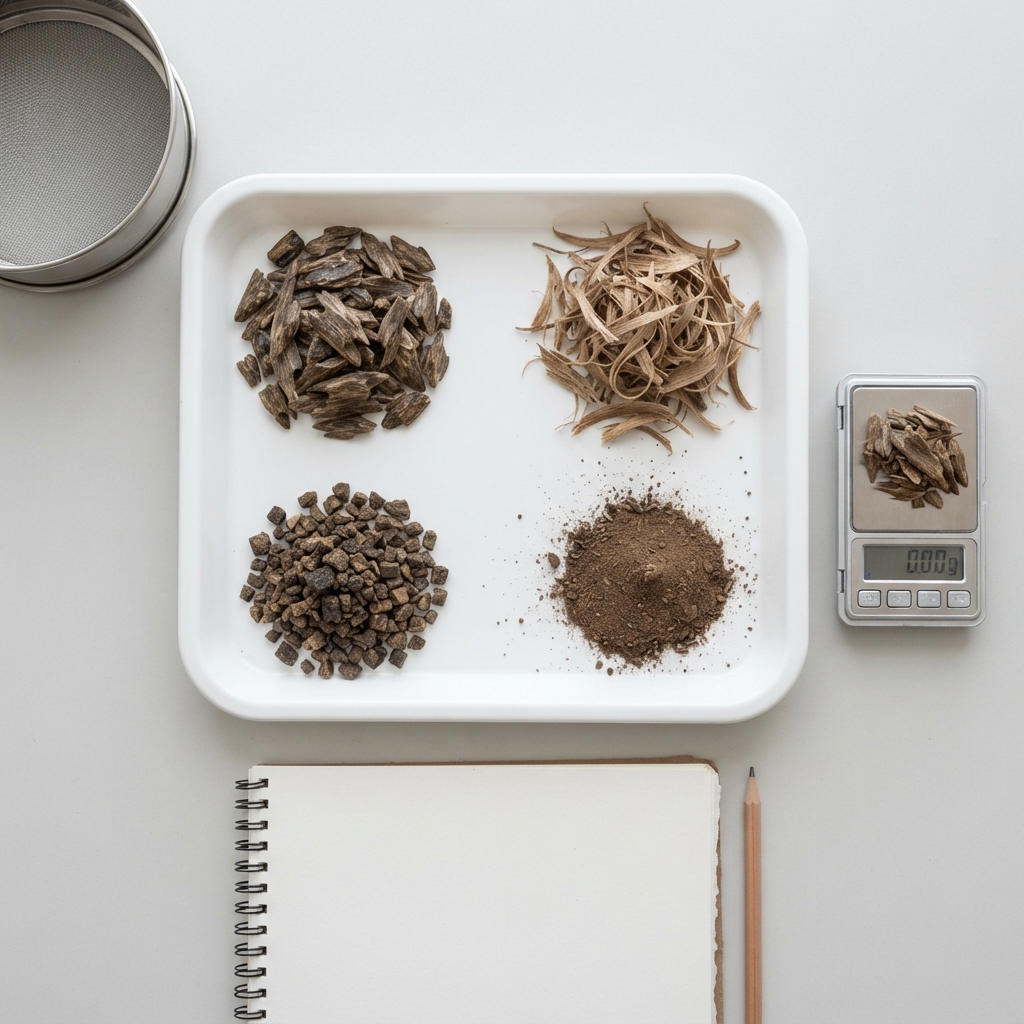
Repeat the identical test on arrival, using the same class definitions and the same portion mass. Two sort tests — one on the approved sample, one on the delivered lot — are far better evidence in a claim than any description of how the material “looked”. The arrival-side routine for a wholesale lot is set out in the site’s goods-in inspection plan.
Pricing each fraction instead of the average
Once the mix is measured, the comparable number for any agarwood shavings supplier quotation is cost per usable kilogram for the fraction your process actually consumes:
Cost per usable kilogram = (material + screening or handling + packing + freight + duty and compliance + inspection) ÷ usable fraction
Work it through on a trial lot with your own figures. A lot quoted at one price with a high sliver and fines share can cost more per usable kilogram than a dearer lot that is mostly cut pieces — or the reverse, if your line mills everything anyway and slivers are not a loss to you. The answer is process-specific, which is why no universal loss rate or market price belongs in a guide like this one. Treat any published percentage as a claim to be tested, not a benchmark.
Do not compare a coarse price with a milled price either. Buying bulk agarwood shavings and grinding in-house carries labour, power, dust extraction and floor losses, and those belong on the same side of the comparison as the delivered price of ready-milled material. If you buy through two sources, the repeatability checks in the repeat-shipment audit are the ones that show whether the mix holds.
Sampling, trial and acceptance
Every agarwood shavings supplier will send a sample; the question is what it represents. Ask how it was drawn, from which production run or container, and whether your order will come from that same material. A sample from a later run is a reference for form, not an approval of your shipment. When you compare two candidates, code the samples and run the same sort test, the same portion mass and the same observation time on both.
Then run a small trial in your own process. A blend or burn trial on a coded sample beats a photograph, and it is the only way to see whether the sliver share in a mixed lot changes how your material feeds, doses or burns. Keep a labelled retained portion of anything you approve, stored in the packaging you expect to receive, and write the approval date on it.
Quotation lines that change the comparison
Before ranking bids on an oud wood shavings wholesale programme, check that every quotation from an agarwood shavings supplier carries the same six elements: material basis (form, production route, species or source description, net or gross weight), moisture basis (as-received or oven-dry, and when measured), screening basis (which openings, what was removed, whether it is included in the quoted weight), packing (net weight per unit, liner, compression, labelling), delivery and duty (Incoterm, risk transfer, freight, insurance, clearance and species documents), and inspection (who checks, when, by which method, and the remedy). A bid missing a line is not comparable: ask for the line rather than filling the gap with an assumption.
The costs that recur in mixed lots are screening you pay for twice, dust bought at wood price, volume-filled bags that weigh short after settling, and re-screening labour at your own site. Each belongs in the landed cost, not in a later argument.
Screening a supplier on evidence that repeats
Identity and control. Match the company on the quotation to the bank account, the export documents and the holder of any species-related permit. Traders are legitimate, but you need to know which party controls the material and the sorting, because that party decides whether the next lot repeats.
A quote that restates your composition. A credible agarwood raw material supplier repeats your class definitions, shares, measurement method, moisture basis and packing. A price plus a photograph means the brief was not read. The same test applies when you compare an agarwood chips supplier with one quoting slivers: if the reply does not restate your classes, there is nothing to compare.
Sorting as a capability, not a phrase. “We can sort to your requirement” is only real if the supplier can name the equipment, the openings used, the resulting fines level and the effect on price and lead time. Ask an agarwood shavings supplier what the minimum is for a sorted lot rather than a mixed one.
Change notification. Ask what happens when the upstream job that generates the slivers changes. A supplier who can describe the trigger for telling you, and for re-sampling, is easier to work with than one who promises permanent uniformity from natural wood.
Species and trade compliance. Agarwood-producing taxa are regulated internationally. Kew’s CITES and Timber guide (2nd edition, 2019) notes that Aquilaria wood chips and powders are among the traded forms, and the US Fish & Wildlife Service explains that the annotation on each CITES listing decides which parts and derivatives need permits. Requirements depend on species, source, form and route, so confirm the exact documents with your supplier, your broker and your national authority. A product name settles nothing, and neither does a plantation origin on its own.
MOQ and lead time by stage. Ask what the minimum consists of and where the lead time goes: allocation, sorting, processing, documentation or freight. A minimum that blocks a genuine trial is a reason to start smaller elsewhere, not a reason to skip testing.
Agarwood Shavings Supplier Evaluation Checklist
Score two or three candidates on the same sheet before committing. A blank answer is a finding, not a neutral result.
| Area | What to verify | Evidence to keep |
|---|---|---|
| Sample | How it was drawn, which lot or run it represents, whether your order comes from that material, and a retained portion stored as approved | Sample ID and date, scaled photographs, written lot linkage |
| Specification | Form and production route stated; class definitions; shares by mass with permitted deviation; screen openings in millimetres; moisture basis; a stated measurement method for each item | Signed specification sheet, your own repeat sort tests on the same definitions |
| Batch | How lots are assembled, expected variation between runs, the trigger and notice for an upstream change that alters the mix | Lot records, previous shipment data, written change-notification commitment |
| Packing | Net weight per unit, liner and moisture barrier, compression, odour isolation, lot labelling, pallet condition | Packing specification, photos of an actual shipping unit, arrival weights on a sample of bags |
| Logistics | Incoterm, lead time by stage, document set, species-related permits, routing and transhipment risk, insurance | Quotation terms, draft documents, freight quote, broker confirmation |
| After-sales | Inspection window, defect and drift definitions, who pays for re-screening or return, replacement availability, a named contact | Written claim clause, remedy ladder, how a past dispute was resolved |
Common mistakes in mixed-lot purchasing
- Buying a form name instead of a composition. The name tells you the dominant class; only a share by mass tells you what you are paying for.
- Quoting one fines figure and no distribution. A single percentage cannot show where the usable mass sits.
- Sampling from the surface of the bag. Slivers stratify, so a top scoop understates the dust at the bottom.
- Assuming shavings are just smaller chips. They differ in origin, geometry and dust behaviour, and need their own limits.
- Comparing a milled price with a coarse price. In-house milling carries costs that belong in the comparison.
- Leaving inspection to the port. Fix the inspection point, portion size and remedy before the container is loaded.
- Accepting a drift with no clause. Without a stated remedy, a mix that shifts between lots is a discussion, not a claim.
What NanjaOud Lists, and What Needs a Sample
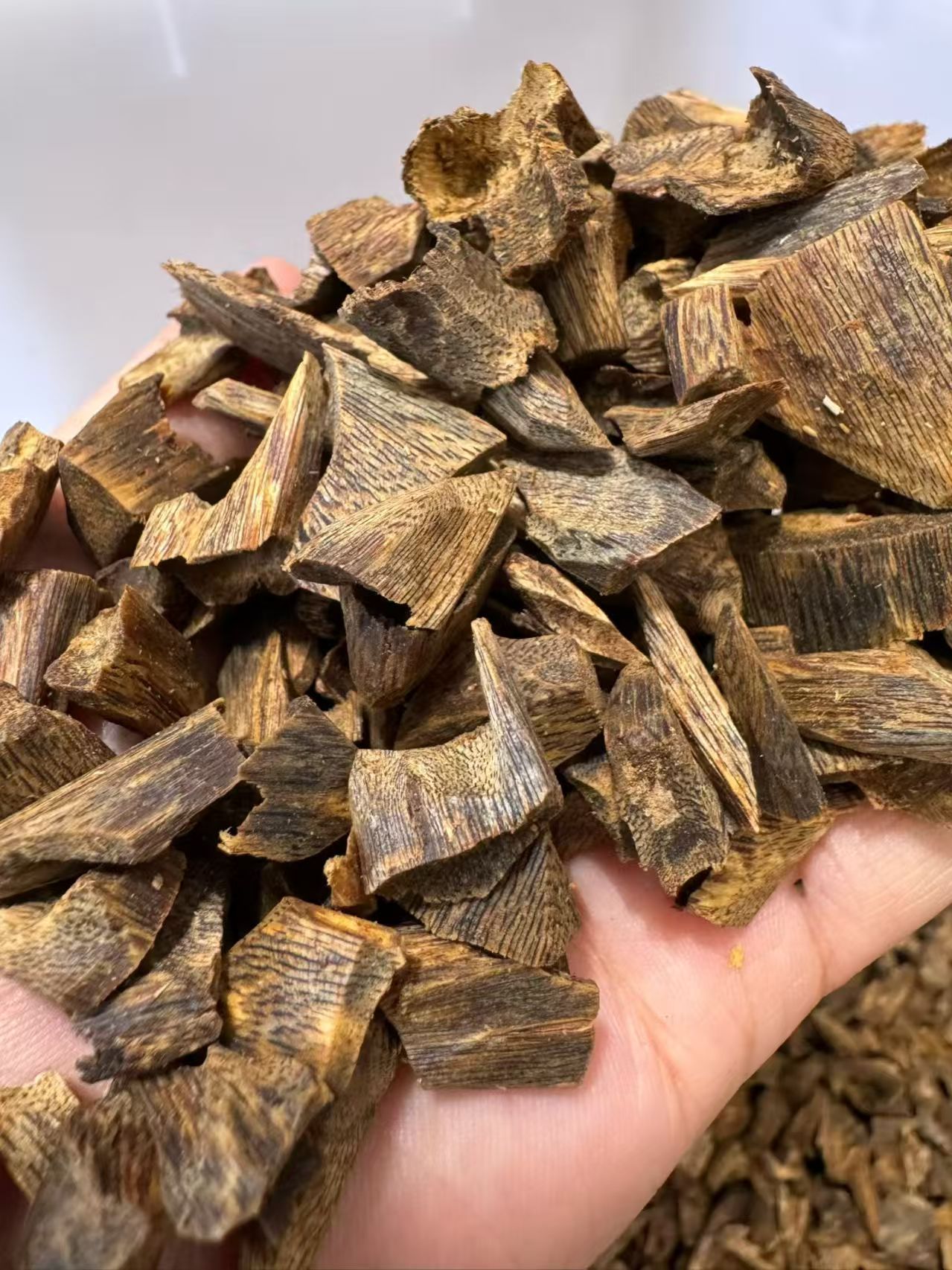
NanjaOud lists agarwood wood fragments and natural small agarwood chips. Neither product name alone defines a screened shavings fraction or the percentage of slivers, fines and larger pieces in a specific lot. Ask for the current lot description, a representative sample and a written particle-form specification. Set the acceptance test and tolerance from that sample before placing a bulk order.
Frequently asked questions
Are agarwood shavings the same as agarwood chips?
No. Chips are pieces cut to a target size and can be sorted and quoted by size range. Shavings are thin slivers, often a by-product of planing, slicing or shaping, and they differ in bulk density, dust behaviour and how they settle in a bag. Specify and sample them separately, even when both come from the same wood.
Why did my shavings order arrive with chips and dust?
Because many lots are sold as a mixture and only the dominant class is named. Public wholesale listings routinely describe one item as chips, shavings and broken pieces, or as graded chips with fine dust included. Without a composition clause and a sort test, the shares are whatever the day’s production produced.
How do I specify particle size for shavings?
Combine sliver limits with screen data: maximum thickness, maximum length, the openings used to measure fractions, and the permitted share passing the finest opening. Screen numbers alone describe slivers poorly, since a long thin piece can pass an opening while remaining awkward to dose.
What sample should I ask for before a bulk order?
Ask for a sample drawn from the lot being offered, with the drawing method and lot reference in writing, and confirmation that your order comes from that same material. Keep a labelled retained portion of anything you approve, stored in the packaging you expect to receive.
Is there a standard moisture figure for agarwood shavings?
There is no universal figure across species, sources and routes. Agree the basis (as-received or oven-dry), the method and the point of measurement, then apply that same method to the approved sample and to the arriving lot. Consistency between the two is more useful than an impressive single number.
What is a realistic MOQ for agarwood shavings?
It varies with how a supplier assembles a lot and with your trial needs, so no single figure is meaningful. Ask what quantity allows a representative sample and a real processing trial, and treat a minimum that blocks testing as a reason to start smaller.
Do agarwood shavings need CITES documents?
Agarwood-producing Aquilaria and Gyrinops species are listed in CITES Appendix II, and whether a specific shipment needs permits depends on species, source, product form and route. Confirm requirements with the exporting supplier, your customs broker and your national authority before ordering.
What is the difference between shavings and granules?
Both are small, but slivers are long and thin and tend to interleave, while granules are cut or crushed to a blockier profile that flows and doses more evenly. If your line needs predictable volume dosing, specify screened small pieces with an agarwood granules supplier rather than slivers.
Conclusion
An agarwood shavings supplier is easier to hold to a specification once the mix inside the bag is written down. Define the classes, agree the shares and the measurement method, run a sort test on the sample and again on arrival, and convert every bid into cost per usable kilogram for the fraction you actually consume. A mixed lot is not a problem in itself; an undefined one is.
Start from your end use, then send NanjaOud your target material form, your sample requirement, the specification items you need confirmed, your expected purchase quantity and your destination market through the contact page. Our team can tell you which current cut formats can be matched to that brief, and which details still need to be verified on a physical sample before a quotation means anything.


