
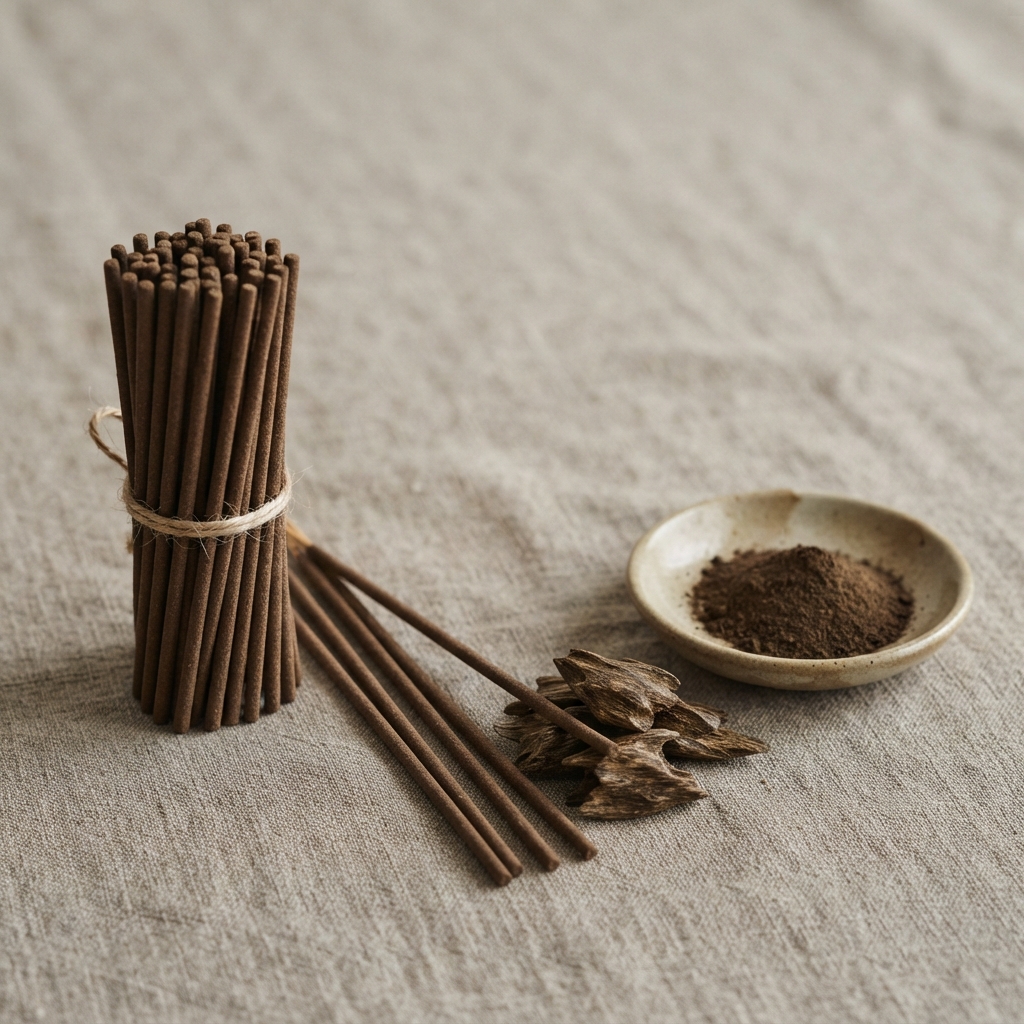
An agarwood incense sticks wholesale supplier is only worth a trial order once its technical answers survive a second round of questions, and that is what this ten-question vetting sequence is for. Each question below is paired with a weak answer, a strong answer and the document that proves the strong one, so three offers can be compared on the same evidence instead of three sales presentations. Bulk agarwood incense sticks are bought on repeatability, and repeatability is visible before you pay a deposit if you ask in the right order.
What an incense sticks wholesale supplier should define first
Suppliers who answer material and construction questions before sending a price list are usually the ones who can document a batch months later. Two sticks that look identical can be different products: one built mainly from resin-bearing agarwood powder, one blended stick where agarwood is a component, and one agarwood-scented stick dipped in fragrance oil. Ask every candidate to place its offer in one of those three categories in writing; ask the supplier to define the material category before comparing prices.
Construction comes next. Coreless incense sticks carry the blend through the full cross-section; cored sticks are coated onto a splint, which changes smoke, ash, breakage and the aromatic share of each stick. Our cored versus coreless construction guide sets out the trade-offs; what matters here is that the construction is written into the specification and never changes between the approved sample and the production run.
| Field to fix | What to record | Why it changes the order |
|---|---|---|
| Species or trade name | Species, trade name, planted or wild, part used | Price, permit description, label wording |
| Agarwood share | A percentage band, not an exact recipe | Separates wood value from fragrance value |
| Construction | Coreless or bamboo-cored | Smoke, ash, breakage, aromatic share |
| Dimensions | Length, diameter, grams per stick, tolerances | Burn time, carton weight, holder fit |
| Finish | Binder, added oils or resins, colourant, moisture at packing | Label wording, aroma stability, mould risk |
Ask an agarwood incense sticks supplier to sign those five fields on the quotation itself. A refusal is a finding, not a negotiating position.
The ten vetting questions
Send all ten to every candidate in the same message, in this order. Answers read side by side reveal more than any single reply, and a supplier that skips the technical half has told you what its production file looks like.
| Question | Weak answer | Strong answer | Evidence to request |
|---|---|---|---|
| 1. Which species or trade name is in the blend, and is the wood planted or wild? | "Pure natural agarwood" | Names the species or trade name, planted or wild, part used | Material declaration on the quotation |
| 2. How much of the stick is agarwood, and what is the rest? | "100% natural, no chemicals" | Agarwood share band, binder and carrier named, oils and resins declared | Component list and allergen statement |
| 3. Coreless or cored, and what are the exact dimensions? | "Standard size" | Construction, length, diameter, grams per stick, tolerances | Specification sheet |
| 4. What burn time and smoke level do you guarantee on that specification? | "About 40 minutes, low smoke" | A measured range with test conditions and method | Batch test record |
| 5. Can I burn three sticks from different bundle positions? | A stock photograph instead | Yes, with the bundle lot code visible | Your own recorded test |
| 6. How do you make batch two match batch one? | "Same formula" | Retained approval sample, batch sheet, in-process checks | Batch record template |
| 7. What is the MOQ per SKU, and does private-label packing change it? | One figure for the container | MOQ by format and pack, plus mixed-SKU rules | Written MOQ table |
| 8. What exactly does the unit price include? | A single FOB number | Price basis, sticks per pack, Incoterm, packing and breakage allowance | Itemised quotation |
| 9. How is the stick protected in transit? | "Strong export carton" | Inner pack method, board grade, pallet pattern | Packing specification |
| 10. Who handles a claim, and within what window? | "Contact me anytime" | Named contact, notice window, remedy ladder | Claims clause in the contract |
Test samples so the results can be compared
Code the samples, remove brand names, and test every candidate on the same day in the same room, away from draughts, in the same holder. Record ignition, any flare-up before the stick settles, total burn time, smoke density, ash colour and whether the ash curls or falls, whether the stick extinguishes before the end, and how the scent develops from the first third to the last. Score each attribute from one to five with a short note rather than an overall impression; our burn-performance test sheet is built for that record.

Order a second sample weeks later to test stability, then seal and sign the approved sample, reference it on the purchase order, and require a pre-shipment sample drawn from finished bulk rather than from the sample room. If a custom incense sticks manufacturer is developing a new blend for you, start that second check later, because a fresh formula moves more than a standing line does. The sealed sample is what settles most later arguments about "the sample was better".
Commercial terms that decide the landed cost
Read the quotation as a set, because a low unit price with a high minimum per SKU and thin inner packing is usually the more expensive option.
- Confirm the incense sticks MOQ per SKU rather than per order, and whether mixed SKUs can share a container.
- Convert every offer to cost per sellable stick at your door: packing, print, breakage allowance and freight included.
- Fix the lead-time schedule in writing — sample, production window, printing, documentation — not as one estimate.
- A private label incense sticks program is a packaging project attached to a product specification, so ask who approves artwork, whether a dieline proof is signed before mass printing, who pays for plates, and which label content is your responsibility in the destination market. Our private-label and OEM briefing guide covers the sign-off sequence.
- Agree the notice window after arrival, the evidence you will send, and the remedy ladder — replacement, credit, price adjustment or return — before the container ships.
Documents, labels and CITES
No single document set makes incense sellable everywhere, and any supplier who says otherwise is simplifying a question that belongs to your importer of record. Ask an incense sticks wholesale supplier for a component declaration, a safety data sheet where the fragrance or product requires one, an allergen statement for the fragrance portion, and test reports that show the laboratory, the method, the date and the batch code they refer to.
Label duties are set by the destination market. In the European Union, Regulation (EU) 2023/988 on general product safety has applied since 13 December 2024 and places traceability and labelling obligations on economic operators, including a responsible person established in the EU for many products, as summarised by the European Commission. Other markets set their own language, warning and importer-identity rules, so confirm label content before artwork is approved.
Agarwood comes mainly from Aquilaria and Gyrinops, both listed in CITES Appendix II. The CITES review of the two genera describes how the trade is regulated and why permits travel with wood and derivatives (CITES CoP19 information document, 2022). Whether a finished incense shipment needs a permit depends on the species, the form of the material and the destination: ask the supplier to name the species and to show permit copies that match the lot, then confirm the position with your customs broker. Burning also produces particulate matter, and published indoor-air studies such as those in Aerosol and Air Quality Research (2022) recommend ventilating a room during and after use — a use instruction for the retail pack, not a marketing claim in either direction.
Wholesale Agarwood Incense Supplier Comparison Checklist
Score every candidate — an agarwood incense sticks supplier quoting one line or a full-range factory — from one to five on each row, keep the evidence beside the score, and weight the rows as shown. Adjust the weights to your channel if you prefer, but hold them fixed across all suppliers so the totals mean something.
| Dimension | Weight | Score 1 looks like | Score 5 looks like |
|---|---|---|---|
| Material | 15% | "Natural agarwood", no species | Species, planted or wild, part used, in writing |
| Formula transparency | 15% | No disclosure at all | Share band, binder, oils, colourants declared |
| Product specification | 10% | "Standard size" | Dimensions and grams with tolerances |
| Burn performance | 15% | One claimed burn time | Measured range with method and conditions |
| Sample stability | 15% | One sample, no lot link | Two coded samples plus a retained approval sample |
| MOQ | 5% | One container figure | MOQ table by format and pack |
| Packaging | 10% | Cartons only | Inner pack, board grade, label proof |
| Quotation | 5% | Single unit price | Itemised, Incoterm, validity, breakage allowance |
| Lead time | 5% | Verbal estimate | Written schedule including document time |
| After-sales | 5% | Unnamed contact | Named contact, window, remedy ladder |
Reject any supplier that scores one on material, formula transparency or sample stability, whatever the total: those three rows are where an order becomes unenforceable. A supplier with a good total and an empty evidence column is a supplier you cannot audit six months from now.
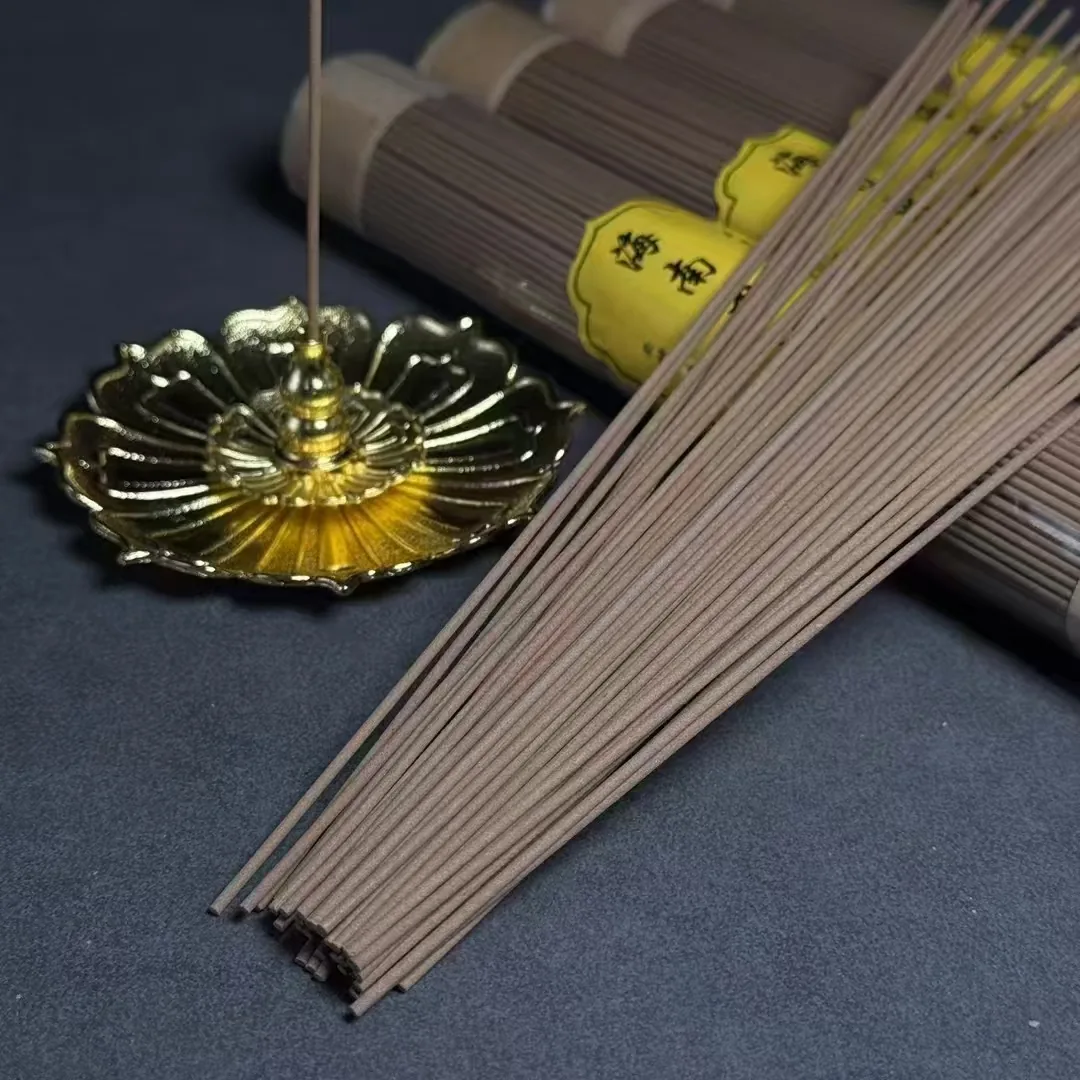
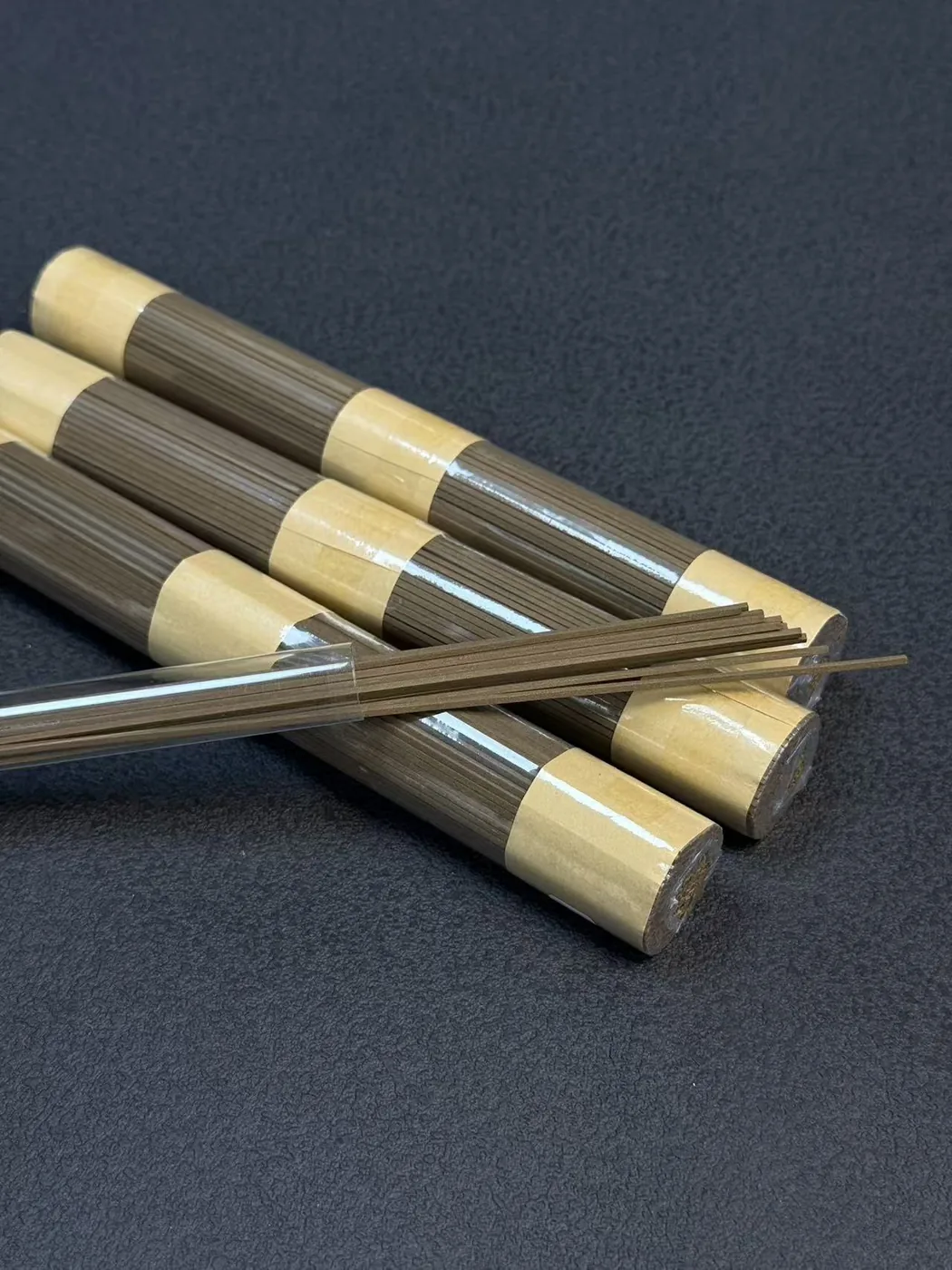
Agarwood incense sticks from NanjaOud
NanjaOud lists agarwood incense products for B2B enquiries. Product names and photographs do not establish a universal composition, burn time, MOQ or document set. Ask us to confirm the material, construction, packaging and sample basis for the specific item you intend to buy. See the agarwood incense range, OEM and private label information, and quality and supply overview; confirm any order-specific capability in the quotation.
Conclusion
Choosing an incense sticks wholesale supplier is a comparison of evidence, not adjectives. Fix the material, construction and dimensions in writing, ask the ten questions in the same message to every candidate, test coded samples under identical conditions, price the packing and freight into a cost per sellable stick, and agree the claim route before the deposit. Do that and the second batch becomes a reorder rather than a dispute. If you are preparing a first or repeat order, send your estimated quantity, target market, stick format, dimensions, packing direction and sample standard to our contact page so the available options can be confirmed against your brief.
Frequently asked questions
What should an incense sticks wholesale supplier put in writing before a first order?
The material category, agarwood share band, construction and dimensions, the burn range it will stand behind, MOQ per SKU, what the price includes, the packing specification and the claims window. If any of the eight is missing, the quotation is an opening position rather than an offer.
How many suppliers should I vet at once?
Three to five, with an identical written brief. Fewer than three gives you no benchmark for price or evidence; more than five multiplies sample and test work without changing the decision.
Is a coreless stick better than a cored stick?
No. Construction changes the aromatic share, smoke and handling, but execution matters more than the category. The real risk is an undefined or silently changed construction.
What should a sample request include?
Format and construction, dimensions, estimated first-order and annual quantity, target market, retail or ritual use, packing direction and the acceptance criteria you will test against. A sample sent without those cannot be quoted like-for-like.
How do I check that bulk matches the approved sample?
Keep a sealed approval sample, reference it on the purchase order, and require a pre-shipment sample drawn from finished bulk. Re-run the same burn test and compare loading photographs before the container leaves.
Do agarwood incense sticks need CITES documents?
It depends on the species in the product, the form of the material and the destination country. Ask for species identification and permit copies that match the lot, then confirm with your customs broker.
Why do sticks break in transit, and who pays?
Most breakage comes from weak inner packing, over-dry sticks or compressed cartons. Agree the packing specification and a breakage allowance in writing, photograph cartons on arrival, and claim through the contract clause rather than a chat message.


