

Choosing an incense sticks wholesale supplier for a distributor range is a range-level decision before it is a price decision. You are buying a family of sticks that must share geometry and behave the same shipment after shipment. The supplier worth signing is the one whose evidence survives a second sample round.
Why a distributor's brief differs from a single-brand brief
A brand launching one product defines one stick. A distributor has to hold the family together: which SKUs share a geometry, which scents are variants of one base blend, and whether the factory can repeat that family when one line outsells the rest. Write the brief first — SKU count, channels, fixed stick type and size, scent directions, packing per SKU, first order and annual volume.
Agarwood sticks are not dipped sticks
Mass-market incense is a splint dipped in fragrance compound, where wood powder carries a perfume oil. An agarwood stick is bought for resin-bearing heartwood of Aquilaria or related genera, ground and bound into a paste. With dipped sticks you compare oils; with agarwood sticks you compare a named material whose species, grade and share in the blend must be described before price means anything. Decide per SKU whether you sell a predominantly agarwood-powder stick, a blend, or an agarwood-scented stick, and keep that label on your product file. Our guide to qualifying an agarwood incense sticks manufacturer covers the material ladder.
Cored and coreless change the range, not just the stick
Coreless is extruded paste with no splint; cored is paste coated onto a bamboo splint. Neither is better in itself, but they behave differently in a wholesale programme.
| Range decision | Coreless | Bamboo-cored |
|---|---|---|
| What carries scent | Whole cross-section | Splint adds little aroma |
| Breakage | Brittle; needs firmer inner packing | Rigid; coating cracks, splintered tips |
| Burn and ash | Often softer, finer ash | Lignin affects burn; heavier ash |
| Channel fit | Gift, boutique, meditation, spa | Ritual, devotional, volume retail |
| Specify | Diameter, length, grams, dryness | Splint diameter, coating, exposed splint |
Pick one construction per tier, state it in every specification, and never accept a substitution when a line runs short. See construction testing for the measurement detail.
Match format and scent to the channel
Burn time scales mainly with length, diameter and packing density, so a longer stick is a different product with different freight weight and holder needs — not an upgrade. Fix the holder, room context and retail band first, then ask for sticks that fit. Describe scent in workable terms (resin note, sweetness, dry-down, intensity at one metre), and ask whether several SKUs can come from one base blend for a coherent range.
Testing a sample set, not a sample
Sampling is not about whether a stick smells pleasant. It builds evidence you can compare across suppliers and later enforce.
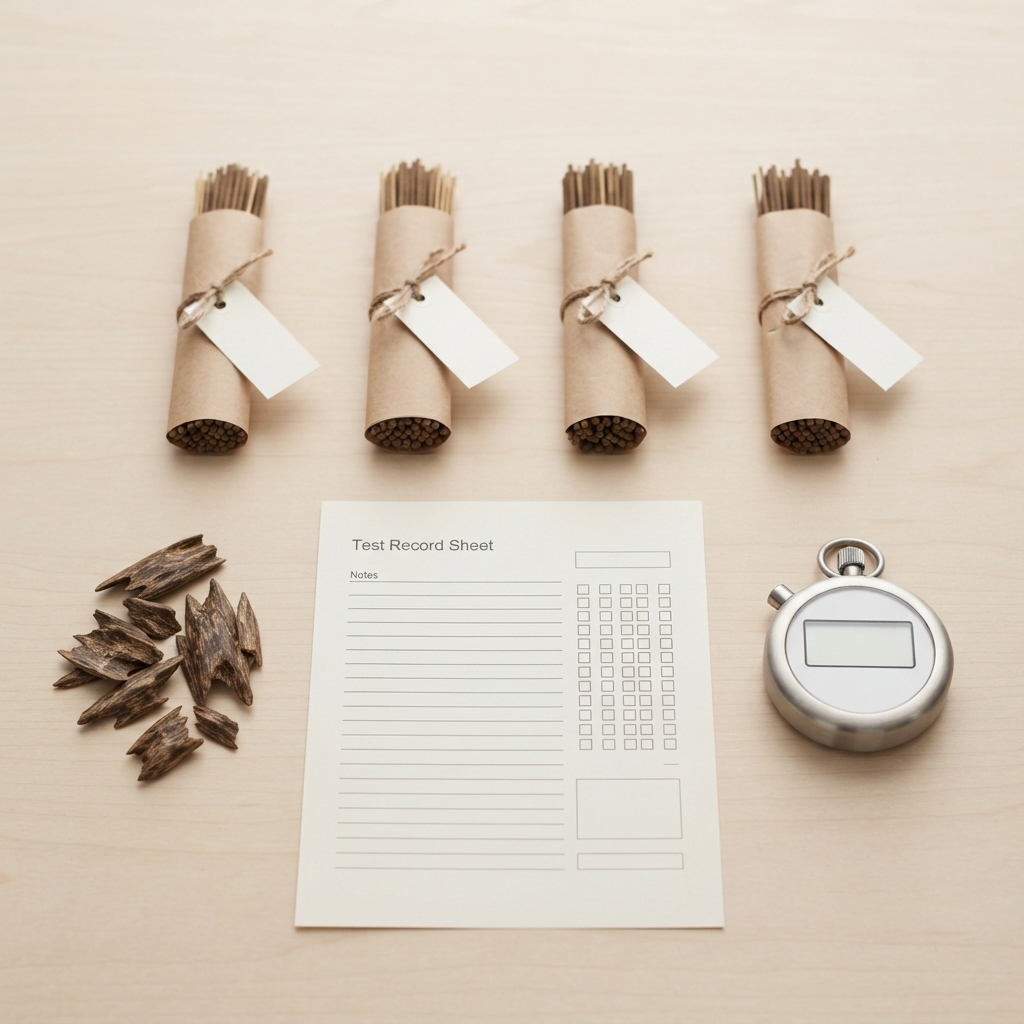
Material and formula bands, in writing
Per SKU: species or trade name and part used, agarwood share as a band rather than a recipe, binder type, added oils or resins, any colourant, moisture at packing. A supplier protecting a formula can still disclose categories. If one line is documented and the next is described only as "agarwood", you know which line will be hard to reorder.
Appearance and packing as received
Check straightness, cracks, diameter along the stick, colour variation, fines in the bag, count against the stated count, seals and carton condition. Photograph the opened bundle on arrival; that image is your baseline later.
One burn protocol, every SKU
Burn three to five sticks from different bundle positions, same room, same holder, same day, away from draughts. Record ignition, flaring before it settles, burn time, smoke density, ash colour and behaviour, self-extinguishing, and how scent develops from first third to last. Score one to five with a note. Two testers scoring separately is worth the hour: a stick one calls smoky and another calls weak usually burns inconsistently, which scales badly in a container.
Second round, then bind it to the order
Re-order the same coded set three to six weeks later and compare. This measures what a quotation cannot: whether the factory repeats itself once the sample room moves on. Then sign one approval sample per SKU, reference its code on the purchase order, and require a pre-shipment sample from finished bulk plus photographs of packed cartons.
The commercial file: MOQ, quotes, packing and claims
MOQ per SKU, not per order
Ask for the minimum per SKU. One number for a mixed container is often the line the supplier would prefer to run, and range planning collapses when three of five SKUs fall below the real threshold. Confirm whether SKUs share a container, whether the mixed minimum counts cartons or value, and the reorder minimum per SKU — that figure decides whether you can restock a fast seller without taking a slow one with it.
Normalise to cost per sellable stick
Confirm price basis (stick, bundle, inner box, carton), sticks per unit, packing and printing included or not, Incoterm, who books freight, currency, validity, payment terms and breakage allowance. Then divide landed carton cost by the sticks that actually reach a customer after the allowance. That conversion reorders most shortlists.
Private label, OEM and ODM
Verify who approves artwork, whether a dieline proof is signed before printing, the minimum per SKU, who pays print setup, and which label content is yours in the destination market. NanjaOud's agarwood incense range lists current stick formats and the customization route; commercial specifics sit in the quotation.
Packing, lot codes and reorder timing
Incense is brittle and takes up moisture, so inner protection matters more than carton print. Specify inner packing, board grade, moisture barrier, pallet pattern and a lot code with production date on each carton. Keep that code in your stock records so a complaint traces to a production window. Agree reorder lead time including documentation time.
Breakage, drift and wrong goods
Agree the notice window, the evidence pack (sealed carton, opened bundle, counted broken sticks, burn comparison against the retained sample) and the remedy ladder: replacement, credit, next-order adjustment, return. Treat transit breakage, quality drift and wrong goods as three separate failures with different remedies.
Compliance depends on the destination market
No supplier can certify a product for every country, and requirements are not uniform across the United States, the European Union, the Gulf and Southeast Asia. Compliance follows material, form, destination and channel, and belongs to your importer of record.
Documents to request
Per SKU: component declaration, a safety data sheet where the product or its fragrance components require one, an allergen statement for the fragrance portion, and any test report with laboratory, method and date. A report without a method and batch reference proves little; a pack covering two lines out of five is a warning.
Labels, traceability and indoor use
In the European Union, Regulation (EU) 2023/988, applicable since 13 December 2024, sets traceability and labelling duties for manufacturers and importers, and the European Commission's summary of the regulation sets out the importer obligations. Other markets have their own rules on language, warnings and importer identity. Because burning incense produces smoke and particulate matter, a ventilation instruction belongs on the pack; keep claims descriptive and avoid health or air-quality wording.
CITES and agarwood species
Commercial agarwood comes mainly from Aquilaria and Gyrinops, listed under CITES, and shipments of their parts and derivatives generally need origin-country export documentation plus whatever the importer's country requires. CITES has reviewed these genera, including the working document on agarwood-producing taxa for the twentieth Conference of the Parties. Whether a finished stick needs a permit depends on species, form and destination: have the supplier name the species, supply permits matching the shipment, and confirm with your customs broker.
Scoring finalists on one checklist
Score one to five, multiply by the weight, keep the evidence column filled. Change the weights to suit your risk, but publish them before scoring so the result is a decision, not a preference.
| Dimension | Weight | Pass condition | Evidence |
|---|---|---|---|
| Raw material | 15 | Species, part and origin per SKU | Material declaration on quotation |
| Formula transparency | 10 | Agarwood band, binder, oils, colourants | Component list, allergen statement |
| Product specification | 15 | Construction, length, diameter, grams, pack count | Signed specification sheet |
| Burn performance | 15 | Time, smoke, ash, self-extinguishing in limits | Your test sheet, both rounds |
| Sample stability | 15 | Second round inside tolerance bands | Two coded sets, retained sample |
| MOQ and range fit | 10 | Per-SKU minimum, mixed rule, reorder minimum | MOQ table, not a verbal range |
| Packaging | 8 | Inner protection, board grade, barrier, print readiness | Packing spec, dieline, proof |
| Quotation | 7 | Convertible to cost per sellable stick | Itemised offer, Incoterm, validity |
| Lead time | 3 | Sample, production, documents scheduled | Order confirmation schedule |
| After-sales | 2 | Notice window, remedy ladder, named contact | Claims clause |
Treat raw material, product specification and sample stability as gates, not points: failing any of them cannot be rescued by a strong score elsewhere. Walk away when answers are late and vague before the order, when a second sample round cannot be produced, when permits do not match the shipment, or when a quotation cannot become a per-stick landed cost. For a second pass on supplier answers, use the ten vetting questions for an incense sticks wholesale supplier.
Agarwood incense supply at NanjaOud
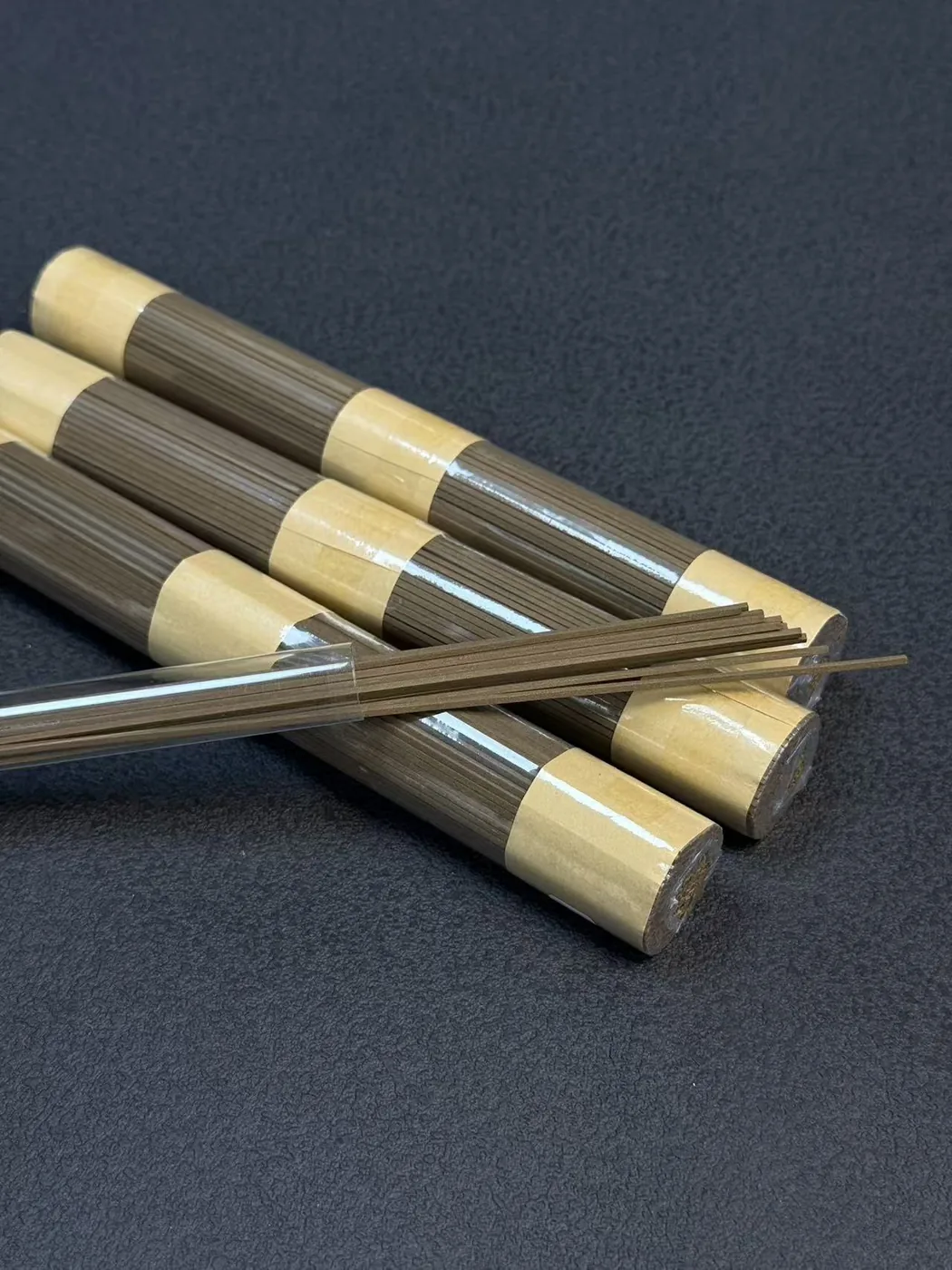
NanjaOud lists agarwood incense products for buyers comparing stick format, presentation and packaging. Use the listing as a starting point, then request a written specification and current sample for each proposed SKU. Confirm dimensions, composition claims, packing, minimum quantity and reorder terms for the actual order rather than assuming that one reference photo defines the whole range.
Conclusion
Choosing an incense sticks wholesale supplier for a distributor range comes down to sticks you can describe, a sample set that repeats, a quotation you can convert to cost per sellable stick, and documents that match the destination. Score finalists on one weighted sheet, keep the evidence, and treat material, specification and sample stability as gates. If you are preparing a first or repeat range order, send your estimated quantity, target market, stick type and dimensions, packing direction and sample standard to our contact page and we will confirm what is available for your project.
Frequently asked questions
How do I choose an incense sticks wholesale supplier for several SKUs?
Brief the range before asking for prices, request the same specification from three to five suppliers, and test a coded sample set twice before discussing volume. Choose the supplier whose evidence repeats and whose per-SKU minimum fits your stocking plan.
Is a coreless stick better than a bamboo-cored stick?
No. Construction changes aroma share, smoke, ash and breakage, but execution matters more. Avoid an undefined construction, or a supplier swapping one for the other between shipments.
What MOQ should I expect?
Minimums are set per supplier, per SKU and per packing format, and move with stick size, print setup and material grade. Ask for a written table separating stock and private-label packing, plus the reorder minimum per SKU.
Do agarwood incense sticks need CITES documents?
It depends on species, form and destination. Ask the supplier to name the species and supply permits matching the shipment, then confirm with your customs broker.
Why do sticks break in transit, and who pays?
Mostly weak inner packing, over-dry sticks or compressed cartons. Agree the packing specification and a breakage allowance in writing, photograph cartons on arrival, and use the claims clause rather than an informal message.


