
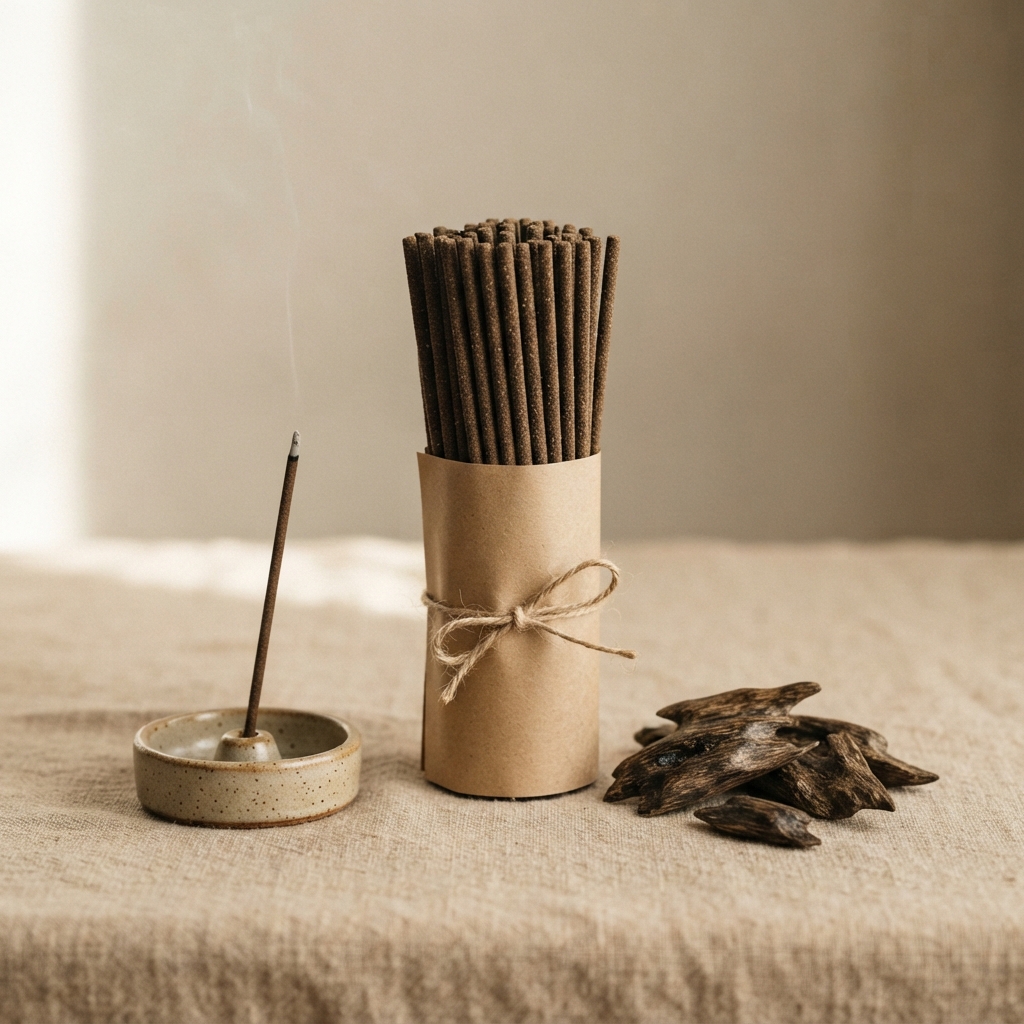
Choosing an agarwood incense sticks manufacturer for wholesale orders comes down to four things you can verify: the stick construction and material a factory can repeat, a sample you can measure against, commercial terms that fit your pack and volume, and the documents your destination market requires. Everything else — catalogue photography, fragrance adjectives, "premium" wording — stays a claim until it appears in a written specification.
Why Agarwood Incense Is Not a Generic Incense Purchase
Mass-market incense is usually judged on fragrance strength and price per stick. Agarwood changes that calculation, because the aromatic wood is the expensive part of the stick, and the cheapest offers are usually cheap in the same place.
What the material share actually contains
Ask for a composition statement with percentages: agarwood material and its form (powder, fine chips or extract), binder, charcoal or wood-powder filler, fragrance additives, and any combustion aid. A quotation that says "natural agarwood" without a material share cannot be compared with another quotation, because two sticks of identical weight can contain very different amounts of agarwood.
Fix the claim you are buying as well: species or trade name, origin, plantation or wild material, and the grade of the powder behind it. Trade names move loosely in this industry, so treat a name such as Hainan or Kynam as a description to confirm on the sample and in the material statement, not as a certificate.
What a manufacturer can prove, and what it cannot
A factory can give you a written material specification, a batch record, retained samples and, where the wood is regulated, trade documents. It cannot prove aroma quality with a photograph. Judge the paperwork on whether it names the same material as the quotation, and judge the aroma on coded samples you burn yourself.
Match the Stick Format to Your Market First
Format decisions made late turn into packaging, freight and complaint problems. Settle these before you ask three factories for prices, because the format is the part of the brief an agarwood incense sticks manufacturer has to quote against.
Cored and coreless sticks behave differently
| Decision | Cored stick (bamboo core) | Coreless stick (extruded paste) |
|---|---|---|
| Structure | Coated bamboo core through the stick | Pressed aromatic paste, no core |
| Handling | More resistant to bending in transit | More brittle; diameter and packing matter more |
| Burn behaviour | Core keeps the stick straight while burning | Burns as a column; can curve if the paste is weak |
| Ash | Bamboo core remains after the coating burns | Ash form depends on binder and filler |
| Retail fit | Traditional and high-volume segments | Premium, gift and design-led ranges |
| What to specify | Core diameter, coating thickness, length | Extrusion diameter tolerance, straightness, breakage limit |
Neither construction is better. A gift-box range usually wants slim coreless incense sticks for their appearance, while a high-volume traditional account may prefer a cored stick for handling and price. What matters is that the construction is written on the purchase order with a diameter tolerance, because "coreless" alone does not fix the size. Buyers comparing the two in detail can work through our notes on cored versus coreless agarwood incense sticks.
Dimensions, pack count and scent brief
Fix length in millimetres, diameter in millimetres with a tolerance, and the retail pack count, whether that is 10, 20 or 40 sticks. Pack count drives carton size, freight and shelf price, so a quote per kilogram of sticks is not comparable with a quote per retail box. For scent, describe what the buyer should notice at five, twenty and forty minutes, and whether the dry stick should smell strongly. That brief is testable; "sweet and woody" is not.
How to Evaluate Samples Without Fooling Yourself
Read the composition statement before you burn anything
Attach every sample to a written description of what it is meant to be. If a sample arrives without a code, a production reference or a material statement, you are testing a gift rather than a product, and nothing you learn from it can be enforced later.
Physical checks on arrival
- Straightness and surface: cracks, chipped ends, dark spots that could indicate moisture or mould, uneven coating.
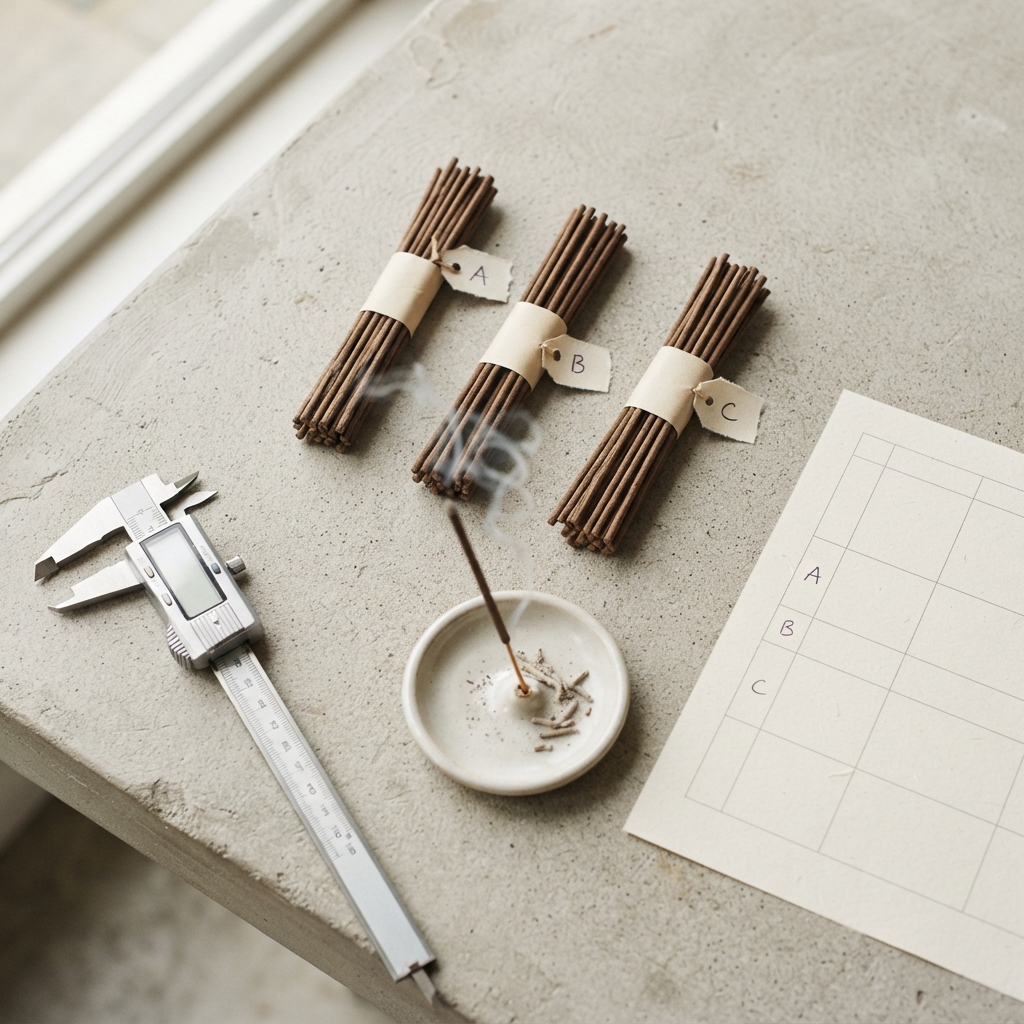
- Diameter: measure ten sticks with a caliper and record the range, not only the average.
- Weight: weigh ten sticks; a spread wider than the quoted tolerance predicts an inconsistent burn.
- Breakage: count broken sticks in the bundle as received, before you handle it.
Run a burn test someone else can repeat
An incense stick burn test is only useful if it is repeatable, so burn three sticks from each sample in the same room, away from draughts, on the same holder, and record time to full burn, whether the stick stayed lit, smoke density against a plain background, ash colour and whether the ash held its shape, and the scent at start, middle and end. Photograph the ash beside a ruler. Keep the sheet with the sample code so a colleague can repeat the test and produce comparable notes rather than a different opinion.
Compare blind, then tie approval to the bulk order
Ask for three or four coded samples and score them on one sheet without knowing which factory sent which. Incense stick sample approval should end with a sealed reference: photograph the approved sample beside a scale, sign and date the record, and write acceptance limits into the order — diameter range, weight range, burn-time band, maximum breakage and the retained-sample reference. Without those numbers, "same as sample" is an opinion rather than a term.
Wholesale Terms That Decide the Real Unit Cost
Every incense sticks wholesale supplier quotes in its own format, which is why the numbers rarely line up until you convert them to the same basis.
MOQ questions worth asking
Ask whether the incense stick MOQ applies per scent, per pack size or per order; whether the sample fee is credited against the first order; and whether artwork, printing plates or dieline work are charged once or on every run. A low minimum with a separate plate charge for each scent is often more expensive than a higher minimum on one SKU.
Compare quotations on one basis
Convert every offer for bulk agarwood incense sticks to cost per retail pack and cost per stick, including carton quantity, carton weight and volume, Incoterm, freight and documents. A quotation that excludes export packing or certification is not comparable with one that includes them, and the gap usually appears in the landed cost rather than the headline price.
Packaging, private label and OEM
Build the dieline from the actual bundle, not from a template: stick length plus tolerance, bundle diameter, inner sleeve, outer carton and any desiccant together decide whether the pack protects the sticks. In a private label incense sticks programme, confirm who owns the artwork, who approves label copy, and whether the factory or a third party prints. "OEM" and "ODM" are used loosely — OEM usually means made to your specification, ODM usually means a factory-developed product you brand — so ask which one you are buying before you compare prices.
Transit protection and batch records
Agree bundle ties, carton compression strength and how each carton is marked with a batch or production code. Ask for one retained sample per shipment, held by the factory, so a later complaint can be checked against the actual lot rather than against a photograph from last year.
A claims route that works after arrival
Define defect classes before the order: breakage above an agreed percentage, diameter or weight outside tolerance, and scent deviation from the approved sample. Agree the notification window, the evidence you will send (photographs, counts, the retained-sample reference) and the remedy order — replacement, credit or offset on the next order. A supplier who will not put this in writing is telling you something useful about the next shipment.
Import Compliance and Safety Questions to Settle Early
Requirements are set market by market, and no single certificate covers every destination. A manufacturer that exports regularly should be able to answer these three questions before production, not after arrival.
Regulated wood and CITES
Agarwood-producing species in the genera Aquilaria and Gyrinops are listed in CITES Appendix II, so international trade is controlled through permits; the FAO's overview of CITES and sustainable forest trade records that all agarwood-producing species in those two genera are now listed in Appendix II. CITES agarwood paperwork should name the permit holder, describe the product form you are buying, since sticks, powder and chips are described differently, and state who handles re-export if the goods pass through another country.
Ingredient and safety documentation
Request a full ingredient declaration, the safety data sheet for any fragrance mixture used, and a statement of what the stick contains beyond agarwood. Retailers in some markets ask for this before listing a burning product, and it is far easier to obtain from the factory that made the batch than from a trader a year later.
Labels, warnings and indoor air
Label rules differ by country: language, importer details, safety warnings and any rules covering chemical mixtures in the product. Public health services such as NHS Inform publish indoor air pollution guidance that covers combustion sources and ventilation, and buyers increasingly ask suppliers what smoke and particulate information they can provide. Write factual usage instructions — burn in a ventilated area, keep away from children and combustible material, never leave a burning stick unattended — and avoid "smokeless" or health claims unless you can document them.
Wholesale Agarwood Incense Supplier Comparison Checklist
Score each candidate agarwood incense sticks manufacturer from 1 to 5 on the same day against the same brief, and keep the evidence beside the score. The weighting is yours; the dimensions should not change between suppliers.
| Dimension | What to ask | Evidence to keep |
|---|---|---|
| Material and origin | Species or trade name, plantation or wild, agarwood share | Material statement and sample code |
| Formula transparency | Full composition, binder, fillers, additives | Written composition |
| Product specification | Length, diameter with tolerance, weight, pack count | Spec sheet matching the purchase order |
| Burn performance | Burn-time range, smoke, ash behaviour, staying lit | Your own completed test sheet |
| Sample stability | Same result across two sample rounds | Second coded sample result |
| MOQ | Per scent, per pack or per order; plate and artwork charges | Written quotation |
| Packaging | Dieline built from the real bundle, protection, label approval | Dieline and a production pack sample |
| Quotation | Cost per stick and per pack, Incoterm, freight, documents | Normalized comparison sheet |
| Lead time | Production, packing, documents, transit | Dated schedule with milestones |
| After-sales | Defect classes, claim window, remedy ladder | Clause in the purchase order or contract |
What to Confirm With NanjaOud Before You Order
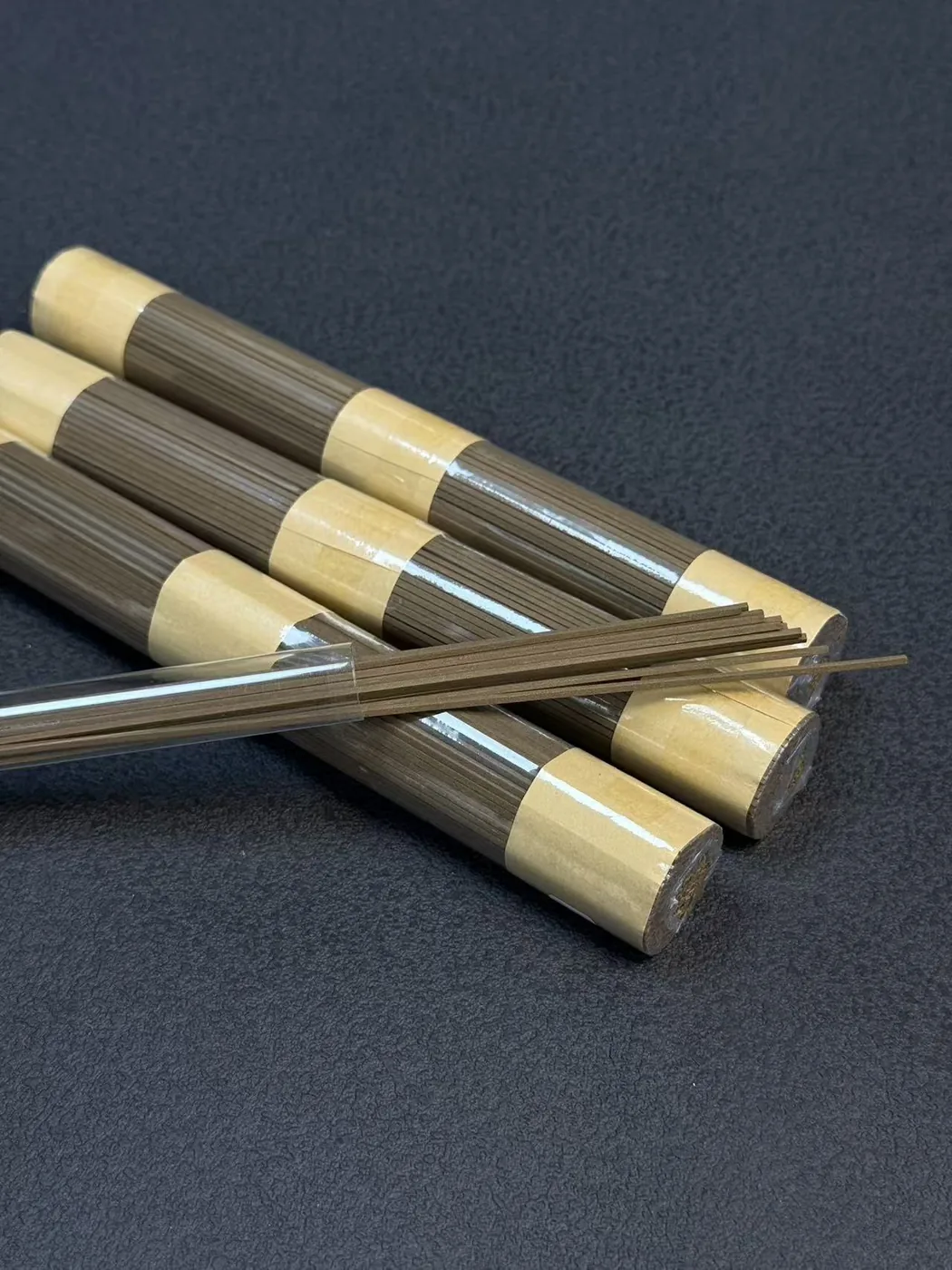
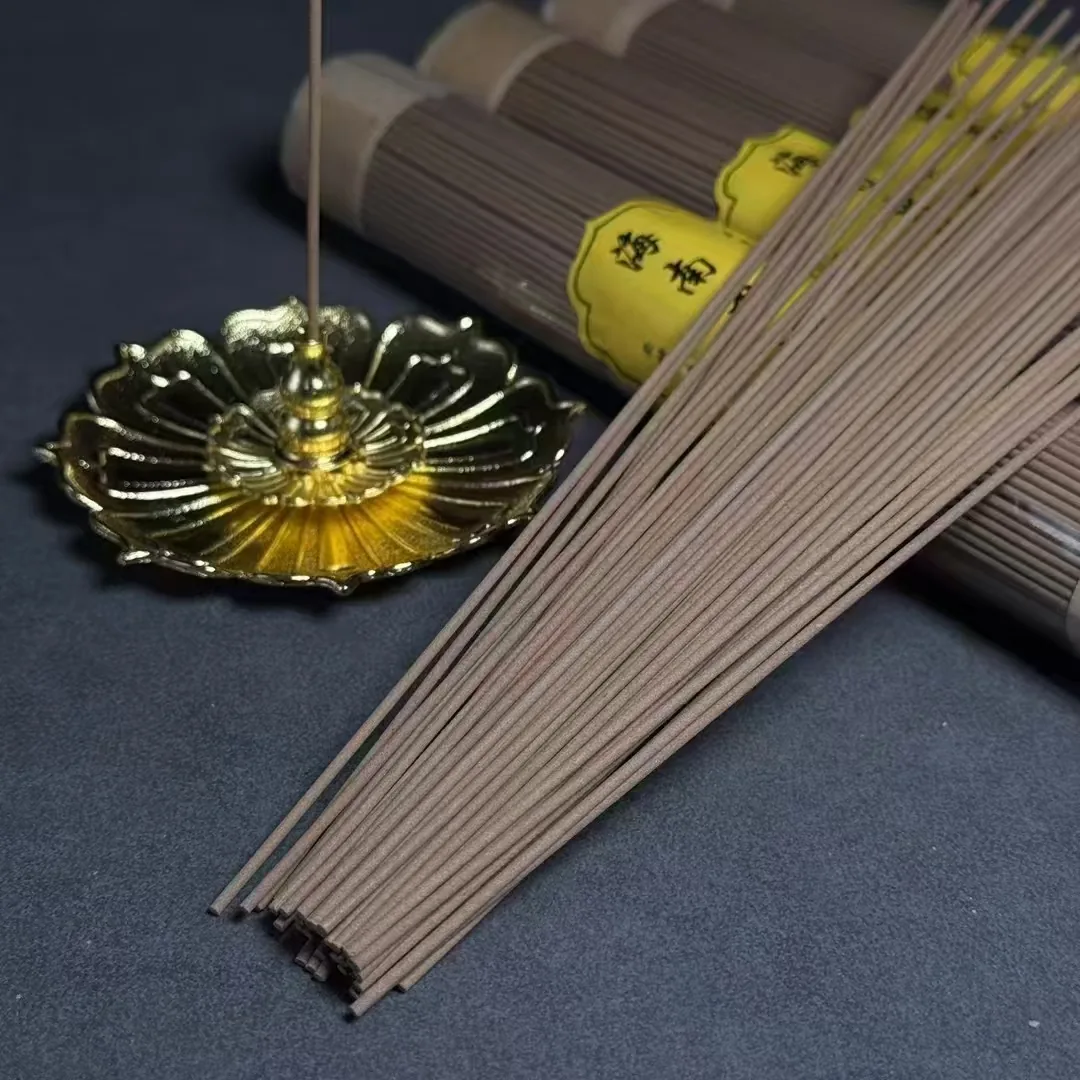
NanjaOud shows agarwood incense stick formats in its product range. Use those references to shortlist a construction and presentation style, then ask for the current SKU specification and a coded sample. Confirm material description, stick length and diameter, pack count, breakage allowance, label claims, destination and order quantity in writing. Do not infer a fixed burn time, minimum quantity, certificate or repeatability guarantee from a catalogue image.
If you need a second supplier comparison checklist, review the wholesale supplier vetting guide. For a quotation, send your target market, expected volume, construction and approved-sample criteria through the contact page.
Frequently Asked Questions
What should I ask an agarwood incense sticks manufacturer first?
Ask for the composition statement and a written stick specification — length, diameter with tolerance, weight and pack count — followed by coded samples. Price is the fourth question, not the first, because two quotations only become comparable once those three answers exist.
Is a coreless stick better than a cored stick?
Not in general. Coreless sticks suit premium and gift ranges that rely on a slim, even appearance; cored sticks handle better in transit and often suit high-volume traditional accounts. Specify the construction and the diameter tolerance either way.
How many samples should I test before ordering?
Burn at least three sticks per sample and repeat the test in a second round with new codes. A single stick tells you about one stick; two rounds tell you whether the factory can produce the same thing twice.
What MOQ should I expect on agarwood incense sticks?
It depends on the scent, the pack size, the artwork and whether the factory has to run a new printing plate. Ask what the minimum is measured against, and whether sample and plate costs are credited against the first order, rather than comparing minimum numbers alone.
Do incense sticks need CITES documents?
It depends on the species and the product form. Agarwood-producing Aquilaria and Gyrinops species are listed in CITES Appendix II, so shipments may need permits issued by the exporting country. Confirm the position for your product and destination with the supplier and your import authority before production starts.
How do I compare quotations fairly?
Convert each offer to cost per stick and cost per retail pack, then add carton dimensions and weight, Incoterm, freight and document costs. A lower unit price with a heavier carton or excluded paperwork is often the more expensive order.
What if the bulk order does not match the approved sample?
That is why the approved sample, its photographs and the acceptance limits belong in the purchase order. Report the deviation inside the agreed window with counts, photographs and the sample reference, then apply the remedy ladder you agreed: replacement, credit or offset on the next order.
Conclusion
An agarwood incense sticks manufacturer is only as good as the specification behind the quotation. Fix the construction, dimensions and pack count; test coded samples twice under the same conditions; compare offers on cost per stick and landed cost; and settle documents, packaging and claims before the deposit. Then the second order is a repeat rather than a new negotiation.
If you are preparing a wholesale or private-label programme, send our team your estimated volume, target market, stick type and dimensions, packaging direction and sample standard through our contact page, and we will confirm what we can supply for your market.


