
Short answer: give the supplier an intended use, target format and physical reference, then describe the scent at lighting, during steady burning and after the stick is extinguished. Say which impressions are essential, which are unwanted and how samples will be compared. Keep scent approval separate from claims about ingredients, smoke, burn time or safety. Give every sample a code and record the exact version you approve. That makes a subjective preference usable in an OEM quotation and later production discussion.
The NanjaOud incense range and incense-stick product listing provide starting points for a buyer enquiry. The OEM and private-label page describes a brief-to-sample workflow. None of those pages gives a universal recipe or guarantees that a named scent can be reproduced without an actual trial. This article is a method for writing a buyer brief; any available format, formulation direction and commercial terms need direct confirmation.
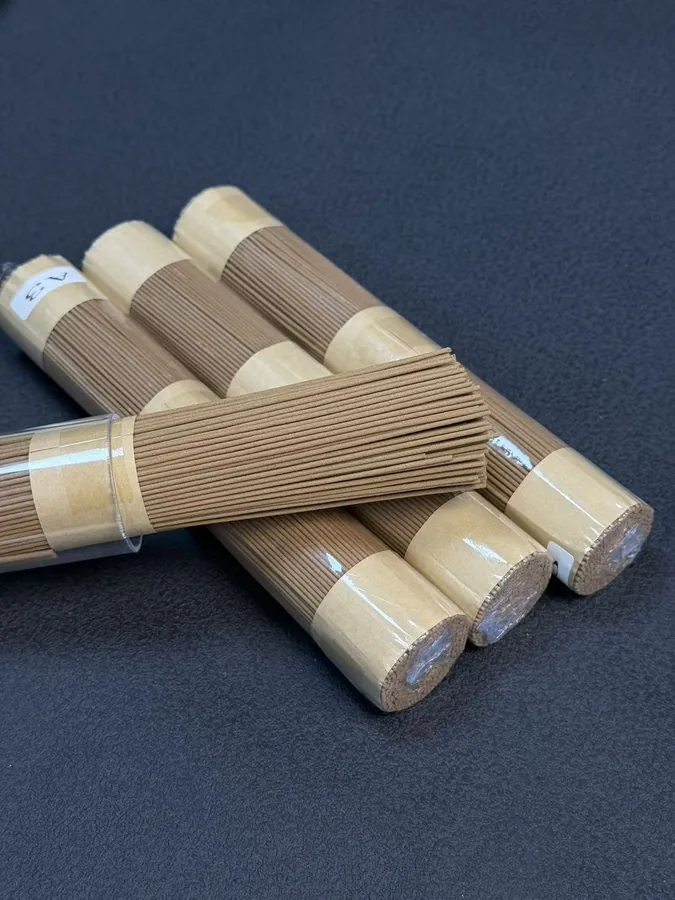
NanjaOud site reference image of an incense-stick presentation. It does not identify the recipe, scent, test sample or production lot discussed below.
Start with the setting in which the scent will be judged
“Warm agarwood, suitable for the Middle East” is too broad to guide a sample. An incense stick used in a small retail demonstration may be judged differently from one used in a larger hospitality room. A gift set may be opened and smelled before anyone lights a stick. A private-label brand may care most about the scent after several minutes of burning. State the intended user, room or setting, holder, pack and approximate evaluation period. Do not assume everyone in a region wants the same aroma; describe the actual brand or buyer preference.
Tell the supplier whether the brief concerns a stick, another incense format or a still undecided concept. The material form and stick geometry can affect the experience. If an existing product is being replaced, send an identified reference sample or an authorized benchmark and explain what should be retained or changed. A photograph can show presentation, but it cannot communicate scent. A reference sample should have a code, date and storage note so both sides discuss the same object.
Identify the decision owner. A distributor, fragrance evaluator, packaging team and commercial buyer may all comment, but a sample cannot be approved by a collection of contradictory informal messages. Name who will consolidate feedback, who will sign off the scent and what further checks are required before an order. This is especially useful when a buyer compares several suppliers.
Describe the scent as a sequence, not a label
Ask reviewers to write what they actually notice at three moments: the unlit product, the first period after lighting and the later steady stage. A brief can use everyday words such as woody, sweet, dry, resinous, smoky or spicy, but each word needs context. “Woody” might mean fresh timber to one reviewer and a dense, dark note to another. If a descriptor matters, add a reference: “the dry wood impression in reference A, with less sweetness,” for example. This is a hypothetical wording example, not a description of a NanjaOud product.
Define an unwanted impression as clearly as a desired one. If a sharp opening, heavy sweetness or lingering char note would disqualify a sample, say so. Do not request a precise formula ratio from sensory language alone. Perceived aroma depends on composition and on how the stick burns in the intended environment. A supplier may propose more than one technical route; the buyer should evaluate the resulting product and ask which material and process details can be disclosed.
Use intensity comparisons carefully. “Moderate in our 20-square-metre test room with the specified holder” is more useful than “medium strength” without a setting, although even that room size is only an example of how to record a test condition. Ventilation, distance and the number of sticks will change the impression. When several reviewers disagree, preserve their individual notes before writing a consensus. An average score can hide the reason one candidate failed.
| Brief field | Useful buyer input | Decision it supports |
|---|---|---|
| Intended product | Stick format, use setting, pack direction and target buyer | Defines the trial context |
| Reference | Coded physical sample, photograph of pack and permission to use benchmark | Gives a shared comparison point |
| Desired sequence | Unlit, initial burn, middle and later aroma notes | Separates changing impressions |
| Must avoid | Named off-notes, excessive intensity or other rejected impressions | Helps the supplier prioritize revisions |
| Review setup | Holder, room, ventilation, distance, count and observation intervals | Makes sample comparisons more repeatable |
| Approval owner | Reviewer names, version code and sign-off rule | Prevents ambiguous approval |
| Separate checks | Appearance, breakage, burn continuity, packaging and claims review | Keeps scent preference from replacing product acceptance |
The table is a brief template, not a NanjaOud specification. The buyer should remove fields that do not matter to the product and add any market-specific labeling or document requirements after checking the intended destination.
Keep the trial comparable without pretending it is a laboratory test
Evaluate candidates in the same holder and with the same lighting and observation method. Use one stick at a time in a suitably ventilated space and note the date and conditions. If reviewers smell several candidates in sequence, allow for lingering aroma and record the order. Blind or coded samples can reduce brand expectations during the first evaluation. A simple worksheet is enough to make feedback traceable; it does not turn a small panel into a population study.
Record what happened before discussing preferences. Did the stick establish an ember easily? Did it go out? Did the aroma change after the first few minutes? Were the last notes still acceptable in the intended setting? These observations should be linked to the code on the actual received sample. A comment such as “version B is warmer but the opening is too sharp” gives the supplier a clearer direction than “make it more premium.”
The separate incense burn-test guide explains how to record ignition, burn continuity and ash. Use that assessment alongside the scent brief; liking the aroma does not establish acceptable burn performance. Visible smoke also cannot establish an emissions or health claim. If a brand plans to use words such as “low smoke” or “natural,” ask for a defined claim basis and market review before placing those words on packaging.
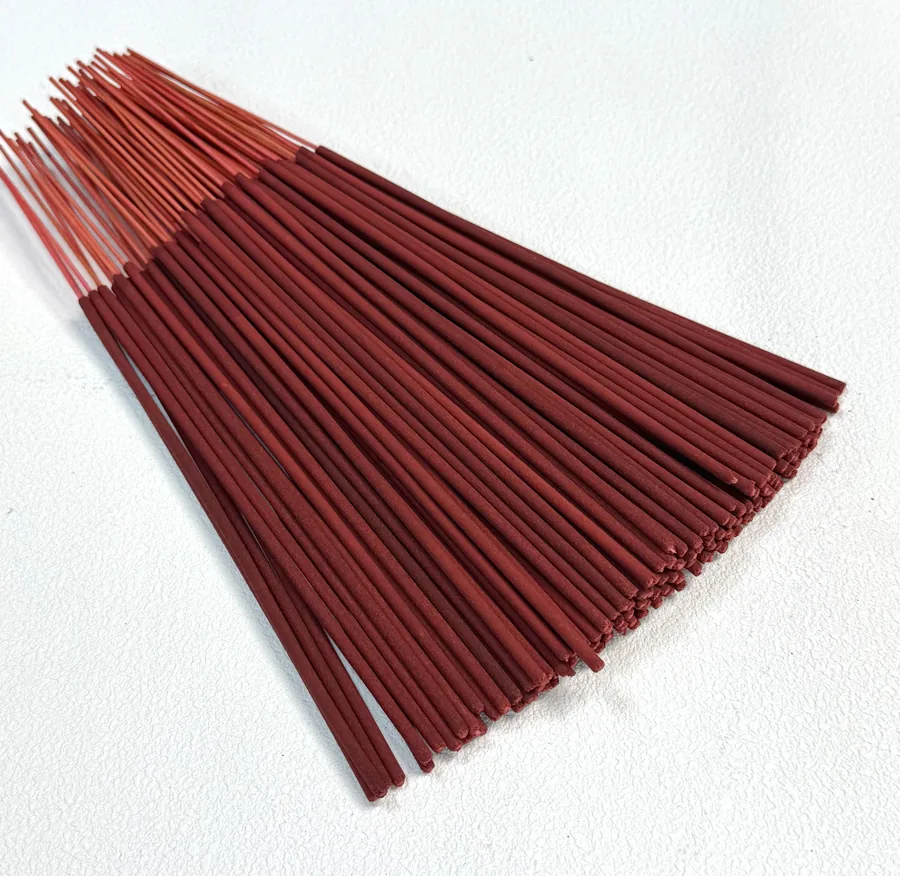
A second NanjaOud site reference image shows a different stick presentation. It is a visual comparison only; it is not an aroma reference or proof of a recipe.
Turn feedback into one revised instruction
After the first round, consolidate comments by decision: retain, change, investigate or reject. Attach the original brief, sample code, dated sensory notes and relevant photographs. If the supplier changes a material, geometry, pack or process, assign the new sample a new version and repeat the affected checks. A message saying “same scent as last time” is not enough to define what changed or which sample was accepted.
It helps to distinguish a scent target from a production acceptance criterion. A buyer may approve a reference sample's overall character, then agree separately how later production will be compared with that reference. Natural materials and sensory judgments can vary. Neither a photograph nor a single reviewer can guarantee perfect repetition. Agree how representative samples, lot identity and differences will be handled in the order documents. If a supplier cannot explain what a proposed sample represents, keep it at the development stage.
For an RFQ, send the product format, estimated order scope, destination, packaging direction, reference code, desired scent sequence, rejected notes and evaluation record. Ask NanjaOud which current product or OEM direction can be sampled and which specifications or documents it can confirm. The contact page is the appropriate path for that discussion. Avoid assigning a price, MOQ, lead time or certificate to a scent concept before the supplier confirms the actual offer.
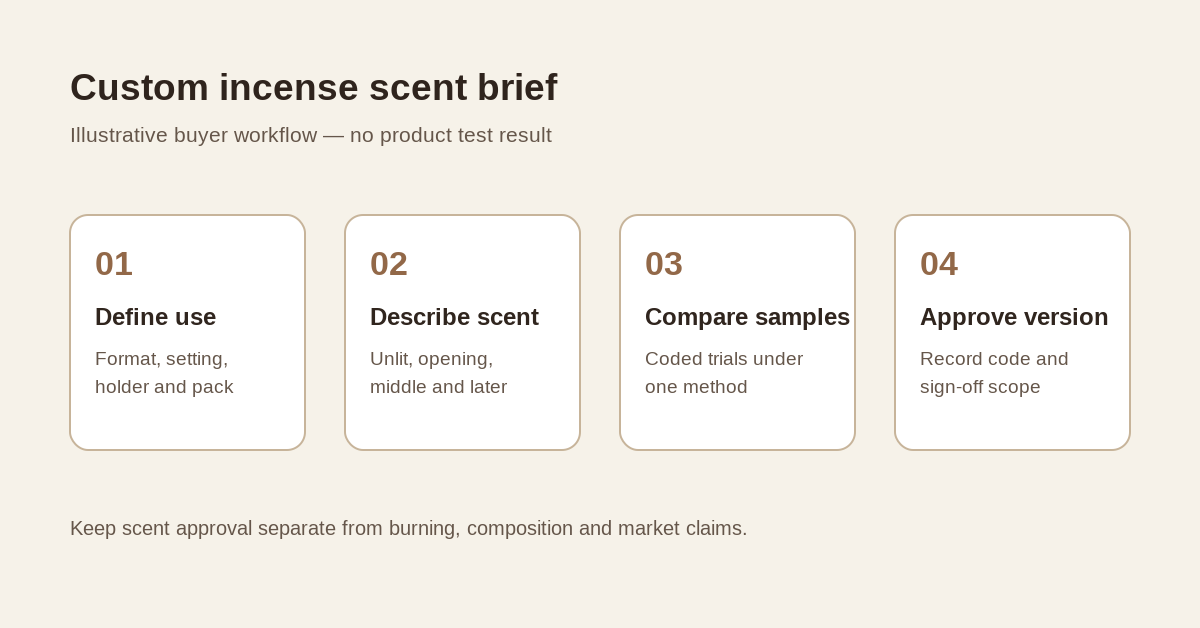
Illustrative buyer workflow. It is not a NanjaOud test report, formula or production record.
Buyer FAQ
Can I send a list of fragrance adjectives instead of a reference sample?
You can start with words, but add a use setting and a physical reference when possible. Define what each important word means to your team. If a reference cannot be shared, ask for several coded directions and compare them under one written method.
Should I approve the scent from an unlit stick?
No. Unlit aroma can be part of a retail experience, but the burned product may smell different. Record both and state which matters more to the final offer.
How many people should evaluate the sample?
Choose reviewers who represent the actual product decision and record who participated. There is no universal panel size for every commercial brief. A small internal panel can guide development; it should not be described as proof of broad consumer preference.
Does a scent match prove the ingredient or origin claim?
No. Sensory similarity cannot establish botanical identity, origin, purity or recipe. Request supporting documents for any claim that will appear in buying or marketing materials, and review them for the specific offered material.
What happens if the supplier revises the stick after scent approval?
Give the revision a new code. Check the changed feature and any linked performance, including burning and packaging where relevant. Record whether the old approval is superseded or still applies to a specific earlier version.
The useful outcome of a scent brief is a better sample conversation. Send NanjaOud the intended product, a coded reference if available and the decision record. Ask for a sample that can be identified, evaluated and discussed against a real order specification.


