
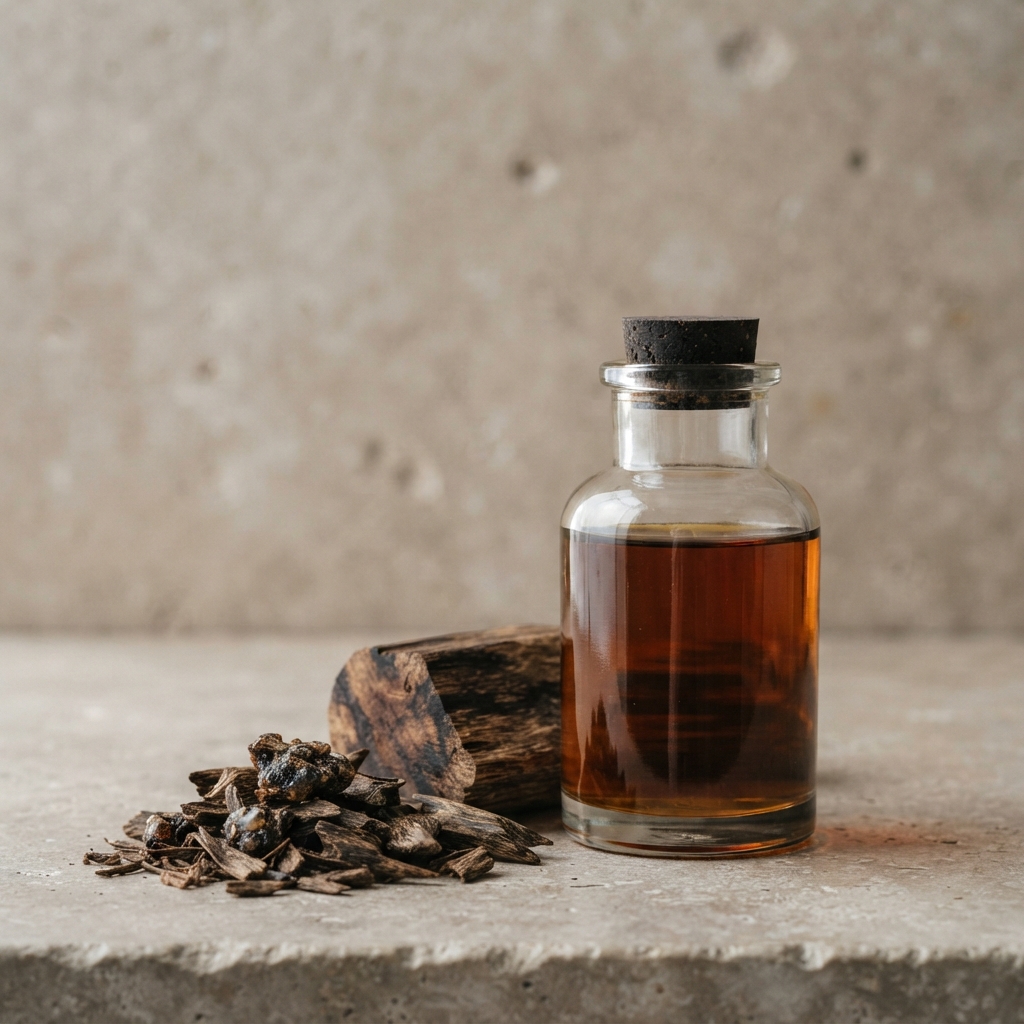
Oud oil import compliance is a documentation exercise before it is a purchase. A buyer who assembles a supplier file — species and origin, extraction route, batch records, safety data, permits and approved samples — can compare quotations on equal terms and defend the shipment to a customs broker, an insurer and a retail customer. This guide sets out what belongs in that file, which questions to send a supplier, and how to test the answers before money moves.
Oud oil and agarwood oil: one material, two names
Oud oil and agarwood oil usually describe the same aromatic material: an oil-bearing product derived from resinous wood of Aquilaria and related genera. The difference is linguistic and regional rather than chemical. Oud is the Arabic and South Asian trade term; agarwood is the English botanical and customs term. A quotation may also use oudh, gaharu, aloeswood or kyara for specific grades or origins.
That matters for procurement because the name on an invoice is not a specification. Two suppliers can both write oud oil and ship materially different products: different species, different resin load, different extraction route, different dilution. ISO 9235:2021 defines the vocabulary for aromatic natural raw materials, but a vocabulary standard does not certify that any particular drum matches it. Treat every product name as an entry point to a written specification, not as a substitute for one.
A practical rule for the first email: ask each supplier to state in writing the genus and species, the country and region of harvest, the plant part used, the extraction method, and whether the oil is diluted, blended or sold as produced. If any of those fields is answered with we can discuss it, you do not yet have a comparable offer.
Why oud oil import compliance starts with documents, not prices
A price per kilogram is only meaningful once the material, the unit, the packaging, the delivery term and the documents are fixed. Two quotations that differ by 40 percent are rarely a negotiation problem; they are usually two different products, or one product with a document gap the buyer will pay for later at the border. Oud oil import compliance rarely fails on price. It fails on a missing permit, an SDS in the wrong language, or a batch code that appears on the drum but not on the certificate.
Building the file first also changes the conversation. Suppliers who genuinely manufacture answer document questions quickly and consistently. Suppliers who resell tend to answer with reassurance instead of records. That difference is visible within two exchanges, long before a deposit is discussed.
Who you are actually buying from
Manufacturer, processor, wholesaler and trader are four different business models, and the difference shows up in what a supplier can prove rather than what they claim. A buyer shortlisting an agarwood essential oil supplier or a bulk agarwood oil supplier is really testing which of these four models sits behind the quotation.
- Grower or plantation operator controls raw material supply and can usually explain harvest years, plantation location and resin formation practice.
- Processor or distiller controls extraction and can produce a batch record: input wood weight, extraction route, yield, dates, operator and equipment.
- Wholesaler holds stock in standard grades and can ship small quantities quickly, but may not know which batch came from which production run.
- Trader or agent coordinates between producer and buyer. This can work well, but only when the producer is named and the documents are issued by the producer.
Questions that separate a producer from a reseller
Ask which legal entity issues the certificate of analysis, which entity holds the export permit, and whether the bank account name matches the contracting entity. Ask for the production address rather than the sales office address. Ask what happens if the approved sample and the shipped lot differ. A producer answers with a batch reference; a reseller answers with a promise.
Our separate guide to verifying an oud oil manufacturer against a trader sets out the document trail in more detail, and the oud oil RFQ structure shows how to put these questions into a request that two suppliers can answer in the same format.
Raw material and extraction: the two variables that set your specification
Resin content and extraction route together explain most of the price spread between offers, and most of the performance difference in your own formula. For anyone buying oud oil for perfume manufacturing, these two variables decide whether a trial batch behaves the same way at scale.
On the material side, species, harvest region, tree age and the proportion of resinous wood in the charge all change the aromatic profile and the yield per kilogram of wood. Planted and wild material behave differently and are documented differently. On the extraction side, steam or water distillation, solvent extraction and supercritical CO2 produce oils with different colour, density and top-note behaviour, and they carry different residue and labelling considerations.
Neither variable can be judged from a photograph. Both can be described in a specification, and both can be checked against a retained sample and a batch record.
Why an aroma description cannot prove purity
Sensory language is useful for selection and useless for verification. A trained panel can describe opening notes, heart and dry-down, and that description helps you decide whether an oil suits a fragrance brief. It cannot tell you whether the oil was diluted with a carrier, extended with a cheaper aromatic material, or blended from several production runs.
Purity is a claim about composition, so it needs compositional evidence: a batch-linked certificate of analysis, a chromatographic profile where the supplier provides one, and a documented chain from wood to drum. If a supplier answers a purity question with adjectives rather than documents, that is the answer. Our guide to verifying purity and dilution claims in pure oud oil wholesale offers covers how to phrase the request.
The document file: what each item proves for oud oil import compliance
Four document families cover most oud oil import compliance decisions. Request them together, for the specific batch you are being offered, and check that the batch code matches across all four.

Safety data and composition information
A safety data sheet is a hazard communication document, not a quality certificate. In the United States, OSHA's Hazard Communication Standard (29 CFR 1910.1200, Appendix D) sets the sixteen-section SDS format; in the European Union, classification, labelling and packaging follow the CLP Regulation administered by ECHA. Ask for an SDS in the language of your destination market, and check that the product name, batch reference and supplier details match your quotation.
Composition information is a separate request. For fragrance and flavour use, buyers typically need to know the declared aromatic constituents, any carrier or diluent, and allergen declarations relevant to their market. Ask which of these the supplier can provide and which they cannot; a clear no is more useful than a vague yes.
Labelling and destination-market rules
Labelling obligations depend on what you are importing and where you are placing it on the market, not on the fact that the material is oud oil. A bulk industrial drum, a retail fragrance ingredient and a finished consumer product fall under different rules. Ask your supplier for the product identity they will declare, the HS classification they intend to use, and the label artwork they can support. Confirm the rest with your own regulatory advisor or customs broker for the destination country.
CITES and species documents
Agarwood-producing species of Aquilaria and Gyrinops are listed in CITES Appendix II, as set out in the CITES CoP20 working document on agarwood. Appendix II listing means international trade is regulated through permits, and the requirement attaches to the species and the form of the goods — it is not a single universal certificate that every oil shipment must carry, and it is not a quality mark.
So the correct question is not do you have CITES, but: which species is in this batch, is that species listed, and which permit documents does my destination country require for this form and quantity? Ask the supplier to state the species and the permit reference in writing, and confirm the requirement with the importing authority. Our guide to reading a COA, GC-MS report and batch record explains how these documents relate to each other.
Sampling: designing an evaluation you can defend
A sample is only evidence if you know what it represents. The sample is the first piece of evidence in any oud oil import compliance file, and it is the one item you will still be relying on a year later. Before requesting one, decide what you will measure and record, so that the result can be compared across suppliers and repeated on the next order.
- Link the sample to a lot. Ask for the batch or lot code the sample was drawn from, the draw date and the quantity drawn.
- Record the conditions. Note container type, fill level, storage temperature and light exposure on arrival, and photograph the sealed container before opening.
- Score blind. Code samples and have two people assess opening, heart and dry-down without knowing the supplier. Record colour and viscosity under the same light.
- Test in your application. Run the oil in your actual base or blend at the intended dosage. Performance in a beaker is not performance in a formula.
- Retain and seal. Keep a sealed reference sample of the approved material, with the date and the batch code written on it.
Write the approval into the purchase order. A sample that is not referenced in the order cannot be used in a claim.
Batch consistency, storage and packaging
Consistency is a production capability, not a promise, and it is where oud oil import compliance becomes a manufacturing question rather than a paperwork one. Ask how the supplier controls variation between runs: whether they blend across lots to a target profile, whether they hold retained samples, and what tolerance they accept on colour, density and aroma. Then test it by ordering twice and comparing the two retained samples side by side.
Storage and packaging decide how much of the approved quality survives the freight. Ask for the container material, closure type, headspace, fill weight and any inert gas or desiccant used. Ask how the oil should be stored on arrival and what the supplier recommends as a retest interval. Our guide to storage, retest and batch retention for oud oil gives the clauses to write into an order.
What actually moves the quotation
Five cost drivers explain most of the difference between offers: raw material grade and yield, extraction route and energy cost, packaging and fill size, testing and documentation, and freight with its Incoterm. A quotation that names only a price per kilogram has told you almost nothing about four of them — and those four are usually where the real oud oil import compliance cost sits.
Comparing three or more suppliers on equal terms
Normalise every offer before comparing. Convert each to a landed cost per kilogram at your door, using the stated Incoterm, and add documentation, testing, packaging and freight. Then set the commercial terms beside the technical file: MOQ, sample cost, payment terms, lead time and claim window. Our guide to comparing bulk oud oil quotations provides the conversion table.
A supplier who is 15 percent higher on unit price but ships a documented, consistent batch with a shorter lead time is often the cheaper option once rework, delay and rejected lots are counted.
MOQ, custom packaging and OEM/ODM
Minimum order quantity is usually an allocation figure rather than a sales tactic: it reflects the smallest batch a producer can run without writing off material. Ask what sets the minimum — batch size, packaging run, or documentation — and whether a smaller trial quantity is available at a higher unit price.
For custom packaging and private label, ask in writing what the supplier controls and what they source: bottle and closure, label printing, carton and master case, and any artwork approval step. Confirm who owns the artwork files, what the sample approval sequence is, and what happens to tooling or printed packaging if the programme stops. A credible oud oil private label supplier will answer those four questions before asking for artwork files. NanjaOud's OEM and private label page sets out the formats and packaging directions the company supports; confirm the specifics of your project directly.
Lead time, inspection and claims
Split lead time into its parts: material allocation, production, testing and documentation, packaging, and freight booking. Ask for a figure for each, then build your schedule backwards from your launch date. A single lead time number hides the part that will slip, and a missing or mismatched required permit can delay an otherwise prepared shipment.
Agree inspection before shipment: who inspects, against which specification, and what evidence is issued. Then agree the claim window and the evidence you must supply — photographs, retained sample, original packaging, carrier report. A claim clause without a defined evidence pack is difficult to enforce. Our oud oil supply contract clause guide lists the terms to lock before a deposit.
Oud Oil Supplier Evaluation Checklist
Use this table as the working file for oud oil import compliance. Every row should end with a document or a written answer, not a verbal assurance.
| Check area | What to request | What a complete answer looks like |
|---|---|---|
| Raw material origin | Genus and species, harvest country and region, plant part, planted or wild, harvest year | A written material statement that matches the invoice description and the permit |
| Sample performance | Lot-linked sample, draw date, quantity, container | A coded sample you can score blind and retain against the shipped lot |
| Batch records | Batch code, input weight, extraction route, yield, production dates | A record where the batch code matches the COA, the label and the drum |
| Quotation terms | Unit, Incoterm, currency, payment terms, validity, testing included | A landed cost per kilogram you can compare with two other offers |
| Packaging | Container material, closure, fill weight, headspace, master case | A pack specification that protects the oil through freight and storage |
| Lead time | Allocation, production, testing, packing, freight booking | Five dated milestones, not one number |
| Verifiable documents | SDS, COA, species and permit documents, inspection report | Documents issued by the producing entity, for your batch, in your market's language |
Frequently asked questions
Is oud oil the same as agarwood oil?
In commercial use, yes — both usually refer to oil derived from resinous Aquilaria or related wood. The names differ by region and trade convention, not by composition, so neither name alone tells you the species, extraction route or purity.
What documents should I check for an oud oil import?
Start with a batch-linked product description and sample record, then ask your customs broker and destination-market authority which permits, safety data, labels and other declarations apply to the species, oil formulation, intended use and route. Request a COA or independent test report when your specification requires it; confirm availability and scope with the supplier rather than assuming every lot has one.
Does a CITES document prove the oil is high quality?
No. CITES permits regulate international trade in listed species; they say nothing about resin content, extraction or sensory quality. Treat permits as a legality document and quality evidence as a separate file.
Can I judge purity from the smell?
Not reliably. A trained panel can describe an oil and compare it with a reference, but dilution and blending are compositional questions. Ask for batch-linked analytical documentation and a documented chain from wood to drum.
How much sample should I request?
Enough to run your application test twice and keep a sealed reference. Ask the supplier what quantity they can provide at trial scale and whether the sample is drawn from the production lot you would be buying.
What is a reasonable MOQ for a first order?
It depends on batch size, packaging run and documentation, so there is no universal figure. Ask what sets the minimum and whether a smaller trial quantity is available at a higher unit price before you assume the first offer is the floor.
Which documents should I keep after delivery?
Keep the approved sample, the batch record, the COA, the SDS, the permit documents, the inspection report and the shipping documents together, referenced by batch code. They are the evidence base for any claim and for your next order.
How do I check that supply will be repeatable?
Order twice and compare retained samples and batch records. Ask how the supplier blends across lots and what tolerance they accept on colour, density and aroma. Repeatability is demonstrated, not promised.
Conclusion
Oud oil import compliance is decided by the quality of the file you build before the first order: a defined material, a lot-linked sample, batch records that match across documents, destination-market safety and labelling information, and a clear answer on species and permits. Buyers who assemble that file compare suppliers on evidence; buyers who skip it compare on price and discover the difference at the border.
The next step is a short brief rather than a price request. Tell us your intended application, target market, estimated annual volume, packaging requirement and sample needs, and our team will confirm which agarwood oil products and supply options we can support. You can review the supercritical agarwood oil product, read about quality control and supply, or contact NanjaOud to start the conversation.
Sources cited: ISO 9235:2021, Aromatic natural raw materials — Vocabulary (ISO); OSHA 29 CFR 1910.1200 Appendix D, Safety Data Sheets (US Department of Labor); ECHA, Understanding CLP (European Chemicals Agency); CITES CoP20 working document on agarwood (Aquilaria spp. and Gyrinops spp., Appendix II).


