
Short answer: select a candidate powder by testing it in the intended incense format, with the rest of the recipe and process held as steady as possible. Record the powder's identity and particle profile, then observe mixing, forming, drying, handling and burning or use in the finished item. A mesh label is an input to the trial, not proof that the formulation will work. Approve a reference sample and an agreed specification before asking for a repeat order.
NanjaOud's public agarwood powder range describes crushed and fine forms for incense development and fragrance-related processing. The page says mesh, particle profile, packaging and sample requirements are agreed for each order. Its incense-grade powder listing provides a product direction, but no one published particle distribution or formula ratio should be applied to every enquiry. Ask what current material can be sampled for the exact product you plan to make.
This guide focuses on formulation fit. Record fineness as one property of the sample, then judge the formed product. A measurable powder can still fail in a particular binder, extruder or drying setup. In a loose blend, visible texture may be intentional. The buyer's application decides which difference matters.
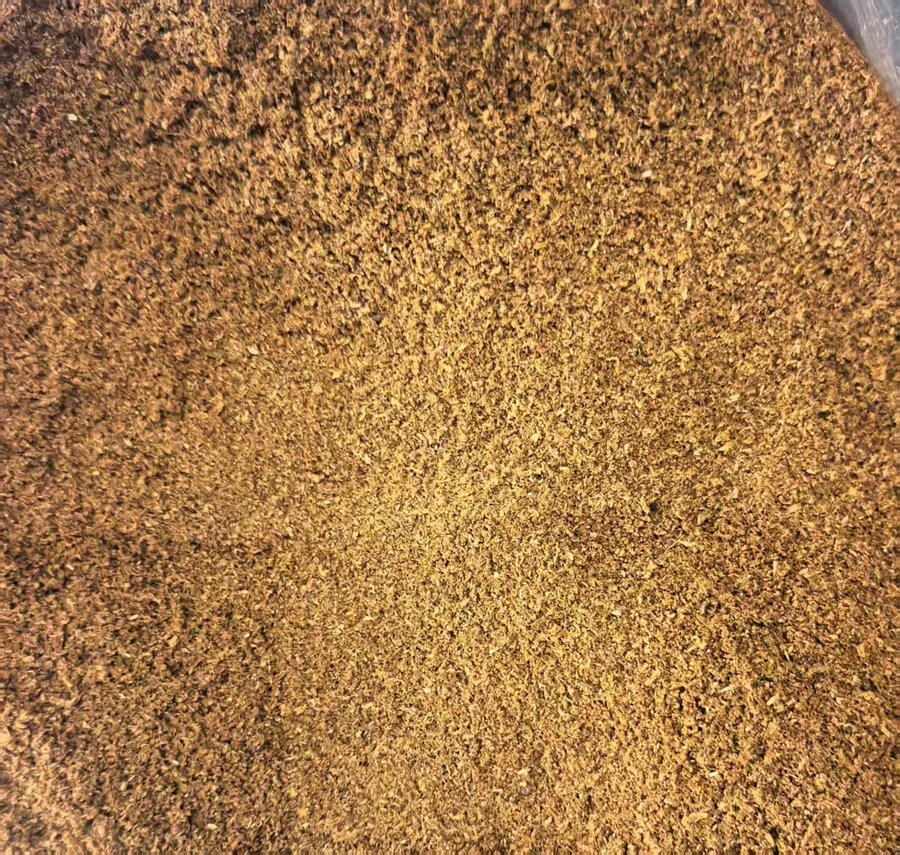
NanjaOud site implementation image used to show a crushed material texture. It is not a microscopy image, sieve result or photograph of the sample discussed here.
Define the finished product first
Write a one-page brief for the item that will be sold or used: coreless stick, coated stick, cone, coil or loose blend. State the target market, intended holder or preparation, scent direction, visible appearance and packaging direction. A loose blend may tolerate a texture that is unsuitable for a narrow extrusion die. A decorative cone may be judged more strongly on surface finish. These are possible design constraints, not claims about NanjaOud's current formulations.
Describe the problem with the existing material if you have one. Does it separate during mixing, form lumps after water is added, crack during drying, show coarse flecks in the finished piece or produce a scent that changes undesirably? Tell the supplier which stage failed. “I need a better powder” gives little guidance; “the candidate forms cleanly but the dried sticks break at packing” suggests a different experiment from a particle-size complaint.
Before asking for a bulk quotation, separate the supplier's material description from the incense maker's formulation trial. A successful trial in one recipe or production line does not automatically transfer to another.
Build a traceable sample record
For every candidate, record its supplier description, received date, sample code and any stated lot or prototype status. Note whether the pack has an inner liner, whether the material is clumped or loose, and any obvious foreign matter. Photograph a representative portion with a scale, using consistent lighting. A dark photograph cannot prove resin content, origin or aroma strength.
Ask for the measurement basis behind a fineness description. If a mesh term is used, request the actual aperture, method and retained fractions rather than only a number. ASTM E11-24 and ISO 3310-1:2016 describe technical requirements for test sieves; citing them does not mean NanjaOud uses either method for a particular lot. For a formulation decision, record the powder information available and then test what the finished item does. The sample should also have a clear link to the material proposed for quotation.
Keep a retained portion in labeled protective packaging. If you later approve a finished incense sample, you should be able to say which powder candidate went into it. If the proposed bulk material is from another lot or production run, discuss what must be rechecked. Natural materials can vary; a label alone is not a substitute for an agreed acceptance sample and method.
| Buyer field | Record in the trial | What it can resolve |
|---|---|---|
| Product format | Stick, cone, coil or loose blend | Sets the relevant process and appearance checks |
| Powder identity | Supplier description, code and lot status | Links the trial to a quotation candidate |
| Particle information | Reported aperture or method, visible texture | Prevents a vague “fine” description |
| Recipe control | Other ingredients, binder and addition order | Keeps comparisons interpretable |
| Mixing behavior | Wetting, clumps, separation and odor | Shows where a candidate differs |
| Forming and drying | Surface, breakage, deformation and handling | Connects raw powder to sellable form |
| Use trial | Lighting, aroma progression, residue or other relevant response | Tests the actual intended use |
| Decision | Accept, revise, repeat or reject with reason | Gives the supplier a clear next step |
This table is a worksheet, not a universal NanjaOud specification. Do not invent a fixed powder percentage or moisture limit from it. The buyer and supplier can agree on the fields that matter after a small, identified trial.
Change one factor at a time where possible
Prepare a baseline using the buyer's current accepted material or a control formulation. Then make a trial batch with the candidate agarwood powder while keeping the rest of the recipe, water addition, equipment settings and drying conditions recorded. If everything changes at once, a better-looking stick does not reveal whether the powder caused the improvement. In development work, perfect control may be impossible; write down deviations rather than pretending the comparison is exact.
Start small enough to observe the material without committing a production run. Note whether the powder disperses evenly, clumps, stains another component or creates dust during transfer. Use the buyer's normal safety and housekeeping procedure for fine powders. The same bag can behave differently when it is opened in a humid room or poured through another feed system; record conditions that might explain a result.
For formed incense, examine the wet piece, the dried piece and the packed piece. A wet stick that looks smooth may crack after drying. A dried stick may be strong on the bench but break when inserted into its retail tube. If a problem appears, record the stage and the proportion of items affected in your trial. Do not assign an invented cause to the supplier. Ask whether a different cut, particle profile, packing or sampling approach can be evaluated, then test the revised candidate.
For a loose blend, focus on distribution and separation as well as scent. Does the agarwood component remain mixed during handling and storage? Does the intended user dose the blend consistently? If a large fraction settles in transit, the issue may involve the blend design or pack, not just the raw powder. Test the packed form that will actually reach the customer.
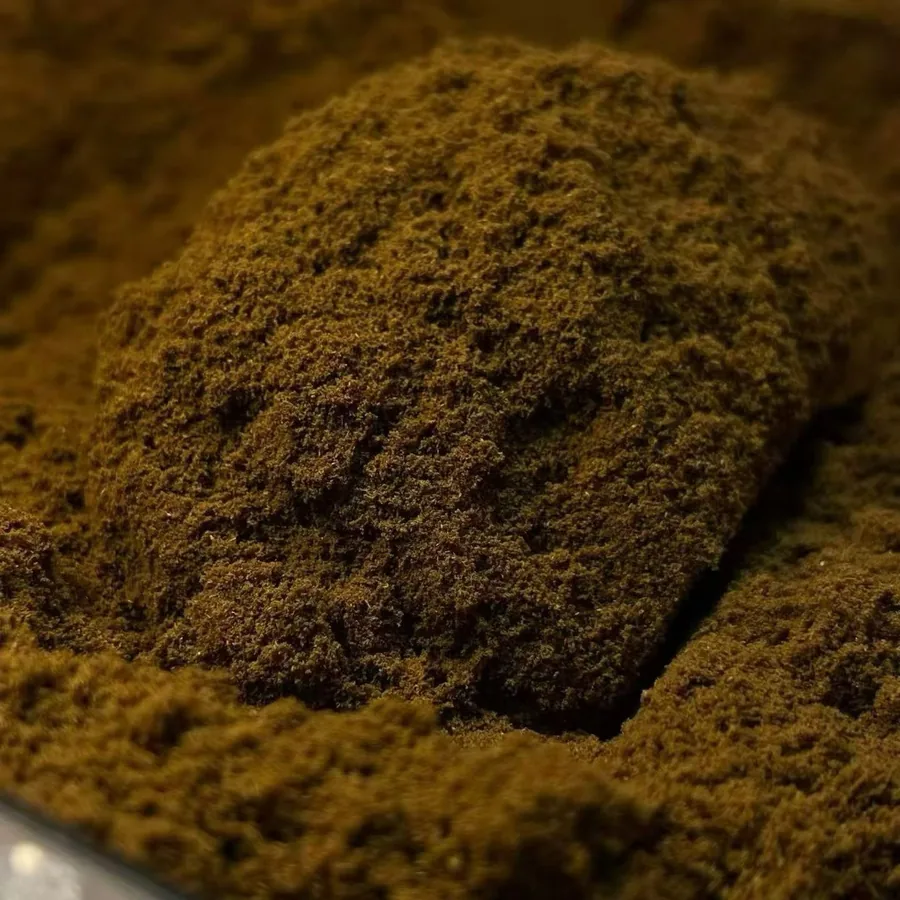
NanjaOud site implementation image. It shows surface texture only; it cannot establish purity, batch consistency, particle distribution or a successful formulation.
Keep aroma and technical performance separate
Record the powder's aroma before mixing and the finished item's aroma during its intended use. A pleasant smell from an open container does not prove the same impression after binder, drying and burning. Give evaluators a common brief and describe first impression, dominant note, change over time and any unwanted note. Avoid assigning a chemical identity or a numerical quality grade from color and smell alone.
If the finished product burns, run an identified sample trial with a consistent holder and room conditions. Note lighting, continuity, aroma and ash where relevant. A visible room observation is not an emissions measurement. Do not turn a development sample into a “non-toxic,” “safe” or “low smoke” claim without a suitable method and market review. For an OEM project, NanjaOud's OEM page provides a route for discussing requirements, sampling and packaging, but the actual recipe and acceptance method remain project-specific.
Convert the trial into a usable RFQ
When a candidate works, save the powder code, finished-product trial code, dated photographs and decision sheet together. State which changes would require a new trial: a different powder lot, binder, format, pack or critical equipment setting. Record any unresolved question. An approval written as “nice scent” is difficult to use six months later; an approval tied to a sample and method gives the buyer and supplier a reference.
In the RFQ, include the desired supply form, intended incense format, quantity estimate, destination, sample and lot status, particle measurement request, packaging direction and any documents the buyer needs to verify. Ask the supplier to confirm what can actually be supplied and quoted. NanjaOud's category page says commercial specifications and supply options are confirmed for the item sampled and quoted, rather than assumed for the whole powder range.
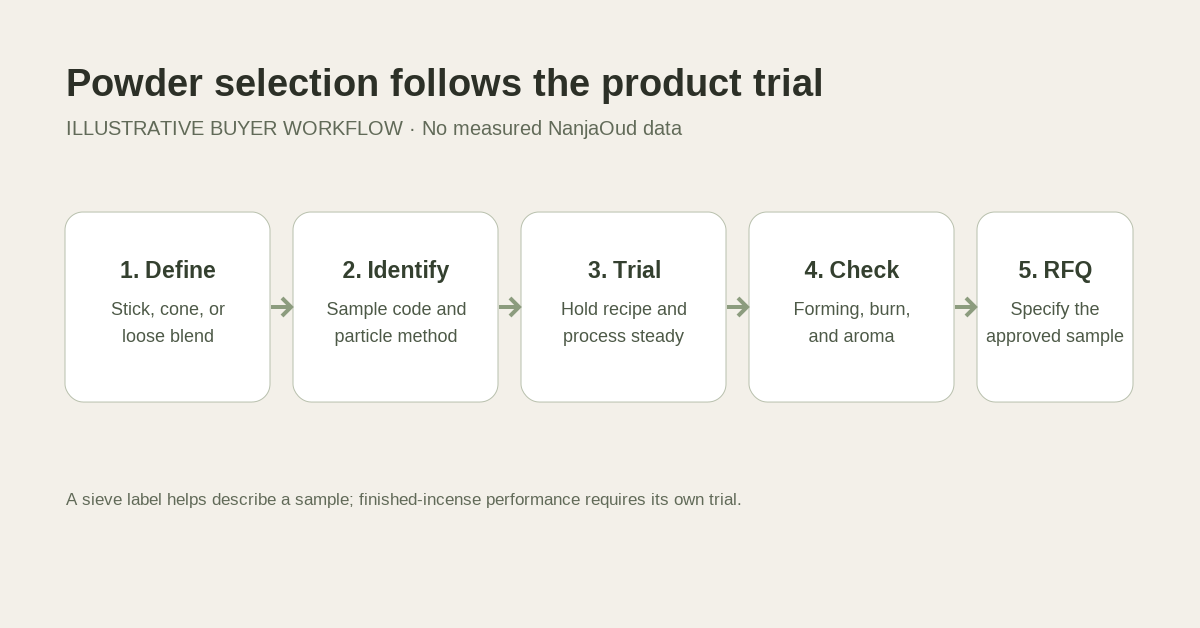
Illustrative buyer workflow. No NanjaOud formula, test result or production record is shown.
Buyer FAQ
Is one mesh number enough to choose agarwood powder for incense?
No. It helps describe a particle profile only when an aperture and method are clear. The buyer still needs to test how the powder behaves in the intended recipe and finished product.
Should I use the same powder for sticks and loose blends?
Only after separate trials show that it fits both. The mixing, forming, appearance and use requirements can differ. Ask the supplier what sample directions are available; do not assume a commercial name guarantees identical performance.
Can a photograph verify that powder is pure or resin-rich?
No. A photograph can help compare visible texture and condition, but cannot establish composition, origin, cleanliness throughout a lot or an agreed grade. Request the evidence relevant to the purchase.
What if a trial works but the supplier offers a different lot?
Keep the approved reference and ask how the new lot relates to it. Decide which identity, particle, sensory and finished-product checks must be repeated before approval.
What should I send NanjaOud first?
Send the intended product format, target market, current formulation problem, sample requirement, estimated quantity and destination through the contact page. Ask which actual powder form and supporting information can be discussed for that enquiry.


